Skip to content
DevMeme
3787 of 7435
The Accidental Creator: The Philosophy of PHP's Rasmus Lerdorf
Languages Post #4128, on Jan 29, 2022 in TG

The Accidental Creator: The Philosophy of PHP's Rasmus Lerdorf

Why is this Languages meme funny?

Level 1: Oops, It Works!

Imagine a kid who builds a treehouse without any plan or instructions. He doesn’t really enjoy hammering nails or measuring wood, he just wants a quick hideout. So he grabs whatever planks and tools he can find and starts nailing things together at random. The ladder might be crooked, and some walls are patched with tape, but in the end the treehouse stands up enough for him and his friends to play in. This kid shrugs and says, “I have no idea how to build a treehouse properly. I just kept adding bits until it looked done. Honestly, I’m not a real builder – I just make stuff stick until it doesn’t fall down.” Now imagine that treehouse becomes super popular – all the neighborhood kids start using it every day. It’s wobbly and weird, and a professional carpenter might look at it and go “Yikes, that’s not how you’re supposed to build one!” But the kids love it because, hey, it’s there and it’s fun. The kid-builder even jokes, “Yeah it’s a crappy treehouse, but it’s still better than what you could build. If a part breaks, I’ll just tape it up again!”

This is funny because you’d expect something as important as a treehouse (where everyone plays) to be built by someone who loves building and knows the rules – but instead, it was thrown together by someone who didn’t even like doing it by the book. In the end, it may not be pretty or perfect, but it certainly does the job. The meme about PHP is just like this story. The creator of PHP basically said, “I didn’t know what I was doing, I just made it work.” And the world ended up using his “treehouse” of a creation everywhere. It’s a mix of surprise and humor – sometimes big things come from quirky, messy beginnings, and it makes us smile that something so vital can start with an “oops, but hey, it works!”

Level 2: Just Get It Working

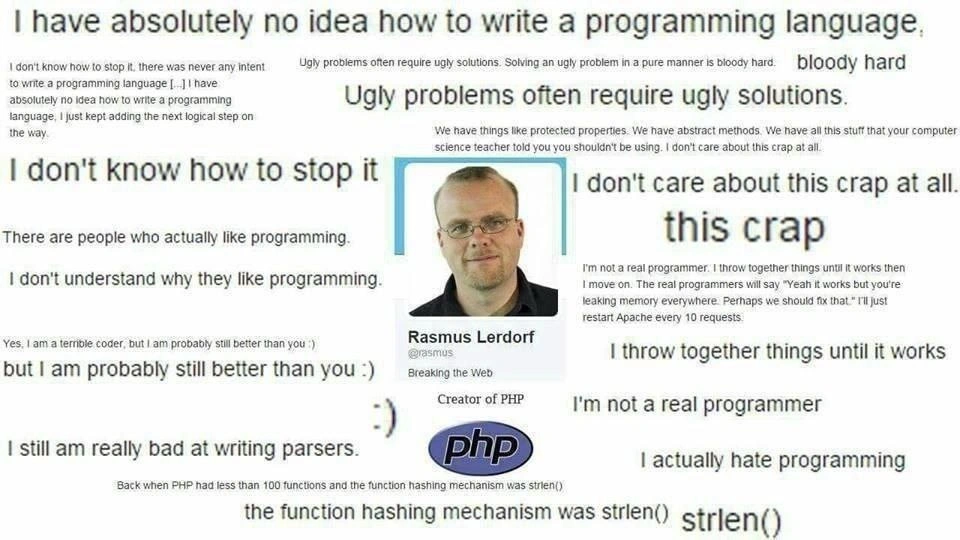
At this level, let’s break down the meme and the concepts for a newer developer or someone not deeply familiar with PHP’s backstory. The meme is a collage of quotes around a picture of Rasmus Lerdorf, who is the original creator of the PHP programming language. PHP (which stands for PHP: Hypertext Preprocessor, a recursive acronym) is a popular language that powers a huge chunk of websites (including platforms like WordPress). The meme highlights Rasmus’s own words about how he wrote PHP in a very unorthodox, make-it-up-as-you-go way. This is funny to developers because usually you’d think the creator of a programming language would be extremely methodical and love programming, but Rasmus admits the opposite.

Some key quotes from the image and what they mean:

  • “I have absolutely no idea how to write a programming language.” – This is Rasmus basically saying he didn’t formally know how to design a programming language. Typically, writing a language from scratch is a complicated task you’d learn in a comp-sci course (involving writing a parser to understand code syntax, an interpreter or compiler, etc.). Rasmus saying he had no idea how to do that, yet ending up creating PHP, is both humble and hilarious. It implies PHP wasn’t born from textbook knowledge; it was born from tinkering.

  • “I don’t know how to stop it.” – Here he’s joking that PHP took on a life of its own. He never intended PHP to become so popular or to keep growing into a full-fledged language, but once people started using it widely, it kept expanding. It’s like he started a snowball rolling downhill and then it became an avalanche – and even the creator couldn’t stop PHP’s growth and all the features being added. New developers might not realize, but PHP in the early days was a much simpler thing (just a set of tools for personal web pages). Now it’s a massive project maintained by many developers worldwide. So this quote captures that sense of “oh no, what have I unleashed?”

  • “Ugly problems often require ugly solutions.” – In programming, an “ugly” solution means a not-so-elegant, perhaps hacky fix to a problem. Rasmus is saying that the problems he was trying to solve (like how to easily add dynamic content to web pages in the 90s) were messy. To solve those, he used messy (ugly) coding tricks. For example, mixing code directly with HTML might be considered an “ugly” approach by purists, but it did solve the problem simply. This is a nod to the idea that sometimes you can’t find a pretty or perfect way to do something, so you do whatever works, even if it’s a bit kludgy.

  • “Solving an ugly problem in a pure manner is bloody hard.” – A “pure” solution means a clean, theoretically sound solution that follows all the ideal principles of software design. Rasmus basically says doing things the ideal way was really hard for these messy web issues, so he didn’t! This is relatable to junior devs who might find that following every best practice can sometimes be overwhelming when you just need the code to work. It’s a bit of a justification for why PHP was built with quick fixes: doing it in a pristine way might have been too difficult or slow to achieve at the time.

  • “I don’t care about this crap at all.” – He’s referring to things like protected properties, abstract methods, and other fancy Object-Oriented Programming (OOP) features that computer science teachers might emphasize. “Protected properties” are class attributes that can’t be accessed from just anywhere, only within certain contexts (like within the class or subclasses). “Abstract methods” are methods defined in a base class that subclasses must implement – basically a way to enforce a design. These are considered more advanced, structured programming techniques. Rasmus saying he doesn’t care about them means when he was building PHP, he wasn’t interested in conforming to those high-level design principles or including every theoretical concept. In fact, early PHP was not very OOP-friendly; it was more procedural (just functions and scripts without elaborate class structures). Eventually PHP did adopt these OOP features because the community wanted them, but Rasmus’s quote suggests he personally wasn’t a fan or didn’t see the need when he was hacking on PHP in the beginning. This quote shows a bit of rebellion against “proper” programming form – he was more focused on practicality than what a professor might consider elegant.

  • “I’m not a real programmer. I throw together things until it works then I move on… I’ll just restart Apache every 10 requests.” – There’s a lot to unpack here. When he says “I’m not a real programmer,” he’s being humorously self-deprecating. Of course, in reality he is one (he made a whole language!), but he’s implying he doesn’t program in the stereotypical, meticulous way. “Throw together things until it works” is exactly what it sounds like: quickly coding and improvising until the program seems to do what it’s supposed to, without polishing or refactoring it much after. Many junior devs can relate to getting something to work and moving on, even if the code isn’t perfect – it’s quite normal when you’re learning or under pressure.

    The Apache bit: Apache is a very common web server software. PHP often runs on Apache to serve web pages. “Restart Apache every 10 requests” refers to a brute-force fix for a common problem. When he says “the real programmers will say ‘Yeah it works but you’re leaking memory everywhere... fix that,’” he means that a more serious programmer would worry about memory leaks (bugs where your program uses more and more memory over time and doesn’t release it). Instead of fixing the leak properly, Rasmus jokes he’d just restart the Apache server process after handling 10 web requests. Restarting Apache clears out all the memory and state, so it’s like hitting a reset button to avoid the leak growing too large. This is obviously a tongue-in-cheek solution – it’s like if your car has a small engine oil leak and instead of repairing it, you just turn the car off and on every few miles so it doesn’t run long enough to lose much oil. It’s not a recommended practice, but it will technically prevent disaster in the short term. Developers find this line funny because it’s an exaggeration of a real tactic: in production, sometimes services are automatically restarted regularly to avoid issues like memory bloat. It’s an acknowledgment that sometimes we use workarounds instead of proper fixes, especially when we’re in over our heads. For a junior dev: it’s as if you wrote a quick script with a bug that slows it down over time, and rather than debugging deeply, you just schedule a reboot of the script periodically – not elegant, but it keeps things running.

  • “Yes, I am a terrible coder, but I am probably still better than you ;)” – Here Rasmus is mixing self-criticism with a playful taunt. He calls himself a terrible coder (because he knows he used lots of hacks in PHP’s creation), but he adds “probably still better than you” with a winky smiley face. This is aimed at all the haters or the smug critics of PHP. Over the years, many programmers (especially those who prefer other languages) have criticized PHP’s design and, by extension, Rasmus’s coding decisions. With this quote, he’s basically saying: “Yeah, I write ugly code, so what? It got the job done, and it’s more successful than anything you might have made.” It’s a bit of fun trash-talk. For a new developer, the lesson here is that in programming culture, there’s some rivalry and pride – but ultimately the value of code is in whether it works and people use it. Rasmus is proudly owning that even if PHP isn’t the prettiest language, it became hugely popular, so he must have done something right.

  • “There are people who actually like programming. I don’t understand why they like programming.” – This one is somewhat shocking to see from a programmer, let alone the creator of PHP! Rasmus is basically saying he doesn’t even enjoy programming. Many developers get into programming because they find it fun, like solving puzzles or creating things. Here he’s suggesting he’s not one of those enthusiasts; he did it as a means to an end. Rasmus originally wrote PHP to solve a personal need (tracking visits to his webpage, managing forms) – not because he adored writing code. So he’s saying he can’t relate to people who code for fun or passion. This is humorous because it’s surprising – like hearing a chef say “I actually hate cooking.” It also resonates with some developers who treat coding as a job or a tool, not a hobby. It gives a bit of comfort: even someone who isn’t in love with coding can still create something monumental like PHP.

  • “I still am really bad at writing parsers.” – A parser is a component of a compiler or interpreter that reads source code and understands its structure (like identifying statements, expressions, etc., according to the grammar of the programming language). Saying he’s bad at writing parsers means he finds it difficult to implement the part of a language that comprehends and breaks down code properly. Early PHP’s parser was pretty simple and had lots of limitations or oddities, precisely because Rasmus wasn’t an expert in compiler design. This quote just reinforces the idea that he didn’t approach PHP like a typical language designer would. For context, most modern languages (like Java, C#, Python) were designed by teams that included compiler experts who carefully defined how the language should parse and behave. PHP, especially in its early versions, was much more loosely thrown together, and this quote is Rasmus basically shrugging and admitting “yeah, parsing (which is super important for a language) isn’t my strong suit.” It’s humorous in the meme because a working programming language by definition needs a parser, and the creator saying he’s not good at that is like a car maker saying “I’m not great at making engines.” It’s endearing and a bit absurd at face value.

  • “Back when PHP had less than 100 functions the function hashing mechanism was strlen().” – Let’s break this down. In a programming language, especially one implemented in C like PHP, there’s often a hash table that maps function names (like "strlen" or "array_merge") to the actual code that executes those functions. A hashing mechanism usually takes a string (the function’s name) and computes a numeric hash value to index into a table for quick lookup. Ideally, a good hash function distributes different strings uniformly to avoid collisions (two names landing on the same spot). In PHP’s earliest days, apparently, they didn’t bother with a fancy hash function. They literally used the strlen() of the function name as the hash. strlen() is a function that returns the length of a string. So, for example, the name "print" has length 5, "echo" has length 4. They would use those numbers (5, 4, etc.) to index functions. This was doable “when PHP had < 100 functions” because maybe they just put them in buckets by name length or something simplistic. It’s kind of a “cheap and cheerful” way to differentiate names. But as pointed out above, this causes collisions: many functions can share the same name length (e.g., "add" and "sub" both have length 3). It likely wasn’t a serious performance strategy, just a placeholder until the language grew. For a junior dev: imagine sorting books in a library by the number of letters in their title – that might be fine if you have 50 books and all titles are unique lengths, but once you have hundreds of books, many titles share the same length and it becomes chaotic. This quote is a technical joke showing just how simplistic and hacky PHP’s internals were at the start. It’s something you’d never teach as a good method, but it worked temporarily. And importantly, as PHP grew, they definitely replaced that with a real hash function or more standard lookup mechanism. It’s a snapshot of a naive solution that existed in PHP’s history.

All these quotes are scattered on a white background around Rasmus’s face and a PHP logo, which gives the meme a chaotic feel – much like the content of the quotes. The overall tone is self-deprecating humor mixed with pride in being unconventional. The meme pokes fun at PHP’s code quality and design by basically quoting the creator admitting to all the “bad” practices that were part of PHP’s creation. If you’ve ever heard developers gripe about PHP (and many do, jokingly, for its odd design decisions), this meme is basically ammunition for that, but coming straight from the horse’s mouth, so to speak.

For a junior developer or anyone new to this, here’s why it’s funny and discussed: Usually, programming languages are seen as these carefully crafted systems built by very experienced architects who love computing. Seeing the PHP creator say he “actually hates programming” and “just threw things together” is ironic. It’s like learning that the architect of a famous monument just winged it with scrap materials. The quotes highlight a disconnect between textbook best practices and real-world problem solving. Many newcomers feel pressure to do things “the right way,” but Rasmus’s story is a reminder that sometimes doing it “wrong” (quick hacks, minimal planning) can still yield hugely successful results – though not without downsides (like language quirks or technical debt later on).

Also, newbies often encounter PHP early in their web development journey (maybe through WordPress or simple scripts). They might notice PHP can be inconsistent or weird at times (like how function naming or error handling works). This meme basically provides the backstory: PHP feels inconsistent because, well, it kind of is – it wasn’t designed in one go, it was patched together over years by someone who openly says he’s not a programming purist. So the meme resonates as a kind of “inside joke” explanation for PHP’s reputation. It’s saying: Don’t be surprised that PHP has odd edges – even its creator jokes about what a kludge it was!

In short, PHP’s origin story as told by Rasmus is both amusing and enlightening. The meme is a celebration of a kind of developer anti-hero: instead of the genius who planned everything perfectly, we have a guy who candidly confesses to muddling through and yet ended up making something huge. For someone early in their dev career, it’s a great illustration that:

  • The tech world often runs on imperfect code under the hood.
  • Practical solutions sometimes trump theoretical elegance.
  • Even if you feel like “I’m not a real programmer,” you can still build real, impactful things.

Just remember though, while it’s funny to hear Rasmus brag about restarting Apache instead of fixing bugs, in your own projects it’s usually worth striving for that balance – quick fixes are fine, but understanding and addressing root causes (like memory leaks) will save you headaches in the long run. PHP eventually had to address those issues as it matured, but in its scrappy beginnings, it really was the wild west, and this meme is a testament to that wild, pragmatic spirit.

Level 3: Pragmatism Over Purity

For an experienced developer, this meme hits close to home by contrasting idealism with real-world coding. Rasmus Lerdorf’s quotes read like the tongue-in-cheek confessions of a battle-worn engineer who chose pragmatism over purity at every turn. The humor emerges from how bluntly honest and unapologetic he is about PHP’s origins. Consider the absurdity and relatability of the creator of PHP saying: “I’m not a real programmer. I throw together things until it works then I move on.” Senior devs chuckle at this because, honestly, who among us hasn’t slapped together a messy solution under deadline pressure and thought, “Well, it works… shipping it!”? Rasmus just takes that everyday dev experience and scales it up to designing a whole programming language. It’s funny and a bit frightening to realize that a huge chunk of the web runs on a platform built with the same hasty “just make it work” ethos that one might use to finish a Friday 5 PM hotfix.

The meme’s collage of quotes encapsulates PHP’s reputation for being a pragmatic, if messy, tool. For instance, “Ugly problems often require ugly solutions” is basically the PHP development philosophy in a nutshell. Back in the late ’90s, building web applications was truly an ugly problem – mixing HTML with logic, dealing with state via forms and URLs, and connecting to databases, all in an era before elegant frameworks. PHP succeeded because it embraced the ugly reality of web programming: you could intermix PHP code directly in your HTML page to fetch data and print it out – not a “clean” separation of concerns by academic standards, but incredibly useful and easy. Senior developers recognize this scenario: when working in the trenches, sometimes quick and dirty solutions are the only viable way forward. Rasmus openly championed that pragmatism. The meme resonates because it’s basically him saying out loud what many devs have whispered to themselves during crunch time: “Screw it, let’s do the simplest thing that could possibly work.”

Another quote, “Solving an ugly problem in a pure manner is bloody hard,” elicits knowing nods from experienced engineers. We’ve all seen projects where pursuing a “pure” design – conforming strictly to patterns, theories, or best practices – made things overly complex or missed the deadline, whereas a quick hack solved the immediate need. The “pure manner” refers to ideal solutions you might learn in theory (for example, designing a perfectly normalized database, or writing a web app with a pristine MVC architecture from day one). Rasmus basically says he didn’t have time for that – and indeed building PHP in a pure, theoretically sound way would have been extremely hard for one person iterating in spare time. It was far easier to write something “good enough” to get the job done (like embedding code in HTML strings) and iterate. This pragmatic just-ship-it mentality is familiar to any senior dev who’s wrestled with balancing perfect code versus working code. The joke is that Rasmus took “just ship it” to the extreme: he shipped a whole language rife with odd edges and said “I don’t care about this crap” when confronted with formalities.

The developer experience (DX) of PHP has always been a double-edged sword, also reflected in the meme. On one hand, PHP made it insanely easy for anyone to start writing web pages that connect to a database – you just and away you go. This approach earned PHP a reputation as the duct tape of the web, enabling quick results without a steep learning curve. On the other hand, that ease-of-use came by forsaking structure and consistency, which became a nightmare in large codebases. Seasoned devs see humor in lines like “I’ll just restart Apache every 10 requests” because it’s a reminder of the band-aid solutions we’ve all slapped on at 3 AM to keep systems running. It’s funny precisely because it’s true – many of us have been there, patching instead of fixing, praying our hack holds until morning. PHP as a platform historically encouraged some of these bad habits: back in the day, you could avoid memory management entirely because each request was short-lived; if something went wrong, the process died and a fresh one handled the next request (especially with CGI or later with Apache’s process model). So the quote about restarting Apache is basically institutionalizing that hack: Rasmus is joking that instead of fixing sloppy code leaks, just periodically flush everything by restarting. Senior developers laugh (and perhaps wince) because it underscores how PHP’s environment allowed developers to get away with things that in other contexts would be considered serious flaws.

The meme also touches on language quirks that senior devs love to debate. PHP’s inconsistent design choices are legendary in programming circles. For example, the standard library function names in PHP seem haphazard: why is it explode() and implode() for splitting/joining strings, but then strlen() (with an abbreviation) for string length, and strtoupper() for uppercasing? Why do some array functions have array_ prefix and others don’t? The answer often is: because different people added them at different times with no single guiding style – exactly what you’d expect from an “accidental language” that grew without a style guide. When Rasmus quips, “I don’t know how to stop it, there was never any intent to write a programming language… I just kept adding the next logical step,” experienced devs appreciate that he’s describing scope creep on a massive scale. His pet project snowballed into the world’s most popular web scripting language, and once it had momentum, it took on a life of its own. That “I don’t know how to stop it” line is practically meme-worthy by itself because it captures the feeling of every engineer who wrote a quick utility, and then suddenly everyone depended on it so you had to maintain it forever. PHP’s evolution beyond Rasmus’s control is a classic tale: once open-source adoption and community contributions kicked in, PHP grew features (like proper Object-Oriented Programming support, frameworks, etc.) that perhaps Rasmus himself didn’t plan or even like. The meme is poking fun at this runaway train aspect of PHP – it started as a simple engine for templating HTML, and became a sprawling language with advanced features, much to the chagrin (or apathy) of its creator.

Let’s not miss the cheeky bravado in, “Yes, I am a terrible coder, but I am probably still better than you ;)” – complete with the winking smiley. This is Rasmus’s playful jab at all the haters and language purists who have mocked PHP over the years. Senior devs recognize this as a mic-drop to endless forum arguments where PHP is derided for bad design. Rasmus essentially says, “Look, I know my code is ugly, but hey, I made something people actually use – what have you done?” It’s a mix of self-deprecation and swagger that only a tech veteran could pull off. It resonates because in the industry, there’s often tension between “real programmers” who pride themselves on elegant code and the scrappy coders who just get things done. Rasmus unabashedly claiming the latter title – not a “real programmer” by elitist definitions – yet still asserting superiority in terms of practical impact, is both funny and a bit inspiring. It reminds seasoned devs that shipping a widely-used product, even if the code is held together with duct tape, is an achievement that armchair critics can’t take away. It also reflects a shared impostor syndrome gone wild; many experienced devs secretly worry their code is crap and they’re muddling through, and here is a hugely successful figure openly validating that notion with a grin.

The collage format with a blurred headshot of Rasmus and scattered quotes visually reinforces the idea of chaotic thoughts from a tech icon. It mirrors how PHP itself can feel: a collage of ideas and fixes thrown together over years. For folks who’ve maintained large legacy systems, there’s humor in recognizing that PHP’s entire design is a kind of institutionalized legacy code — a patchwork that somehow holds together. The meme tickles developers who have lived through the evolution of PHP (or similar languages) because it’s a trip down memory lane: from the wild-west days of editing scripts on a live server (yep, people did that) to the boardroom debates of whether to stick with PHP or rewrite in something “cleaner”. The quotes touch on debates about code quality vs. deliverables, and theory vs. practice. Rasmus’s blatant “I don’t care about this crap at all” (referring to computer-sciencey constructs like abstract classes and protected properties) is practically sacrilegious in a world of software engineering blogs preaching craftsmanship. Seasoned developers understand the subtext: Rasmus cared about solving his web problem and keeping PHP accessible, not about being elegant or theoretically correct. He wasn’t trying to impress professors; he was trying to get web pages to work. And ironically, that focus on developer experience (DX) – making things simple so you can just “throw things together until they work” – is exactly why PHP exploded in popularity. It lowered the barrier for millions of newbie programmers to build dynamic websites in the 2000s, even if it taught them some bad habits along the way.

In essence, the senior-level humor here comes from recognition. We see in Rasmus’s quotes the extreme version of scenarios we encounter in our own work: quick fixes turning into long-term solutions, personal projects growing into critical infrastructure, and the eternal conflict between doing things right and doing things right now. The meme acts like a mirror held up to the software industry, reflecting a truth that’s both funny and a tad uncomfortable: a lot of our digital world is built on code that was written with more enthusiasm than expertise. And as Rasmus’s winking smile reminds us, sometimes that’s okay – after all, the job got done, didn’t it? 😜

Level 4: strlen()-Oriented Programming

At the deepest technical level, this meme highlights accidental language design and the gritty internals of early PHP. Normally, creating a programming language involves formulating a formal grammar (think BNF notation) and writing a robust parser that transforms source code into an Abstract Syntax Tree (AST). Rasmus Lerdorf, by his own cheeky admission, “has absolutely no idea how to write a programming language”. This isn’t false modesty – early PHP was a hacked-together CGI toolkit that evolved without the typical compiler architecture. The quote “I still am really bad at writing parsers” speaks volumes: parsing (the process of analyzing code structure) in PHP’s infancy was done in a very ad-hoc way. Rather than carefully designing lexical analysis and grammar rules up front, features were bolted on as needed. Imagine skipping the entire Dragon Book (the classic textbook on compilers) and just writing C code to handle <?php ... ?> tags in HTML; that’s essentially how PHP started. The language grew organically, meaning Rasmus kept “adding the next logical step” without a grand language theory guiding him. This leads to some legendary quirks in PHP’s syntax and semantics that formal language designers would consider heretical.

One famous tidbit from the meme collage is: “Back when PHP had less than 100 functions the function hashing mechanism was strlen().” In technical terms, this is both hilarious and horrifying. A hashing mechanism is how an interpreter looks up function names quickly (usually via a hash table). In early PHP, Rasmus used the simplest hack imaginable – the length of the function name (strlen) – as the hash! This is a textbook example of a quick-and-dirty solution: it works well enough when you have a small, known set of functions, but it’s theoretically awful for scalability. Using strlen() as a hash means many distinct names yield the same value (e.g. "foo" and "bar" are both length 3, causing a hash collision). It’s the kind of shortcut that would make a Computer Science professor gasp. Instead of a well-distributed hash function (like DJB2 or MurmurHash) giving near O(1) lookups, early PHP’s symbol table lookups were essentially O(n) in the length of the name, and collisions had to be resolved by additional checks. Here’s a pseudocode peek at the absurd simplicity of that early approach:

// Early PHP symbol table hashing (simplified):
unsigned hashFunctionName(const char *funcName) {
    return (unsigned) strlen(funcName);
}
// Consequence: "strpos" (6 letters) and "printf" (6 letters) hash to the same value 6.

This low-level detail is nerdy humor gold: it’s akin to indexing books in a library by the number of letters in the title. It worked okay for a tiny collection, but as PHP’s library of built-in functions grew into the hundreds and then thousands, this method would utterly collapse. Indeed, later versions of PHP replaced such naive approaches with real hash tables and more sophisticated internals (the modern Zend Engine uses proper hashing and opcode caches, far beyond the early hacks). But the fact that the world’s most popular web language began with something as kludgey as strlen() hashing is a legendary example of “ugly problems often require ugly solutions.” The ugly problem in question was how to quickly map function names to code when you’re whipping up a new language runtime without time (or perhaps knowledge) to implement a proper hash function. Rasmus chose an expedient route: one that’s O(n) but “good enough” when n is small. This embodies the pragmatic engineering mindset over theoretical purity at the core of PHP’s origin.

Another deep aspect is memory management and the notorious quote, “The real programmers will say ‘Yeah it works but you’re leaking memory everywhere. Perhaps we should fix that.’ I’ll just restart Apache every 10 requests.” Here we’re touching on operating system and runtime behavior. Proper memory management (avoiding memory leaks) is a serious concern in systems programming. Real leaks occur when a program allocates memory and never frees it, eventually exhausting the system’s memory. The “correct” solution is to track down and fix the leaks in code – a time-consuming, nuanced process especially in C code and extensions. Rasmus’s blasé solution – automatically restart the Apache web server process every X requests – is basically an operational hack to avoid dealing with the underlying memory leak bug. Technically, it exploits the fact that when a process ends, the OS reclaims all its memory, leaks be damned. By frequently cycling the process, you limit how bad the leak can get. This is essentially a crude form of GC (Garbage Collection) by process restarting, an approach that is hilarious to seasoned engineers because it’s the ultimate brute-force fix. It’s like rebooting your computer every hour to deal with a slow memory leak instead of fixing the code – it works, but it’s anything but elegant. The meme resonates here because senior devs know that unbelievably, this tactic was (and sometimes still is) used in real web deployments: for example, Apache’s MaxRequestsPerChild setting was commonly tuned to mitigate leaks in code running on the server by killing off worker processes after a certain number of requests. It’s a “fail-stop” approach – rather than prevent failure, just stop and restart before failure becomes critical. Academically, it’s a defeatist approach (“we can’t easily solve it, so we periodically nuke and reset”), but pragmatically, it kept early PHP sites running 24/7.

From a language design theory perspective, PHP’s early evolution is a case study in “worse is better” – a celebrated notion in software engineering that simple, imperfect solutions can triumph over ideal but complex ones. Rasmus’s design ethos, as evidenced by quotes like “Solving an ugly problem in a pure manner is bloody hard”, aligns with the idea that a quick hack that solves today’s problem can beat a perfect solution that isn’t ready until next year. The humor is that PHP became Turing-complete by accident – Rasmus didn’t sit down to engineer a new Lisp or a Java; he just kept tossing in features needed to handle web forms and database calls, until one day PHP could loop, branch, and build entire applications. Accidentally Turing-complete, indeed. In defiance of computer science orthodoxy, PHP’s features were added piecemeal: first simple variables and embedding code in HTML, later more structured things like objects (after much community begging). The meme’s collage of quotes like “We have things like protected properties... abstract methods... stuff your computer science teacher told you you shouldn’t be using. I don’t care about this crap at all.” underscores Rasmus’s irreverent stance toward object-oriented design principles and academic purity. To a theoretically-inclined engineer, the introduction of half-baked OOP features into PHP (which originally was a procedural templating language) is almost sacrilegious – it’s mixing paradigms in a somewhat inconsistent way. PHP got private/protected attributes and abstract classes only around its 5th version, essentially retrofitting OOP onto a language not initially designed for it. Rasmus implies he added such features because “we have them” now, but he personally doesn’t believe in the high-minded dogma around them. There’s an implicit poke at academia: your professor might say “never use global variables or goto or mix HTML and logic,” yet PHP’s success came from breaking those rules enthusiastically.

In summary, the deep technical humor here comes from the juxtaposition of computer science fundamentals with PHP’s seat-of-the-pants implementation. It’s funny because PHP violates so many principles of language design and software engineering – yet it succeeded wildly. Seasoned devs grin (or groan) at lines like “I have absolutely no idea how to write a programming language, I just kept adding the next logical step” because it’s the diametric opposite of how we’re taught to engineer systems, and yet it’s how PHP (and frankly, many other tools) were born. The meme serves as a kind of cautionary and celebratory tale: cautionary because these ugly solutions (like strlen() hashing and restart-to-fix-leaks) eventually become technical debt at a global scale, and celebratory because sometimes breaking the rules is exactly what makes innovation bloom in our industry. This collage of Rasmus’s quotes is essentially the unfiltered confession of a “non-engineer” who created engineering history. It tickles the brain of any language theorist or veteran programmer, reminding us that beneath PHP’s worldwide adoption lies a collection of hacks and shortcuts that, by all rights, shouldn’t have worked — and yet here we are, living in the world PHP helped build.

Description

A collage-style meme composed of various quotes from Rasmus Lerdorf, the creator of PHP. The image is set on a plain white background with black text of varying sizes. Centered is a profile picture of Rasmus Lerdorf, with his name, Twitter handle '@rasmus', the bio 'Breaking the Web', and the title 'Creator of PHP' underneath. Below that is the official purple oval PHP logo. The meme is covered with scattered, self-deprecating, and brutally honest quotes attributed to Lerdorf, such as: 'I have absolutely no idea how to write a programming language', 'Ugly problems often require ugly solutions', 'I'm not a real programmer. I throw together things until it works', and 'I actually hate programming'. The humor resonates deeply with experienced developers who understand the messy reality of software engineering. It's a statement on pragmatism over theoretical purity, reflecting the history of PHP itself - a tool built for a specific, 'ugly' problem (web pages) that grew into a massive, often-criticized, yet undeniably successful ecosystem. The meme is a tribute to the idea that sometimes, useful things are created by accident or out of necessity, not grand design, a sentiment that senior engineers who've maintained legacy systems for years can appreciate
Comments

16
Anonymous ★ Top Pick PHP's design philosophy is basically the software equivalent of 'if it looks stupid but works, it ain't stupid.' The real genius was making a language so pragmatic that two decades of developers still can't agree on whether it's a brilliant hack or a crime against computer science
  1. Anonymous ★ Top Pick

    PHP's design philosophy is basically the software equivalent of 'if it looks stupid but works, it ain't stupid.' The real genius was making a language so pragmatic that two decades of developers still can't agree on whether it's a brilliant hack or a crime against computer science

  2. Anonymous

    Perspective: the language that powers half the web once hashed its built-ins with strlen() and fixed leaks via a cron-based “restart Apache” loop - so quit worrying, your Kubernetes liveness probe is practically academic

  3. Anonymous

    The most successful web language was created by someone who used strlen() as a hash function and restarted Apache every 10 requests during development. Meanwhile, we're over here debating the theoretical purity of our microservice event sourcing patterns that will serve 12 users

  4. Anonymous

    PHP's function names were hashed by strlen() - which explains htmlspecialchars: not verbosity, just collision avoidance as a naming convention

  5. Anonymous

    When the creator of one of the web's most ubiquitous languages admits he has 'absolutely no idea how to write a programming language' and 'still am really bad at writing parsers,' you realize PHP isn't a bug - it's a feature of shipping pragmatic solutions over academic purity. Lerdorf's brutal honesty is the ultimate reminder that sometimes the most successful systems emerge not from pristine design documents, but from iteratively solving ugly problems with ugly solutions until Apache needs a restart every 10 requests. It's the engineering equivalent of 'I didn't plan this, I just couldn't figure out how to stop it' - and somehow it powered half the internet

  6. Anonymous

    PHP: where the design doc was “whatever didn’t crash Apache,” and two decades later we call it backward compatibility

  7. Anonymous

    Rasmus built PHP's hashing with strrev because even the creator knew proper fixes were for people who like programming

  8. Anonymous

    Only in web engineering does a runtime that once hashed functions with strlen and fixed leaks by “restart Apache” end up running your checkout flow

  9. @cotoha_1 4y

    Pragmatic developer. Is there a book by this name already?

  10. Deleted Account 4y

    I also dont understand, why people like programming.

    1. @QutePoet 4y

      Same as I. There are hundreds of activities that are more interesting than programming.

    2. Deleted Account 4y

      I m sorry but who is actually enjoying programming

      1. @RiedleroD 4y

        I do when I'm coding something interesting and easy in python, specifically.

  11. @s2504s 4y

    Programming is shit

  12. Deleted Account 4y

    Same, it kinda is an escape from reallity for me and therefore I really like it.

  13. @Magilarp 4y

    .

Use J and K for navigation