99 Functions But a Race Condition Is One
Why is this Bugs meme funny?
Level 1: Synchronized Ain’t One
Imagine you have a bunch of kids – say 99 kids just to be dramatic – all trying to grab toys from the same toy box at the same time. There are no rules about taking turns. What do you think would happen? Likely chaos: kids bumping into each other, maybe two kids grabbing the same toy and pulling, someone might end up empty-handed even though there were plenty of toys to share. It’s unpredictable and messy because nobody is coordinating or waiting their turn. In everyday terms, that’s what a race condition is like in programming – chaos from everyone (every piece of code) going for the same resource at once with no rules.
Now, how would you fix the playroom scenario? You’d introduce a rule like “one at a time” or have a teacher or parent synchronize the process – one kid takes a toy, then the next kid, and so on. In programming, we do something similar: we use locks or other mechanisms to make the code take turns when accessing shared stuff. In the meme, the developer jokes that they have “99 functions” all running around asynchronously (imagine 99 little routines all active at once), and not one is synchronized (meaning no one is enforcing the “take turns” rule). So the poor developer’s program is behaving like that toy box free-for-all – and they’re kind of playfully whining about it.
The meme is funny because the person phrased their complaint like a line from a famous rap song. It’s as if a programmer is singing their troubles: “If you have race conditions, I feel bad for you, son. I’ve got 99 functions… and none of them waits their turn!” They’re basically venting that their program has a ton of things happening at once and it’s causing trouble. Even if you don’t get the technical details, you can sense the frustration and humor. It’s the programmer’s way of laughing instead of crying about a tricky problem. The emotional core here is: “Ugh, everything is happening all at once and it’s a mess – I know, I did this to myself – might as well joke about it!” So, just like a traffic jam with no traffic lights, a program with no synchronization is a jumbled, tangled situation. The joke lightens the mood, and anyone who’s dealt with that kind of mess nods and laughs, thinking, “Yep, been there – too many things going on and no coordination. Classic problem.”
Level 2: When Threads Collide
So what exactly is going on here? The meme is joking about asynchronous programming and a type of bug called a race condition. Let’s break those down in simpler terms.
AsynchronousProgramming means writing code where some functions run in the background or at the same time as others, rather than one after the other. Many modern languages and frameworks encourage this. For example, in JavaScript you might use
async/awaitto fetch data from a server without freezing the main thread; or in Java, you might start multiple threads to handle different tasks simultaneously. AsyncAwait (keywords likeasyncandawait) is just one way to manage such background tasks, making code look sequential even though under the hood things might be happening out of order. The key idea: asynchronous code doesn’t wait – it lets multiple operations overlap in time.A RaceCondition is what happens when two or more of those overlapping operations try to use or change the same thing at almost the same time without coordinating. It’s called a “race” because the outcome depends on which operation wins the race to that shared resource. Imagine two functions (Function A and Function B) both trying to update the same variable or file. If Function A happens to finish just before Function B, maybe Function B will overwrite A’s result. If B finishes first, maybe A overwrites B. The end result can differ from run to run – that’s a bug! The program’s behavior becomes unreliable and inconsistent.
Synchronized (in this context) refers to a way of synchronizing or coordinating these operations so they don’t interfere with each other. In some languages (like Java), you can mark a function or a block of code as
synchronized, which essentially means “Hey, only one thing can execute this at a time. Others must wait their turn.” It’s like putting a one-at-a-time sign on a resource. In other languages, you might use a lock or a mutex (mutual exclusion object) to achieve the same effect – these are all tools in the category of ConcurrencyModels to prevent chaos when things run concurrently. If our two functions from the example above were properly synchronized, one would finish updating that variable completely before the other even starts – no overlap, no ambiguous outcome.
Now, the joke says the developer has “99 functions” that asynchronously run, and apparently none of them are synchronized (or protected). They’re lamenting that out of a huge number of functions (99 is probably an exaggeration for comedic effect), not a single one is using a lock or any safety mechanism to prevent race conditions. In a code sense, it’s like:
class Counter {
private int count = 0;
void increment() {
count++; // no 'synchronized' here – this is **not** thread-safe!
}
}
In the above snippet, count++ may look like one step, but behind the scenes it’s actually three steps: (1) read the value of count, (2) add 1 to it, (3) write the new value back to count. If two threads call increment() at the same time, they might intermix those steps. For example: Thread A reads count (say it’s 0), then Thread B reads count (also 0, since A hasn’t written yet), A adds 1 (planning to write 1), B adds 1 (also planning to write 1), then A writes 1, B writes 1. The final result is 1, even though two increments happened – one of them got lost! That’s a race condition in action. If increment() had been marked synchronized (or if we used a proper lock), Thread B would have been forced to wait until Thread A finished, so count would correctly end up as 2. Without that, it’s a free-for-all.
Thread_scheduling by the operating system or runtime decides which thread runs when, and it can swap between threads at any moment. In asynchronous code (like JavaScript’s event loop), it’s the event loop scheduling callbacks or promises resolution at certain ticks. In both cases, the exact timing can vary – maybe one run Thread A wins, another run Thread B wins. As a junior developer, the first time you encounter this, it’s really confusing: “Wait, my code sometimes works and sometimes doesn’t, and it depends on some timing thing?” Yes! That’s the nature of concurrency bugs.
So, the tweet’s author is basically saying: “Look at my poor program – I have a ton of things (functions) running at once and none of them wait their turn or coordinate. If you’re dealing with that kind of bug, you have my sympathy.” It’s both a complaint and a nod to fellow developers. The categories like Bugs and Debugging_Troubleshooting are relevant because tracking down a race condition involves a lot of debugging pain: you might be adding logs, printing thread IDs, or trying to reproduce the issue under different conditions, often muttering “why on earth is this variable occasionally wrong?!” It’s also under CS_Fundamentals because understanding and fixing race conditions requires some basic knowledge of how concurrency works in computer science. Concepts like threads, synchronization, locks, atomic operations – those are fundamental building blocks for writing correct multi-threaded or asynchronous code.
And of course, the whole thing is couched as DeveloperHumor – a bit of levity in the form of a jay_z_parody. This kind of meme is popular in programming circles because it turns a stressful real-life scenario into a joke. It’s a form of SharedPain bonding: only people who have fought with concurrency bugs truly get why having “race conditions” would prompt a facepalm and a knowing laugh. By referencing a famous hip-hop lyric (that even non-developers might recognize) but twisting it into a concurrency_pun, the meme becomes instantly relatable. You see it, you chuckle, maybe you remember that one time your multi-threaded app behaved bizarrely due to a missing synchronized. It’s funny because it’s true, as the saying goes.
In summary, to a newcomer: this meme jokes that the programmer has a code with a lot of concurrently running parts (functions) and zero safeguards on them. It’s like saying “I’ve got countless things going on at once and no control over the chaos – this is going to end badly (and indeed it’s a known problem in my code)”. The humor comes from empathizing with that situation and from the clever way it’s phrased with a musical reference.
Level 3: 99 Functions, 0 Locks
This meme hits home for seasoned developers because it humorously encapsulates a shared pain: the agony of debugging asynchronous code riddled with race conditions. The tweet is riffing off Jay-Z’s famous lyric “I got 99 problems, but a ___ ain’t one,” transforming it into “I’ve got 99 functions” and implying “...and not a single synchronized one.” In other words, the codebase has tons of concurrent functions running asynchronously (99 of them, hyperbolically speaking), and not one is protected by a lock or marked thread-safe. This is a recipe for chaos that any senior engineer has seen before.
Why is this so relatable? In real projects, it’s alarmingly easy to end up with lots of AsyncAwait calls or threaded tasks in the name of performance or responsiveness (AsynchronousProgramming is everywhere, from JavaScript front-ends to multi-threaded backend servers). But if these tasks share data or resources without coordination, you’re courting disaster. The tweet’s author wryly says “If you have race conditions I feel bad for you, son” – a nod to how dreaded these bugs are. It’s practically an expression of sympathy among developers: “Oh, you’re dealing with race conditions? That hurts, I’ve been there.” The next line “that asynchronously run” highlights the culprit: things running out-of-order or in parallel. When a program’s functions execute concurrently (for example, two threads updating the same variable, or two async operations on the same data), unexpected interactions occur. One function might overwrite what another is doing, depending on a millisecond timing difference. This leads to flaky behavior: maybe 1 in 1000 runs fails, or data occasionally comes out wrong. Debugging such issues is notoriously hard – run it with a debugger or extra logs and the timing shifts, possibly hiding the bug (truly a nightmare to troubleshoot in Debugging_Troubleshooting sessions).
The phrase “not a single synchronized one in sight” is basically calling out the lack of any mutex or lock mechanism. In languages like Java or C#, marking a function or block as synchronized (or using a lock) means only one thread can execute it at a time, preventing concurrent mishaps. Seeing none of 99 functions synchronized implies a codebase with zero regard for thread safety – a tongue-in-cheek exaggeration reflecting real-life tech debt or oversight. Senior devs chuckle (and cringe) because they know exactly how such situations arise: tight deadlines and Bugs that get quick asynchronous fixes, junior devs unaware of thread safety, or just assuming “it’ll be fine” until production proves otherwise. It’s a hallmark bug_lament: you’re crying on the inside about a severe issue, but making a joke out of it on Twitter to cope. The humor also lies in mixing a hip_hop_reference with programming jargon – a bit of cultural crossover that tech folks find funny. It’s a concurrency_pun in the format of a rap lyric, which makes it memorable and shareable as DeveloperHumor.
On a practical note, every experienced developer reading this can envision the chaotic scenarios: maybe 99 asynchronous requests hitting a shared cache with no locking, causing data corruption. Or a multi-threaded game loop with tons of functions updating the game state simultaneously, leading to random glitches because none use synchronized access. We’ve learned (often the hard way) that to fix such issues, you have to introduce some form of coordination (locks, atomic variables, message queues, etc.), which ironically can become a bottleneck or source of deadlock if not done carefully. But doing nothing – as in this tweet’s scenario – isn’t an option if you want correctness. The meme gets a nod of understanding because it highlights that gap between knowing best practices and the messy reality of real codebases. It’s funny in the same way gallows humor is: “Our system is basically 99 uncontrolled functions racing each other… ha ha (cry).” Everyone laughing has likely been on pager duty at 2 AM because of exactly this kind of bug. The tweet succinctly captures that “too real” aspect of developer life, using a familiar song line to deliver the punchline. This blend of SharedPain and clever lyricism is why the meme resonates: it’s both a technical in-joke and a commiseration among those who survived hairy concurrency bugs.
Level 4: Happens-Before Blues
At the very core of this meme lies a race condition, a classic problem in concurrent programming where the system’s outcome depends on the unpredictable timing (thread_scheduling) of events. In theoretical terms, when multiple operations run in parallel without proper coordination, there's no defined happens-before relationship to order them. Without some form of synchronization, the instructions from different threads or asynchronous tasks can interleave in nearly any order – leading to nondeterministic results. Modern processors and runtimes aggressively optimize execution: they may reorder instructions, cache values per core, and delay applying changes to shared memory until absolutely needed. If no synchronized block or lock is present to act as a memory barrier, one thread might not immediately see another thread’s update (violating the assumption of a single consistent memory). The result? RaceConditions where two operations race to complete, and the final state depends on which wins – a fundamental violation of determinism in the program.
From a CS fundamentals standpoint, this is concurrency chaos. A high-level line of code like count++ is actually multiple low-level steps (read, add, write). Two threads doing count++ simultaneously can overlap these steps in a way that one increment is lost. Mathematically, if each count++ should add 1, running two of them ideally yields +2; but due to interleaving, you might still get +1. The CS_Fundamentals of mutual exclusion dictate that only one thread at a time should modify shared state to avoid this – that’s exactly what mechanisms like locks, semaphores, or the synchronized keyword enforce. They create an atomic section of code (a critical section) where one thread’s operations fully complete before another thread enters, establishing a clear before-and-after order (the happens-before guarantee). Without these, the system’s state changes are not linearizable or predictable. This unpredictability is what makes concurrency bugs so infamous: they often lurk as Heisenbugs (disappearing when you add logging or run a debugger, because that changes timing). The meme bemoans that fundamental oversight: 99 functions running concurrently with “not a single synchronized one in sight.” It’s highlighting a deep truth in computing – concurrent systems without proper synchronization are mathematically unstable, prone to bizarre, hard-to-reproduce bugs that defy our sequential intuitions. In short, the tweet is a lament about an underlying theoretical nightmare every systems engineer recognizes: the beautiful but terrifying complexity of uncontrolled asynchrony.
Description
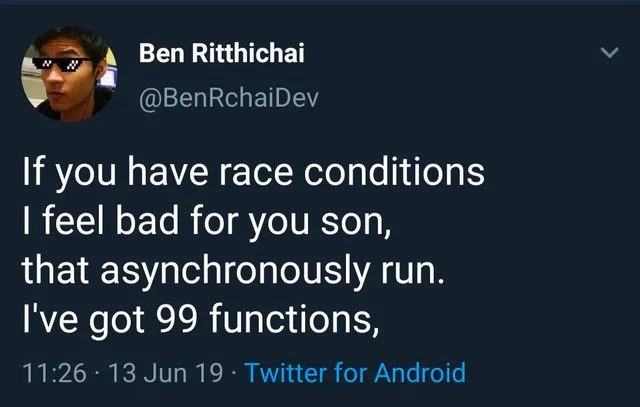
A screenshot of a tweet from user Ben Ritthichai (@BenRchaiDev) against a dark background. The user's profile picture is a man wearing pixelated 'Thug Life' sunglasses. The tweet is a parody of the famous Jay-Z lyric from '99 Problems.' The text reads: 'If you have race conditions / I feel bad for you son, / that asynchronously run. / I've got 99 functions,'. The timestamp below indicates it was posted on '13 Jun 19'. The humor is derived from adapting a well-known hip-hop line to a notoriously difficult software engineering problem. Race conditions are bugs that occur in multi-threaded or asynchronous environments when the timing of events affects the outcome in an undesirable way. They are famously hard to reproduce and debug. The joke is relatable to any developer who has wrestled with the unpredictable nature of concurrent code
Comments
7Comment deleted
I've got 99 functions but a bug ain't one... until two of them access the same memory address at the same time
Sure, you’ve got 99 functions, but until one of them locks that shared resource, you’ll still be debugging the remix at 2 AM
The real flex is having 99 functions that actually do one thing each, instead of that one 3000-line function named doEverything() that's been "temporarily" handling your async operations since 2019
The real tragedy isn't the race conditions - it's that after debugging them, you'll discover you actually have 100 functions because you added a mutex wrapper. At least with 99 problems, Jay-Z knew the exact count; with async code, you're never quite sure what's running when, or if that callback you registered three refactors ago is still lurking in the event loop like a ghost in the machine
Race conditions: eventual consistency's evil twin, turning 'idempotent' into 'maybe this time' at scale
Pro tip: if adding a log line makes the crash vanish, that’s not a fix - it’s a scheduler-dependent mutex made of I/O latency
Race conditions are the only bugs that turn a deterministic spec into a probabilistic SLA - unit tests pass 99 times, prod picks the 100th