Skip to content
DevMeme
381 of 7435
Management's One Weird Trick to Sound Smart
Management PMs Post #445, on Jun 12, 2019 in TG

Management's One Weird Trick to Sound Smart

Why is this Management PMs meme funny?

Level 1: Tiny Stand, Big Crowd

Imagine you’re a kid who just built a small lemonade stand in your front yard. You proudly show your parents the stand, excited to serve a few neighbors on a sunny day. Now picture one of the grown-ups tilting their head and asking with a serious face, “But can this lemonade stand serve 1000 people in one afternoon?” You’d probably blink in surprise. You only expected maybe 10 thirsty neighbors, not an entire town! The question seems so out-of-left-field that it’s funny. Why would they ask something so big about something so small you’ve just made?

In this little story, you are like the developer who built a new app or feature, and the grown-up is like the manager. The manager’s question "Does it scale to 1000 people?" is like asking if your tiny lemonade stand can suddenly become a huge restaurant chain overnight. It’s a bit silly and kind of missing the point. You were just happy it works for your neighborhood! The grown-up is using a fancy question to sound smart – they’re basically saying, “Sure, it works now, but what if it gets really, really popular?” It’s not a bad question; even with lemonade, if a thousand people did show up, you’d run out of lemons and cups pretty quick! But asking it every single time you show them something new starts to feel like a joke.

The humor here comes from the mismatch: the kid (developer) is thinking about the present, and the adult (manager) is dramatically leaping into a far-off future just to appear clever. It’s funny because the adult might not actually know how to make a lemonade stand serve 1000 people – just like the manager might not know how to make the app handle a million users – but asking the question makes them sound wise. And every time they do it, the kid’s eyes go wide for a second, which the adult finds rewarding. In reality, the kid might be a bit annoyed or confused, just like developers sometimes feel when they get that question in a meeting yet again.

So the meme is joking that a manager’s “secret weapon” is to always ask this big scary-sounding question – “But does it scale?” – kind of how a parent might always ask, “But what if it was a thousand people?” It makes the manager feel like they’re super insightful (and maybe makes the developers scramble like the kid imagining a thousand customers). The joke’s on the idea that using this one liner is an easy trick to impress the “nerds” (developers), when in truth it’s just a fancy way to ask, “Can your thing work if it gets much bigger?” Everyone ends up laughing because it’s a pretend kind of smartness – one little question that’s meant to awe people, used over and over until we all see through it, just like the lemonade stand scenario.

Level 2: Scalability 101

Let’s break down what “Does it scale?” actually means in tech, and why it’s such a buzzworthy question. Scalability in simple terms is a system’s ability to handle growth. If 100 people use your app today and tomorrow it’s 100,000 people, will your app still work smoothly? Will it crash, slow to a crawl, or handle the increase without breaking a sweat? When someone asks “But does it scale?”, they’re asking: can this solution grow larger or handle more load without failing?

In a software context, there are a couple of common ways to scale up. Vertical scaling is like giving your computer more power – for example, upgrading to a faster processor or more memory so it can handle more tasks. Horizontal scaling means using more computers/servers in parallel – like having 10 servers share the work that one server used to do. Real-world example: imagine a single cashier at a store (vertical scaling would be training that cashier to go superspeed; horizontal scaling would be adding more cashiers so each one has fewer people to serve). Both approaches help the store serve more customers – that’s scaling.

Now, managers care about this because in the business world growth is the goal. If your product is a hit, you might get a flood of new users. A non-technical manager might not know the nitty-gritty of code or databases, but they’ve heard horror stories of apps failing when they got popular. So they latch onto “Does it scale?” as a smart-sounding way to ask “Will this hold up when we’re successful?”. It’s a valid question! If we launch a new feature, and suddenly a million people try it, we want to know the system won’t melt down. This falls under the realm of ManagerExpectations – they expect the tech team to be forward-thinking and consider future demands, not just current ones.

However, there’s a bit of humor in how this question gets used. In tech circles, buzzwords are words or phrases that become trendy to say, sometimes without full understanding. Things like “cloud-native”, “synergy”, “AI-powered” – and yes, “scalable” – sound impressive. Some managers or executives pepper these into conversations to come off as knowledgeable. Communication gap alert: developers often speak in specifics (“we used a PostgreSQL database with read-replicas to handle more queries”), while a non-technical manager might summarize concerns with broad terms (“will the database approach be scalable?”). Both are talking about making sure the app can handle growth, but one is detailed and the other is high-level.

For a junior developer or someone new to the industry, hearing “Does it scale?” in a meeting might be intimidating at first. You might think, “Oh no, did I forget to consider something important? Have I planned for millions of users?” It’s a question that can catch you off guard. Early in your career, you might mostly be focused on making things work at all. The idea of planning for huge scale can feel like looking way down the road. Over time, though, you learn that scaling is one of those things that depends on context. Not every project needs to handle Google-level traffic immediately; sometimes it’s perfectly fine (even smart) to build a simpler solution for now and improve it when growth actually happens. There’s a famous concept in programming: “premature optimization is the root of all evil.” In plain terms, that means if you worry too much about hypothetical future problems (like extreme scaling) before you even solve the current ones, you might over-complicate or delay doing what needs to be done now. Seasoned engineers balance this: they design systems that can grow, but they also know when not to over-engineer from day one.

So, when this meme jokes about a manager asking “But does it scale?” at every opportunity, it’s poking fun at those managers who perhaps use the term without understanding. They know just enough that scalability is important, but maybe not when or how to address it. It’s like if you learned one fancy word and kept using it to impress people. The nerds_vs_management clash here is real: tech folks might roll their eyes because they’ve heard it so often, or because the question is being asked at the wrong time (like showing a tiny proof-of-concept and immediately getting grilled on handling millions of users). That’s why this scenario lands as relatable humor in tech – many have experienced that well-meaning but slightly off-base question from the higher-ups.

In summary, scalability means being ready to grow. It’s a critical concept in software and systems design. But using “Does it scale?” as a one-size-fits-all question can sometimes miss the nuance. The meme highlights that with a wink: leadership trying to speak the language of tech, and maybe overdoing it a bit, leaving the actual techies amused (or exasperated). For junior devs, the takeaway is: don’t be afraid of the question, but also know that context matters. And if you ever find yourself in a meeting hearing that query out of the blue, just remember – you’re witnessing a classic bit of TechHumor play out in real time.

Level 3: Fake It Till You Scale It

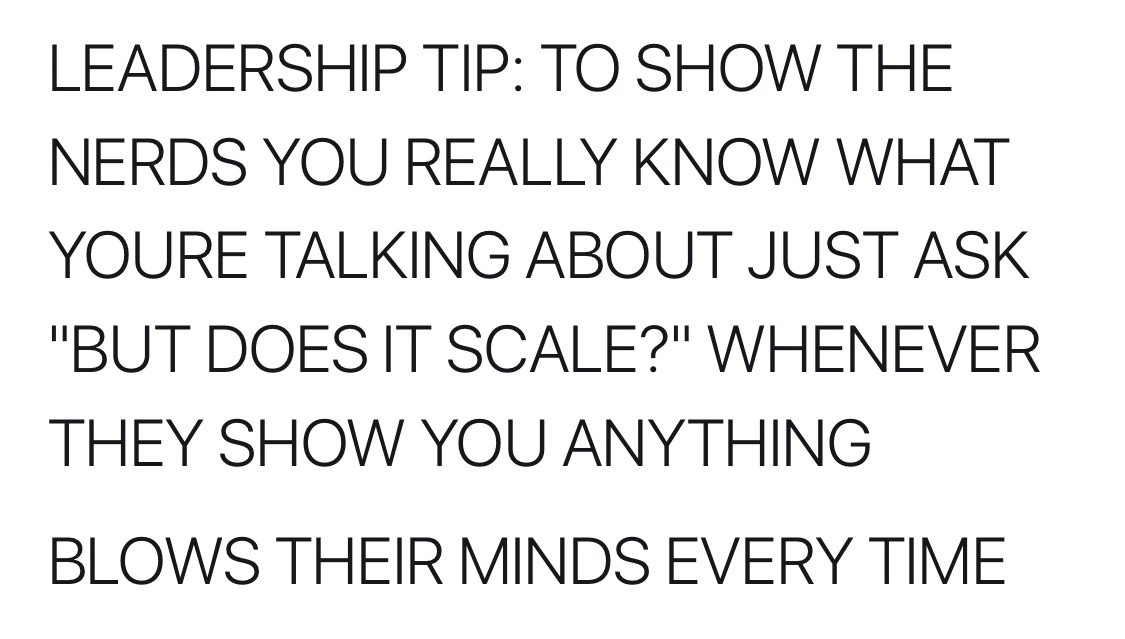
This meme nails a classic corporate culture gag: a manager with just enough tech lingo to play high-level architectural posturing. The text suggests a cheeky “LEADERSHIP TIP” – instructing managers to ask “But does it scale?” whenever developers (the “nerds”) present anything. It satirizes the sort of ManagementHumor every engineer recognizes: the boss who contributes to every meeting by parroting buzzwords like scalability, cloud, or synergy. Why is it funny? Because we’ve all been in that meeting where a non-technical leader, eager to show technical insight, drops the scale-bomb out of nowhere. It’s the ultimate game of manager_buzzword_bingo. The developers might be demoing a simple prototype or a new feature, and here comes the predictable question about handling a hypothetical flood of millions of users. It’s a gotcha that’s simultaneously legit and eye-roll inducing. Legit, because “Does it scale?” is a real concern in software design – you don’t want your system crashing when usage spikes. But eye-roll inducing because the way it’s asked here feels performative, a display of fake technical depth.

The humor plays on the communication gap between techies and management. The manager in the meme believes this question “blows their minds every time.” To them, it’s a power move: you watch the devs pause, scramble, maybe stutter about AWS autoscaling or adding more servers, and the manager basks in looking visionary. From the engineers’ side, it’s almost a running joke – of course we thought about scale… well, at least after the last time something fell over in production! But having it thrown at you in every meeting feels like a ritual hazing. It’s reminiscent of that trope where upper management reads one tech article on Scalability or hears a success story of a startup going from 100 to 1 million users, and suddenly it becomes their mantra. They’ll ask it at stand-ups, sprint demos, even coffee breaks – sometimes completely out of context. As a result, developers exchange knowing glances: here we go again. It’s the nerds_vs_management dynamic distilled into one overused question.

What really sells the joke is the grain of truth. In practice, making something truly scale – handling spikes of traffic, growing seamlessly from one server to a cluster of hundreds – is one of those daunting engineering challenges. Good engineers do care about it, but they also know about trade-offs and timing. If you’re building a quick internal tool for 5 users, you don’t need a planet-scale architecture on day one (there’s the famous warning against premature optimization). Yet certain managers apply Silicon Valley startup expectations to every project: they’ll talk about “future-proof design” and toss out “but what if we get 10x the users next month?” even when you’re making something like the office lunch order app. It’s a mix of ManagerExpectations and a bit of tech humor: the manager’s job is to think big and cover all bases, but when it slips into cliché, everyone in the room recognizes the pattern.

This meme resonates because it pokes fun at a relatable humor scenario: the well-meaning (or sometimes self-important) boss trying to impress the "nerds". It’s architectural posturing at its finest – using a serious engineering concern as a party trick. Developers have a love-hate relationship with this. On one hand, we’re happy leadership cares about scalability and not just pushing features out the door. On the other hand, being grilled with a stock question instead of specific feedback can feel superficial. It’s like presenting a detailed plan for a new library feature and getting a one-liner response, "But will it work on our entire global dataset?". You suddenly have to defend your design’s honor in theoretical extreme conditions. And if you haven't considered it, well, now you look unprepared – cue the sweating and the hurried assurances. No wonder the meme suggests it “blows their minds”: a sufficiently clueless manager might genuinely believe they’ve outsmarted the dev team by identifying a blind spot every single time. Meanwhile, the dev team is either quietly chuckling or frantically improvising a scaling story.

In essence, this meme is satire about tech communication. It highlights a leadership tactic: using a broad, impressive-sounding question to mask a lack of detailed understanding. It’s funny because it rings true across many companies – that one boss who always asks about scalability without digging into what it actually entails. It lampoons the fake-it-till-you-make-it approach: when in doubt, just ask the biggest-sounding question. The result? The manager feels like a genius, and the engineers either face-palm or jump through hoops to answer. In the end, everyone in tech has met this character, making “But does it scale?” an inside joke about ManagerExpectations and the ever-present emphasis on thinking bigger, sometimes ridiculously so.

Level 4: The Billion-User Question

At the most architectural level, "Does it scale?" touches on the sheer complexity of building systems for massive growth. In computing terms, scalability is about how well a solution handles increased load: more users, more data, more traffic. It’s not a simple yes-or-no – it’s governed by deep principles like algorithmic complexity and hardware limits. For example, an algorithm that runs in $O(n^2)$ time (where doubling users quadruples work) might be fine for 100 users but choke at 100,000. True scalability often requires rethinking designs: distributing load across servers (horizontal scaling) or beefier hardware (vertical scaling). There’s even Amdahl’s Law, which says no matter how many processors you throw at a task, a part that can’t be parallelized will bottleneck your speedup – a mathematical reminder that infinite scaling is never trivial. In distributed systems, the infamous CAP theorem forces trade-offs: you can’t have consistency, availability, and partition tolerance all perfect at once (choose two, and pray about the third). So when a manager casually drops “But does it scale?”, they’re stepping into a complex domain of throughput limits, memory ceilings, and network quirks. It’s as if a spectator at a rocket launch asked the engineers if the rocket can reach Pluto – the question is grand, but the answer demands serious math and engineering. In theory, we love that they’re considering the future load; in practice, the question glosses over months of capacity planning, load balancing strategies, and database sharding plans that make scaling possible. The irony is that a non-technical manager wielding this question likely isn’t thinking about these gritty details – they’ve learned the vocabulary of scale without the calculus behind it. So at this level, the humor hides a truth: scaling a system is an intricate art and science, and simply asking about it is the easy part. The real work (and genius) is in the trenches of code and infrastructure, grappling with the unforgiving laws of computation to ensure things don’t fall apart when user number one billion comes knocking.

Description

A simple, text-based image on a white background. The text, in a black, sans-serif, all-caps font, reads: 'LEADERSHIP TIP: TO SHOW THE NERDS YOU REALLY KNOW WHAT YOURE TALKING ABOUT JUST ASK "BUT DOES IT SCALE?" WHENEVER THEY SHOW YOU ANYTHING BLOWS THEIR MINDS EVERY TIME'. This meme satirizes non-technical managers who use industry buzzwords to sound knowledgeable without possessing a deep understanding of the subject. 'Scalability' is a fundamental and complex concern in software architecture, but here it's presented as a simplistic, catch-all question to feign technical acumen. The humor resonates with experienced developers who have frequently encountered this exact scenario, where a valid technical question is stripped of its context and used as a power play, often derailing a productive technical discussion. The original post's caption, 'But does this tip scale?', adds a layer of self-aware meta-humor
Comments

7
Anonymous ★ Top Pick My standard reply to 'Does it scale?' is 'It scales to the limits of the budget you approve for the infrastructure.' Suddenly, the conversation becomes much more focused
  1. Anonymous ★ Top Pick

    My standard reply to 'Does it scale?' is 'It scales to the limits of the budget you approve for the infrastructure.' Suddenly, the conversation becomes much more focused

  2. Anonymous

    I wired a one-liner in Terraform that spins up a Kubernetes cluster named “yes-it-scales” every time a VP asks - the node pool finishes before their next buzzword, and suddenly I’m the cloud visionary

  3. Anonymous

    The best part is when they ask "but does it scale?" about your bash script that runs once a month to clean up log files

  4. Anonymous

    The beautiful irony is that 'but does it scale?' is simultaneously the most overused management cliche AND the most legitimate architectural concern - because yes, your elegant microservices solution that works perfectly for 100 users will absolutely crumble at 10 million, your database will become a single point of contention, and that 'temporary' N+1 query will bring your entire infrastructure to its knees. So while managers ask it to sound technical, engineers hear it and genuinely panic because they know their Redis cache is held together with hope and a single-threaded event loop

  5. Anonymous

    Scalability: the question where 'it depends' - on CAP, consistency needs, and budget - is always right but drives architects to drink

  6. Anonymous

    When leadership asks “does it scale?”, I ask “what’s the workload profile?”, and watch the meeting autoscale from buzzword to p99 latency, replication lag, and a 3x AWS invoice

  7. Anonymous

    Asking 'does it scale?' without a traffic model is leadership’s no-op: it compiles as thought leadership, generates O(n) meetings, and an exponential cloud bill

Use J and K for navigation