Skip to content
DevMeme
5837 of 7435
Deprecation Timeline for ECDSA, EdDSA, and RSA Due to Quantum Vulnerability
Cryptography Post #6393, on Nov 20, 2024 in TG

Deprecation Timeline for ECDSA, EdDSA, and RSA Due to Quantum Vulnerability

Why is this Cryptography meme funny?

Level 1: The New Lock and the Super Thief

Imagine you and all your friends have been using a special unpickable lock to keep your treasures safe. This lock is like RSA or ECDSA – it’s been trusted for a long time because no regular thief had the tools to break it. But then, someone announces that in about 10 years, a super thief with a magic key (that’s the quantum computer with Shor’s algorithm) will come to town. This magic key can open any of the old locks almost instantly. Uh-oh!

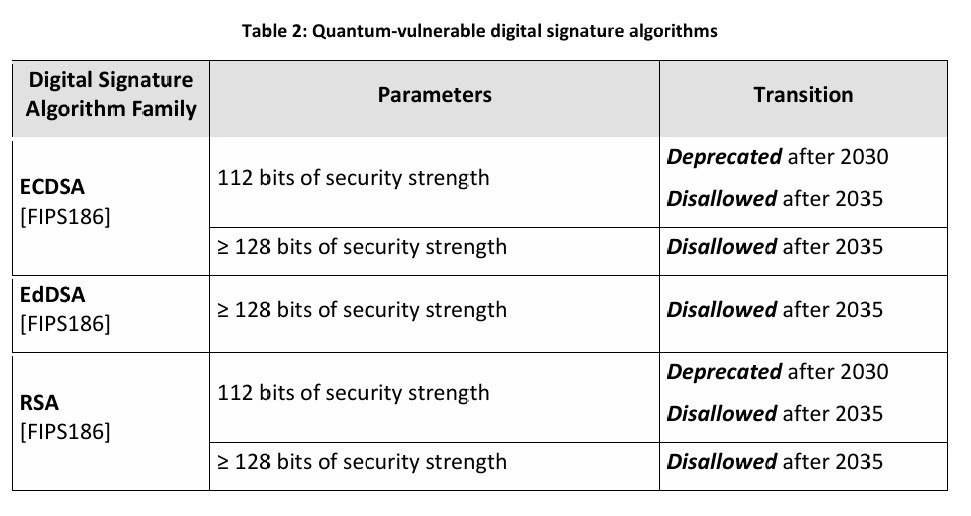
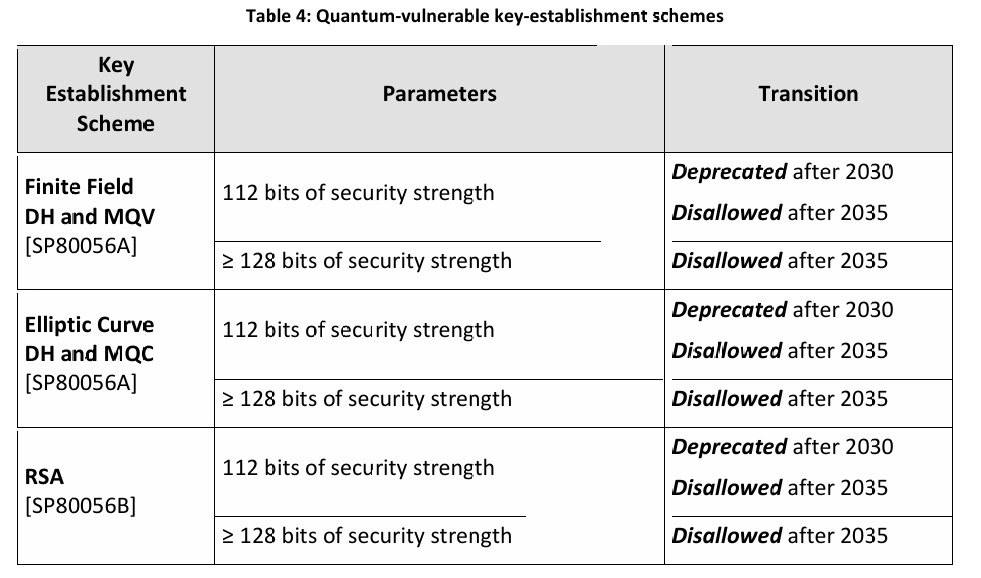
The chart in the meme is basically the town council (NIST) saying: “We need to start using a new kind of lock that the magic key can’t open. By 2030, try not to install the old locks anymore, and by 2035, stop using the old locks entirely.” In other words, everybody should switch to locks that even the super thief can’t pick – these new locks are like the post-quantum algorithms (lattice locks or hash locks, let’s say).

It’s a bit funny in a nerdy way because we usually don’t plan the retirement party for a lock or a code years in advance. Here we are, literally setting a date when our current security tricks (the old locks) become obsolete. The feeling is a mix of scary and reassuring: scary because, wow, a super thief is coming that can break what we thought was unbreakable; reassuring because all the folks in charge are planning ahead so we won’t be caught by surprise.

So the meme’s table, stripped of the tech lingo, is like a big calendar reminder: “New super-powerful burglars expected by 2035. Upgrade all locks before then!” It’s funny because it sounds like something from a heist movie, but it’s real planning in the tech world. In simple terms: our current secret codes are great, but a new kind of quantum burglar is on the horizon, so we’re all getting ready with new secret codes that even that burglar can’t crack. The joke (and truth) in it is how matter-of-fact the deadline is – as if you could mark on your fridge calendar the exact year your security needs to change.

Level 2: Preparing for the Quantum Shift

Let’s break this down in simpler terms. The table is from NIST (the U.S. standards body that guides a lot of cybersecurity practices) and is basically telling everyone using current encryption algorithms: make a plan to change them, because tomorrow’s tech will break them. The algorithms named – RSA, ECDSA, and EdDSA – are all ways to create digital signatures or do encryption. A digital signature is like a digital seal or proof that a message/file was created by the real person and not tampered with. For example, when you visit a secure website (HTTPS), the site’s certificate is digitally signed (often with ECDSA or RSA) to prove it’s legit. When you sign a git commit or an email with PGP, you might be using RSA. When you use SSH keys to log into a server, those keys are often RSA or Ed25519 (Ed25519 is a popular type of EdDSA). These are the traditional_signature_algorithms we’ve relied on for security on the internet.

Now, what does it mean that they’re “quantum-vulnerable”? It means there’s a known way for a future quantum computer to defeat these algorithms. A quantum computer isn’t just a super-fast version of your laptop; it’s a totally different machine architecture that uses quantum physics. It can solve certain problems much faster than normal computers. One of those problems happens to be the core math behind RSA/ECDSA. Specifically:

  • RSA security comes from the fact that multiplying two big prime numbers is easy, but figuring out the original primes from the huge product (factoring) is super hard for normal computers. It’s a one-way street in classical computing.
  • ECDSA/EdDSA security comes from a similar one-way street: multiplying points on an elliptic curve is easy, but figuring out the multiplier (the discrete log) is hard.

Quantum computers running Shor’s algorithm can basically reverse those “hard” problems quickly. Think of it like this: if RSA is a super complicated puzzle that would take a normal computer millions of years to solve, a future quantum computer could solve it perhaps in minutes or hours. That’s devastating for security because it means an attacker with a quantum computer could forge your signatures or decrypt your secrets.

NIST’s table is essentially a timeline for phasing out these quantum_vulnerable_signatures:

  • Deprecated after 2030 means that starting 2030, these algorithms (like RSA 2048-bit or ECDSA with certain curves) are officially considered outdated. “Deprecated” is like a polite way of saying “use at your own risk; we really recommend switching.” After 2030, if you’re designing a new system, you definitely shouldn’t choose RSA or ECDSA.
  • Disallowed after 2035 is stronger. By 2035, these algorithms shouldn’t be used at all in compliant systems. “Disallowed” means if you follow NIST standards (which many governments and companies do), you must have switched to something else by then.

They separate rows by security strength (112-bit vs ≥128-bit) because currently we measure how strong keys are by bits. For example, a 2048-bit RSA key is about 112-bit security, while a 3072-bit RSA or a 256-bit ECC (like curve P-256 or Ed25519) is ~128-bit security. Larger bit numbers mean more effort needed for an attacker before quantum computers. But here’s the catch: even 128-bit security RSA/ECC will fall to a big enough quantum computer. So NIST is effectively saying: no matter how large you made your RSA/ECC keys, by 2035 you shouldn’t rely on them.

So what do we use instead? Post-quantum algorithms (algorithms believed to resist quantum attacks). These include:

  • Lattice-based cryptography: uses math problems on grids of points (lattices) that currently have no efficient quantum-solving method. Examples are new signature schemes like CRYSTALS-Dilithium or FALCON. They produce digital signatures too, but their math is different and safe from known quantum tricks.
  • Hash-based signatures: use cryptographic hash functions in clever ways to sign messages. Hash functions (like SHA-256) are only mildly affected by quantum (quantum can speed up brute-force guessing, but not completely break them). Schemes like XMSS or SPHINCS+ fall here. They often have very large signature sizes or other quirks (like each key can only sign a limited number of messages), so they’re a bit less convenient, but they’re quantum-safe.

ECCEllipticCurveCryptography (which ECDSA and EdDSA belong to) and RSA are often built into all sorts of software and hardware. For a junior developer or someone new to security, this timeline is saying: the stuff under the hood that makes your app “secure” (like SSL/TLS libraries, JWT signing, OAuth tokens, blockchain transactions, etc.) will need to be overhauled in the next decade. It’s a big deal. Think about all the places you see RSA – even the acronym “RSA” might appear in file formats (e.g., ssh-rsa in authorized_keys), in API names, in documents. Similarly, Ed25519 keys are used everywhere now for their speed and security… but those too must eventually be replaced.

Let’s put a concrete example: Suppose you have an SSH key that is RSA 2048-bit. It works great now. NIST saying “deprecated after 2030” implies that by 2030, you should switch to something else – maybe SSH will support a new quantum-resistant key type (maybe something like ssh-pq with a lattice key). If you keep using the old RSA key past 2035, and if a big enough quantum computer exists by then (or if someone recorded your encrypted traffic today and can decrypt it in 2035), your login isn’t safe. They could forge the signature of your key or figure out your private key. So the guidance is: start practicing crypto agility – design your systems to be able to swap out cryptographic algorithms easily.

One more term from the table: FIPS 186 mentioned next to each algorithm (like ECDSA [FIPS 186]) just refers to the Federal Information Processing Standard publication that defines those signature algorithms. It’s basically citing the document where RSA/ECDSA/EdDSA are standardized. Now those standards are being amended to include “by the way, these will be phased out by 2030-2035.”

For a newcomer, the key takeaway is: quantum computing is forcing a once-in-a-generation change in cybersecurity. Even though practical quantum computers that can do this don’t exist yet, we know from math that if/when they do, our current crypto fails catastrophically. So the authorities in charge of security standards are way ahead on this, giving everyone a long heads-up. It’s like being told well in advance that a new kind of super burglar is being born in 10-15 years, so all the locks in every building must be replaced. It sounds a bit sci-fi, but it’s grounded in real science and proactive risk management.

Level 3: Crypto Doomsday Clock

For seasoned security engineers, this table hits like a cold splash of reality – and a dash of dark humor. It’s the kind of announcement that makes everyone in the Cryptography community nod knowingly (and maybe nervously chuckle). Why? Because we’ve seen deprecation deadlines before (MD5? SHA-1? those old friends had their send-off parties too), but this one ups the ante by pre-emptively obsoleting algorithms before they’re broken. It’s like NIST is standing at the front of a packed server room, clearing its throat to declare: “Ladies and gentlemen, start your migrations – the quantum winter is coming.”

The humor is subtle and cynical-veteran flavored: imagine a grizzled security architect forwarding this timeline around with the subject line “Happy New Year 2030 – RSA’s Retirement Party.” It’s funny because it’s true – RSA and ECDSA have been our reliable workhorses for decades, and now they have a literal end-of-life date. Engineers remember past migrations: sunsetting old TLS versions, lengthening keys when 1024 bits got weak, purging SHA-1 certificates after Google’s collision demo. Those were painful, but largely reactive (we changed after weaknesses were demonstrated). Here, NIST is practically writing an obituary in advance. It has a very “I, for one, welcome our quantum overlords” vibe – acknowledging the threat long before it materializes, so nobody can say they weren’t warned.

From an industry perspective, the table condenses a massive post_quantum_migration project into a few cells. Each row is a saga:

  • ECDSA – the backbone of many secure systems (from TLS certificates to blockchain signatures) – flagged “Deprecated after 2030”. Translation: by 2030, stop using ECDSA in new designs. That’s barely a few years for long-lived systems! Senior devs know that means starting the transition yesterday. Legacy IoT devices, VPN appliances, authorized SSH keys, even that HSM in the bank’s vault – all likely using ECDSA (or its cousin EdDSA). How many of those can realistically be updated by 2030? The table’s dry text belies a frantic scramble in the making.
  • RSA – the granddaddy of digital signatures (and encryption), with decades of library support and hardware acceleration – given the same send-off. In fact, RSA with 2048-bit keys (112-bit security) joins ECDSA on the 2030 chopping block. Ever tried updating a 10-year-old Java app’s crypto? Now imagine doing it at global scale. One can almost hear the collective groan of enterprise IT: “We just finished migrating everything to RSA-2048 and ECC, and now we have to rip it out again?” Yes, because by 2035 it’ll be “Disallowed” – an unambiguous “thou shalt not use.”
  • EdDSA – specifically Ed25519 (widely beloved for being modern, fast, and secure) – is also on the hit list (“Disallowed after 2035”). There’s irony here: many switched to Ed25519 thinking it was future-proof forever (no known classical weaknesses!). And it is – except against quantum. Now even Ed25519 has an expiration date. This feels like when you buy a fancy new lock for your house, and then the locksmith union announces they’re all switching to a completely different lock type in a decade because the master key is coming.

The shared experience this meme taps into is the looming Y2K-like project we all know is coming but tend to procrastinate. Security folks have been shouting about quantum threats for years, often met with “Yeah, but quantum is always 20 years away.” Well, the calendar pages have flipped, and now we have actual dates: 2030, 2035. The “Quantum of Solace” (if you’ll pardon the pun) is that we still have some time – but the clock is ticking. The signature_transition_timeline in the meme is equal parts serious guidance and a cheeky reality check: it’s both real NIST policy and the kind of thing you’d half-jokingly pin on the break room corkboard, circled in red ink.

Why is fixing this hard? Two words: crypto agility (or lack thereof). Ideally, our systems would be modular – swap out RSA for a post-quantum algorithm with a config change. In practice, many systems bake algorithms deep into protocols and hardware. Think about all the smart cards, secure bootloaders, or embedded devices using RSA/ECDSA. Many will be in the field by 2030 with no update mechanism. The meme slyly underscores this impending headache. It’s “too real” because crypto migrations often require touching every piece of a system: libraries, certificates, protocols, user trust stores, compliance checklists – you name it. And persuading management to fund a huge overhaul for a threat that hasn’t happened yet? That’s a tough sell until regulators (nudged by NIST timelines like this) make it non-optional.

Historically, we got here because cryptography, like software, has its own lifecycle. Algorithms considered rock-solid in the 1990s (RSA, DSA) gave some way to new ones in the 2000s (ECC, EdDSA) for better performance and security margins. Now in the 2020s, it’s not that RSA/ECC got “broken” by clever mathematicians (like how AES wasn’t broken, just eventually keys needed to grow) – instead, an entirely new computing paradigm emerged as the threat. It’s a bit of a plot twist in the TechHistorian narrative of cryptography. We always knew theoretically that large quantum computers would upend these algorithms; the gag was it was a far-off sci-fi concept. But NIST setting a date certain makes it concrete, almost mundane. It’s the ultimate SecurityTradeoffs moment: stick with beloved, battle-tested algorithms and risk total breakage one day, or throw weight behind new, less-proven quantum-resistant ones now and deal with the growing pains.

By presenting this schedule, the meme effectively satirizes the industry’s “fix it later” mindset. It’s as if NIST is the responsible adult at a procrastinators’ party, sternly announcing the deadline while everyone else nervously laughs and refills their coffee. The comedic undertone comes from that blend of dread and determination every senior engineer recognizes. Yes, it’s a headache, but at least we can share a wry smile that even our encryption algorithms have transition timelines now. Cue the gallows humor: “See you at the RSA/EDSCA retirement party in 2030 – bring cake and your favorite lattice-based algorithm to share.”

Level 4: Quantum Supremacy Countdown

In the rarified domain of post-quantum cryptography, this table reads like a scheduled apocalypse for classical algorithms. It highlights how Shor’s algorithm – a quantum algorithm discovered in 1994 – hangs over RSA and ECDSA like a guillotine with a timer. Let’s unpack why:

RSA relies on the hardness of factoring large integers (e.g., a 2048-bit RSA key is the product of two huge primes). On a classical computer, factoring such a number is so astronomically difficult that it's measured in bits of security strength – roughly how many binary operations an attacker would need. For RSA-2048, it’s about 112 bits of classical security (meaning ~2^112 operations, which is infeasible). ECDSA (Elliptic Curve Digital Signature Algorithm), along with EdDSA (Edwards-curve DSA like Ed25519), rely on the hardness of the elliptic curve discrete logarithm problem. A typical elliptic curve like P-256 or Ed25519 offers ~128 bits of classical security, meaning even the best classical algorithms would need on the order of 2^128 tries to forge a signature – effectively impossible with today’s computing power.

Enter quantum computing. QuantumComputingConcepts introduce qubits and phenomena like superposition and entanglement, enabling new algorithms outside classical limits. Shor’s algorithm leverages quantum parallelism and the Quantum Fourier Transform to factor integers in polynomial time. In practical terms, a sufficiently powerful quantum computer could break RSA-2048 not in billions of years, but potentially within hours or days. Likewise, it solves elliptic curve discrete logs with similar efficiency. This is why NIST’s table ominously labels RSA and ECDSA as “Quantum-vulnerable digital signature algorithms.” Once a quantum computer with enough stable qubits exists, these algorithms effectively offer 0 bits of security – utterly broken.

The table’s “112 bits” vs “≥ 128 bits” rows reflect current SecurityTradeoffs. Systems today using 112-bit security (e.g., RSA-2048 or certain shorter ECC curves) are already on notice – they’re marked Deprecated after 2030, meaning by then you shouldn’t be launching new systems with them. But even the stronger classical options (like RSA-3072 or ECC P-256 giving ≥128-bit security) are Disallowed after 2035. This timeline is drawn from NIST SP 800-208 and related guidance, effectively a signature_transition_timeline. It’s a proactive countdown telling everyone: “We assume by 2035, quantum attackers will be a realistic threat. By that time, none of today’s traditional_signature_algorithms can be trusted.” It’s akin to a Y2K for cryptography – sometimes dubbed Y2Q (Year to Quantum) – only this time the deadline isn’t about software bugs, but the fundamental math that secures our digital world.

Crucially, this doesn’t mean digital signatures themselves are going away – it means we must adopt post_quantum_migration strategies, shifting to algorithms believed immune to quantum attacks. Research has delivered lattice-based signature schemes (based on problems like Learning With Errors) and hash-based signatures (like XMSS or SPHINCS+ using one-way hash functions) which even quantum computers can’t easily crack. For example, CRYSTALS-Dilithium and FALCON are lattice-based signatures recently selected by NIST’s Post-Quantum Cryptography project. They rely on math problems that don’t yield to Shor’s or any known quantum algorithm. The trade-off? These new schemes often have larger key sizes or signatures – a small price for safety in a QuantumComputing age. This is the essence of SecurityBestPractices in a post-quantum world: be agile with cryptography. Designs must be flexible enough to swap out algorithms as threats evolve.

In summary, at this deepest level, the meme highlights a pivotal moment in cryptographic history. The traditional RSA and elliptic-curve algorithms, once the unassailable bedrock of digital security, now have expiration dates. It’s both technically fascinating and a bit eerie – a direct consequence of theoretical computer science (quantum algorithms) colliding with real-world security. The humor here, for the cryptographically inclined, is the matter-of-fact way an official table schedules the funeral of our trusted algorithms. It’s as if someone annotated the laws of mathematics: “Effective 2035, factoring large numbers shall be trivial – plan accordingly.” This quantum_vulnerable_signatures timeline is a nerdy mix of cutting-edge science and project management, confronting us with the radical idea that the encryption and signatures protecting the internet today have a ticking clock above them.

Description

This image displays 'Table 2: Quantum-vulnerable digital signature algorithms'. It's a clean, black-and-white table with three columns: 'Digital Signature Algorithm Family', 'Parameters', and 'Transition'. The table lists the algorithm families ECDSA, EdDSA, and RSA, along with their corresponding security strength parameters (e.g., 112 bits, >= 128 bits). The 'Transition' column provides specific deadlines, indicating that the weaker versions of ECDSA and RSA are 'Deprecated after 2030' and all listed algorithms are 'Disallowed after 2035'. This is not a meme but a critical piece of technical documentation. It provides the specific, actionable details for the cryptographic migration mandated by the US government's post-quantum strategy. For senior engineers and architects, this table is a direct warning that the foundational pillars of current internet security have a clear expiration date, necessitating long-term planning for a complex and mandatory migration to quantum-resistant alternatives
Comments

7
Anonymous ★ Top Pick I'm not saying this migration will be painful, but I'm stocking up on project manager apology templates now. 'We've encountered some unforeseen cryptographic challenges in our sprint to defy quantum physics.'
  1. Anonymous ★ Top Pick

    I'm not saying this migration will be painful, but I'm stocking up on project manager apology templates now. 'We've encountered some unforeseen cryptographic challenges in our sprint to defy quantum physics.'

  2. Anonymous

    NIST just scheduled RSA, ECDSA, and EdDSA for retirement by 2035 - meanwhile our change-control board still hasn’t approved SHA-1 removal, so odds are Shor’s algorithm will finish the migration before we do

  3. Anonymous

    Just found out my RSA keys expire in 2035, which coincidentally is also when I planned to finally migrate that legacy system to microservices

  4. Anonymous

    Nothing says 'job security' quite like a cryptographic deprecation table with a 10+ year runway - plenty of time to migrate those legacy systems you've been meaning to refactor since 2015, right? By 2035, we'll finally have an excuse to touch that ancient authentication service that's been running untouched in production since the Obama administration, assuming quantum computers don't break it first and assuming you can still find someone who remembers why ECDSA with 112-bit keys seemed like a good idea back then

  5. Anonymous

    112 bits of security? Quantum computers will Shor-ten that to zero by 2035 - time to PQC or bust

  6. Anonymous

    ‘Disallowed after 2035’ sounds far away until you factor HSM firmware lead times and root‑CA rollover windows - start the Dilithium migration before procurement finishes the NDA

  7. Anonymous

    NIST says “disallowed after 2035”; our crypto‑agility plan says “start discovery in 2034 and find an RSA key baked into a million bootloaders.”

Use J and K for navigation