Skip to content
DevMeme
5836 of 7435
Quantum Vulnerability and Deprecation of Key-Establishment Schemes
Cryptography Post #6394, on Nov 20, 2024 in TG

Quantum Vulnerability and Deprecation of Key-Establishment Schemes

Why is this Cryptography meme funny?

Level 1: Changing All the Locks

Imagine you and all your friends have been using a super strong lock to protect your secret candy box. This lock is so tough that no regular key can open it except your own. For years, everyone trusts these locks to keep their treasures safe. Now, picture that you hear news that a genius kid in the future might invent a skeleton key – a magical master key that could open any of these locks easily. That sounds scary, right?

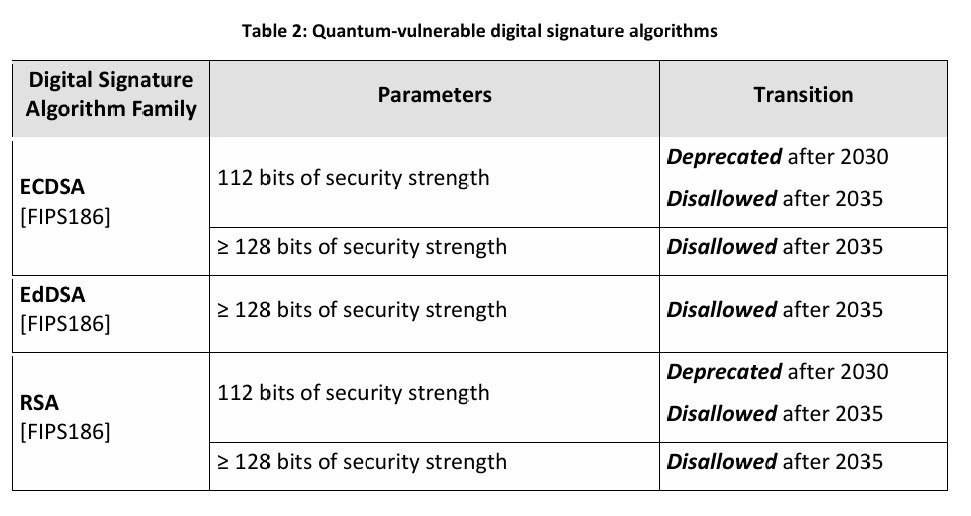
This meme is basically saying: the people in charge of security (let’s call them the “lock experts”) have looked at the magic tricks that might come in the future (in this case, super advanced quantum computers), and they decided we all need new locks. They even gave a schedule: by the year 2030, our current locks (named RSA, Diffie-Hellman, and ECC – but think of them just as Lock A, B, and C) should start being replaced. And by 2035, we should stop using those old locks entirely, because by then that skeleton key (the quantum computer) might be ready to use by burglars.

It’s like your parents telling you, “In ten years, thieves will have X-ray vision to see the combination of your safe. So by then, you must get a new safe with a different kind of lock.” They haven’t seen the thief with X-ray vision yet, but they’re pretty sure it’s coming. So they’re warning early.

Why is this a bit funny (in a nerdy way)? Well, usually memes are jokes, but this one is actually a real announcement dressed up like a meme. The humor is kind of in the seriousness: it’s a straightforward table with dates, but it’s being shared around with a knowing chuckle because it’s such a “big deal” stated so plainly. It’s as if someone shared a note saying “Dragons might appear in 2030, please build dragon-proof houses by 2035,” and all the castle builders are passing it around going “Wow, times are changing!”

So in simple terms: the locks we use for secrets today won’t work against tomorrow’s super lock-picks (quantum computers). We have to invent new locks that the super lock-pick can’t open. And the meme is showing the deadline by when everyone needs to switch out their old locks for new ones. It’s both a heads-up and a bit of a joke because setting an exact date for these things is unusual. Imagine marking your calendar for 2035 with “no more old locks allowed!” – it feels far away, yet kind of specific.

If you’re not into the tech details, just remember this image as: “The countdown has begun for changing all our digital locks before the quantum burglars get here.” It’s a mix of “Wow, the future is coming” and “We better get ready!” in one neat little table.

Level 2: Classic Crypto vs. Quantum Threat

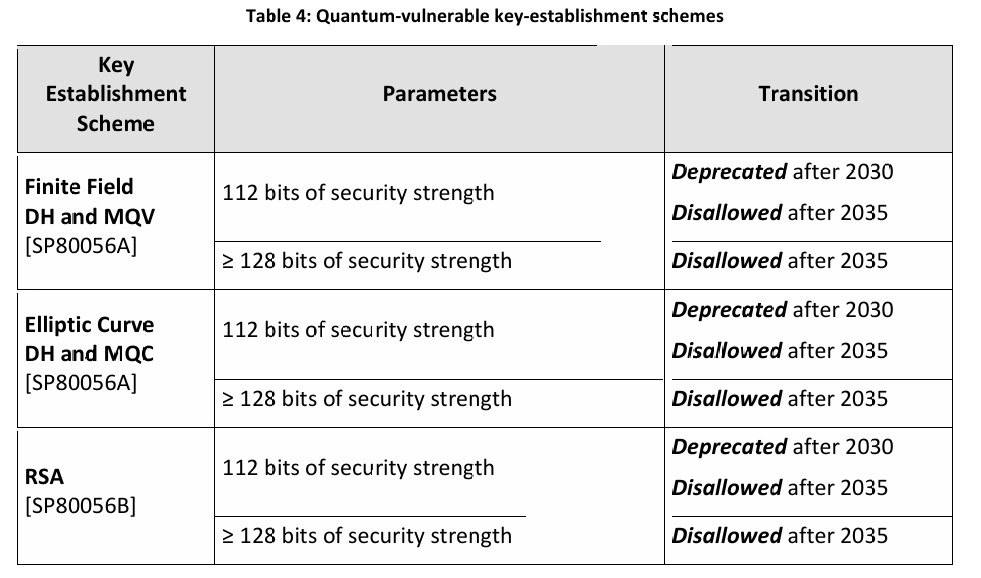
Let’s break down what this meme is actually showing and why it’s important. The table is from NIST (the National Institute of Standards and Technology), which often sets the rules and best practices for computer security in the U.S. and globally. The title, “Quantum-vulnerable key-establishment schemes,” is a fancy way of saying “Encryption methods that won’t be safe once powerful quantum computers are around.” Key-establishment schemes are methods used by computers to agree on secret keys over a network. Popular ones today include:

  • Finite Field Diffie-Hellman (DH): a classic way for two parties to create a shared secret key, even if an eavesdropper is listening. It relies on arithmetic in a finite field (basically doing math modulo a large prime number).
  • MQV (Menezes–Qu–Vanstone): an advanced variant of Diffie-Hellman that adds some extra security properties (it’s also based on finite field math or elliptic curves, and is defined in NIST’s SP 800-56A standard).
  • Elliptic Curve Diffie-Hellman (ECDH): a newer, more efficient take on Diffie-Hellman that uses elliptic curves. It achieves the same goal (shared secret key) but with smaller keys and faster computation. This has been widely adopted in protocols like TLS (the lock icon in your browser).
  • RSA key establishment: RSA is usually known for encryption and digital signatures, but it can also be used to establish a secret key. For example, one side generates a random key and uses the other side’s RSA public key to encrypt it; once that’s sent and decrypted with the private key, both sides share the secret. RSA relies on the difficulty of factoring large numbers (like multiplying primes). SP 800-56B is the NIST doc covering RSA usage for key establishment.

Now, what does quantum-vulnerable mean in this context? It means these methods (DH, MQV, ECDH, RSA) are all built on math problems that a future quantum computer could solve relatively easily. Specifically, a big quantum computer can break:

  • Diffie-Hellman/ECDH by solving the discrete logarithm problem quickly,
  • RSA by factoring the large number quickly.

Today, with normal computers, if you use strong enough keys (e.g., 2048-bit or larger for RSA, 256-bit curve for ECDH), these problems are practically unsolvable — it would take billions of years to brute-force or mathematically crack them. That’s why we measure a “112-bit security strength” for some of these; it’s a way to compare it to symmetric encryption strength (112 bits is considered okay but nearing the lower end of acceptable, 128 bits is good strong security by today’s standards).

However, a quantum computer isn’t a super-fast version of a normal computer; it’s a new kind of machine that uses quantum physics to compute. Quantum computers can solve some problems much faster by doing many calculations at once in a weird parallel way (thanks to superposition of qubits). There’s a known quantum algorithm (Shor’s algorithm) that would let a quantum computer factor numbers and crack these discrete logs exponentially faster than we can now. So things like RSA-2048, which are unbreakable today, would be broken in maybe a matter of days or hours if a sufficiently large quantum computer existed. It’s as if we found a cheat code for these math problems.

Now to the table: it lists those vulnerable schemes and gives two dates: “Deprecated after 2030” and “Disallowed after 2035”. This is NIST basically scheduling the retirement of these algorithms.

  • Deprecated after 2030: This means that after 2030, these algorithms shouldn’t be used in new systems or products. They’re on their way out. It’s like saying “from 2030 onward, these are old and should be avoided.” If you’re designing a system in 2031, you better not plan to use RSA or ECDH; they’re telling you those are outdated by then due to the quantum threat. You might still see them in use between 2030 and 2035, but they carry a big warning label.
  • Disallowed after 2035: This is a stronger line. By the time we hit 2035, you should no longer use these algorithms at all, in any compliant or secure system. “Disallowed” means if you’re following NIST guidelines (which many governments and companies do), these algorithms become forbidden for use – as in, if you used them, you wouldn’t pass a security compliance check or you’d be violating policy. It’s the end-of-life date.

Think of it like how old SSL and early TLS versions were phased out: first they said “don’t use TLS 1.0 after 2014” (for example) and later “if you use TLS 1.0/1.1 after 2020, you’re not compliant.” Similarly, NIST is giving a grace period to migrate. By 2030 you should start phasing out RSA/DH/ECC, and you have at most until 2035 to be completely done with them.

Why 2030–2035? It’s a guess based on how far along quantum computing might be. Right now in 2024, quantum computers are still small (tens or hundreds of qubits, with lots of errors). But there’s a global race by companies and governments to build bigger ones. NIST and the security community don’t want to be caught off-guard. They figure that by the early-to-mid 2030s, there’s a risk that someone could have a quantum computer powerful enough to crack these schemes. It might happen even sooner, or maybe later – nobody can predict perfectly. But setting those dates encourages everyone to be prepared before it’s too late. It’s like a safety buffer: even if the first big quantum computer arrives in 2035 or 2040, our goal is to have all critical systems already using quantum-resistant crypto by then.

So, the meme is showing this table because it’s a stark reminder: the crypto we know and love is on a ticking clock. For a junior developer or someone new to security, the immediate question is: What do we use instead? The answer is post-quantum cryptography (PQC) – new algorithms that NIST and others have been working on that quantum computers can’t easily break. These rely on different hard math problems (like lattice problems, which are kind of like a multi-dimensional grid guessing game, or error-correcting codes, etc.). Some names of these new algorithms are floating around in tech news – for example, Kyber (a lattice-based encryption scheme) and Dilithium (a lattice-based signature scheme) were chosen by NIST in 2022 as likely replacements. Don’t worry if those sound unfamiliar; they’re just next-generation tools we’ll be hearing more about.

For now, what you need to know is that developers and companies should start planning to update their cryptographic tools. Many programming libraries (like OpenSSL, BoringSSL, etc.) are adding support for these new algorithms so that in the next few years, software can start using them. There’s even the idea of “crypto agility,” meaning design your systems so it’s easy to swap out one algorithm for another. That way, if one algorithm gets weak or broken, you can quickly move to something stronger (we wish we had more of that in the past!). This is especially important in the context of quantum threats, because we may find out in a rush that something needs to change.

To put it simply: The meme is reminding everyone that RSA, Diffie-Hellman, and elliptic curves—basically all our current public-key methods—have an expiration date due to quantum computers. NIST suggests that by 2030 you should start using something else, and by 2035 you absolutely shouldn’t be using them at all. It’s a schedule for one of the biggest shifts in computer security history. Developers who are just learning about encryption might find it surprising: “Wait, the stuff I’m learning today (like generating an ECC key or using RSA) will be considered insecure in a decade?” Yes – and that’s why it’s both an exciting and slightly scary time to be getting into cryptography.

On the lighter side, this is being shared as a “meme” in developer circles partly because it’s a bit surreal. We usually see memes with cats or cartoons, not dry tables from NIST. The humor is in the seriousness: it’s like sharing an obituary for RSA in advance. People might joke, “RSA 1977–2035, rest in peace, you served us well.” Or, “Time to tell the boss we have only a few years to solve quantum computing… or to switch all our encryption.” It’s a nerdy kind of humor, poking fun at the fact that we have a bureaucratic timeline for dealing with a very sci-fi problem (quantum computers breaking encryption). But it’s also informative: if you weren’t aware of this issue, seeing the meme might prompt you to google “quantum vulnerability” or “post-quantum crypto” — and that’s a good thing! It means more developers getting up to speed on what might be the next big change in how we secure data.

In summary, this meme’s content is telling us: Start preparing for the new era of encryption. The old guard (RSA, DH, ECDH) is going to retire by 2035 because of the quantum threat. If you’re a junior dev, it’s a hint that the crypto you use in your projects will evolve. It’s time to become aware of terms like post-quantum, and maybe keep an eye out for new libraries or protocols that support quantum-resistant algorithms. And if nothing else, it’s a cool blend of science fiction and software engineering reality – something that was theoretical (quantum computers hacking cryptography) is now important enough that official deadlines are being set. Kinda wild, right?

Level 3: Y2Q – The Crypto Doomsday Clock

For experienced engineers and security architects, this meme hits like a flashback to Y2K, except now it’s Y2Q – “Year to Quantum.” It’s both tongue-in-cheek and deadly serious: NIST is effectively holding up a giant countdown clock for phasing out RSA, Diffie-Hellman, and ECC, much like companies in the 90’s had a countdown to fix the Year 2000 bug. The table snippet – “Deprecated after 2030” and “Disallowed after 2035” – lays out firm deadlines for encryption algorithms that have been bedrocks of secure communication for decades. Seasoned devs see the humor in this because they know how organizations handle such deadlines: usually with procrastination, last-minute scrambles, and a heap of technical debt.

Imagine the enterprise meeting rooms in 2034: a panicked conversation that “We really should finish replacing all our RSA-based systems this quarter, because next year it’s officially disallowed.” Seasoned folks chuckle (and cringe) because they’ve lived through similar “drop-dead date” migrations. Remember when SHA-1 was deprecated and everybody had to switch to SHA-256 for certificates? Or when we had to purge TLS 1.0/1.1 in favor of TLS 1.2+ by a certain date? Those were smaller undertakings compared to what’s coming. This time it’s not just patching a library or updating a cipher suite – it’s redesigning the cryptographic foundation of many systems. RSA key exchange and ECDH handshakes are everywhere from your HTTPS connections to VPN tunnels and IoT device firmware. An old-timer might wryly note: “We’ve only just finished sunsetting 1024-bit RSA and other 90s crypto, and now we’re told all of it has got to go by 2035.” It’s the ultimate legacy code problem: instead of outdated frameworks or OSes, it’s our legacy math that needs an upgrade.

The meme is a black-and-white excerpt from an official NIST table, which makes it ironically meme-worthy. Normally, memes use funny images or exaggerated jokes, but here the dry bureaucratic format is the joke – it’s a reality check that reads almost like a corporate expiry notice for algorithms. It’s as if NIST sent an eviction letter to RSA, Diffie-Hellman, and ECC: “Pack your things by 2030, you’re on notice, and by 2035 you’re out.” For experienced developers, there’s a dark humor in seeing beloved algorithms given a retirement date. These algorithms have been like the trusty old guard for security – RSA has been around since 1977, Diffie-Hellman even earlier (1976), and ECC making big strides in the 2000s as the sleeker alternative. They’ve survived so many other threats (like increasingly powerful classical computers, new mathematical attacks, etc.) by just using larger keys. But now they have a non-negotiable end-of-life due to quantum computing – a completely different enemy. It’s “adapt or die,” and NIST is making the call.

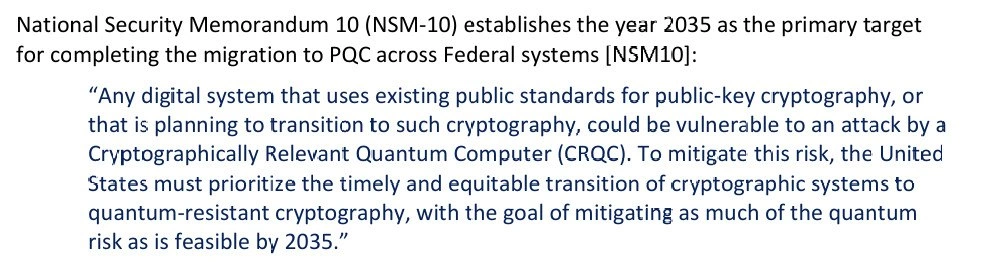
From a senior perspective, the timeline also hints at the massive crypto_migration_strategy every organization must embark on. You don’t just flip a switch on New Year’s 2030 to move off RSA; it’s a phased process that should start now. NIST setting these dates is their way of telling the industry to get moving on post_quantum_transition. The savvy engineer knows to read between the lines: if something is deprecated by 2030, you better have the replacement in place well before then, because by 2030 you should ideally no longer be using it in new systems. By 2035, using RSA/DH/ECC might not only be non-compliant with standards, but outright dangerous if quantum computers materialize faster than expected.

There’s also an implicit “or else”: post-2035, if you haven’t migrated, your security might be considered equivalent to plaintext in the eyes of regulators (especially for government and industries that follow NIST guidelines strictly). It’s a bit ominous – hence the doomsday clock vibe – but also a bit comical given how far-off those dates sound to some. Experienced devs know 2030 isn’t that far in enterprise terms. Many large organizations have tech (and humans!) that have been around longer than 10–15 years. Think of critical infrastructure running ancient cryptographic libraries baked into hardware, or all those embedded devices in the field (like smart meters, medical devices, satellites) that use RSA/ECDH and can’t be updated easily. The wry joke is that some of those will inevitably blow past 2035 still using “forbidden” crypto, and then we’ll have compliance exceptions and rushed fixes.

Another layer of humor for the battle-scarred engineer is recalling previous deprecation deadlines: “Disallowed after 2035? Sure… just like how nothing was supposed to use RC4 or MD5 after their deprecation dates, yet here we are still finding them in old systems.” The table feels like a stern parent setting a curfew, but the rebellious teenage code might sneak out anyway. A cynical veteran might quip that come 2036, someone will discover an ancient server still using RSA-2048 and have to call in a priest cryptographer to exorcise it.

Jokes aside, the meme sparks real discussions among senior folks: How do we actually prepare for this? It’s not often we know a specific timeframe to replace a foundational technology. Usually deprecations happen after something’s broken, but here we have a heads-up. Smart teams are already working on that crypto agility – making their systems flexible to swap algorithms easily. Many are testing hybrid key exchange in TLS (combining classical ECDH with a post-quantum KEM like Kyber, so even if one fails, the other survives). The timeline forces long-term budgeting and planning: migrating a large organization’s PKI (Public Key Infrastructure), updating certificates, protocols, and even hardware (some hardware security modules might not support the new algorithms and will need upgrades).

For those in the Security field, this meme resonates as a mix of anxiety and dry humor. It’s not just theoretical; NIST’s deadlines often end up baked into compliance regimes (like FIPS certification requirements). So a CISO reading “Disallowed after 2035” knows that’s essentially the drop-dead date for regulatory approval. It’s both comforting to have a schedule and daunting considering the amount of work. The table’s matter-of-fact style (“Deprecated after 2030 / Disallowed after 2035”) elicits a knowing smirk: security folks have been warning about quantum vulnerability for years, and now the bureaucratic machinery is catching up. It’s now official – you can show this meme to the management chain as justification: “Look, NIST says we must be off RSA/DH/ECC by 2035, it’s not just me being paranoid.” It’s a rare meme that doubles as an argument in a PowerPoint slide for budget.

In essence, at Level 3 the meme highlights a serious paradigm shift with a tinge of humor: the guardians of our encrypted world have an expiration date, and it’s stamped right there in black and white. It’s funny in a geeky way because we rarely see such long-term yet concrete deadlines in tech. It’s like being told the programming language you use daily will be illegal in 10 years – you’d chuckle and then nervously wonder if you should start learning a new one. Here, instead of a language, it’s our fundamental security algorithms. The “Quantum Doomsday Clock” is ticking, and everyone from protocol designers to software engineers has to pay attention. The meme’s table, dry as it looks, is basically NIST shouting: “Pencils down on RSA and Diffie-Hellman by 2030, folks!” – a somber message wrapped in the familiarity of a meme for those who know the implications.

# Pseudocode representation of NIST's quantum deadline enforcement
if current_year >= 2030:
    if algorithm in ["RSA", "DH", "ECDH"]:
        warn("Using quantum-vulnerable algorithm. It's deprecated, migrate soon!")
if current_year >= 2035:
    if algorithm in ["RSA", "DH", "ECDH"]:
        raise SecurityException("Disallowed: algorithm broken by quantum attacks!")

(Above: A lighthearted snippet imagining how policy might be enforced in code – come 2035, using RSA or ECDH in your system might literally throw errors like this.)

For veterans, this is both reassuring (we have a plan) and grimly amusing (we know how these plans go). They’ve seen how long it took to kill off older protocols and ciphers; now an entire class of key establishment schemes has its tombstone pre-engraved. The “meme” subtly says: get ready for the great crypto migration, and maybe set a reminder for 2029 so you’re not scrambling at the last minute! It’s a blend of gallows humor and professional challenge – the kind that makes a security engineer sigh, shake their head, and then share the image with the caption “Welp, it’s official – the crypto apocalypse has a schedule now.”

Level 4: Polynomial Time Bomb

At the cutting edge of cryptography and quantum computing, the meme’s table highlights an impending clash of fundamental math and futuristic tech. Under the hood, today’s public-key algorithms like RSA, Diffie-Hellman (DH), and Elliptic Curve Cryptography (ECC) rely on problems believed to be intractable for classical computers. Cracking RSA means factoring a huge number into primes, and breaking DH/ECC means solving discrete logarithms on a large finite field or elliptic curve. These are problems that take astronomically long on any normal computer – their difficulty grows super-polynomially with key size, giving us security levels measured in bits (e.g. 112-bit security strength roughly corresponds to RSA 2048).

Enter quantum computing – a completely different model of computation harnessing qubits that can exist in superposition and leverage entanglement. A powerful quantum computer can perform certain calculations exponentially faster than classical machines by operating on many possibilities at once. In the 1990s, mathematician Peter Shor discovered a quantum algorithm that factors integers and computes discrete logs in polynomial time. This is the polynomial time bomb ticking under classical crypto: Shor’s algorithm would reduce breaking RSA-2048 from an infeasible task (on the order of $2^{112}$ operations classically) to something a sufficiently advanced quantum computer could do perhaps in hours or days. Likewise, ECC and finite-field DH succumb to the same quantum trick – essentially any scheme based on factorization or discrete log (Diffie-Hellman groups, RSA moduli, or elliptic curve groups) is vulnerable. They’re collectively called quantum-vulnerable key-establishment schemes because once a cryptographically relevant quantum computer (CRQC) exists, these schemes offer zero protection; encrypted secrets using 2048-bit RSA or 256-bit ECC could be decoded as easily as solving a small Sudoku with the right quantum hardware.

NIST’s timeline in the meme is grounded in this theoretical reality. “Deprecated after 2030” and “Disallowed after 2035” are essentially NIST’s way of saying the clock is ticking on these math problems. By 2030, even using RSA/DH/ECC at ~112-bit security (like RSA-2048 or ECC P-224) will be officially frowned upon, and by 2035 forbidden for compliant systems – regardless of key size. Even larger keys (≥ 3072-bit RSA or ≥ 256-bit ECC, giving ≥128-bit classical security) are listed as Disallowed after 2035. This seemingly paradoxical stance (why disallow stronger keys too?) reflects NIST’s confidence that Shor’s algorithm doesn’t care about your key length once a big enough quantum computer exists. With enough stable qubits, breaking RSA-3072 is as easy as RSA-2048 – both fall in polynomial time, collapsing the roughly $2^{128}$ vs $2^{112}$ classical effort gap. In essence, the strength of these algorithms goes to zero in a post-quantum world, so NIST has set a hard end-of-life.

Underneath the meme’s dry table is a deep principle of computational complexity: the difference between problems that are exponentially hard and those that are polynomial-time solvable. Classical cryptography bets on certain problems staying exponential (so they’re impractical to solve). Quantum computing upends that bet by changing the rules of what’s efficiently solvable. It’s a one-way street: a quantum breakthrough can turn decades of Moore’s Law-driven key length increases into dust overnight. The humor here – if any – is a kind of dark academic irony: our trusted encryption algorithms have an expiration date because physics and math have conspired to give adversaries a super-powerful tool. This is a rare case where we know exactly why something secure today will be insecure tomorrow, thanks to well-understood algorithms like Shor’s (and to a lesser extent Grover’s algorithm, which weakens symmetric ciphers by a square-root factor). It’s not often in engineering you get a countdown to obsolescence that’s rooted in published theorems and predicted technological growth. NIST is effectively saying, “We’ve proven your crypto will die, we just haven’t built the assassin yet – but we expect to, so plan accordingly.” The meme resonates on this advanced level: it’s a mix of theoretical computer science and practical security policy, a real-world ticking clock for protocols.

In response, the world of cryptography is undergoing what you might call the post-quantum transition. The table is from a NIST document (e.g. SP 800-56 series) outlining a roadmap to migrate away from vulnerable algorithms towards post-quantum cryptography (PQC). PQC involves new schemes based on hard problems believed to resist quantum attacks – like lattice-based cryptography (hard lattice problems), code-based cryptography, multivariate polynomial problems, and hash-based signatures. Notably, NIST has already run a multi-year competition to standardize PQC algorithms: for example, CRYSTALS-Kyber (a lattice-based key encapsulation mechanism) and CRYSTALS-Dilithium (for digital signatures) were selected as primary algorithms to replace RSA/ECC in the post-quantum era. These rely on mathematical puzzles with no known efficient quantum (or classical) solutions (like the Shortest Vector Problem in lattices for Kyber). So behind that bland table lies a frantic global effort by mathematicians and computer scientists to switch the underpinnings of secure communication before the quantum time bomb explodes. It’s a fascinating interplay of theory and engineering: cryptographers are in a race against the quantum research community, trying to get new defenses widely deployed before someone, somewhere achieves a breakthrough in quantum computing that could overnight make today’s internet communications readable. Essentially, this meme is a reminder of both the fragility and resilience of cryptography – fragile because it hinges on unproven hardness assumptions, resilient because the community is proactively reinventing itself via NIST’s guidance. Think of it as the cryptographic endgame where we preemptively outmaneuver an adversary that wields physics like a cheat code. In short, the table’s deadlines are the formalization of “we have X years left until all our encrypted data becomes an open book.” It’s a mix of awe (at quantum algorithms’ power) and urgency (to deploy quantum-resistant solutions) that only seasoned security geeks truly appreciate.

Description

This image presents 'Table 4: Quantum-vulnerable key-establishment schemes'. It is a structured, black-and-white table with three columns: 'Key Establishment Scheme', 'Parameters', and 'Transition'. The table identifies three major key establishment schemes as vulnerable: 'Finite Field DH and MQV', 'Elliptic Curve DH and MQC', and 'RSA'. For each scheme, it specifies security strength parameters (112 bits and >= 128 bits) and provides a clear transition plan: 'Deprecated after 2030' and 'Disallowed after 2035'. This is a highly significant piece of technical documentation, not a meme. It outlines the official end-of-life for the cryptographic handshake protocols that currently secure a vast majority of internet traffic (e.g., TLS). For senior engineers and system architects, this is a direct mandate to plan the migration of critical network infrastructure away from these foundational, but soon-to-be-insecure, standards
Comments

7
Anonymous ★ Top Pick The year is 2034. A junior dev asks, 'Hey, did we ever get around to replacing that old Diffie-Hellman key exchange on the legacy billing server?' The silence that follows is deafening
  1. Anonymous ★ Top Pick

    The year is 2034. A junior dev asks, 'Hey, did we ever get around to replacing that old Diffie-Hellman key exchange on the legacy billing server?' The silence that follows is deafening

  2. Anonymous

    NIST says RSA is disallowed after 2035 - perfect, that’s exactly how long our architecture board needs to bike-shed the namespace for our “PostQuantumCryptoFactoryProviderImpl.”

  3. Anonymous

    "2035: The year we finally deprecate RSA and that one legacy service still using RC4 somehow achieves quantum supremacy through sheer technical debt."

  4. Anonymous

    When your RSA keys have a longer deprecation timeline than most JavaScript frameworks have lifespans, but quantum computers are still giving them an existential crisis. At least we have until 2035 to migrate - plenty of time to add it to the backlog, right after that Y2K remediation ticket

  5. Anonymous

    NIST's 2030 deprecation: five years to migrate keys - enough time for one enterprise RFP cycle and zero actual progress

  6. Anonymous

    Perfect - NIST gives us until 2035; that’s exactly how long it’ll take to inventory every TLS endpoint still doing ECDH/RSA behind a forgotten load balancer, wedge in X25519+Kyber on the HSMs, and renegotiate all the partner contracts

  7. Anonymous

    Enterprises read “disallowed after 2035” as “start a PoC in 2034,” then discover their PKI, HSM, and TLS stack treat ‘DH or RSA’ as a boolean

Use J and K for navigation