The Definitive Guide to Triggering Developers
Why is this IndustryTrends Hype meme funny?
Level 1: Emperor’s New Tech
Imagine your friend comes to you all excited about a new toy that everyone is talking about. They say it’s the coolest, most advanced toy ever – it can do everything: your homework, clean your room, make you breakfast, you name it. It sounds awesome but also a little unbelievable, right? Now picture that someone even made a fancy book about this toy, with a super serious cover, claiming it’s the “definitive guide” – meaning the ultimate book – on how to use this magical toy. The cover looks very official with a neat drawing of an animal on it, so at first you’d think, “Wow, this must be real.” But then you read the title and it says something silly like “Triggering Kids: The Definitive Guide” and asks, “Does your backpack use Quantum stickers?” That would probably make you giggle because it’s mixing a bunch of big fancy words that don’t really go together in a sensible way. It’s clearly a joke.
In simple terms, this meme is funny for the same reason it’d be funny to see a serious-looking book about an obviously made-up super-toy. Grown-up programmers often hear about new “amazing” tech ideas that promise to do everything. A lot of times those promises turn out to be more talk than truth – just like a toy that claims to do your homework is too good to be real. Experienced folks have seen these fads (popular trends) come and go, so they tend to roll their eyes when they hear a bunch of big buzzwords. This picture is making fun of that. It’s like the story of The Emperor’s New Clothes: everyone’s raving about something that might not even exist, and the people who’ve been around longer can’t help but laugh.
So, the big joke here is: “Look how absurd this sounds!” The meme pretends to be a cover of a serious book but uses a nonsense title and buzzwords to poke fun at how people sometimes fall for flashy new ideas. Even if you don’t know the tech words, you can feel that contrast – it looks formal and educational, but it’s actually as silly as a book about an invisible toy. It makes developers laugh because it tells a little truth in a playful way: Don’t believe every fancy promise, and sometimes it’s okay to laugh at the hype.
Level 2: Hype Unpacked
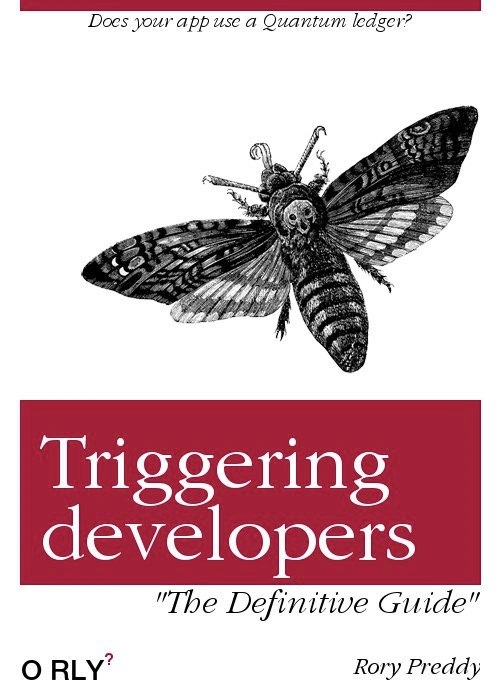
For newer developers, let’s break down what’s going on here. The image mimics a classic O’Reilly tech book cover. O’Reilly Media is a famous publisher known for its programming and technology books – if you’ve ever seen those white covers with a colored band and a detailed animal drawing on the front, that’s an O’Reilly book. They often have titles like “Learning Python” or “JavaScript: The Definitive Guide”. That phrase “The Definitive Guide” is commonly used to mean “the ultimate, most complete guide on a topic”. It’s a bold claim, so using it in a joke title makes the boast sound silly. In the meme, the main title is “Triggering developers” and the subtitle is “The Definitive Guide”. Obviously, no real tech book would be called that – it’s deliberately absurd. The idea of a “definitive guide” to annoying developers sets the stage that this is a satire of tech culture, not a real book.
Now, the question at the very top – “Does your app use a Quantum ledger?” – is poking fun at buzzwords and hype. A buzzword in tech is a trendy term or phrase that everyone suddenly starts using, sometimes without fully understanding it. “Quantum ledger” isn’t a standard term you’ll find in any beginner textbook; it’s basically two buzzwords stuck together. Let’s split it: quantum computing and ledger. Quantum computing refers to a very cutting-edge type of computing that uses principles of quantum physics to perform calculations. It’s a real technology (researchers and big companies are working on it), but it’s super advanced and not something typical apps use – and definitely not something you just plug into a web app casually. The other part, ledger, in tech talk often means a distributed ledger, which is a fancy way to say blockchain or a system like a blockchain where transactions are recorded across many computers. Blockchain was a huge buzzword a few years ago (thanks to Bitcoin and other cryptocurrencies) and people started claiming a blockchain could revolutionize everything, from finance to voting to supply chains.
So, by asking “Does your app use a Quantum ledger?”, the meme is parodying those unrealistic expectations. It’s like asking, “Have you combined two ultra-futuristic, mostly impractical technologies into your project just because they sound cool?” It’s an exaggerated version of what junior devs sometimes hear in the real world. For example, a non-technical manager might ask, “Hey, should we put some AI or blockchain in our product? I heard they’re the future!” If you’re new to the field, questions like that can be confusing or intimidating. You might think, “Wait, should we be doing that? Am I behind on something important?” The meme assures you that feeling lost is okay – often those questions come from hype rather than actual needs. Industry trends can create pressure to adopt every new tool or paradigm (from microservices to machine learning) even when it’s not a good fit. This can lead to a kind of buzzword fatigue among developers, where we get tired of hearing grand promises about “revolutionary” tech that doesn’t live up to the billing. That fatigue is exactly what “Triggering developers” is referencing – these buzzwords trigger a reaction because devs have learned to be skeptical.
Let’s decode some other elements: The bottom-left logo says “O RLY?” which is a playful take on the O’Reilly logo. “O RLY?” is internet slang for “Oh, really?” often used in a sarcastic way when something sounds unbelievable or dumb. There’s even a famous meme of an owl with that phrase. By using “O RLY?” instead of “O’Reilly”, the image immediately signals it’s a parody. It’s basically the meme winking at us, saying “we’re joking here.” On the bottom right, it credits Rory Preddy, who is presumably the person who created this meme (or the jokey “author” of this fake book). Crediting the creator is common in meme culture and also makes it resemble a real book cover (which would list the author’s name).
The black-and-white moth illustration in the middle is part of imitating the O’Reilly style. Real O’Reilly books often have an engraving of an animal that’s tangentially related to the book’s topic (or sometimes just an interesting animal the publisher chose). For example, the book “Programming Perl” famously has a camel on it, and “Learning SQL” has a pig. Here, a moth is used. There isn’t an obvious connection between moths and developers being triggered, so the randomness is likely the joke – it makes it look authentically like an O’Reilly cover because it’s exactly the kind of detailed sketch you’d see on one. It might also be a subtle nod to the term “computer bug” (the first documented computer bug was literally a moth). Even if you don’t catch that historical tidbit, the moth still serves to make the fake cover look convincing at first glance.
Now, why is this funny to developers and what does it say about DeveloperExperience_DX and culture? It’s highlighting a common experience in developer life: getting bombarded by hype. In developer communities (on forums, Twitter, Reddit, etc.), you’ll often see jokes about “buzzword bingo.” Buzzword bingo is a game where people make a bingo card filled with trendy terms (like “AI”, “IoT”, “serverless”, “blockchain”, “quantum computing”, “synergy”, etc.) and then jokingly check them off during a meeting or presentation. If someone hits all the buzzwords, you win bingo – it’s a way to cope with meetings that are full of fluff. This meme basically gives us a buzzword bingo win in one image. By stacking Quantum and ledger (and implying all sorts of other grandiose ideas with the concept of a “definitive guide”), it captures the feeling of “Ugh, not this buzzword nonsense again.” Developers with even a bit of industry exposure quickly learn that there’s always a “hot new thing” being touted. Today it might be Quantum ledgers, yesterday it was something like “crypto AI cloud”. Chasing each hype can be exhausting and often pointless, because many of these trendy ideas don’t pan out or at least don’t apply to most everyday software projects.
So if you’re a junior developer, the takeaway is: don’t panic if you hear crazy terms like “quantum ledger” thrown around. The meme is reassuring you that even veteran developers find a lot of buzzwords laughable. It’s okay to ask, “Does this thing even make sense?” Often, hype is more about marketing and fear of missing out than about real technical improvements. Good developers learn to focus on fundamentals and choose the right tools for the job, not just whatever is currently hyped. In fact, being skeptical of big promises is part of healthy developer experience – it protects you (and your project) from jumping into overcomplicated, unproven tech just because of the buzz. That’s why this parody resonates: it’s a bit of community self-care through humor. The next time someone asks if your app uses a “quantum ledger” or any other buzzword soup, you can grin and remember this meme. It’s basically the developer way of saying, “We see through the hype, and we’re not falling for it (oh really?).”
Level 3: Buzzword Bingo Blackout
This meme nails the industry hype epidemic with a perfect parody of an O’Reilly book cover. To seasoned developers, the combination of Quantum ledger and “The Definitive Guide” sets off all the alarms on our internal BS buzzword detectors. We’ve sat through enough conference keynotes and DevCommunity meetups to recognize when jargon is being stacked like a Jenga tower. The top tagline “Does your app use a Quantum ledger?” sounds exactly like a clueless CTO parroting the latest IndustryTrends_Hype he heard on a podcast. It’s the kind of question that triggers eye-rolls from engineers because it’s basically asking, “Have you tried sprinkling the current hype du jour into our product for no reason?”
The O’Reilly book cover format itself is a brilliant canvas for this satire. In tech circles, O’Reilly Media is famous for publishing definitive programming books, each emblazoned with a meticulously drawn animal on the cover. Here we’ve got a detailed engraving of a moth – a random, slightly ominous creature – smack in the center. O’Reilly covers traditionally feature animals as a quirky identifier (Perl had a camel, Git has a bat, etc.), so the moth both sells the authenticity of the spoof and possibly winks at tech history (the first actual computer “bug” in 1947 was famously a moth 🦋). By choosing a moth, the meme whispers “Oh really, another bug?” to those in the know, poking fun at how each new fad introduces more chaos.
The title “Triggering developers” in huge serif print is the cheeky heart of the joke. It implies that this fake “definitive guide” is all about pushing developers’ buttons by overloading them with trendy lingo. It’s satire, but it rings true: nothing triggers developers quite like a non-engineer excitedly asking if we’ve rebuilt our stable app to use some blockchain quantum AI microservice because everyone says it’s the future. The subtitle “The Definitive Guide” mocks the grandiose claims of tech books and documentation that promise to be the last word on a subject – often a subject that was barely in anyone’s vocabulary six months ago. It’s a dig at our habit of declaring something the ultimate authority on a technology that might itself be a passing fad. Experienced devs have seen “Definitive Guides” come and go, collecting dust once the hype train moves on to the next buzzword. Seeing that phrase slapped under an absurd title is a wink to every senior engineer who’s lived through the full hype cycle from inflated promises to disillusionment.
Let’s talk about “Quantum ledger,” the pièce de résistance of nonsense jargon here. It’s a mash-up of two high-octane buzzwords: quantum computing and distributed ledgers (a fancy term for blockchains). Each of those on its own has been the center of massive hype. Quantum computing promises to solve problems with spooky physics magic, and ledgers like blockchain have been hailed as the solution to everything from finance to food safety. But put together, “Quantum ledger” has no clear meaning – it’s basically Buzzword Mad Libs. It sounds plausibly futuristic to a CEO, but to engineers it’s pure parody. We can practically hear the BuzzwordBingo cards fluttering to the floor. In fact, if you had “quantum”, “ledger”, and maybe “AI” or “serverless” on your bingo card, that single phrase might give you a blackout win. It satirizes how tech marketing loves to pile on fashionable concepts hoping the sheer weight of trendy terms will impress people (while actual developers just groan).
Even the faux publisher mark “O RLY?” in the bottom corner is loaded with irony. It’s styled exactly like the O’Reilly logo, but instead it spells the meme-ish phrase “Oh, really?” – the classic internet owl meme and a perfect expression of skepticism. It’s like the book cover itself is side-eyeing the title: “Oh REALLY? Triggering developers with a Quantum ledger, you say? Sure, Jan.” This clever detail confirms the whole thing is a joke and aligns with the IndustrySatire tone. It’s poking fun at how easily some folks slap authoritative branding on absurd ideas. The inclusion of an author name, Rory Preddy, adds to the realism of the fake cover (and gives credit to the creator of the meme). The author’s real-sounding name next to something so ridiculous underscores the contrast between serious presentation and silly content – a hallmark of good parody.
In the DevCommunity, this meme hits a nerve because it reflects real fatigue. Developers have been inundated with buzzword saturation for years – today it’s Quantum Ledgers, yesterday it was Microservices on the Blockchain, before that it was Big Data in the Cloud, and on and on. Each time, management or the media pushes the idea that if you’re not using XYZ new tech, you’re falling behind. That pressure trickles down and affects DeveloperExperience_DX: engineers feel forced to rewrite perfectly fine systems or learn half-baked frameworks just to check the buzzword box. The result? Frustration, late nights, and haunted Git repos full of abandoned “innovations”. So when seasoned devs see a tongue-in-cheek “definitive guide” to the latest fad, it’s both hilarious and cathartic. It’s a meme saying what we wish we could say in sprint planning: “Can we not chase every shiny new concept, please?”
Ultimately, this parody book cover is funny because it’s painfully true. It uses the gravitas of an O’Reilly manual – something we usually trust to teach us hardcore tech – to instead call out the absurdity of gratuitous hype. It’s the perfect bait-and-switch: authoritative design, ridiculous content. Every element, from the moth illustration to the “O RLY?” logo, reinforces the joke that our industry sometimes takes itself far too seriously with these trends. The meme resonates with developers who have felt “triggered” by buzzword-laden meetings and blog posts. It’s a satirical mirror, reflecting the IndustryIrony that the louder something is marketed as “the future of development” with grandiose guides and claims, the more experienced devs suspect they’re being sold snake oil.
Description
This image is a parody of an O'Reilly technical book cover, a format instantly recognizable to most software developers. It features the title 'Triggering developers' and the subtitle '"The Definitive Guide"'. Instead of 'O'REILLY', the publisher is cleverly altered to 'O RLY?'. The cover has a white background with a red banner for the title, and features a detailed black and white illustration of a Death's-head hawkmoth, consistent with O'Reilly's animal-themed covers. Above the moth is an example of a triggering question: 'Does your app use a Quantum ledger?'. The humor comes from its satirical take on the annoying and often nonsensical questions developers receive from non-technical stakeholders who mix up buzzwords. 'Quantum ledger' is a meaningless combination of two hyped technologies (Quantum Computing and Blockchain), perfectly capturing the essence of a question designed to frustrate any experienced engineer

Comments
12Comment deleted
My project manager asked if our microservices were synergistic with the quantum blockchain AI. I told him yes, but only after we refactor the mainframe to be serverless
“Sure, let’s strap a quantum ledger onto the monolith - then our data can be both strongly and eventually consistent… right up until someone opens Grafana and collapses the waveform.”
The only thing more terrifying than explaining CAP theorem to a PM who just discovered 'quantum ledgers' is realizing your distributed system already exhibits quantum properties - it's simultaneously working and broken until someone observes the monitoring dashboard
Nothing triggers a senior architect quite like 'Does your app use a Quantum ledger?' - the perfect intersection of two overhyped technologies that solve problems you definitely don't have. It's the enterprise equivalent of asking if your todo list needs Byzantine fault tolerance and superposition states. The moth illustration is particularly apt: just as Grace Hopper's moth was the original bug, using quantum ledgers for conventional CRUD apps is the modern debugging nightmare - except this time, the bug is in the architecture decision document, and it's going to haunt your on-call rotation for years
“Quantum ledger” is vendor-speak for “blockchain, but centralized” - an audit trail that’s somehow both immutable and GDPR-compliant… until Legal observes it
Quantum ledger? Mine's entangled: immutable until the investor meeting, then fully rewritten
We tried a quantum ledger - turns out it’s just QLDB; the only thing in superposition is the requirements until a stakeholder observes the demo and they collapse into “ship yesterday,” immutably recorded in Jira
Lol Comment deleted
Lol Comment deleted
Triggered Comment deleted
Would buy Comment deleted
oo look it’s the African death's-head hawkmoth in the pic Comment deleted