Python's Rise: From C's Protégé to Dominant Predator
Why is this Languages meme funny?
Level 1: The Cub Bites Back
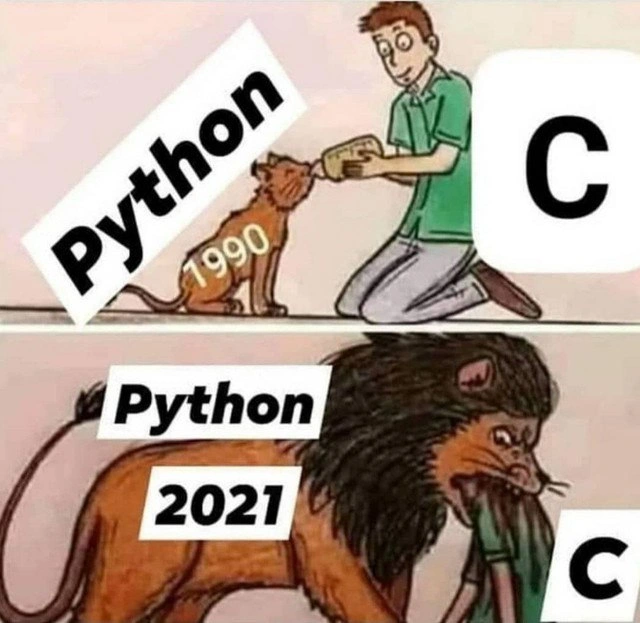
Imagine you have a tiny baby lion cub as a pet. In the first scene, the cub is small and cute, and a friendly zookeeper (wearing a shirt with a big “C” on it) is feeding it with a bottle. The cub isn’t threatening at all – it needs help to grow. Now fast-forward many years. In the second scene, that cub has grown into a huge, strong lion with a big mane. And guess what? The lion has playfully pounced on the same zookeeper who used to feed it! It’s biting his leg (not too gently). This is funny because usually we expect the caretaker to be in control, but here the pet has become so powerful that it turns the tables.
This is like a story of a little newcomer becoming the big boss over time. In our meme, the names Python and C on the picture are actually the names of two programming languages (just like English and Spanish are languages for people, Python and C are languages for computers). Back around 1990, Python was new and small, and C was the big important language teaching it tricks. By 2021, Python had grown huge in popularity – it became so widely used and powerful that it kind of “bosses around” C now. The funny picture with the lion cub and lion makes it easy to see: the little one you cared for can grow up to surprise you! It’s like if a student grows up to outperform the teacher, or if a kid becomes taller and stronger than the parent and starts play-wrestling them. The meme makes us smile because we don’t usually think of a snake named Python turning into a lion – but here it means Python the language became the king and gave its older teacher (C) a big, unexpected chomp.
Level 2: From Cub to King
Let’s break down the scene for those newer to the programming safari. In the top panel (set in 1990), we see a small lion cub labeled “Python” with the year 1990 next to it. A man in a green shirt labeled with a big “C” is gently feeding the cub. This represents how Python, a programming language created in the early 90s, started off small and was supported by C, an older and very powerful programming language (first developed in the 1970s but hugely popular by 1990). The metaphor of feeding suggests that C was helping Python grow. In real life, this is true in a technical sense: the main implementation of Python (called CPython) is written in C, and many Python modules (especially early on) used C code for the heavy lifting. So, C literally gave Python a lot of its functionality and performance in those days. Back then, C was like the experienced mentor or the dominant force in programming – if you were coding in 1990, you’d likely use C (or its object-oriented cousin C++) for serious projects, and Python would seem like a tiny new “scripting language” used for lightweight tasks.
Now look at the bottom panel (labeled 2021): the cute cub has become a huge, dark-maned lion labeled “Python 2021,” and it’s aggressively biting the man labeled C. The roles flipped! This illustrates that by 2021, Python had grown up to be one of the most dominant programming languages, while C’s relative influence (at least in buzz and widespread use) had been overshadowed. When we talk about a language “dominating,” we mean Python became extremely popular and widely used across the industry. Surveys, pop culture in coding, and job postings around 2021 showed Python at the top or near the top in popularity, whereas C was less in the limelight (though still important behind the scenes). For example, many beginners learn Python first nowadays (often in school or coding bootcamps) because it’s easy to read and write. Python code looks like plain English in many ways and you don’t have to deal with nitty-gritty details like manually managing memory. C, on the other hand, is lower-level: writing C involves handling things like memory allocation and pointers (which is powerful but also easier to make mistakes). In short, Python is high-level and user-friendly, while C is closer to the machine and requires more expertise to use effectively.
Because computers have gotten incredibly faster and have tons of memory compared to the 90s, using a slower but easier language like Python often makes sense for many tasks in 2021. Developers can whip up programs quickly in Python – whether it’s a small automation script, a web server using Django/Flask, or a data analysis using libraries like pandas – and it “just works” without worrying about the hardware details. Back in 1990, if you tried to do heavy tasks with a language as slow as Python, it might have been impractically slow on the computers of the day. So, people stuck to C (or C++, etc.) for speed. But by 2021, Python’s speed (or lack thereof) is less of a deal-breaker for many projects because modern computers are so fast and because Python has optimized C/C++ libraries for the really heavy lifting (like crunching numbers in numpy, which is written in C). This is one reason Python usage exploded – you get the productivity and simplicity benefits without worrying as much about performance, at least for a huge range of applications.
The meme’s joke is essentially an example of language_popularity_trend: Python vs C over time. It’s showing Python’s growth in a dramatic, funny way. In 1990, Python was like the little kid or trainee being helped by the expert (C). By 2021, that trainee became the champion and even “attacks” the former champ. Think of it as the classic story of the underdog becoming the top dog. The labels “Python 1990” and “Python 2021” make it clear we’re comparing the same entity (Python) at two points in time. The lion imagery is borrowed from a common meme format (raising a lion cub then the grown lion turning on the owner) to symbolize dominance. Python is depicted as a lion because lions are often called “king of the jungle,” implying Python became the king of programming languages (at least in popularity). And poor C in the second panel is getting chomped – meaning C’s pride is hurt as it loses its top position. This doesn’t mean C is gone; it’s a humorous exaggeration. In reality, programmers still use C a lot (for system kernels, embedded systems, high-performance tools, etc.). But Python has stolen a lot of the spotlight, community mindshare, and beginner interest. The meme tickles tech folks because it captures a real feeling: those who’ve been around see Python everywhere now, doing things C used to do, and they recognize how tables have turned.
For a junior developer or someone new to coding, the takeaway is: Python and C are two programming languages with very different histories and roles. Python started small in the early ’90s but became extremely popular by the 2020s, whereas C was a giant early on and remains important but not as “trendy” today. The humor comes from personifying these languages as animals and people – Python as a growing lion and C as the person who raised it – to show how a newcomer can rise to overtook an old champion. It’s a bit like seeing a student outgrow and surpass their teacher. In tech, this kind of story happens when a new technology (here Python) becomes easier or more suitable for many tasks than the older one (C), leading to a big shift in what people choose to use. That’s the essence of the joke: the once small Python now dominates, giving the older C a run for its money (and maybe a bite on the leg!).
Level 3: King of the Code Jungle
In 1990, the programming world was a very different jungle. The C language reigned supreme – a lean, low-level C carnivore powering operating systems, databases, and the hottest new apps on your IBM or Sun workstation. Meanwhile, a newcomer called Python was just a tiny cub finding its footing. Created by Guido van Rossum around 1989 and released in 1991, Python was then a niche scripting language, often dismissed by serious system programmers as a cute toy for automating trivial tasks. It was as if the mighty C was kneeling down to bottle-feed this little orange cub, not sensing any real threat. In the first panel of the meme, the man with C on his shirt represents the dominant C language “nurturing” Python’s early growth (quite literally handing it sustenance). This is more than just metaphor – the primary Python interpreter (CPython) is actually written in C, and many of Python’s early libraries wrapped C/C++ code. In other words, C fed Python in its infancy by giving it a runtime and performance boosts under the hood.
Fast-forward to 2021, and the second panel shows a dramatic role reversal: that once-tiny cub has grown into a full-maned lion, and it’s mauling its old caretaker. This captures a real industry trend – by 2021, Python had become the giant predator in the programming ecosystem, often ranking at the top of language popularity indexes (even overtaking C on the famed TIOBE index and others around that time). Python went from an underdog to the “king of the developer jungle,” fueled by explosive growth in fields like web development, data science, machine learning, and automation. Its gentle learning curve and powerful high-level features lured in newcomers and seasoned devs alike. Companies hyped it up for quick prototyping and diverse use cases – the IndustryTrends_Hype was real. The meme’s darkly comedic violence (Python the lion biting down on C) reflects how thoroughly Python has dominated mindshare: in many domains where C used to be the default choice, Python now roars. Experienced engineers chuckle (or grimace) at this panel because they’ve lived this shift. They remember when knowing C (or at least C++ from the CFamilyLanguages) was the hallmark of a serious programmer. But over the decades, they watched Python’s rise — first as a handy glue language, then as the go-to for everything from devops scripts to AI research.
There’s also an implied commentary on LanguageEvolution and the food-chain of programming. Higher-level languages like Python often stand on the shoulders of lower-level languages like C. But once they mature, they can overshadow their predecessors in usage and visibility. This is akin to a software ecosystem cycle: each new generation of language is fed by the old (through interoperability and borrowing concepts), grows stronger thanks to faster hardware and broader adoption, and eventually might push the old-timer out of the spotlight. Seasoned devs might jokingly call this “the predator becomes prey” scenario. Indeed, C enabled Python’s birth, but now finds itself pushed aside in many areas by the very thing it nurtured. It’s a classic case of LanguageWars irony – similar to how C itself once displaced assembly language as the default, now Python has come to steal the crown.
Make no mistake, the meme is exaggerating for humor – C isn’t actually extinct or “dead” (even today it’s irreplaceable for systems programming, embedded devices, and high-performance components). But the image of Python 2021 biting down on C captures how it feels for many old-school programmers to see job postings, tutorials, and developer surveys now dominated by Python. It’s the “lion’s share” of attention going to a language that was once an adorable curiosity. Many experienced devs can’t help but smirk: who would have thought that the little pet snake we fed in the ’90s would grow a mane and turn into this bossy beast? The humor lands because it’s both absurd and true – an entire generation witnessed Python’s transformation from cub to king, and this meme condenses that 30-year saga into one savage sight gag.
Description
A two-panel comic illustrating the evolution of the Python programming language in relation to C. In the top panel, dated '1990', a cartoon person labeled 'C' is shown kneeling and tenderly bottle-feeding a small lion cub, which is labeled 'Python'. This represents the early days of Python, which was implemented in and heavily dependent on the C language. In the bottom panel, dated '2021', the scene has dramatically changed. A massive, ferocious, fully-grown male lion, also labeled 'Python', is now carrying the person 'C' in its mouth, seemingly having overpowered them. This visual metaphor humorously depicts Python's explosive growth in popularity and capability over three decades. It has evolved from a relatively small 'scripting' language that relied on C for performance into a dominant force in the software industry, particularly in fields like AI, data science, and web development, arguably surpassing C in widespread use and demand

Comments
21Comment deleted
It's ironic that C gave Python the bottle, considering C still forces you to manage all your own garbage. Python just learned to automate the cleanup after its meals
1990: “Let’s just wrap the C with a tiny Python script.” 2021: That “tiny script” pip-installs half the internet, calls C through ctypes, and C is now the legacy module nobody’s brave enough to refactor
Remember when we used to joke about Python being 'slow'? Now it's consuming 80% of our GPU clusters for ML training while C developers are still arguing about whether to use malloc or calloc. The real plot twist is that the lion is probably just a wrapper around highly optimized C libraries anyway
This meme perfectly captures the Cambrian explosion of Python's ecosystem - from a humble scripting language that played nice with C extensions in the '90s to the apex predator of 2021 that's consumed entire domains: data science, ML, automation, and even systems programming via PyPy and Cython. The irony? Python still needs C under the hood for performance-critical paths (NumPy, TensorFlow), making this less a hostile takeover and more of a 'I am the captain now' moment where Python's ergonomics and batteries-included philosophy won the developer mindshare war, relegating C to the embedded systems and kernel development reservation. The real kicker: most Python devs have never written a C extension, yet they're standing on the shoulders of giants who did
Python started lapping up C milk; now it's the apex predator turning every C extension into a segfault safari
Python became the lion by outsourcing the sprinting to C while the GIL held the leash
CPython didn’t beat C; it turned C into an implementation detail and ate the hiring market
Nah Comment deleted
Нет Comment deleted
How? They are two different beasts. Comment deleted
Тем временем C: Comment deleted
But python was introduced in 1991 Comment deleted
the 1.0 version appeared in 1991, yes, but it was in development since the 80s Comment deleted
no, this retarded meme is here too Comment deleted
+ Comment deleted
Nah, giant tortiose would be more truthy Comment deleted
Теперь я понимаю, почему робоняня с катушек слетела... У Пина указатель был не на то место Comment deleted
English, please По-английски говорить в этом чате надо Comment deleted
please only speak English in here, or provide a translation alongside your message Comment deleted
no problem Now I get why robotic nan from kikoriki gone crazy... Pin've got a pointer pointing to a wrong place Comment deleted
Nah Comment deleted