Semicolon-Zoned by a Python Developer
Why is this Languages meme funny?
Level 1: The Compliment That Didn't Translate
A man tells a woman she's like the period at the end of his sentences — meaning "I literally can't function without you." Her comeback: "I write in a language that doesn't use periods." It's like telling someone "you're the key to my house" and hearing "my house has no locks" — the compliment isn't just rejected, it's made irrelevant, which stings far more. Her huge laugh in the photo sells it: she's not offended, she's delighted with herself, because she found the one technically-correct loophole that dissolves his entire romantic line. It's the nerd version of a mic drop — done entirely with punctuation.
Level 2: What a Semicolon Actually Does
In most C-family languages, the semicolon tells the computer "this instruction is complete" — like a period at the end of a sentence:
// Java: every statement must end with ;
int x = 5;
System.out.println(x); // delete a ; and the build fails
# Python: the end of the line IS the end of the statement
x = 5
print(x) # no semicolon needed
y = 1; z = 2 # legal, but style guides frown at it
This is the difference between a statement terminator (mandatory punctuation, as in Java/C/C++) and a statement separator that's only needed when you put multiple statements on one line (Python's situation). Python instead uses significant whitespace — indentation defines code blocks, where other languages use { }. Every developer who switches between the two families knows the muscle-memory comedy here: Python programmers reflexively typing semicolons for a week, Java programmers getting IndentationError and feeling personally judged. The meme's joke depends on exactly this portability gap — a compliment that compiles cleanly in one language throws an exception in another. Early career tip hiding inside the gag: metaphors, like code, have target environments. Check which interpreter your audience is running before you ship.
Level 3: Rejection as a Syntax Error
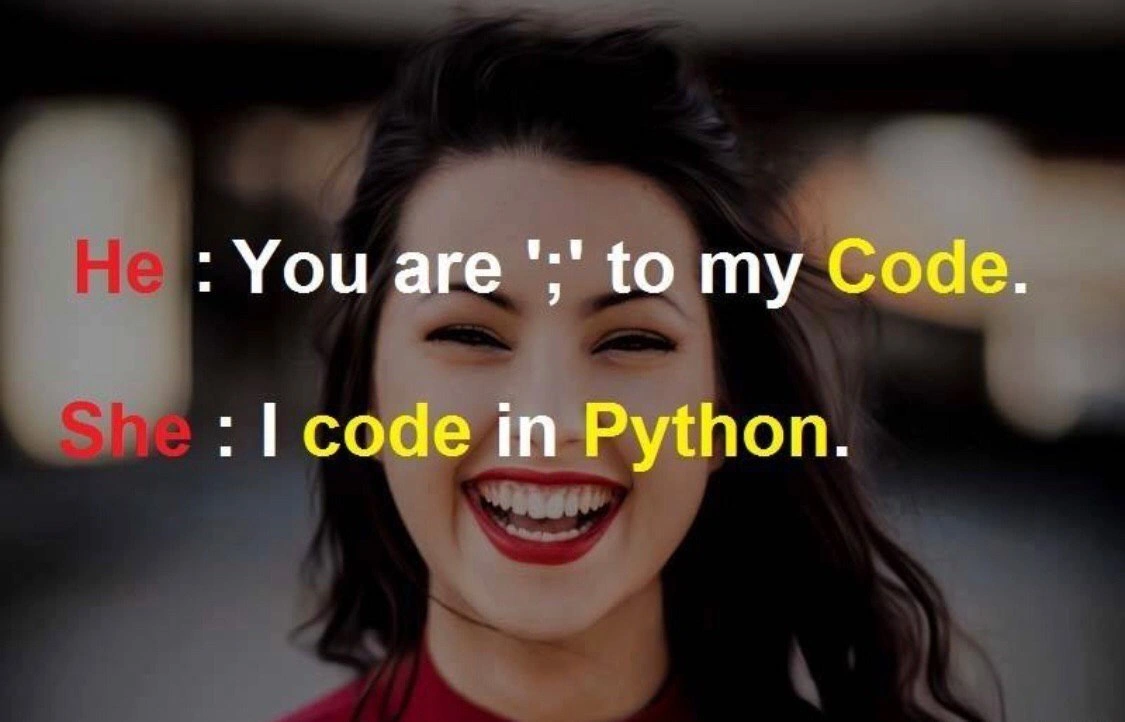
The pickup line is structurally sound — for the wrong grammar. Over a photo of a woman laughing (the perfect reaction shot for what she's about to do), the exchange runs:
He: You are ';' to my Code. She: I code in Python.
His metaphor depends on the semicolon being essential: in C, C++, Java, and their descendants, ; is the statement terminator, the token the parser requires to know a statement has ended. Omit one and the compiler responds with the most famous error message in programming education — frequently pointing at the wrong line, just to build character. So "you are the semicolon to my code" translates to without you, nothing I do compiles. Genuinely sweet, by compiler standards.
Her reply is a one-line dependency audit. Python's grammar is newline-delimited: the end of a line ends the statement, and indentation does the structural work braces and semicolons do elsewhere. Semicolons exist in Python — they're legal for cramming statements onto one line — but they're optional, and idiomatic style (the kind enforced by every linter and the community's style orthodoxy) treats them as a smell. Which upgrades her response from "no" to something far colder: the thing you claim to be is, in my world, permitted but unnecessary, and using you would get flagged in review. He pitched himself as critical infrastructure; she reclassified him as dead syntax.
The deeper layer seniors enjoy is that this is the language wars compressed into a romance format. The C-family worldview says explicit terminators are safety — the code means what the punctuation says, whitespace be damned. The Python worldview says the terminators were always ceremony — humans already end statements with newlines, so why type the ritual character? Forty years of flame wars about syntax philosophy, and this meme settles it the way these things are actually settled in practice: not by argument, but by someone saying "that's not how it works where I live." JavaScript developers, meanwhile, read this meme in cold sweat from the corner, where semicolons are optional but with traps — automatic semicolon insertion being the proof that trying to please both worldviews creates a third, scarier one.
Description
The image features a stock photo of a woman with dark hair, smiling broadly at the camera. Overlaid on this photo is a short, two-line dialogue presented as a meme. The first line reads, 'He : You are ';' to my Code.', with 'He' in red text and 'Code' in yellow. The second line is the reply, 'She : I code in Python.', with 'She' in red and 'Python' in yellow. The humor stems from a fundamental difference in programming language syntax. In many languages like C++, Java, and JavaScript, the semicolon (;) is a crucial piece of syntax used to terminate a statement. The line 'You are ';' to my Code' is a nerdy pickup line implying 'You complete me.' However, Python uses newlines to delimit statements, making semicolons optional and generally unnecessary. Her response is a witty rejection, effectively saying, 'You are not needed,' or 'I am complete without you.' This joke resonates with any developer who has worked across these different language families
Comments
8Comment deleted
He tried to be her statement terminator, but she had already moved on to asynchronous code and didn't need him to resolve her promises
He: “You’re my code.” She: “Perfect - now I’ll comment on every awkward dependency, mark half your lines as tech-debt, and still get paged when a junior deletes the block in prod.”
This is like trying to impress someone with your deep knowledge of CORBA patterns when they've been shipping serverless functions since 2016
He called her essential punctuation; she declared him optional syntax in her runtime. Cleanest deprecation notice ever shipped
The real power move here isn't just knowing Python doesn't need semicolons - it's the implicit assertion that she's moved beyond the syntactic noise of C-family languages to embrace Python's philosophy of readability and simplicity. It's the programming equivalent of responding to 'You complete me' with 'I'm already self-contained and don't require external dependencies.' Classic Pythonic confidence: why terminate statements explicitly when significant whitespace and clean syntax already make your intentions crystal clear?
“You’re my code.” “Then treat me like prod: no force pushes, no hotfixes, and zero changes after 5pm.”
Rule of thumb in reviews: if 95% of the diff is identifier renames and the remaining 5% preserves my off-by-one, that’s not a refactor - it’s a fork of my mistakes
He offered a hard terminator; she preferred soft indents - syntax mismatch at first commit