Skip to content
DevMeme
111 of 7435
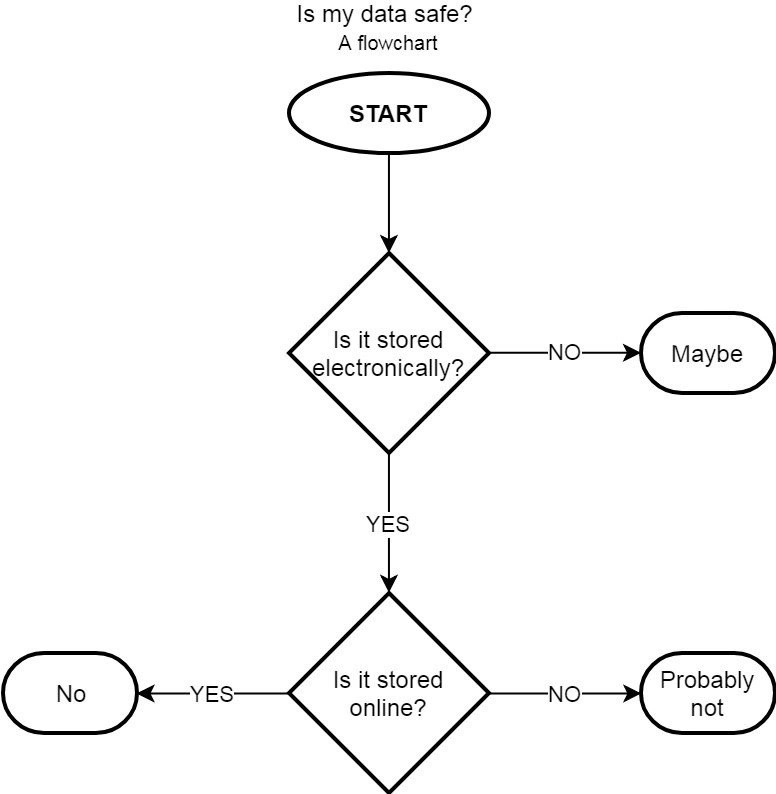
Data Safety Flowchart for the Digital Age
Security Post #143, on Feb 17, 2019 in TG

Data Safety Flowchart for the Digital Age

Why is this Security meme funny?

Level 1: The Game You Can't Win

Imagine a board game where every path on the board — every single one — ends at a square that says "you lose" or "you probably lose." That's this chart. Someone asks a hopeful question, "is my stuff safe?", and the chart answers like a brutally honest fortune teller: if your secrets are on a computer connected to the internet, no; on a computer not connected, probably not; not on a computer at all... maybe. The joke is in what's missing — there's no "yes" anywhere, like a menu with no food on it. It's the kind of laugh you do with a sigh, because deep down everyone suspects the chart is right.

Level 2: Reading the Diamonds

A flowchart is the classic diagram for decisions: ovals mark start/end points, diamonds hold yes/no questions, and arrows trace every possible path — programmers love them because they map directly onto if/else logic:

def is_my_data_safe(electronic: bool, online: bool) -> str:
    if not electronic:
        return "Maybe"
    if online:
        return "No"
    return "Probably not"
    # note what this function can never return: "Yes"

The two questions carve the world into real security tiers. "Stored electronically" separates paper records from digital ones — digital data can be copied perfectly, instantly, and invisibly, which is what makes it both useful and risky. "Stored online" asks whether the data is reachable over a network: anything connected to the internet can, in principle, be attacked by anyone on Earth, at any hour, for free. That's why the offline branch (an air-gapped system — physically disconnected from networks) rates "probably not" instead of "no": attackers need physical access, which raises the cost enormously. Early in your career, this chart is worth internalizing before your first data breach post-mortem: assume anything you store will eventually be read by someone you didn't intend, and design accordingly — encrypt it, limit who can touch it, and don't hoard data you don't need.

Level 3: A Decision Tree With No Happy Path

The genius of "Is my data safe? A flowchart" is structural: it's a perfectly formed decision diagram — START oval, two clean decision diamonds, properly labeled edges — whose terminal states are Maybe, Probably not, and No. There is no node labeled Yes. The chart's formalism promises an answer, and the formalism itself delivers the punchline: in the entire reachable state space of your data's existence, safety is not a terminal state.

Walk the branches like a security veteran would. Is it stored electronically? → NO → Maybe: even paper isn't safe — it burns, floods, gets photographed, and walks out of offices in briefcases, hence the hedging. Electronically but offline?Probably not: this is the air gap, security's gold standard, and the "probably" is earned. Air-gapped systems have been famously jumped — by infected USB sticks (the vector behind some of history's most notorious industrial malware), by insiders, by the simple entropy of someone eventually plugging the thing into the network "just for a minute." And stored online? → a flat, unhedged No. Not "it depends on your configuration." Just no.

That flat No is where seasoned engineers nod grimly, because it encodes the industry's actual track record rather than its marketing. Breach disclosure has become background radiation: credit bureaus, hotel chains, social networks, password managers — entities with nine-figure security budgets — have all leaked at scale. The recurring causes are rarely exotic cryptanalysis; they're misconfigured storage buckets left world-readable, credentials committed to public repos, unpatched appliances, phished employees, and supply-chain compromises where the attacker poisons a dependency you trusted. The professional response to this reality isn't despair, it's a shift in threat modeling: stop asking "is it safe?" (a category error, as the chart demonstrates) and start asking "safe from whom, for how long, and what happens when it leaks?" That's why mature practice obsesses over defense in depth, breach detection, encryption at rest, and minimizing what you collect in the first place — the only data that's truly safe is the data you never stored. The flowchart's deadpan security nihilism is funny precisely because it's the compressed, honest version of every risk-assessment meeting you've ever sat through.

Description

A simple flowchart diagram with a white background and black text and shapes, titled 'Is my data safe? A flowchart'. The chart begins with an oval 'START' node. The first decision diamond asks, 'Is it stored electronically?'. The 'NO' path leads to a rounded rectangle labeled 'Maybe', suggesting uncertainty even for physical data. The 'YES' path leads to a second decision diamond that asks, 'Is it stored online?'. The 'NO' path from this diamond points to a rounded rectangle labeled 'Probably not', indicating that offline electronic storage is still insecure. The 'YES' path, for data stored online, points ominously to a final rounded rectangle simply labeled 'No'. The humor lies in its cynical and absolutist take on data security, implying that any data stored electronically, especially online, is inherently unsafe. This resonates with senior engineers who understand the vast and complex attack surfaces of modern systems, making true data safety an almost unattainable ideal

Comments

8
Anonymous ★ Top Pick This flowchart is missing the final step for data stored online: an arrow pointing from 'No' to a box that says 'And it's now part of a training set for an AI you'll have to debug later.'
  1. Anonymous ★ Top Pick

    This flowchart is missing the final step for data stored online: an arrow pointing from 'No' to a box that says 'And it's now part of a training set for an AI you'll have to debug later.'

  2. Anonymous

    For the next SOC 2 audit I’m just submitting this flowchart - if they want a “Yes” branch they can budget for a quantum-proof, air-gapped papyrus cluster

  3. Anonymous

    The only difference between "Probably not" and "No" is whether the attacker needs physical access or just a bored teenager with Shodan

  4. Anonymous

    The flowchart is missing one branch: 'Is it in a backup?' - YES leads to 'No, but at least there are two copies for the attackers.'

  5. Anonymous

    This flowchart perfectly captures the modern security engineer's worldview: if your data exists in any digital form, it's not a question of *if* it will be compromised, but *when*. The only truly safe data is the data that was never created - or perhaps etched on stone tablets and buried in a Faraday cage at the bottom of the Mariana Trench. Even then, someone will probably find a zero-day exploit for erosion

  6. Anonymous

    Enterprise threat model in one diagram: unless it’s air-gapped and in a locked filing cabinet, assume ‘No’ - every other path is one IAM policy typo away from public

  7. Anonymous

    Salt mines beat S3 buckets every time - until the intern's USB washes up on the beach

  8. Anonymous

    Data safety flowchart: electronic → there’s a forgotten S3 bucket; online → start drafting the breach notice; offline → someone will email a photo of it anyway

Use J and K for navigation