The Python Femboy Pipeline
Why is this DevCommunities meme funny?
Level 1: Magic Book Makeover
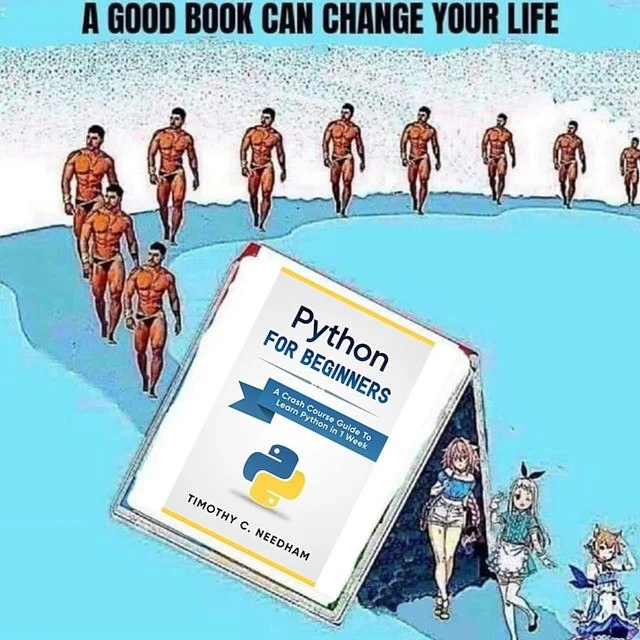
Imagine there’s a magic book that can totally change you when you go through it. In this picture, a bunch of very strong guys walk through a giant book and come out on the other side as cute cartoon girls. 😮 It’s like if a tough weightlifter read a magical story and suddenly turned into a bubbly anime character! This is funny because normally, reading a book might teach you something new, but it’s not going to completely swap your personality or appearance. The meme is using a silly, make-believe idea to show how learning something new (here it’s a coding language called Python) can feel like it makes you a whole new person. It’s exaggerating that feeling in a playful way. Even though in real life you won’t sprout pink hair and a frilly outfit just from studying, you might come out of a great book or lesson feeling totally transformed and excited. The picture makes us laugh because it takes that feeling and turns it into a cartoon: a true magic book makeover!
Level 2: New Language, New You
At its heart, this meme is about how learning a programming language – in this case, Python – can dramatically change how you see yourself as a coder. It falls under the categories of Learning and Languages because it’s literally about the learning process of a new coding language and the personal transformation that comes with it. The top caption sets the stage: “A GOOD BOOK CAN CHANGE YOUR LIFE.” We often hear that phrase about inspirational novels or self-help books. Here, it’s humorously applied to a programming book. The implication is that reading a really good Python beginner book could completely alter your “programming persona” (basically, your identity and style as a developer).
In the image, a bunch of super muscular men are walking into a gigantic book titled “Python FOR BEGINNERS: A Crash Course Guide To Learn Python In 1 Week.” These buff guys represent the “before” state. You can imagine this as you (or any developer) before diving into Python – maybe you were working in another language or just starting out, feeling pretty tough and confident with what you know. The men are literally walking through the pages of the book, which is depicted like a tunnel or gateway. On the other side of this tunnel, they come out as pastel-colored anime girls. It’s a very exaggerated, cartoonish way to say: “After you go through this Python book, you’ll come out completely different.” The transformation is drawn from an internet joke format where characters change appearance (often into anime style) after a magical experience – here the magic is learning Python! The contrast is intentionally absurd to make us laugh: big burly dudes turn into cute animated girls. That’s not something you expect, right? But that shock value drives home the meme’s point about the great change.
So why specifically Python, and why do people joke that it changes you? Python is one of the most popular programming languages for beginners and experts alike. It’s known for having a gentle learning curve, meaning it’s relatively easy to pick up compared to languages like C++ or Java. For example, to print “Hello, world” in Python, you just write: print("Hello, world!"). No need to set up a class or worry about a main function or data types for a simple task. Python code often reads like plain English, and you can do a lot with it without needing to understand the deep inner workings of the computer. This ease-of-use is empowering for someone new. You get results fast, which is super encouraging. Many folks on their LearningToCodeJourney start with Python and feel like, “Wow, I’m actually coding and it’s not as scary as I thought!” That excitement can indeed change how you view yourself – you go from “I don’t know if I can code” to “Hey, I’m a programmer now!” in a short time. The meme encapsulates that by showing a literal persona swap after reading a “Crash Course” book. (Side note: Realistically, you won’t master Python in one week – but a week is enough to grasp fundamentals and definitely enough to make you feel like you’ve unlocked a new superpower.)
Let’s talk about the anime girl part, since that’s a funny choice. In online developer communities (and tech circles in general), you’ll often find people using anime avatars, sharing anime GIFs, or making jokes with anime references. It’s a quirky part of internet culture that overlaps with programming culture, especially on forums, Discord groups, and meme pages. By showing the men turn into anime-style characters, the meme is saying that learning Python not only changes what tools you use, but also sort of welcomes you into a different subculture. Think of it like joining a club. Before, you were in the “tough coder” club – perhaps focused on low-level programming, dealing with lots of technical complexity. After learning Python, maybe you join the “Pythonistas” club. The Python community often emphasizes being friendly and inclusive. People share fun projects (like making games, doing art with code, or simple robotics) and often use a more lighthearted tone. So the anime girls can be seen as a symbol of a more playful, creative identity that a new Python coder might adopt. It’s a huge visual contrast to the muscle men, which makes it funny and memorable. It’s basically saying: Python will make you soft and lovable (in a good way)! – obviously exaggerated for comedic effect.
Now, in practical terms, how does a “programming persona” change when you learn Python? For one, your toolset changes. Suppose earlier you were using a language like Java – you’d compile your code, you’d worry about types and boilerplate (lots of extra code to do simple things). After Python, you’re probably writing and running code in an interactive way. You might use the Python REPL (read-eval-print loop where you type code and see results immediately) or a Jupyter Notebook, which lets you mix code and output and notes – great for exploration and play. Instead of spending a lot of time setting up infrastructure, you quickly write scripts. Let’s say you used to write 10 lines to open a file and read data in another language; in Python, you can do it in 2 lines with a with open(...) as f: block. You also gain access to libraries galore. Python has libraries for almost everything: want to make a website? Use Django or Flask. Want to analyze data? Import Pandas or NumPy. Interested in machine learning? There’s TensorFlow or Scikit-learn. A new Python learner often goes, “Whoa, there’s a library for that?!” and suddenly starts using these powerful tools to do things that would have been daunting to code from scratch. This can absolutely change your outlook – you start approaching problems thinking “I bet there’s a Python module that already does this” instead of “I have to build everything myself.” It’s a shift from a lower-level, DIY mindset to a higher-level, assemble-and-glue mindset. Neither is inherently better in all cases, but for someone new, the latter feels like having an army of helpers at your side. No wonder the meme suggests you come out the other end with a whole new vibe!
Let’s not forget the learning aspect itself. The title says "Python FOR BEGINNERS" and “A Crash Course Guide to Learn Python in 1 Week.” Crash courses are designed to give newbies a quick ramp-up. They often have you build small projects, like a simple game or a basic web app, to demonstrate how much you can do with what you just learned. Finishing such a book can be exhilarating. One day you didn’t know how to code, a few days later you’ve written a little program that, say, organizes your photo collection or rolls dice for a game. It really can make you feel like a new person. The meme exaggerates it to the point of a magical physical transformation, but symbolically it’s true: you have new abilities and a new confidence. In developer humor, it’s common to represent that change with an over-the-top metaphor – hence the muscular_men_to_anime_girls scenario. It’s much funnier and more eye-catching than just saying “I felt different after I learned Python.”
Also, notice how the book in the image is portrayed almost like a tunnel or portal (the water is parted around it, creating a path). This suggests that the book is a gateway to a new world. Walking through a book is a whimsical idea – it’s like those fantasy stories where stepping into a painting or through a wardrobe takes you to another land (think Narnia, but for programmers!). Here that new land is the land of Python programming. And indeed, once you step into Python, you discover a whole ecosystem and community: PyCon conferences, Stack Overflow questions tagged with python, subreddits and forums full of Python enthusiasts, and so on. It can feel like you’ve entered a vibrant, different place in the tech universe. The meme is essentially celebrating that entrance with a big, dramatic ta-da!
In simpler terms: this meme jokes that learning Python can give you a complete makeover as a developer. It’s a playful exaggeration meant to resonate with anyone who has gone through a big learning leap. If you’re a junior developer or just learning to code, the meme might also be a cheeky way of saying “come to the Python side, we have cookies… and maybe anime avatars!” It uses the language of internet culture to say something sincere: that acquiring new knowledge (especially something as empowering as programming) changes you. And in the coding world, Python is often that first love that changes everything. So, new language, new you – you won’t literally become an anime character, of course, but you might start feeling like a hero in your own coding story after that first good book. And that’s both funny and kind of heartwarming in a geeky way!
Level 3: Statically Buff, Dynamically Cute
This meme paints an absurdly vivid picture of how learning Python can utterly transform a developer’s identity. We see a line of hyper-muscular, shirtless men marching into a giant “Python FOR BEGINNERS” book. The book lies open like a tunnel, even parting the waters around it (a cheeky nod to Moses parting the Red Sea). And on the other side of this mystical crash course? The brawny dudes emerge as pastel-colored anime girls. It’s a comical metamorphosis – as if a hardcore systems engineer walked into a Python tutorial and walked out saying “uwu” and building TensorFlow models with a pink-themed IDE. Experienced devs can’t help but smirk: the image exaggerates a truth we recognize. Each programming language has its own culture and mindset, and switching to a new one – especially one as high-level and beginner-friendly as Python – can feel like stepping into a whole new world. The giant book here is literally the gateway to that world, portrayed almost as a holy text splitting the sea of code and leading you to the promised land of Pythonic bliss.
Let’s unpack why this language_learning_transformation is so exaggerated yet relatable. The muscular men on the left can be seen as a developer’s “before” state – perhaps an old-school C++ or Java programmer or just one’s past self before Python. In that state, you’re dealing with heavy syntax and strict rules. Think of curly braces, semicolons, manual memory management, rigid type systems – doing all that low-level heavy lifting can make a coder “buff” in the sense of being tough and detail-oriented. You pride yourself on understanding complex things like pointer arithmetic or byte-level optimizations. It’s a serious, no-nonsense persona: the kind of programmer who talks about big-O notation over coffee and isn’t afraid to wrestle the machine for performance.
Now enter Python, the friendly snake (and yes, the book’s cover prominently shows the familiar blue-and-yellow Python logo 🐍). The book’s subtitle promises “A Crash Course Guide To Learn Python in 1 Week” (authored by Timothy C. Needham). Any seasoned developer reading that claim will chuckle – we all know you won’t become a software guru in a week. But we also remember that heady feeling when a new language clicks. In just a short time, you can go from struggling to write a loop to effortlessly automating tasks. One intense week with Python might not make you an expert, but it will supercharge your confidence. It’s that honeymoon phase of learning – everything seems possible and magical. The meme visualizes this by having our buff coder literally change form after passing through the book. It’s a python_beginner_book_meme taken to the extreme: the idea that a good tutorial can do more than teach you syntax – it can change your life (or at least your coding style). The top caption “A GOOD BOOK CAN CHANGE YOUR LIFE” hammers this home, taking a common inspirational saying and applying it to the coder’s journey. Here it’s played out with tongue firmly in cheek: the life-changing book turns Avengers-style macho men into sparkly anime protagonists.
For veteran developers, the humor also lies in how much Python can shift one’s approach to programming. Python is a high-level, interpreted language with dynamic typing. In plainer terms: it handles a lot of the heavy lifting for you, so you can focus on solving problems rather than on the minutiae of the machine. Switching to Python from a lower-level language is liberating, almost like discovering a shortcut or cheat code. Suddenly, tasks that once required a page of code and careful planning become a one-liner you can write on the fly. For example, a C++ veteran might be used to writing a loop to square numbers in an array. After picking up Python, they realize they can do the same job in one clean line:
// Before learning Python: squaring a list of numbers in C++ (the "buff" way)
std::vector<int> numbers = {1, 2, 3, 4, 5};
std::vector<int> squares;
for (int x : numbers) {
squares.push_back(x * x);
}
# After learning Python: squaring a list using a Pythonic list comprehension
numbers = [1, 2, 3, 4, 5]
squares = [x * x for x in numbers]
For someone accustomed to the C/C++ style, that Python one-liner feels almost magical. It’s not that Python invented mathematics, of course – it’s that the language provides concise, readable constructs (like list comprehensions) to express your intent without all the scaffolding. In Python, you don’t need to manually manage an index or a vector’s size; the language abstracts it away. A senior engineer seeing this will nod knowingly: Yep, that’s the Python effect. It parts the sea of boilerplate and lets you stride across to the solution. After a few wins like this, even a previously skeptical, “hardcore” programmer might start grinning like a kid with a new toy. Suddenly their mindset shifts from “How do I wrestle this machine into doing what I want?” to “Wow, the language just lets me do it!”. No wonder our meme characters come out the other side looking whimsical – they’ve discovered a fun new way to code.
Another aspect here is the culture shock (or culture embrace) that comes with Python. The transformation into anime girls is a playful nod to how one’s persona and community engagement can change. Python’s community is huge and welcoming. It’s the lingua franca of beginner coders, data scientists, makers, and hobbyists automating their home scripts. When you dive in, you inevitably get exposed to the in-jokes, the memes, the DeveloperHumor that permeates forums and social media. For instance, you learn that Python is named after Monty Python (the 1970s British comedy troupe), not the snake – so suddenly you’re catching references in tutorials to spam and eggs or the Ministry of Silly Walks. You discover the playful side of documentation (like the import this Easter egg printing the Zen of Python, or the antigravity module that opens an XKCD comic in your browser). In short, you go in a stoic coder, and you come out a bit more lighthearted, maybe even quirky. The meme uses anime characters to embody that newfound whimsy. It’s as if the developers have joined an online Python community where a lot of members have anime avatars, share meme references, or just generally express themselves more colorfully. The once “muscle code” macho might now pepper their speech with words like “Pythonic”, get excited about a new Django release, or use a cute snake emoji when chatting about code. They’ve gone from a bare-metal mindset to a more abstract, expressive one – from command-line soldier to Pythonic magical girl, metaphorically speaking.
From a senior perspective, there’s also an affectionate poke at the learning curve and the overconfidence that a crash course can instill. We’ve all seen the newbie who reads “Learn X in 24 Hours” and then tweets like they’ve ascended to guru status. Here, walking through the book and instantly becoming an anime heroine satirizes that sudden self-reinvention. But it’s not mean-spirited – more a shared joke. We all have that origin story: the first technology or language that made us feel powerful. Maybe it was writing your first BASIC program, or mastering pointer arithmetic in C, or in this case, spinning up a Python script that does something useful. In that moment, you do feel changed. Your toolbox has a fantastic new addition, and you start seeing problems through a new lens. The meme just cranks that feeling up to 11 for comedic effect. The anime_transformation_meme format (muscular_men_to_anime_girls) is a perfect dramatization: it’s visually so over-the-top that it captures the emotional truth of the experience while being obviously cartoonish. We laugh because, yeah, reading a Python book won’t literally change your gender or turn you into a kawaii cartoon — but it might change the way you write code, the communities you hang out in, and the jokes you laugh at.
In summary, the senior dev in me appreciates how this meme layers multiple inside jokes: the miraculous parting-book gateway, the one-week crash course hype, the shift from low-level grind to high-level ease, and the cultural leap into anime/meme territory. It’s poking fun at the LearningToCodeJourney we’ve all been through. As exaggerated as it is, there’s a grain of truth: learning a language like Python can indeed be a chrysalis of code – you emerge with new powers and a new perspective. Of course, real transformation is a gradual process, not an instant anime makeover. But by cramming that journey into one outrageous image, the meme perfectly captures the giddy wonder and personality shift that a “good book” (or any great learning experience) can spark in a developer’s life. It’s an ode to the Python learning curve, celebrated with equal parts sarcasm and genuine enthusiasm.
Description
A meme with the heading "A GOOD BOOK CAN CHANGE YOUR LIFE". It depicts a book titled "Python FOR BEGINNERS" acting as a dividing line in the sea. On one side, a line of muscular men in speedos are walking, while on the other side, a group of anime "femboys" are walking. The visual joke implies that reading a beginner's Python book will transform a stereotypically masculine man into a femboy, a popular and ironic trope within some online developer communities. This meme satirizes the stereotypes and subcultures that form around specific programming languages, suggesting that learning Python leads to adopting a particular aesthetic and online persona
Comments
7Comment deleted
Some say Python is a gateway drug to functional programming; apparently, it's also a gateway to a whole different kind of character build
15 years wrangling cache lines and template metaprogramming; one “Python for Beginners” crash course later and we’re pastel anime avatars arguing asyncio semantics in a Jupyter notebook
After 20 years in tech, I've learned that 'Python for Beginners' books don't create 10x engineers - they create developers who spend 10x longer debating whether to use list comprehensions or map() while their TypeScript colleagues have already shipped three microservices and deprecated two of them
Ah yes, the classic 'Python for Beginners' fork in the road - where one path leads to microservices architecture discussions and the other to arguing about which anime IDE theme has the best syntax highlighting. Both groups will eventually converge at the same Stack Overflow thread at 3 AM, though they'll never admit it
Beware 'Python for Beginners' - the on‑ramp has negative friction; one quick script later, you own the ETL and the ML notebook running in prod
Python mastery in 1 week? That's like claiming you've tamed the GIL - looks ripped on the cover, but it'll hang you in prod
Python for Beginners: learn it in a week, spend five years explaining virtualenvs, dependency pinning, and why your CPU‑bound pipeline is still single‑threaded (hi, GIL) while you quietly rewrite the hot path in Rust