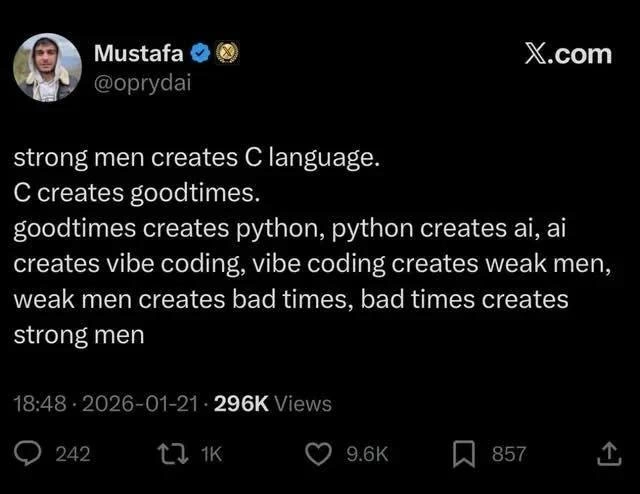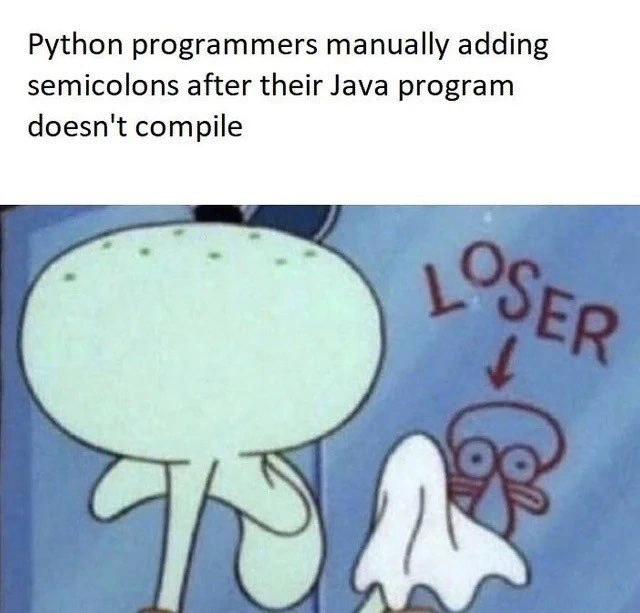
Python Devs Debugging Java
Why is this Languages meme funny?
Level 1: New Game, New Rules
Imagine you’re really good at one game, like say checkers, and in that game the rules are very familiar to you. Now you go to play chess for the first time, which looks a bit similar (it’s a board with squares and pieces), but the rules for how the pieces move are different. You might accidentally try to move a chess piece the way you move one in checkers, and the instructor or your opponent would stop you and say, “Nope, that’s not allowed in this game.” You’d probably feel a bit embarrassed for forgetting the new rule.
That’s like what’s happening in this meme. The programmer is used to the Python way of doing things, where you don’t need a special little character at the end of each line of code. That’s the first game (like checkers) with its own rules. Now the programmer has to play by Java rules (the second game, like chess), where there is a special rule: every statement must end with a semicolon – which is kind of like a period at the end of a sentence. He writes his code without those semicolons (because in his old habit you just hit Enter to go to a new line, no punctuation needed). The Java compiler is like the chess rulebook saying “Hold on, you broke a rule – you forgot a semicolon!” It’s as if the teacher said your sentence is incomplete because you forgot the period. Realizing the mistake, the programmer gets flustered and starts adding semicolons everywhere, a bit like a student quickly putting periods at the end of every line of an essay after discovering they left them out. In the SpongeBob picture, the cartoon character is looking in the mirror seeing the word “LOSER” pointing at him. In simple terms, that’s how the programmer feels – he’s calling himself silly or a loser for not remembering such a small rule.
Now, of course, he’s not really a loser; he just made an honest mistake in a new situation. It’s like forgetting to say “Thank you” in a place where it’s expected, and then feeling bad about it. The humor comes from the fact that he overreacted a little – instead of calmly adding the one or two missing semicolons in the right spots, he’s frantically putting them after every line, kind of like a panicked student dotting every sentence, even ones that already had periods, just to be sure. To someone watching, that overreaction is funny because we know he’ll sort it out with a bit of patience.
So, in everyday terms: the meme is showing a person who switched to a new set of rules and fumbled a bit. We laugh because we recognize that feeling of “Oops, I forgot the rule, let me fix it!” Everyone makes mistakes when they try something new, even grown-up programmers. The blue squid character from SpongeBob (Squidward) is used to dramatically show how the programmer feels looking at his mistake — a little ashamed and frustrated. But just like learning any new game or language, with a bit of practice he’ll get it right. In the meantime, he might just need a friendly pat on the back (or a hug) to say, “Hey, it’s okay, you’ll remember the semicolon next time!”
Level 2: Mind the Semicolon
Let’s break down what’s happening in simpler terms. This joke is about the differences in syntax rules between the Python and Java programming languages, and how a developer might get confused switching from one to the other. In Python, you normally do not put a semicolon at the end of each line of code. For example, in Python you can write:
# Python code (no semicolons needed at end of lines)
name = "Alice"
print("Hello, " + name)
This is perfectly fine in Python. Each line is understood to be a complete statement because Python treats the line break (the newline) as the end of the statement. Python also uses indentation (spaces or tabs at the start of a line) to group code into blocks (like inside an if or a loop) instead of curly braces { }. So Python’s style feels a bit like writing plain English or pseudocode – very minimal punctuation. It’s one reason Python is praised for being readable and simple.
Now compare that to Java. In Java, the syntax comes from older languages like C, and it requires certain punctuation. Every statement in Java must end with a semicolon. It’s like saying to the compiler “this line is done, move to the next.” If you omit a semicolon in Java, the code will not compile at all. For instance:
// Java code example (with a missing semicolon)
public class HelloWorld {
public static void main(String[] args) {
System.out.println("Hello, " + "Alice") // Oops, missing semicolon at end of this line
System.out.println("Welcome to Java!");
}
}
If a Java programmer tries to compile the above code (using the javac compiler), it will throw an error and refuse to create the program. The error might look like this:
HelloWorld.java:3: error: ';' expected
System.out.println("Hello, " + "Alice")
^
This message is the compiler complaining that it reached the end of the line and was expecting a semicolon there. The ^ symbol points to where the issue was detected (after the closing parenthesis). When the compiler says "';' expected", it’s a strong hint that you forgot a semicolon somewhere before that point. In this case, it’s right at the end of the System.out.println(...) line. Until you fix that by adding the missing ;, the Java program simply won’t compile (meaning you can’t run it yet because the build failed). “Doesn’t compile” is just a programmer’s way of saying the code has errors and the compiler couldn’t turn it into an executable form.
So why is this particularly about a Python programmer? Well, a developer who primarily writes Python might not be used to thinking about these little ; symbols at all. It’s easy to forget to add one when you switch to writing Java code, because your brain’s on “Python mode” where hitting Enter is enough to end a statement. The meme jokes that when the Java program didn’t compile, the Python dev’s reaction was to manually go back and start adding semicolons at the end of every line, hoping that will placate the angry Java compiler. The phrase “frantically sprinkle semicolons” paints a funny image of someone just tossing ; characters into their code left and right in desperation. It’s an exaggeration, of course, but it captures that panicky troubleshooting feeling.
Let’s talk about the image and why it says “LOSER”. The image is from SpongeBob SquarePants, a famous cartoon. The character shown is Squidward Tentacles, who in this scene is looking at a mirror. On the mirror, written in red, is the word “LOSER” with an arrow pointing down at his reflection. In the context of the meme, the Python dev is being compared to Squidward in that moment of self-realization. It humorously suggests that the programmer feels like a “loser” when they see their Java code failing to compile and realize it might be due to something as small as missing semicolons they didn’t even know to include. It’s a bit of self-deprecating humor. The developer isn’t actually a loser, of course — learning a new language’s quirks can make anyone feel clumsy at first. But that dramatic self-critique is meant to be relatable and funny. Many of us have sat there, staring at an error, and felt a bit dumb for not immediately spotting what’s wrong.
The categories here are about Languages and Bugs/Debugging. This falls right into both: it’s language-specific syntax causing what is essentially a bug (a compile error is a bug in your code you have to fix). It also touches on LanguageGotchas or LanguageQuirks – those little things that can trip you up when moving between programming languages. For example, forgetting a semicolon in Java is a classic gotcha for someone coming from a semicolon-free language like Python. Another example of a language quirk might be how Python uses and/or vs. other languages using &&/|| for logical AND/OR, or how whitespace is significant in Python but not in Java. These differences mean you have to adjust your habits when you switch languages.
To a junior developer or someone new to coding, here’s the plain situation: Python and Java have different rules for writing code. If you write Python-style code in Java, it will break because Java’s compiler is expecting things (like ;) that Python doesn’t use. The meme is a funny exaggeration of a Python coder trying to fix a Java program by adding lots of missing semicolons because the error messages made it sound like semicolons were the issue. It highlights a common form of DebuggingFrustration: when you don’t fully understand an error, you might try a bunch of quick guesses to fix it. Sometimes beginners literally do add a bunch of semicolons everywhere if the compiler complains, or they add extra parentheses or other syntax blindly until the error changes or goes away. It’s a trial-and-error approach to troubleshooting. Of course, the better approach (which we learn with experience) is to read the error carefully, pinpoint the exact spot, and only add a semicolon where it’s truly needed. But in the heat of the moment, especially if you’re new to compiled languages, it’s easy to panic.
Also, consider the mindset shift required: Python is an interpreted language (you run it directly, and it will point out an error in code when it hits one), whereas Java is compiled (it checks the whole program and demands it to be 100% correct syntax-wise before it will run anything). That means a Python dev might not be used to seeing a bunch of errors upfront. In Python, if you make a small mistake, you often find out by running the code and seeing a traceback or error at a certain line. In Java, you find out by compiling and the compiler listing all the problems it found in your code (which can be many if you, say, forgot a semicolon on multiple lines or missed a curly brace). It can feel a bit overwhelming at first – almost like the machine is yelling at you for every little thing. That’s why the meme’s Python programmer is portrayed as overwhelmed and just slapping semicolons on every line to make the red error lines go away.
In summary, the meme uses a SpongeBob gag to portray a confused developer (a typically semicolon-free Python user) dealing with a strict Java compilation error. The key tags like Python, Java, CompilerErrors, and SyntaxErrors all point to this exact scenario. It’s programming humor that resonates with anyone who’s had to learn the hard way that different languages have different “grammar rules”. The Python dev will eventually learn that only certain places need those semicolons, and that the Java compiler isn’t just trolling them – it’s actually being helpful by preventing bad code from running. But at the moment captured by the meme, that poor dev is having a rough time and probably facepalming at the mirror, feeling inadequate. The community response (“This guy needs some hugs 🤗”) shows fellow developers empathize deeply — we’ve all felt that sting, and we know that with a bit of encouragement (and perhaps a friendly Java mentor), this Python programmer will be back on their feet, semicolons and all.
Level 3: Compile-Time Culture Shock
For seasoned developers, this meme evokes a very familiar scenario: context-switching friction. The Python developer in question is experiencing a classic culture shock moving into Java’s world. In Python, you hit Run and deal with issues as they come (perhaps a SyntaxError if you made a typo, but often you can run parts of the code interactively). In Java, you must first appease the compiler, which acts like a strict gatekeeper preventing your program from running until everything is perfectly in order. The humor arises from the Python dev’s panicked reaction: “It doesn’t compile... must be missing a semicolon somewhere!” This is a tongue-in-cheek reference to a common newbie (and sometimes not-so-newbie) reflex in C/C++/Java: when a compile error isn’t immediately understood, blame a missing semicolon or brace. It’s practically a reflex born from experience that one misplaced { or forgotten ; can indeed break the build. Here, the Python-first dev doesn’t have years of Java muscle memory, so their knee-jerk debug tactic is to sprinkle semicolons everywhere in the code like a frantic chef adding salt to a dish that “tastes off,” hoping it will magically fix the problem.
This frantic semicolon peppering is a form of cargo-cult debugging: doing something that you’ve heard often fixes things (adding a ;) without fully understanding the underlying problem. Compiler errors in Java can sometimes be misleading to the uninitiated — for example, a missing curly brace earlier in the file might cause the compiler to spit out “; expected” at a later line because it got confused about where a statement should end. A Python dev, unfamiliar with such cascades, might literally take the error at face value and start inserting semicolons at the ends of lines that were actually fine. It’s the programming equivalent of pushing a door that says “pull” and then pushing on every panel in sight in a panic. Experienced Java developers chuckle because they’ve seen this exact brand of debugging frustration (or lived it). Many can recall their early days switching from a forgiving script language to Java or C++ and feeling utterly humbled by the compiler’s strictness. The LanguageGotchas are real: switch the environment and suddenly all your instincts betray you. Forget to terminate a statement in Java, and the compiler’s harsh red text calls you out. Use Python-style syntax in Java (like not ending lines, or using a colon after an if-statement out of habit), and you’ll be met with a wall of errors. Conversely, Java devs stepping into Python have their own comedy of errors (writing ; at ends of lines in Python, which thankfully doesn’t break anything, or bracing everything only to find Python cares about indentation instead).
The SpongeBob reference amplifies the humor for those in on the joke. We have Squidward Tentacles, a character known for his cranky, prideful demeanor, looking dejectedly at the word “LOSER” scrawled on the mirror with an arrow pointing right at him. In our context, Squidward is the Python developer persona, realizing his reflection (the code he wrote) isn’t living up to Java’s expectations. The “LOSER” tag is an exaggerated representation of the developer’s imposter syndrome or embarrassment. It’s that moment we’ve all had when a trivial mistake makes us feel ridiculously incompetent. You can almost hear the internal monologue: “I can’t believe I’m struggling with something as basic as a semicolon! I must look like such a loser right now.” Of course, in reality, they’re not a loser; they’re just new to Java’s LanguageQuirks, but the emotion is real and thus comically relatable. The meme echoes a shared sentiment: everyone has been Squidward at some point, staring at a baffling error message, doubting their skills over something small.
From an industry perspective, this also pokes fun at the minor LanguageWars that developers engage in. Python aficionados often joke about Java’s verbosity (all those public static void main ceremonies, braces and semicolons everywhere). Java folks might rib Python for being too loosey-goosey with types and structure. Here, switching camps leads to a small humiliation. It’s a friendly reminder that each language has its own learning curve and pitfalls. Seasoned engineers know that when debugging, you have to read the error message carefully and understand why the compiler is unhappy. The meme’s poor Python dev instead applies a brute-force fix: add ; everywhere. It’s funny because it’s a massive overcompensation. It’s like seeing someone furiously hitting the compile button after each semicolon insertion, as if swatting flies, with the compiler still complaining, and the developer’s frustration mounting. We laugh because we’ve been in those shoes and also because, from the outside, the situation is absurd – Java isn’t “angry about every line,” just one specific spot, but in a panic the distinction gets lost.
In essence, the meme hits on debugging panic and syntax-induced self-doubt. It’s an ode to the humbling experience of being a beginner again in a different tech stack. Any senior dev who’s done on-call or tried to quickly patch code in an unfamiliar language at 3 AM can identify with that “just make it compile!” desperation. The difference here is it’s a Python dev in broad daylight discovering that their usual laissez-faire newline endings won’t satisfy Java’s strict compiler rules. The caption text itself (“Python programmers manually adding semicolons after their Java program doesn’t compile”) reads like the setup to a comedy sketch and pairs perfectly with Squidward’s defeated posture. It’s both a gentle roast of Python devs’ habits and a self-deprecating admission by polyglot programmers that, yes, we’ve all done something this goofy under pressure. If you’ve ever had a compile error and “fixed” it by randomly changing things – adding a parenthesis here, a semicolon there – until the error vanished, you’ll likely cringe-smile at this meme. And if you haven’t... well, as the saying goes, “there are two kinds of programmers: those who have panicked over a missing semicolon, and those who will.” 😉
Level 4: Semicolon Wars
At the deepest technical level, this meme highlights a clash of programming language syntax paradigms. Java and Python represent two different schools of language design: one relies on explicit statement terminators (like semicolons ; and braces {}), while the other uses the off-side rule (indentation and newlines) to structure code. In Java’s formal grammar (influenced by C and ALGOL), every statement is expected to end with a semicolon token. In BNF-like pseudocode, you could imagine a rule such as Statement ::= Expression ";" – the semicolon is a non-negotiable syntax element. The compiler’s parser dutifully marches through the source code, tokenizing and matching patterns; when it doesn’t find a ; where one should be, it throws a syntax error. Python, by contrast, was designed with readability in mind and follows a different grammar strategy: newline characters and indentation signal the end of a statement or block. Instead of curly braces and semicolons, Python uses the indentation level to determine code grouping, an idea known as the off-side rule (first seen in languages like ABC and Haskell). In Python’s grammar, a line break effectively plays the role of the statement terminator, so no explicit ; is required at the end of each line (though Python will tolerate semicolons if you put them – they’re treated as optional separators when you want multiple statements on one line).
This fundamental syntactic difference means that a Python programmer stepping into Java is entering a more rigid context-free grammar domain where the compiler won’t let them get away with the slightest deviation. The humor here taps into that theoretical backdrop: a developer used to one grammar (where line breaks suffice) is scrambling to satisfy another grammar that screams for a ;. It’s almost like a linguist suddenly faced with a language where every sentence must end in a specific punctuation mark to be considered valid. Under the hood, the Java compiler’s parsing algorithm (likely an LL or LR parser) is encountering an unexpected end-of-line and flags it as an error, often specifically stating something like “; expected”. Compilers are pedantic—much like a strict grammar teacher—because they have to be unambiguous in understanding your code. One missing semicolon can cascade into a chain of parse errors as the compiler struggles to recover; this is why older C/C++ devs remember that a lone missing ; could generate pages of confusing errors. Modern compilers try to pinpoint the issue, but the message "missing semicolon" is practically a rite of passage in languages like Java, C, or JavaScript.
On a theoretical note, this contrast also reflects differences in language philosophy. Python’s design emphasizes minimal ceremony and uses dynamic typing and runtime interpretation (though it does compile to bytecode) – its errors tend to be runtime exceptions or immediate syntax errors for things like bad indentation. Java, being statically typed and compiled to bytecode ahead of time, enforces correctness upfront at compile time, catching issues before the program can run. That compile step can feel unforgiving to someone used to the quick edit-run feedback loop of an interpreted language. There’s a bit of a cognitive science angle here too: the programmer’s mental model and muscle memory are conditioned by Python’s syntax rules, which don’t map one-to-one to Java’s rules. The resulting confusion is not just a trivial mistake but an illustration of how our brains form syntax expectations. In essence, the meme offers a lighthearted peek into cross-language interference – a concept akin to switching between spoken languages and accidentally applying grammar from one to the other. The “Semicolon Wars” have been a long-running saga in programming culture: debates over whether we need them or not, languages dropping or adding them, and the personal wars developers fight when moving between these worlds. Here we see a foot-soldier (the Python dev) caught on the wrong side of the battle, frantically peppering ; everywhere like syntax appeasements to the Java gods. It’s a comedic illustration of how a single tiny character, the semicolon, embodies deep design decisions in compilers and language theory, and how ignoring those decisions (or being ignorant of them) leads to compile-time chaos.
Description
A two-panel meme roasting developers who switch between programming languages. The top panel has black text on a white background that reads, 'Python programmers manually adding semicolons after their Java program doesn't compile'. The bottom panel features a still from the 'SpongeBob SquarePants' cartoon, where the character Squidward Tentacles is looking at a crude wall drawing of himself. Above the drawing, the word 'LOSER' is written in red, with an arrow pointing down at the caricature. The joke centers on the syntax differences between Python, which doesn't require semicolons to terminate lines, and Java, which does. It humorously depicts a Python developer's rookie mistake when trying to write Java, implying that forgetting semicolons is a basic error and resorting to adding them manually as a 'fix' is a sign of inexperience or desperation, hence the 'loser' label

Comments
22Comment deleted
The fastest way to spot a Python dev on a Java project is to check the commit history for 'forgot semicolon,' followed by 'added semicolon,' then 'removed semicolon from print statement.'
javac: “’;’ expected.” Me, a decade of PEP 8 muscle memory: global search-replace for semicolons - knowing deep down the real bug is the uncclosed “>” three generics up
After 15 years in the industry, the most humbling experience isn't debugging a race condition in production or explaining CAP theorem to executives - it's watching your IDE light up like a Christmas tree because your Python-trained muscle memory forgot that Java still parties like it's 1995 with mandatory semicolons
This perfectly captures the cognitive dissonance when context-switching between languages with different syntactic philosophies. The real irony? A Python developer adding semicolons to Java code that won't compile is like trying to fix a NullPointerException by adding more whitespace - technically valid in the source language, but addressing a symptom rather than the actual compilation failure. The meme brilliantly satirizes how muscle memory and language idioms can lead even experienced polyglot developers to apply solutions from one paradigm to problems in another, when the actual issue is likely missing imports, type mismatches, or structural errors that the Java compiler is actually complaining about
Watching a Python dev fix javac by sprinkling semicolons is cargo‑cult debugging; the compiler’s mad about class name ≠ filename, invariant generics, and Maven’s transitive roulette - punctuation isn’t a design pattern
Python dev vs Java compiler: semicolons applied, braces ignored - classic polyglot stall-out
Pro tip: if javac says expected ';' and your fix is to carpet‑bomb the file with semicolons, you're just writing a Python‑to‑Java transpiler that emits empty statements - wait until the type checker surfaces the other 84 errors
Python? More like popo, amirite Comment deleted
java programmers when they're only getting legacy codebase maintaining jobs Comment deleted
That's c++. "Oh boy, can't wait to use those nifty c++20 ranges at my new job" Comment deleted
C++ is still widely used though. Comment deleted
especially in competitive programming Comment deleted
that I don't know, but definitely in games Comment deleted
Those are usually programming tasks, like on codewars or hackerrank Comment deleted
me, a beginner, using java in competitive programming :/ Comment deleted
Do you use FastScanner for inputting data? Comment deleted
no, this guy needs some semicolons Comment deleted
Orrr... he could use kotlin Comment deleted
or haskell Comment deleted
or brainfuck Comment deleted
That would kill him as a programmer Comment deleted
Python and semicolon jokes? Again? Comment deleted