The Four Stages of Writing 0.5 in Code
Why is this Languages meme funny?
Level 1: Half a Pizza
Imagine you and your friends are sharing a pizza. One friend is very straightforward – they say, “Let’s split this pizza in half,” and they simply cut it into two equal parts. That’s like writing 0.5 in code: clear and direct, you get half the pizza. Another friend is a bit geeky and says, “I’ll take 0.5 of the pizza.” It sounds a little technical (who talks about 0.5 of a pizza?), but everyone understands they mean half as well. Then there’s a third friend who’s just being quirky: they say, “I’ll take .5 of the pizza,” dropping the 0. It’s the same half a pizza – this friend is just trying to sound cool or save a tiny bit of breath, and you might chuckle because it’s an odd way to say it. Now the fourth friend decides to be really strange and humorous. They hold up a sign that says “YES” (as in “yes, we have a whole pizza”). Then they literally cut that “YES” sign into two pieces and say, “Here you go, that’s my share – I took ‘yes’ and divided it by 2!” This is totally goofy – everyone knows they still just mean half the pizza, but they chose the most confusing way to express it. It’s funny because the end result is the same (each friend gets half a pizza), but that last friend’s method makes you laugh and shake your head. They used something true (“yes, we have one pizza”) and split it to symbolize one-half. It’s as if someone went out of their way to make a simple idea complicated, just to show off or get a laugh. And that’s exactly why the meme is humorous – it’s poking fun at how a simple half can be expressed in increasingly odd and “clever” ways, even though in the end, half is just half!
Level 2: One Half, Many Ways
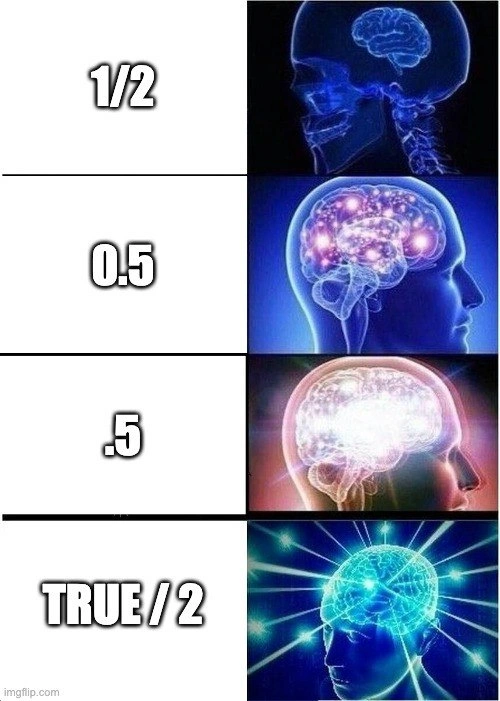
At this level, let’s break down what each panel’s text means in plain coding terms. The meme shows four ways to represent one-half (0.5) in code, each a bit different in how a computer interprets it.
1/2– This looks like the fraction one-half, and indeed it is, but in many programming languages if you write it just like that, the computer might think you’re doing integer division. Integers are whole numbers (no decimal point), so if you divide 1 by 2 as integers, the computer will give you the whole number part of the answer. 1 divided by 2 is 0.5 mathematically, but the whole number part is 0 (since 0.5 has no whole units, it’s less than 1). So1/2in a language like C, C++, Java, or older Python (Python 2) would result in0. It’s essentially throwing away the “.5” because those languages, seeing two integers, assume you also want an integer result. This often surprises new programmers. It’s like asking a calculator that only knows whole numbers, “what is 1 divided by 2?” – it will round down to 0. So in the meme’s first panel,1/2represents a naive or not fully correct way (in many contexts) to get 0.5.0.5– This is a floating-point literal for one-half. A floating-point number (or “float”) is a number that can have a fractional part (decimals). Writing0.5explicitly tells the computer this is a decimal value. Nearly every language will understand0.5as half exactly. So unlike1/2, this will produce a result of 0.5 (assuming the code prints or uses it in a floating-point context). The second panel’s0.5is the straightforward, no-confusion way to represent half in code. The brain in the meme is brighter here, implying this is a more enlightened approach than the first – it avoids the mistake of integer division by directly using a decimal. If you’re a new programmer, one key lesson is: when you want a fraction like 1/2, make sure you’re using floats or doubles (decimals), not just integers. Writing0.5is a clear way to do that..5– This is essentially the same as 0.5, just written without the leading zero. Some programming languages allow you to omit the 0 and just start with “.5” to mean the same thing. For example, in JavaScript,.5will be understood as 0.5, and in C or C++ as well. In Python, however,.5by itself would actually cause a syntax error – Python expects a digit before the decimal point, so you’d need to write0.5. So whether you can do this depends on the language’s syntax rules. When allowed,.5is just a shorter way to type 0.5. It might be used by some developers as a tiny shortcut or out of personal style. The meme is joking that someone who writes.5is feeling even more powerful or clever – the glowing brain suggests they’ve taken that extra step in knowledge. From a learning perspective: there’s nothing mathematically different between 0.5 and .5 – they both are the same numeric value of one-half. Just remember some languages require the zero for clarity. So the third panel is basically “look, no leading zero, I know what I’m doing!” It’s a minor syntactic trick that isn’t particularly significant, but it shows you how code can sometimes be written in multiple ways to mean the same thing.TRUE / 2– Now this one looks odd!TRUEis a boolean value (meaning it represents truthfulness: true or false). Normally, we use booleans in logical conditions, likeifstatements, not in math. However, in many languages, a booleanTRUEcan act like the number 1 andFALSEacts like 0 when you put them in a numeric context. This is a form of type coercion, where the language automatically converts one type into another to make an expression work. So ifTRUEis treated as 1, thenTRUE / 2is effectively1 / 2. And as we discussed, if the language then does this division in floating-point mode (or later converts the result to a float), you get 0.5. For instance, in Python you can actually do:
result = True / 2
print(result) # This will output 0.5, because True is treated as 1
Here, Python sees True (note: Python’s boolean is capitalized True/False) and knows internally that True is the same as 1 for arithmetic. It then divides 1 by 2. In Python 3, the division operator / always gives a float result, so 1/2 becomes 0.5. In a language like JavaScript, if you write true / 2, JavaScript will convert true to 1 as well (because it’s trying to do a numeric operation) and get 0.5. The meme’s final panel is using this quirky fact to represent one-half in the strangest way: dividing truth by 2. It’s like a little inside joke about language quirks – something you wouldn’t typically do in real code, but it’s funny to know it’s possible. It shows how far you can stretch the idea of “one-half” in code by involving a completely different concept (a boolean) and relying on the computer to bend it into a number.
So, stepping back: the meme goes from a normal fraction (1/2), to an explicit decimal (0.5), to a stylistic decimal with no zero (.5), to a wacky use of a boolean (TRUE/2). Each step relies on a deeper understanding of how computers interpret these symbols. The humor comes from the fact that the last method is technically correct in some situations, but it’s also amusingly convoluted. This is classic coding humor: playing with the flexibility (and oddities) of programming languages. If you’re newer to coding, the takeaway lessons hiding in the joke are: be careful with integer vs. float division (1/2 vs 0.5 matters!), and know that booleans can sometimes act like numbers (True being 1, False being 0) but using them that way will definitely surprise people who read your code!
Level 3: Half-Truth Hackery
This meme humorously escalates the ways a coder might represent “one-half” in code, each step ostensibly showing a more enlightened (or rather, more galaxy-brain 🤯) approach. The first panel with 1/2 is the simplest expression of a half — but any seasoned developer will smirk here, recalling how such a seemingly straightforward fraction can hide a pitfall. In many languages, writing 1/2 literally performs an integer division: you ask the computer to divide one by two using whole numbers. The result? It evaluates to 0 (since one divided by two is 0 with a remainder in integer math). Many of us learned this the hard way: that initial “small brain” panel evokes junior devs scratching their heads when 1/2 in C or Java results in zero, not the 0.5 they wanted. It’s the classic rookie mistake in CS fundamentals – forgetting to use a floating-point type for a fractional result. The meme implies that using 1/2 to represent 0.5 is a bit primitive (dimly lit brain), not truly brilliant at all, possibly even a bug in the making if you’re in the wrong language!
Next, the meme’s brain grows brighter with 0.5 in the second panel. Here, the coder explicitly writes a decimal literal. This is a step up in “enlightenment”: using 0.5 tells the compiler or interpreter “this is a floating-point number, a real half.” Any language will treat 0.5 as a proper fraction (typically a double precision float), so you’ll actually get the expected half value. This is akin to a developer learning from experience: “Ah, I should write 0.5 instead of 1/2 to avoid that truncation problem.” It’s a more informed approach – no surprises at runtime. The inclusion of the leading 0 before the decimal is also a common convention for clarity (and in some languages, mandatory). The meme suggests that writing 0.5 shows a brighter brain – the developer knows how to make half appear correctly. It’s straightforward, unambiguous, and exactly what you mean. In real life coding, we’d applaud this simple clarity.
The third panel, captioned .5, shows an even more radiant brain, hinting at a cheeky refinement of the same idea. Dropping the leading zero doesn’t change the value at all – .5 is still 0.5 – but it’s often seen as a kind of “clever trick” or stylistic flourish in code. Some languages (like C, C++ or JavaScript) let you write .5 and will interpret it just fine as 0.5. It’s a tiny bit more concise. Why is this seen as a bigger brain move in the meme? It’s poking fun at the idea that a developer might consider themselves extra clever or elite by using a slightly esoteric syntax, saving one character, or adhering to a certain style. There’s a bit of irony here: .5 is no more efficient for the computer than 0.5, it’s purely cosmetic. In fact, many style guides encourage always writing the leading zero for readability – it’s easier for human eyes to see “0.5” than “.5” which could be mistaken for something like a struct accessor or decimal point at a glance. But in the culture of programming humor, showing off knowledge of such a nuance (knowing you can start a literal with .) is portrayed as a kind of enlightenment. It’s the dev equivalent of saying, “I know the rules so well, I can bend them for style.” The meme’s humor here comes from exaggerating that pride: the brain is glowing, as if .5 were a monumental discovery, when in reality it’s just another way to write the same thing.
Then we reach the final cosmic enlightenment: TRUE / 2. The brain in this panel is transcending reality, pulsing with cosmic energy – an obvious tongue-in-cheek depiction of “ultimate brilliance.” This line of code is where type coercion and language quirks turn a simple task (getting 0.5) into a head-scratcher. What’s going on? The code is literally dividing the boolean value TRUE by 2. In many languages (especially those with roots in C or in the world of weakly-typed logic), TRUE is effectively 1. So TRUE / 2 becomes 1 / 2. If the language then treats that as a numeric operation in a floating context, you get 0.5 as the result. This is true (no pun intended) in Python (True acts like 1) and in JavaScript (true becomes 1 when used with a number). It’s a wild way to circumvent writing the number directly. Using a boolean in arithmetic is a hack that relies on implicit conversions, something that’s usually more of a neat trick than good practice. Seasoned developers recognize this as a nod to boolean logic in computers: since TRUE is truthy and often equals 1, dividing it by 2 yields a half. The humor is that no sane programmer would normally express 0.5 as TRUE/2 – it’s deliberately obtuse. It’s the kind of thing you might see in an obfuscated code contest or jokingly in a code review to troll your coworkers. We laugh because it’s technically correct (in certain languages) yet completely unnecessary and opaque to human readers. It’s the meme’s way of saying “look how galaxy-brain I am, I used a boolean to get my half!” – mocking that faux-cleverness. Anyone who’s spent enough time coding has seen folks do similarly convoluted things either to save a few keystrokes or to show off language trivia. It evokes that shared experience of encountering code that makes you do a double-take: “Did someone really just divide true by 2 to get 0.5?!”
Ultimately, this hierarchy of “brilliance” is satirical. The expanding brain meme format is often used to joke that the final, most enlightened idea is actually absurd. Here, the truly enlightened being writes TRUE / 2 to get one-half, which is funny because it’s a ridiculously roundabout way to arrive at a very simple value. It highlights a common theme in developer humor: the tension between clever tricks and clear code. A senior engineer knows that while this boolean division trick might be amusing (and teaches us about how data types work), it’s definitely not something you’d want in real production code for the sake of clarity. The meme works because we’ve all been through the journey it depicts: from ignorance about integer vs float division, to understanding numeric literals, to maybe indulging in cheeky tricks with types. The “brilliance” grows in the picture, but in reality the practicality drops – and that reversal is what makes it hilarious to anyone who codes.
Level 4: Half-Truth Alchemy
Under the hood, this meme touches on some neat language design quirks and type system wizardry. In formal math or logic, the concept of boolean truth values (True/False) is separate from numbers. But many programming languages blur this line for practical reasons. Historically, early languages like C didn’t even have a distinct Boolean type – they just used integers (0 for false, 1 for true). Modern CPUs don’t have a special “truth register”; they use bits and bytes, so a true/false value is typically stored as 1 or 0 in a byte. This means that at a low level, True is essentially the integer 1. The result? You can perform arithmetic on truth values as if they were numbers, a bit of alchemy where boolean logic and arithmetic mix.
Consider how a compiler or interpreter processes these representations of one-half. The expression 1/2 might undergo integer division if both 1 and 2 are integers in a statically-typed language – yielding 0 due to truncation of fractions (since dividing two integers often produces an integer result). In a language like C or Java, 1/2 uses integer arithmetic (unless one operand is a float), so the math is done in the integer domain (no fractional component) – it’s literally performing a bit-shift right on the binary 1, discarding the remainder. By contrast, writing 0.5 or .5 directly represents a floating-point literal. The language’s lexer recognizes the decimal point and creates a binary floating-point value (in IEEE 754 format, 0.5 is a neat value: in binary it’s 0.1, an exact representation). So 0.5 is immediately a double or float constant, and no integer division occurs. The subtle variation between 0.5 and .5 is purely syntactic sugar: some language grammars allow a leading dot for a fractional literal, treating .5 as the same token as 0.5. This is handled by the compiler’s parser rules – for example, in C, .5 is a valid constant of type double (because the standard allows either a digit sequence followed by a dot and more digits, or a dot followed by digits). Some languages (like Python) are stricter and require the leading 0, both for clarity and to avoid confusion with other uses of the dot (like object attributes), but in others, dropping the zero is just a quirky shortcut. It’s a micro-level detail of compiler internals: the scanner sees the . followed by a digit and knows it’s not a structure access but a numeric literal. Enlightened? Perhaps not cosmic, but it shows how flexible the syntax can be.
Now, the big cosmic brain moment: TRUE / 2. This leverages implicit type coercion and the numeric nature of booleans in certain languages. In Python, for instance, True is an instance of bool, which is a subclass of int. This design means True == 1 and False == 0 under the hood (a choice made for backward compatibility with older Python, where people often used 1 and 0 as truth values). So doing True / 2 in Python triggers the integer 1/2 operation, but Python 3’s / operator produces a floating-point result even for integers, giving you 0.5. In JavaScript, a dynamically-typed language, using true in an arithmetic expression forces a conversion where true becomes the number 1 (and false becomes 0), so true / 2 yields 0.5 as a Number. This is all defined by the language’s coercion rules (JS’s ECMAScript spec explicitly outlines how booleans convert to numbers when needed). The fact that TRUE / 2 can equal 0.5 is like a little stroke of computational magic: the interpreter transmutes the boolean into a numeric type on the fly. Not all languages allow this sorcery – in a strictly typed language like Java or C#, true / 2 wouldn’t even compile, because those type systems forbid treating a boolean as a number without an explicit cast. But in more weakly-typed or dynamically typed environments, the boundaries are fluid. It’s a fascinating glimpse into language design: how the line between Boolean logic and arithmetic can blur for the sake of convenience or historical reasons. The meme’s final panel riffs on this by taking the notion of “one-half” to an absurd place, exploiting the true nature of TRUE (pun intended) as the numeral 1. It’s a playful nod to the eccentric corners of programming languages – where literal truth can be divided to produce a half.
Description
A four-panel 'Expanding Brain' meme illustrating progressively more obscure ways to represent the number 0.5 in programming. The first panel shows '1/2' next to a simple brain scan, representing the most basic fractional form. The second panel displays '0.5' with a slightly more illuminated brain, the standard decimal notation. The third panel shows '.5', a common code shorthand, with an even brighter brain. The final panel, representing the highest level of enlightenment or 'galaxy brain,' shows the expression 'TRUE / 2' next to a brain radiating pure energy. The humor is aimed at developers who understand type coercion, where in many languages the boolean value 'TRUE' is implicitly cast to the integer 1, making the expression evaluate to 0.5. It's a joke about discovering language quirks and writing 'clever' code that is often unreadable and considered bad practice, despite being technically correct

Comments
50Comment deleted
The final panel is how you write 0.5 when your goal is to make the next developer who maintains your code question their career choice during a pull request
Peak engineering: express 0.5 as (true / 2) so the compiler and the next maintainer both experience implicit coercion
This is the same code that passed review because the senior who wrote it 'has been doing JavaScript since before you were born' and insists that truthy division is a valid performance optimization
The real galaxy brain move is when you realize that in JavaScript, (true / 2) === 0.5 but (true + true) / 2 also equals 1, making boolean arithmetic the most elegant way to confuse junior developers during code reviews while technically being completely valid. It's the programming equivalent of 'just because you can, doesn't mean you should' - a principle we all learned after that one time we chained 47 ternary operators because we thought it made us look clever
TRUE/2: the half-truth every JS dev lives by
TRUE/2 is the quickest way to make JS and Python tests green, Go fail the build, Rust file a grievance, and your next code review add “no implicit coercion” to the lint rules
Lint bans magic numbers? Fine - use TRUE/2; it’s self-documenting, leverages type coercion, and accurately describes the codebase: a half‑truth
the problem is that true is not always equal to 1 Comment deleted
No Comment deleted
Any number except zero can be true Comment deleted
But true is always one. Comment deleted
in what programming language ?) Comment deleted
I don't know of any programming lang where true is not 1. However, some don't allow implicit conversions. Comment deleted
If you convert 5 to Boolean, you get True if you convert True to Integer, you get 1 Works in Python and JS. I didn't check other languages. Comment deleted
You can print(true+1) in almost any language and get 2: C++,java,python... But there is also Ruby and maybe smth else where true works strange. Comment deleted
Really Comment deleted
syka eshe raz takyuy huety pizdanete...... Comment deleted
*suka yeshyo raz takuyu huyetu pizdanyotye... Comment deleted
please talk english or provide a translation to your text Comment deleted
i just corrected the guy above. Here's the translation: fuck, if you fucking say that fucking thing just one more time... Comment deleted
it's alright, I didn't warn either of you Comment deleted
thanks Comment deleted
you too Comment deleted
Ooo, vi tozhe iz anglii?)) Comment deleted
Translate: Ooo, you are from england too Comment deleted
I can‘t deal with the fact that non-null objects are TRUE in php… Comment deleted
you can deal with the fact in Ruby if you like. Also in Ruby 0 is True. Comment deleted
fuck ruby ngl Comment deleted
ngl? Comment deleted
not gonna lie Comment deleted
thanks, I didn't know this one. And speaking of 0 == True in Ruby, IMHO you shouldn't rely on implicit conversions too much. Explicit may be a bit slower to work with, but it is less likely to present some bugs. Comment deleted
aye, I absolutely agree. Still, fuck ruby Comment deleted
Ruby is fine. Rails are fucked though Comment deleted
Some languages are value specific and don't have booleans like C. Others accomodate booleans too and are boolean strict. Comment deleted
While the likes of python don't allow interconversion at all. (Unless a module is used.) Comment deleted
python does allow some implicit conversions. True/2==0.5 in python. Comment deleted
true * 0.5 Comment deleted
ooo kurwa Comment deleted
#define TRUE 666 Comment deleted
just use true / (double)(true << true) Comment deleted
Does in any language .5 work? Comment deleted
in Russian it doesn't Comment deleted
Ерiс Comment deleted
css Comment deleted
1. >> 1 Comment deleted
I dont think that will work as bit shift is performed on integers, not decimals. At least in Python 3, it gives me an error Comment deleted
well yeah, you could (theiretically) do it with integer to get 5, and then use casting magic to turn it into 0.5, but that is cursed as hell Comment deleted
someone said casting magic? double d = 1.0; long long temp = ( (*(unsigned long long*)&d) & ~0x7ff0000000000000) | ( ( ( (*(unsigned long long*)&d) >> 52) - 1) << 52); d = *(double*)&temp; std::cout << d << std::endl; Comment deleted
Carmack detected Comment deleted
you can try it out online https://godbolt.org/z/8nqEv5bjW Comment deleted