Project Naming By Acronym
Why is this CodeQuality meme funny?
Level 1: Secret Club Name
It is like naming your school project SPMTBDX because you know it means "Super Powerful Machine That Builds Dinosaurs X," then expecting everyone else to remember it forever. The joke is funny because the person naming it feels like a genius, while everyone else just sees a pile of letters.
Level 2: Names Are Interfaces
In code, names are part of the user interface for developers. A variable name, repository name, or project name tells other people what something is before they read the implementation. If the name is clear, it saves time. If it is an acronym, everyone has to memorize it.
The meme shows the acronym being expanded word by word, which is how many backronyms are born: somebody starts with letters that sound cool, then finds words to make them seem official. This can be fun in a meeting, but it becomes painful later when the team has to document, search for, monitor, and explain the system.
For a junior developer, the practical lesson is simple: choose names that help the next person. user-session-cleanup is less exciting than USC, but it is much easier to understand at 2 AM. Code readability is not just about formatting; it starts with not making your coworkers solve a word puzzle before they can fix a bug.
Level 3: Acronym Debt
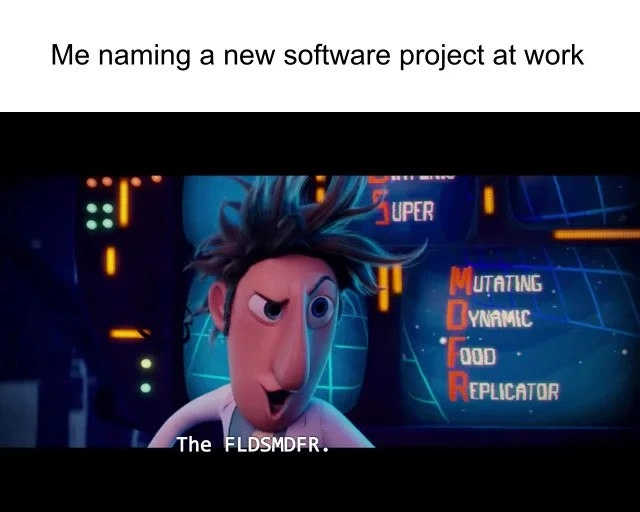
The top caption says:
Me naming a new software project at work
Below it, the scientist proudly presents The FLDSMDFR. while the screen tries to justify the letters with words like MUTATING, DYNAMIC, FOOD, and REPLICATOR, plus a partially visible SUPER. The image is funny because every engineering organization has produced at least one internal system whose name sounds like it was generated by a committee trapped in a product kickoff.
This is naming debt, the cousin of technical debt that does not show up in benchmarks but absolutely shows up in onboarding. A project name becomes a handle for architecture, ownership, incident channels, dashboards, repositories, runbooks, permissions, feature flags, and Slack folklore. If that handle is an opaque acronym, every future conversation starts with a small decoding tax. FLDSMDFR is ridiculous on purpose; real internal names often get uncomfortably close by accident.
The deeper satire is that acronyms feel efficient to the author and hostile to everyone else. The person inventing one has the full expansion in their head, so the abbreviation seems clever and compact. Six months later, a new engineer sees the repo name, the deployment target, and the alert label, then has to ask whether MDR is a service, a team, a subsystem, a migration, or a typo from 2018 that became permanent because renaming it would break Terraform.
Good software naming is not about being poetic. It is about readability under stress. During an incident, billing-reconciliation-worker may be boring, but it tells you where to look. A heroic acronym makes everyone rely on tribal knowledge, which is documentation that has chosen to live inside the most overbooked senior engineer. Naturally, that engineer is on vacation when the pager starts.
The post message, Acronyms suck unless you're the one coming up with them, captures the incentive problem exactly. Inventing the name is a moment of creativity. Maintaining it is years of explaining why the food-replicator-looking service is actually the authentication cache invalidation daemon.
Description
The image has a white top caption reading, "Me naming a new software project at work." Below it is an animated movie scene of a wide-eyed scientist presenting a machine name, with a screen behind him spelling out parts of the acronym as "MUTATING," "DYNAMIC," "FOOD," and "REPLICATOR" and a small partially visible "SUPER" near the top. The subtitle at the bottom reads, "The FLDSMDFR." The developer joke is that internal software projects often end up with opaque, over-engineered acronyms that sound impressive in a launch meeting and become unreadable tribal knowledge forever after.
Comments
1Comment deleted
Every project starts with a backronym and ends with a runbook explaining how to pronounce the incident channel.