Skip to content
DevMeme
1717 of 7435
JIRA Points: The Zodiac for Engineering Managers
Agile Post #1920, on Aug 15, 2020 in TG

JIRA Points: The Zodiac for Engineering Managers

Why is this Agile meme funny?

Level 1: Fortune-Telling at Work

Imagine you and your friends have a project, like building a treehouse, and your teacher (or mom acting like a project boss) asks, “How hard is each task? Let’s not use hours, give me a made-up score for each thing to do.” So, you look at “hammering nails” and say “This is 2 points of effort,” and “lifting the wood planks to the tree” might be “5 points of effort.” These points aren’t an exact measure (they’re not minutes or hours; they’re just feeling-based numbers). Now picture the teacher taking those numbers and planning everything super strictly: “Oh, you can do 7 points a day, so in 3 days exactly 21 points will be done and the treehouse is finished.” That sounds a bit shaky, right? It’s like she’s treating your guesswork as a perfect prediction.

Now let’s bring in the astrology part. Astrology is like when someone reads the stars or their birthday zodiac sign to predict what kind of day they’ll have (Will I be lucky? Should I avoid doing important stuff today?). Most people treat it as just fun – you don’t really run your serious plans on it. But imagine someone really plans their life around those horoscopes. It would seem a bit silly to trust the stars that much, yeah?

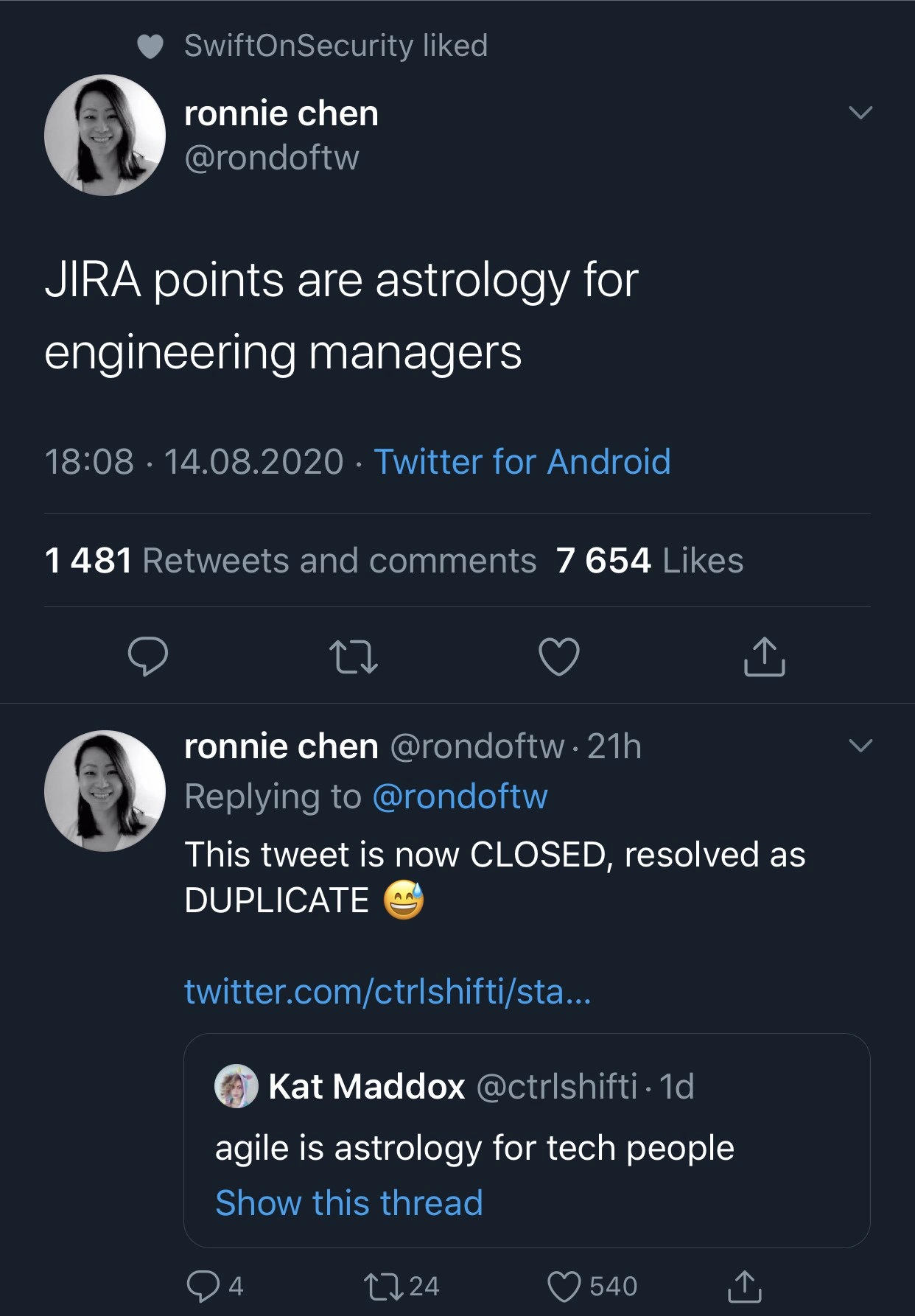
This meme basically says that giving tasks story point numbers and managers believing those numbers absolutely is as silly as relying on horoscopes. It’s comparing the two in a funny way: “JIRA points are astrology for engineering managers.” Think of JIRA points like those effort scores you give to tasks. And think of engineering managers as the teachers or bosses who really want to know when the treehouse (or project) will be done. The meme is joking that those bosses treat the points almost like magical future-telling. They see, say, 50 points of work and believe “Ah yes, by the alignment of the calendar and our last sprint’s velocity, the project shall be done by October!” – kind of how someone might say “The stars say I’ll find fortune next month.” Both are a bit of make-believe mixed with hope.

To make it even funnier, the person who made the tweet pretended that tweet itself was like a work ticket in a JIRA system. When they found out someone else had already made the same joke earlier, they replied to their own tweet saying, “This tweet is now CLOSED, resolved as DUPLICATE 😅.” Think of that like your teacher saying, “Oops, someone already handed in the exact same science project idea, so we’re marking yours as a duplicate.” It’s poking fun at how in software teams we often mark tasks or bug reports as “duplicate” if they’re repeats – a very work-ish thing to do, applied in a playful way to a tweet. The smiley emoji 😅 shows they’re laughing at themselves a bit for accidentally repeating someone else’s idea.

So, in a super simple analogy: This meme is funny because it’s like saying the boss plans our work by looking at a crystal ball. We all kind of know a crystal ball isn’t a real way to plan, just like those story point numbers are not a sure thing – they’re guesses. But sometimes at work, people act like those guesses are magical truth. Seeing someone point that out is both relieving and comical. It’s a laugh of recognition, like, “Haha, yeah, it does feel like we’re doing fortune-telling with these points, and the bosses eat it up!”

Ultimately, it’s humor that anyone who’s ever had to guess how long something will take can understand. We’re basically chuckling at the idea that we use fancy terms and numbers to feel in control of something uncertain. It’s as if at work we roll some dice or consult the stars but dress it up in official language so it sounds serious. Deep down everyone knows it’s a bit of a game. The meme just says it out loud in a fun way: planning in software can be as mystical (and unpredictable) as reading your horoscope, and that’s why we find it funny when someone puts it like this.

Level 2: Points vs Hours

Now, let’s break this down in simpler terms for those newer to Agile and Scrum. The meme talks about JIRA story points. What are those? In agile software development (especially Scrum), a story point is a unit of measure for estimating the size of a piece of work. Think of tasks (often called “user stories” or just “stories”) in the project backlog. Instead of estimating each task in hours or days, teams assign a numeric value – the story point – that represents how much effort or complexity they think the task involves relative to other tasks. For example, a simple bug fix might be 1 point, adding a moderate new feature might be 5 points, and a huge refactor could be 8 or 13 points. These numbers are often chosen from a rough scale (like 1,2,3,5,8…) to avoid false precision and because humans are bad at exact estimates but decent at relative comparisons. The core idea is: two points task is about twice the effort of a one point task (in the team’s shared understanding), but it’s not explicitly tied to “two hours” or “two days” – it’s abstract.

JIRA is a popular tool (by Atlassian) used by software teams to track tasks, bugs, and project progress. In JIRA, each task or issue can have a field for story points. During Sprint Planning (a meeting at the start of a sprint, which is a time-boxed iteration, often 1-2 weeks long), the team will discuss each story and assign these points through a process often called planning poker. In planning poker, each developer literally plays cards with numbers (story point values) on them to vote on how hard they think the story is. If everyone shows the same number, great – that’s the estimate. If not, they discuss further (Why did you think it’s an 8? I thought it was a 3 because maybe I know a simpler approach, etc.) until they reach consensus. It’s a fun and gamified way to get the team’s input and avoid one person anchoring the estimate.

So far so good – it’s a collaborative technique to gauge work. Now, where does the “astrology” come in? Astrology is the belief that the positions of stars and planets can influence human affairs or predict the future. It’s considered a pseudoscience – entertaining to many, but not backed by scientific evidence. The tweet jokes that “JIRA points are astrology for engineering managers.” This implies that to some engineering managers – the people who oversee development teams and timelines – story points are being used like a magical forecasting tool (just like someone might use horoscopes to predict their day). The humor here is saying: managers treat the sum of story points (often called velocity when you add up how many points get done in a sprint) as if it’s a precise, fate-binding metric. Instead of recognizing that these estimates are just educated guesses by developers, some managers might think, “This team completed 30 points last sprint, so they will definitely do 30 or more every sprint, and thus we can schedule exactly X points of work for the next quarter.” It’s like using a horoscope: “Our project is a Leo, so it will face challenges mid-month but triumph in the end” – sounds silly, right? The meme is highlighting that same silliness in how story point metrics are sometimes misused. AgileHumor often pokes at this because many devs have experienced a manager or scrum master treating velocity trends as unassailable truth. If the velocity chart goes down one sprint, alarms ring and there’s a post-mortem, even if maybe half the team was on vacation – common sense that no chart can magically account for.

Let’s clarify a few terms that are implicitly referenced:

  • Sprint: A short, fixed-length period (usually 1-2 weeks) in which a Scrum team aims to complete a set of tasks. Sprints are the heartbeat of Scrum. At the end of a sprint, ideally, the team has potentially shippable features or progress to show.
  • Sprint Planning: The meeting where the team plans which user stories (from the backlog, the big to-do list of the project) they will tackle in the upcoming sprint. This is where story points come into play to decide how much the team can take on – they look at how many points worth of work they usually do (velocity) and select stories that sum up to around that number.
  • Velocity: The total number of story points completed in a sprint by a team. For example, if in Sprint 1 the team finished tasks worth 20 points, their velocity is ~20 for that sprint. Over several sprints, teams often compute an average velocity to help plan future sprints (e.g., “We tend to do ~20 points per sprint, so let’s not commit 50 points of work next sprint.”). It’s a loose capacity planning metric.
  • Backlog: The ordered list of all pending work items (user stories, tasks, bugs) for the project. It’s like the team’s big wish list, constantly prioritized by a Product Manager or Product Owner typically.
  • Engineering Manager: In this context, a person who manages developers, often concerned with timelines, resource allocation, and overall progress. They might not code the features themselves but need to report to upper management or clients whether the team is on track. Many engineering managers use tools like JIRA to get metrics and status.
  • Astrology analogy: The phrase draws a parallel between believing in star signs (for guidance) and believing in story point numbers (for project guidance). It’s implying a kind of blind faith in something that might not have a solid rational basis.
  • Duplicate issue: In bug tracking systems like JIRA or others (Bugzilla, GitHub issues, etc.), if the same problem or request is reported twice by different people, one of them is often closed with a resolution like “Duplicate” (meaning this issue is not going to be handled separately because another ticket already covers it). It’s a bit of ProjectManagementHumor to apply this concept to a tweet.

Now, look at the second part of the meme: Ronnie (the original tweeter) replies to their own tweet with, “This tweet is now CLOSED, resolved as DUPLICATE 😅”, and attaches a card showing another tweet by Kat Maddox saying, “agile is astrology for tech people.” What’s happening is Ronnie discovered someone else had already made a very similar joke about Agile and astrology. So, they’re humorously “closing” their tweet as if it were a JIRA ticket that duplicates an existing issue. That’s something you’d see commonly in JIRA or any bug tracker: a maintainer would say “Closing this as duplicate of ISSUE-1234,” linking to the original issue. By doing this on Twitter, Ronnie essentially says “Whoops, someone filed this joke earlier!” The 😅 emoji underscores the playful embarrassment. This reflex to mark something as a duplicate is very familiar to developers and project managers— it’s second nature when managing a backlog or a Kanban board. So this detail is an extra wink to people in software: it’s not only joking about agile estimation (the astrology bit) but also about our day-to-day issue-tracking process obsession.

Also notable: The screenshot indicates the tweet was liked by SwiftOnSecurity, a well-known tech Twitter personality famous for witty takes on InfoSec and IT. This shows how widely the joke resonated; even prominent figures in tech found it amusing enough to engage with. The engagement numbers (1,481 Retweets, 7,654 Likes) confirm that this struck a chord in the community – clearly many folks in tech have felt that story points and agile rituals can be absurd. The inclusion of the second tweet by Kat Maddox (with a similar joke) might also hint at how common this sentiment is – multiple people independently compare agile to astrology, which itself is commentary on agile’s reputation in some circles.

In simpler terms: as a new developer or someone early in their career, here’s why people find this meme funny and relatable:

  • Story points are supposed to help estimate work, but if you’ve participated in a few sprint plannings, you might have felt like you’re just guessing numbers. Sometimes you’ll see a team scrum master or manager treat those guesses very seriously, which can feel awkward or comical.
  • Engineering managers often ask “Why did we only do 15 points this sprint when last sprint we did 30? What’s wrong?” and you’re sitting there thinking, “Uh, maybe because last sprint’s ‘5 points’ were nothing like this sprint’s ‘5 points’? Or half the team was debugging production issues? Or our estimates were off (surprise!)?”
  • You start to realize story points aren’t a perfect metric – they’re useful for teams internally but can be misused. It’s a common agile pain point that the process meant to help manage uncertainty ironically gets wielded as if it were certain.
  • The astrology analogy is a humorous exaggeration: of course story points have some basis (team discussion and consensus), they’re not literally random star alignments. But from a cynical perspective, when you see them misapplied, it feels like a hokey form of fortune telling.
  • By calling story points “astrology for engineering managers,” the tweet implies managers use them to comfort themselves that they can predict the future (“This project will finish on time because the points say so!”) much like someone might feel comfort reading their horoscope (“Today will be a good day because my zodiac reading said so!”).
  • Finally, the duplicate tweet closure is just a fun example of developers bringing their work mindset into social media. It’s the kind of joke you only fully get if you’ve dealt with Jira tickets or GitHub issues: closing duplicates is mundane in our work tools but seeing it applied to a tweet is unexpected and thus funny.

In summary for this level: the meme is a lighthearted roast of Agile project management practices. It jabs at how Scrum sometimes feels like following an arbitrary system with its own lingo and rituals (points, sprints, stand-ups) that outsiders might find as perplexing as astrology. And it also shows how devs often cope with these frustrations using humor — even meta-humor like treating tweets as if they were JIRA issues. If you’re new to software teams, just know that joking about JIRA, Scrum, and story points is practically a sport among developers. It’s how we collectively vent about the quirks of our work processes. This meme is one of those jokes: it says “hey, we all know this part of our process is kinda silly, right?” in a way that’s concise, witty, and instantly recognizable if you’ve been through a few sprint cycles.

Level 3: Horoscope-Driven Development

At the high end of complexity, this meme skewers Agile estimation practices with a scathing, been-there-done-that twist. In Scrum, teams assign story points to tasks (often user stories in a backlog) as an abstract measure of effort or complexity, typically using a Fibonacci-like sequence (1, 2, 3, 5, 8, 13...) for estimation. The intended purpose is noble enough: acknowledge uncertainty, avoid the false precision of exact hour estimates, and gauge relative size of work. But in practice? Story points often end up as cosmic guesswork. The tweet’s punchline "JIRA points are astrology for engineering managers" nails the cynicism many developers feel during Sprint Planning. It suggests that these numbers are as scientifically grounded as a daily horoscope, yet some engineering managers cling to them as if consulting the stars for project timelines.

Why is this funny to a seasoned developer? Because we’ve all seen managers treat velocity (the number of story points completed per sprint) like a crystal ball. It’s a running joke – or tragedy – in the industry that the burndown chart might as well be a zodiac chart. When a manager proudly proclaims, “This team delivers 42 points per sprint, therefore we’ll be done in two sprints,” experienced devs exchange knowing glances. We’ve learned (the hard way) that treating these software metrics as gospel is about as reliable as reading tea leaves. Story points were meant for relative estimation and internal team calibration, not an exact science for delivery dates. Yet here we are, with Project Management offices making decisions as if Aries being in Mars somehow guarantees a feature is done by Q4.

This meme resonates especially with battle-worn developers who have survived multiple “agile transformations” and countless JIRA grooming sessions. The dark-mode Twitter screenshot – complete with SwiftOnSecurity liked at the top – lends it extra techie cred. The self-referential reply "This tweet is now CLOSED, resolved as DUPLICATE 😅" is icing on the cake for those familiar with issue tracking workflows. It mimics how a JIRA ticket or GitHub issue gets closed as Resolved: Duplicate when someone files a redundant bug report. In this case, Ronnie (the tweeter) discovered their quip echoes an earlier observation by Kat Maddox ("agile is astrology for tech people"). Instead of simply saying “oops, someone already said this,” they jokingly handle it with process satire – using the bureaucratic language of a ticket resolution. This is the kind of meta-humor developers adore: turning a Twitter thread into a mock bug tracker. It’s the union of internet culture and developer inside jokes, where even tweets have JIRA ticket statuses.

To a senior engineer, the analogy between Agile estimation and astrology lands well because it captures an underlying truth: despite all our fancy processes and ManagementHumor about productivity, predicting software development is notoriously hard. There’s even academic backing for the skepticism – e.g., the infamous Cone of Uncertainty concept in project management, or Brook’s Law (“adding manpower to a late software project makes it later”). We know that mystical certainty is unattainable, yet corporate rituals demand something – anything – to estimate progress. The result is AgilePainPoints like contentious planning poker sessions where developers argue whether a task is 3 points or 5 points as if that quantitative distinction actually guarantees anything. In the moment, it feels as absurd as haggling over horoscope signs. The tweet and its popularity (thousands of retweets and likes) show a collective catharsis: it’s not just you; Agile sometimes really does feel like an elaborate act of faith, with engineering_managers reading story point charts like astrologers reading star charts.

Let’s draw the parallel more explicitly. Consider this tongue-in-cheek comparison of astrology vs. Agile metrics:

Astrology Belief 🎴 Agile Equivalent 📊
Planets aligning determine your destiny Story points aligning determine your deadlines
Zodiac sign (Aries, Taurus…) defines traits Team’s velocity defines its productivity in manager’s eyes
Daily horoscope predicts your day Sprint burndown chart predicts your project’s outcome
No scientific proof, but people believe No precise accuracy, but managers insist on the numbers

In reality, using story points should be better than astrology – it’s an attempt at collective intelligence, leveraging the team’s experience to guess complexity. But as the meme highlights, when abused by management, it degenerates into AgileHumor: a process we follow because it’s in the Scrum Guide, not because the cosmos truly ordained that refactoring the login module is an 8-point task. A seasoned dev reading "JIRA points are astrology for engineering managers" chuckles because it rings true in a painful way. It’s a bit of gallows humor: we laugh so we don’t cry about how estimation and corporate SprintPlanning theater often miss the point (pun intended). By invoking astrology – the quintessential pseudoscience – the meme is effectively calling out Jira_story_points as a pseudo-metric when misused. And boy, have many of us seen them misused: from bosses who equate story points to exact hours (ugh) to those who demand ever-increasing velocity as if summoning better fortune.

In summary, at this expert level we see the meme as sharp satire of project management culture. It underscores a well-known Agile pain point: the disconnect between the ideal of flexible, fact-based planning and the reality of sometimes arbitrary numbers that give a false sense of control. The duplicate tweet closure is a bonus joke layered for the initiated: acknowledging that this critique of agile_estimation isn’t new — it’s a known issue, filed and replicated, much like every tedious bug we’ve all seen multiple times. This meme hits home because it validates the inner developer skepticism: sometimes our planning process is about as rational as consulting a horoscope, but heaven forbid we don’t follow the ritual! The veteran chuckles, perhaps with a twinge of PTSD from past Sprint demos, fully appreciating how this tweet deftly calls out the process satire inherent in our daily stand-ups and planning meetings.

Description

A screenshot of a tweet from user Ronnie Chen (@rondoftw). The main tweet, posted on August 14, 2020, reads, 'JIRA points are astrology for engineering managers'. Below this, there is a reply from the same user that says, 'This tweet is now CLOSED, resolved as DUPLICATE' accompanied by a grinning face with sweat emoji. This reply links to another tweet from user Kat Maddox (@ctrlshifti) which states, 'agile is astrology for tech people'. The visual is a standard Twitter interface with dark mode. The joke criticizes the practice of assigning story points in Agile development, equating their predictive value to that of astrology, especially from the perspective of management who might rely on them heavily. The follow-up tweet adds a layer of insider humor by using JIRA's ticket resolution statuses to acknowledge that the original observation is not unique

Comments

7
Anonymous ★ Top Pick Our team's velocity chart is less of a predictive tool and more of a Jackson Pollock painting. We call our estimation method 'abstract expressionism.'
  1. Anonymous ★ Top Pick

    Our team's velocity chart is less of a predictive tool and more of a Jackson Pollock painting. We call our estimation method 'abstract expressionism.'

  2. Anonymous

    I deal out planning-poker cards like tarot - if the Fibonacci spread looks auspicious it’s a 5-pointer, otherwise we blame Mercury in prod-retrograde and mark the epic as a duplicate

  3. Anonymous

    The best part about story points is watching a team argue for 30 minutes whether something is a 5 or an 8, then watching it take exactly 3 days regardless of what they picked

  4. Anonymous

    The real genius here is marking the tweet as 'CLOSED, resolved as DUPLICATE' - perfectly capturing how engineering managers treat story points with the same arbitrary precision as closing tickets. It's the software equivalent of reading tea leaves to predict delivery dates, except the tea leaves have Fibonacci numbers and everyone pretends they're statistically significant. The irony is that both the original observation and its resolution status are themselves perfect examples of the theater they're mocking - we all know this exact tweet exists in 47 other forms across Slack channels, but this one got 'accepted' by the community backlog

  5. Anonymous

    JIRA points: where managers divine sprint velocity from Fibonacci entrails, proving estimation's as scientific as a retro's 'what went right?'

  6. Anonymous

    Story points: a dimensionless Fibonacci currency that lets finance put astrology in a spreadsheet

  7. Anonymous

    Story points: the unit where two 8s become a 13 when the VP joins planning - please mark this take RESOLVED - DUPLICATE so velocity doesn’t dip before the QBR

Use J and K for navigation