The two schools of programming tutorials: Python vs. Lisp
Why is this Languages meme funny?
Level 1: Shallow End vs High Dive
Imagine you’re taking two different swimming classes. In the first class, the teacher starts you off in the shallow end of the pool. They show you how to float, how to kick your legs gently, and they make sure you’re comfortable with the basics. This feels safe and easy, and you gain confidence little by little. This is like learning Python: you begin with simple things like saying “Hello” to the computer and taking baby steps.
Now think of a second class where the teacher walks you straight over to the high diving board on day one and says, “Alright, jump off and let’s do a flip!” That would be crazy, right? It’s exciting but also a huge challenge from the very start. This is what the Lisp approach in the meme is like: instead of starting with something easy, it’s as if the teacher says “Let’s solve a big puzzle right now!” It’s funny because normally you’d expect to start with easy stuff, but here one teacher (Lisp) is super enthusiastic and throws you into an advanced challenge immediately. The humor comes from this extreme difference – one approach is gentle and step-by-step, while the other is bold and assumes you’re ready to tackle something hard right away. Even if you’re not a programmer, you can laugh at the idea of a lesson that skips the simple hello and goes straight into “let’s do something insanely tricky for our first exercise!” It’s like going from 0 to 100 in one go, which is both a little bit scary and a little bit cool at the same time.
Level 2: Building Blocks vs Brain Teasers
Let’s break down what this meme is talking about in simpler terms. It’s comparing how tutorials teach two programming languages – Python and Lisp – very differently.
Python is a popular programming language known for being beginner-friendly. In a typical Python tutorial, you start with the absolute basics. For example, the first thing you often learn is how to display some text on the screen. The traditional example is to print the message “Hello, world!”. In Python, that’s as easy as:
# Python: a simple "Hello, world!" example print("Hello, world!")This line of code uses Python’s built-in
printfunction to show text output. After “Hello, world!”, a Python lesson might next teach you what a function is and how to call one (e.g., defining your own function withdefand then invoking it with parentheses likemy_function()). It would introduce basic data types, such as a dict (short for dictionary), which is Python’s term for a key-value mapping data structure (imagine a real dictionary where you look up a word to get a definition – a Python dict lets you look up a key to get a value). You’d also learn how to organize code into a module (basically a file containing Python code or a library you can import). All of these steps are like learning the basic tools and words in a language before trying to write a story. The Python tutorial approach is very step-by-step: first show how to do simple output, then how to do calculations or use variables, then how to put code into reusable pieces (functions and modules), and so on. It’s designed so that someone with no programming experience isn’t overwhelmed.Lisp is another family of programming languages (like Common Lisp or Scheme, among others) known for a different approach. Lisp has a unique syntax – it uses a lot of parentheses and prefix notation (meaning you write the operator before the operands, like
(+ 1 2)to add 1 and 2, instead of1 + 2). Lisp was born in academic circles, and it’s a favorite in some computer science courses to teach fundamental concepts. A Lisp tutorial often assumes the learner is either somewhat experienced or at least ready to tackle big ideas. Instead of spending much time on printing “Hello, world” (which in Lisp is also just a simple(print "Hello, world!")call, not very exciting), many Lisp introductions go straight into demonstrating recursion or other powerful concepts. Recursion is when a function solves a problem by calling itself on smaller parts of the same problem – it’s a key idea in computer science and especially in functional programming (a programming style Lisp is known for).A classic problem used to illustrate recursion is the Tower of Hanoi. This is a puzzle where you have three pegs and a stack of disks of different sizes. The goal is to move the stack of disks from one peg to another, one disk at a time, never placing a larger disk on top of a smaller disk. The trick is that to move the whole stack, you have to recursively move smaller stacks around – it’s a brain teaser that naturally maps to a recursive solution. Lisp, being good at recursion, can solve this problem in a very elegant way. Here’s a tiny taste of what that might look like in Lisp code:
;; Lisp: solving Tower of Hanoi recursively for 3 disks (defn hanoi [n from to via] (when (> n 0) (hanoi (dec n) from via to) ; move n-1 disks out of the way (println "Move disk from" from "to" to) ; print the move for the largest disk (hanoi (dec n) via to from))) ; move the n-1 disks to the target (hanoi 3 "Peg A" "Peg B" "Peg C")Don’t worry if the syntax looks odd – the key idea is that this Lisp function
hanoicalls itself ((hanoi ...)inside its own definition) to handle smaller numbers of disks, which is exactly what recursion is about. The program prints out steps to move 3 disks from Peg A to Peg B (using Peg C as an auxiliary). The details of the code aren’t as important as the fact that a Lisp tutorial might present something like this to you early on to show how recursion works. It’s definitely more complex than printing “Hello, world!” – you can see it involves thinking about a puzzle and breaking it down into sub-problems.
The meme jokes that a Lisp tutorial basically says “Forget starting slow, let’s jump right into a tough puzzle!”. The line “F**k yeah let’s solve Tower of Hanoi” is a very informal (and slightly vulgar) way to express “Heck yes, we’re going to tackle this cool problem immediately!” This contrasts with the Python tutorial style of carefully introducing one concept at a time. In simpler terms, the Python teacher starts by showing you how to say hello and do basic tasks, whereas the Lisp teacher says hello quickly and then immediately challenges you with a famous puzzle. This reflects the different learning curve of the two languages: Python’s curve is gentle at the beginning, while Lisp’s curve can be steep, asking you to grasp abstract ideas early. For a newcomer, the Python approach feels friendly and straightforward – you get quick wins like seeing output on your screen right away. The Lisp approach can feel challenging but also intriguing – you’re solving a real puzzle and seeing the language’s strengths from the get-go, even if it’s a harder first step.
In summary, the meme is pointing out this funny difference in teaching style: Python tutorials start with basic, everyday programming skills (printing text, calling functions, using simple data types), whereas Lisp tutorials might throw you into a mind-bending problem (like Tower of Hanoi) to illustrate deeper concepts like recursion. It’s a playful observation that what counts as a “Hello, world” introduction in one language community might be considered too elementary in another. That contrast can surprise new learners, and that surprise is exactly what makes the joke land.
Level 3: Hello World? Hold My Parentheses
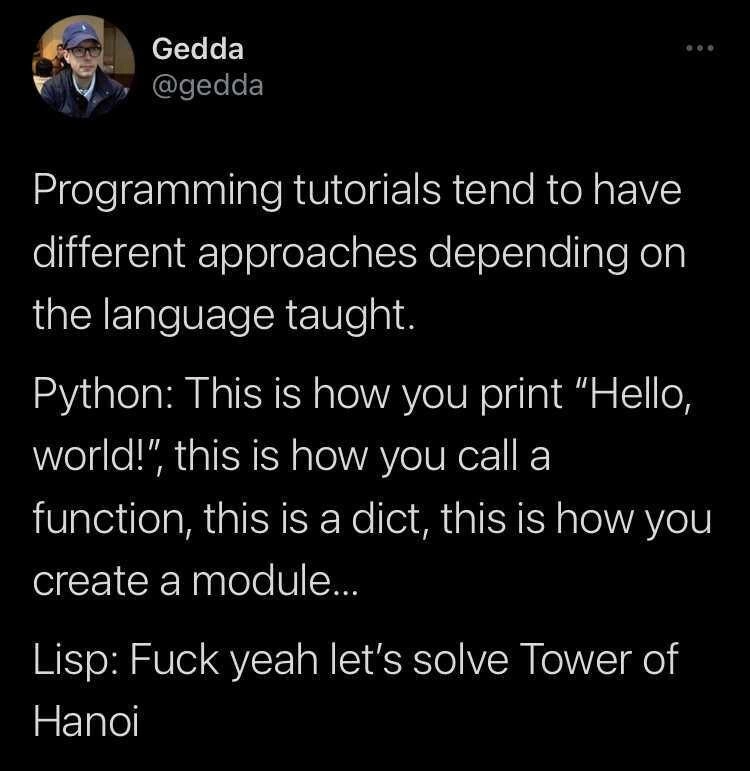
For experienced programmers, this meme hits on a well-known language comparison trope: Python is famed for its newbie-friendly tutorials, while Lisp (and other functional or older languages) often expect you to dive into the deep end. The tweet format of the meme (white text on a black background, with the user handle @gedda) provides a developer humor snapshot that many can relate to. It contrasts two teaching philosophies with tongue-in-cheek flair. On the Python side, you have the hand-holding introduction: “This is how you print ‘Hello, world!’; this is how you call a function; this is a dict; this is how you create a module…” – essentially, hello_world_basics and step-by-step familiarization. This is reminiscent of most Python tutorials or courses, which assume the reader has never coded before and need to learn fundamental concepts one at a time. Python’s community and documentation put a big emphasis on clarity and simplicity for beginners. A senior developer knows that when someone says they’re learning Python, the first things they’ll encounter are exactly these building blocks (printing output, using simple data structures like dictionaries, writing functions, etc.).
Then comes the punchline: “Lisp: F**k yeah let’s solve Tower of Hanoi”. It’s an exaggeration, sure, but not without a kernel of truth. Many of us who’ve dabbled in Lisp or taken a university CS class using Scheme can attest that recursion_teaching_style is a big part of the Lisp tradition. Instead of spending much time on trivial syntax, Lisp courses or books (for example, the famed Structure and Interpretation of Computer Programs using Scheme) often plunge into interesting problems early on. The Tower of Hanoi puzzle is a classic – it’s a staple of CS textbooks to illustrate recursion and algorithmic thinking. Seeing it pop up as the first thing in a Lisp tutorial is a comedic hyperbole that seasoned devs recognize: it captures the bravado of Lisp enthusiasts who might say, “Hello world? Hold my parentheses…” as they show off a powerful recursive solution. The phrase “F**k yeah” in the meme text amplifies this enthusiasm with a bit of profanity for comic effect – it paints the Lisp teacher as an extreme, rock-and-roll professor who’s impatient to demonstrate something impressive. It’s funny because it rings almost true: Lisp has a reputation for attracting more academically minded programmers who get excited about elegant solutions to classic problems, whereas Python’s culture is about getting beginners comfortable with basics.
This humorous contrast also hints at the learning curve differences. A developer who’s been around the block knows that Python is often the first language taught in bootcamps and intro courses precisely because it’s accessible. You can go from zero to printing output and writing a loop in minutes. Common Lisp, on the other hand, is typically encountered by programmers who already have some experience or by students in a computer science program. The meme exaggerates that a Lisp tutorial assumes you’re ready to wrestle a dragonslayer puzzle right away. It resonates with anyone who’s skimmed a Lisp guide and thought, “Whoa, we’re doing that now?” The comedic element is the shock value: it’s like the tutorial saying “we won’t bother with baby steps; let’s do something hardcore immediately.” Developers share this meme because they find truth in it – different languages foster different teaching styles, and the contrast can be both jarring and hilarious. The tweet-format presentation makes it easy to share this observation in a relatable way, as if someone is just casually pointing out this absurdity on social media. In the world of coding humor, such stark juxtapositions get a knowing laugh: we recognize the language_comparison stereotype being played up. In short, the meme works because it’s a playful jab at how the Python world coddles newcomers with gentle examples, while the Lisp world says “screw the shallow end, let’s dive straight into theory”. Any programmer who’s had to switch between an imperative language learning resource and a functional programming resource will likely chuckle and maybe recall their own experiences of that “culture shock.”
Level 4: Baptism by Recursion
At the deepest level, this meme highlights a clash of paradigms rooted in the history and theory of programming languages. Lisp (LISt Processing), one of the oldest high-level languages (designed by John McCarthy in 1958), emerges straight from the realm of academic computer science and mathematical logic. Its DNA is intertwined with lambda calculus – a formal system for defining computation with function abstraction and application. In lambda calculus (and by extension Lisp), recursion isn’t just a trick, it’s a foundational concept. Functions calling themselves to solve smaller instances of a problem are as natural in Lisp as loops are in other languages. The result? Lisp tutorials often dive head-first into classic recursive problems to showcase the language’s power. The meme’s exaggerated example, “Lisp: F**k yeah let’s solve Tower of Hanoi”, actually isn’t far off from reality in some Lisp circles. It pokes fun at how a Lisp guide might skip trivial syntax and immediately illustrate elegant recursion on day one. This is a nod to Lisp’s theoretical elegance: minimal syntax (just lots of parentheses and prefix notation), code that is homoiconic (code as data, data as code), and a tradition of demonstrating concepts like recursion and functional programming early and with gusto.
On the other side, Python (created in 1991 by Guido van Rossum) comes from a much more pragmatic tradition, emphasizing readability and a gentle learning curve. Python’s philosophy, summarized in the Zen of Python (“Simple is better than complex”, “Readability counts”), encourages teaching by building up from the basics. The typical Python tutorial is incremental: start with the simplest program possible – printing “Hello, world!” – then move through basic syntax, data types, and functions one step at a time. This reflects an imperative mindset and an educational design that prioritizes immediate approachability over theoretical depth. In theoretical terms, Python abstracts away a lot of complexity to let beginners get results without delving into formal theory. There’s a computer science joke that Lisp was born from math and Python was born from engineering: Lisp’s lineage (stemming from Alonzo Church’s work and early AI research) means it treats programming almost like a CS fundamental subject from the outset, whereas Python’s lineage (influenced by ABC and scripting languages) treats programming as a tool to accomplish tasks with minimal ceremony. The meme humor arises from these inherent differences: Lisp’s academic learning culture often throws you into a baptism by recursion, while Python’s mainstream culture holds your hand through “Hello, world” and beyond. A seasoned developer or CS student will chuckle at how solving the Tower of Hanoi is presented as Lisp’s version of a “Hello, world” – it’s an absurd yet insightful commentary on how language design and history shape learning curves and tutorial styles.
Description
A screenshot of a tweet from the user Gedda (@gedda). The text humorously contrasts the teaching methodologies of different programming language tutorials. The tweet starts, 'Programming tutorials tend to have different approaches depending on the language taught.' It then gives two examples. For 'Python:', it lists a gentle, step-by-step introduction: 'This is how you print "Hello, world!", this is how you call a function, this is a dict, this is how you create a module...'. In stark contrast, for 'Lisp:', the approach is abrupt and dives into advanced computer science: 'Fuck yeah let's solve Tower of Hanoi'. The humor lies in the accurate portrayal of language cultures. Python is known for its beginner-friendly, gradual learning curve, while Lisp, a historically academic and powerful language, often has tutorials that presume a strong theoretical foundation and immediately tackle complex, recursive problems, reflecting its deep roots in computer science

Comments
13Comment deleted
Python tutorials hold your hand. Lisp tutorials hand you a copy of SICP and a parenthesis-shaped rock and say, 'Good luck, you'll need it.'
Python’s Day 1: print("Hello, world!"). Lisp’s Day 1: write a meta-circular evaluator that solves Tower of Hanoi. My Day 1 as architect: figure out why that 1998 Lisp Hanoi demo is now the core of our data-migration pipeline
The real difference is that Python tutorials spend 3 chapters explaining list comprehensions while Lisp tutorials assume you've already implemented your own Lisp interpreter by page 2 - and both communities think the other is doing it wrong
The real difference isn't the tutorial approach - it's that Python tutorials assume you want to build something useful, while Lisp tutorials assume you're ready to question the fundamental nature of computation itself. Python says 'here's how to print'; Lisp says 'here's why printing is just a side effect in the grand tapestry of lambda calculus.' By the time you finish a Lisp tutorial, you've either achieved enlightenment or you're debugging macros that generate macros at 3 AM, muttering about homoiconicity
Python 101: print('hello'); Lisp 101: SICP speedrun where Tower of Hanoi is the unit test for your meta-circular evaluator
Python 101 prints 'hello'; Lisp 101 writes a macro that solves Tower of Hanoi during read-time, then bikesheds tail-call semantics
Python tutorials spoon-feed dicts; Lisp drops Hanoi to cull herds unable to tail-optimize their way out of infinite recursion
c: calculate this text file of employee salaries Comment deleted
lisp: let's build lisp Comment deleted
haskell: quicksort, it's always quicksort Comment deleted
And then it's never actually quicksort. https://www.informit.com/articles/article.aspx?p=1407357&seqNum=3 Comment deleted
Interesting read, thanks, not often you find someone meaningfully singing the virtues of c++ Comment deleted
Co-author of the D language by the way. https://en.m.wikipedia.org/wiki/Andrei_Alexandrescu Honestly my favourite take on C++ is https://bartoszmilewski.com/2013/09/19/edward-chands/ Comment deleted