Skip to content
DevMeme
1224 of 7435
The Gatekeeping Dog of Developer Wisdom
DevCommunities Post #1366, on Apr 22, 2020 in TG

The Gatekeeping Dog of Developer Wisdom

Why is this DevCommunities meme funny?

Level 1: Truth Hurts

Imagine you love watching cooking shows. You know all the funny jokes chefs make in the kitchen and the quirky things they say like “Bam!” or “Yes, chef!” It makes you feel like you’re part of the chef world. But if you’ve never actually cooked a meal and then you walk into a real restaurant kitchen, a chef might jokingly tell you, “Hey, knowing our jokes doesn’t make you a chef!” Hearing that would hurt your feelings, right? You’d feel sad because you realize that to really be a chef, you still need to practice cooking for real.

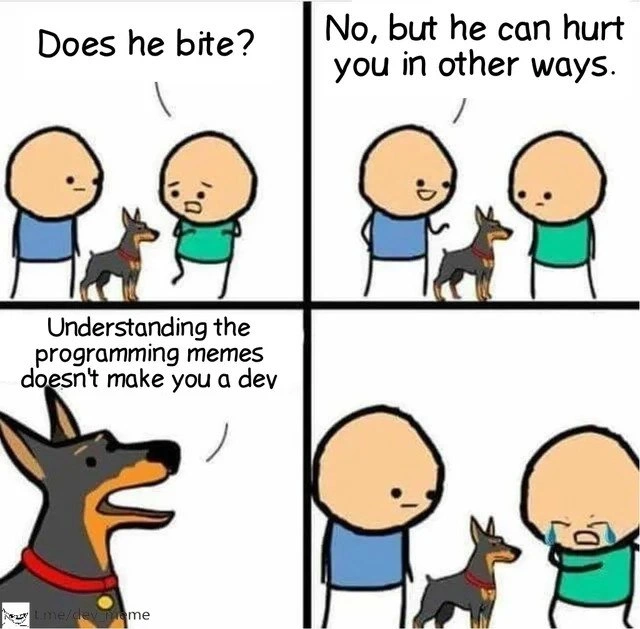
That’s exactly what’s happening in this meme. The little dog isn’t biting the man’s hand – instead, the dog is saying something that hurts his feelings. The man thought that because he understands all the funny programmer jokes (the kind of jokes computer programmers make), it means he’s a programmer too. The dog bluntly tells him, “Just knowing the jokes doesn’t make you a developer.” In simple words, the dog is saying: you only become a real programmer by actually writing code and doing the work, not just by laughing at the stories. The poor guy in green hears this truth and starts to cry because, well, the truth hurts. It’s a funny comic because the dog’s honest comment surprises the man (and us) – it’s unexpected and a bit mean, but also kind of true. Just like with any skill, you can’t just know about it or joke about it, you have to do it for real to call yourself that thing. And that little reality check can sting, as the crying friend shows.

Level 2: But Did You Code It?

Let’s break down why this joke hits home, especially if you’re a new coder. Developer communities (whether on Stack Overflow, Discord, Reddit’s r/ProgrammerHumor, or office Slack channels) have tons of programming memes – these are jokes, images, or catchphrases that poke fun at common programmer problems. For example, a classic meme might be someone saying “It works on my machine!” to joke about code that fails everywhere else. Understanding these inside jokes can make you feel like part of the club. You might proudly get references to Git mishaps or debugging nightmares and think, “Hey, I speak the lingo, I must be a dev!”

This comic is playing with that feeling. The friend in the green shirt likely knows a bunch of these DeveloperHumor references. He asks, “Does he bite?” about the dog, and the owner warns, “No, but he can hurt you in other ways.” That’s the setup. Instead of biting, the dog delivers a one-liner that really stings: “Understanding the programming memes doesn’t make you a dev.” Ouch! Why is that hurtful? Because it’s basically saying: knowing the jokes isn’t the same as having the skills. The friend immediately looks heartbroken, which is an exaggerated way to show disappointment and maybe a bit of embarrassment. It’s like he just got told he hasn’t “earned his stripes” yet as a programmer.

This is a form of gatekeeping in tech culture. Gatekeeping means setting an unofficial bar for who gets to be called a “real” member of a community. In plain terms, it’s someone saying, “You’re not a true X until you’ve done Y.” Here, the dog (and the owner by extension) is gatekeeping who gets to be called a developer. The message is: you only qualify as a real programmer if you’ve actually done programming work – writing code, debugging, deploying apps – not just consumed the memes about those experiences. It’s a jokey way of telling the friend, “Go actually build something, then we’ll talk.”

Now, let’s connect this to learning: Many beginners immerse themselves in developer culture online as they learn to code. They watch funny YouTube videos about coding, follow tech Twitter accounts, and laugh at memes about missing semicolons or the agony of npm install. This cultural exposure is fun and even educational (you pick up terms and cautionary tales). However, learning to code is an active process – you have to practice coding, make mistakes, and write programs that run. The meme emphasizes that being a developer is about doing, not just knowing. Memes might teach you what issues exist (like how everyone jokes about JavaScript quirks or off-by-one errors), but you only truly understand those jokes after you’ve run into the issues yourself while coding.

The term DeveloperExperience (DX) usually refers to making tools and processes easier for developers, but here we can think of it as the overall experience of being a developer day-to-day. A good DX for a newcomer would be an environment where they can try things, fail safely, and learn – not one where they’re told off for not knowing enough. That’s why this meme can be seen as poking fun at a not-so-friendly side of dev culture. It highlights a scenario that might feed impostor syndrome for newbies. Impostor syndrome is that anxious feeling many new (and even experienced) developers have where they doubt their own skills and fear being exposed as “not a real programmer.” If you’re new and someone basically says “you’re not a dev,” it can really shake your confidence, much like the crying friend in the comic.

It’s important to note: while the dog’s statement is blunt, it’s meant in good humor here. In real life, most developers remember being beginners and won’t actually be this mean — in fact, many will encourage you to join in, code, ask questions, and yes, share a laugh at memes together. The joke targets a kernel of truth: being able to laugh at developer jokes is easy; building software is hard. True developers earn their title through practice: writing code (often starting with small projects like a personal website or a simple game), shipping that code (which means getting your project out into the world or at least running on your computer or a server), and maintaining it (fixing bugs, adding features, and improving it over time). The comic’s punchline is a reminder of this progression. You don’t become a “real dev” solely by osmosis from meme culture — you become one by doing the work that the memes are about.

Even the format of the meme (the “Does he bite?” dog comic) is widely used online. It’s a template where the dog usually represents some hard truth for different fandoms or communities. In this meme_comic_dog_bite_format, people swap in whatever painful truth fits their context. In the programming world, the chosen truth is this little gatekeeping nugget. So, the friend’s reaction — silently crying — is an exaggeration to make us laugh, but it also captures that little pang of hurt or insecurity a lot of us have felt. Who hasn’t been the newbie at some point, worried that everyone else is a “real” developer and you’re just faking it? The meme is basically winking at us: “Don’t worry, we’ve all been there... just remember, you actually have to code, too.”

In summary, at this level we learn: Understanding programming memes ≠ being a programmer. Memes reflect real coding experiences, but you only level up from meme-literate to developer by gaining real experience yourself. The comic uses a silly scenario and a talking dog to illustrate that gap. It’s a lighthearted nudge for learners: join the fun of dev culture, sure, but don’t forget to put in the keyboard time and actually create something. After all, the real fun (and the real jokes) come from the coding journey itself.

Level 3: When Memes Bite Back

In this meme, a Doberman-reality-check delivers a harsh lesson about developer identity. The stick-figure friend fears a physical bite, but instead the dog sinks its teeth into the ego: “Understanding the programming memes doesn’t make you a dev.” This punchline hits home for seasoned engineers because it satirizes a form of developer-culture gatekeeping we’ve all seen. It’s the veteran guard dog of the programming world saying, “Kid, knowing our inside jokes is cute, but come back after you’ve merged some real code at 2 AM.”

This humor draws on a common DevCommunity experience: newcomers often pick up lingo and laugh at jokes on tech Twitter or Slack — think knowing phrases like // works on my machine or the infamous “it’s always DNS” meme. But the dog (standing in for a grizzled senior developer) reminds us that real respect in the field is earned by writing, shipping, and maintaining code, not just by meme fluency. The panel is funny because it’s painfully true: being able to LOL at TechHumor doesn’t solve a 3-day outage or refactor 5,000 lines of legacy code. The dog’s brutal honesty is a nod to the RelatableDeveloperExperience of realizing that software engineering is a craft earned through hard work and debugging, not just witty one-liners about it.

There’s an implicit impostor syndrome trigger here, too. The friend’s tears in the final panel? We’ve been there. It’s the sting of being told “you’re not a real dev (yet)” and suddenly feeling like a fraud for laughing at jokes that actual coders earned through sweat. The meme calls out the wannabe developer who has all the talk (or in this case, all the memes) but hasn’t walked the walk. It reflects a gatekeeping sentiment: “Real developers code, not just consume DeveloperMemes.” Seasoned devs might chuckle at this because, yeah, we all knew that one guy who spoke in stack overflow jokes but crashed production with a one-liner. It’s a comedic exaggeration of a real divide: reading about deploying apps vs actually deploying and getting that 3 AM PagerDuty alert. The dog’s got the weary look of someone who’s seen one too many “script kiddies” declare themselves experts after binge-watching coding TikToks.

Notice the meme format itself is a meta-inside joke. The “Does he bite?” comic setup is a well-known template where the dog doesn’t bite but says something that hurts more. In our dev twist, the hurt comes from a truth bomb about merit in the programming world. It’s a bit of a self-own for the community too: we recognize this gatekeeping as both funny and problematic. After all, nobody becomes a senior engineer overnight; we all start as beginners enthusiastically repeating what we’ve heard. The veteran perspective, though, is that coding prowess is measured in pull requests and production incidents, not in meme references. DeveloperExperience (DX) isn’t about knowing all the jokes in the handbook; it’s about surviving real-world projects. This comic cleverly uses the dog to voice that senior-dev snark: the pup has definitely chased a few newbie posturing “cats” off its lawn.

To put it in pseudo-code, the dog’s judgment might look like:

# Gatekeeping logic from the dog's perspective:
if person.knows_memes and not person.has_written_code:
    print("Understanding the memes doesn't make you a developer.")
else:
    print("Welcome to the club, dev! Now keep coding.")

In reality, most experienced devs won’t literally bark this at a newbie (we try to be mentors, not attack dogs). But the meme resonates because it captures that senior dev eye-roll when someone thinks reading /r/ProgrammerHumor all day is equivalent to real dev work. It’s funny in a slightly dark way – as if the collective voice of experience is teasing, “Go write some actual code, then we’ll talk.” The brutal truth delivered by the dog is a reminder: in software, you earn the title by doing the work. The humor works because it’s relatable and a tad cathartic – a tongue-in-cheek way of saying what many might think. After all, every programming meme exists due to a real incident or quirk; to truly get them, you eventually have to live through those debugging nightmares yourself. The dog’s bark here is essentially, “Don’t just speak the language of our pain – survive it, and then you’ll be one of us.” It’s a hilariously blunt take on developer gatekeeping, mixing camaraderie with a nip of ouch.

Description

A four-panel comic strip in the style of Cyanide & Happiness. In the first panel, a character in a green shirt nervously asks a character in a blue shirt holding a Doberman-like dog, "Does he bite?". In the second panel, the owner replies calmly, "No, but he can hurt you in other ways." The third panel is a close-up of the dog, who states, "Understanding the programming memes doesn't make you a dev". The final panel shows the character in the green shirt bursting into tears while the owner and dog look on impassively. A watermark for t.me/dev_meme is in the bottom left corner. This meme uses the 'He Can Hurt You In Other Ways' format to poke fun at a common sentiment in the tech community. The joke is about the distinction between surface-level cultural knowledge (like understanding memes) and the deep, practical expertise required to be a software developer. It's a humorous form of gatekeeping that resonates with experienced engineers who have encountered individuals that know the jargon but lack fundamental skills
Comments

7
Anonymous ★ Top Pick Sure, you get the syntax of the meme, but can you compile the experience? The real linter is a production outage at 3 AM
  1. Anonymous ★ Top Pick

    Sure, you get the syntax of the meme, but can you compile the experience? The real linter is a production outage at 3 AM

  2. Anonymous

    Fluent in dank dev memes? Cool - let me know when Kafka loses a partition at 2 AM and your “bro, just retry” punchline turns into a live-action CAP theorem demo

  3. Anonymous

    The same energy as a junior dev who's memorized every system design interview answer but still can't explain why their microservice just took down prod because they didn't know what a circuit breaker was

  4. Anonymous

    This cuts deep because we all know that one person who can quote every XKCD comic and explain the intricacies of the 'two hard things in computer science' joke, yet somehow their GitHub contribution graph looks like a barren wasteland. Understanding why 'it works on my machine' is funny doesn't mean you've ever actually debugged a production incident at 3 AM - though to be fair, the meme fluency does make standup meetings significantly more entertaining

  5. Anonymous

    Understanding programming memes is just mocking prod in a unit test; you’re a dev when “works on my machine” stays true for everyone during a 3 a.m. blue/green rollout

  6. Anonymous

    If meme literacy were experience points, half the org would be Staff; prod still doesn’t scale on reaction GIFs

  7. Anonymous

    Memes: won't segfault your app, but they'll leak your weekend one upvote at a time

Use J and K for navigation