The Developer's Path to Enlightenment
Why is this Learning meme funny?
Level 1: Laugh and Learn
Imagine you want to learn something new, like how to play a game. You could start by reading a serious instruction manual at school (that’s like learning from college). Then you might watch some fun how-to videos online to pick up tricks (that’s like online courses). Next, you actually play with a friend who’s really good and copy some of their moves (that’s like reading someone else’s code). Finally, you start seeing funny cartoons and jokes about the game, and you understand them — maybe they joke about a common mistake you also made, so now you know not to do that. That last part – laughing at jokes about the thing you’re learning – means you’ve really become part of it. It’s silly and surprising, like saying a funny meme taught you more than a textbook, which is exactly why we find it so amusing. It’s the idea that sometimes we learn best when we’re having fun and sharing a laugh.
Level 2: Paths to Code Wisdom
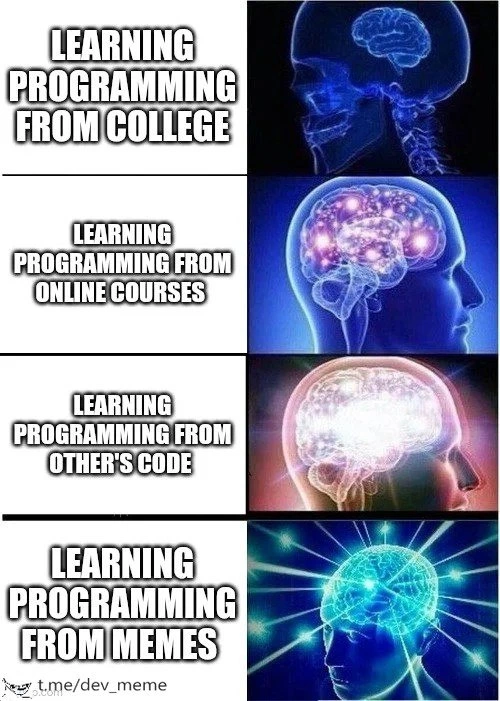
This meme uses the Expanding Brain format (each panel shows a bigger, glowier brain) to rank four ways people learn programming. As the brain image “expands,” the implied knowledge or enlightenment increases. Let’s break down each panel and why it’s ordered this way:
Learning programming from college: The first panel’s text (“LEARNING PROGRAMMING FROM COLLEGE”) is next to a normal blue brain image. This stands for a formal education route – like getting a Computer Science degree or attending a university. In college, you learn foundational concepts: data structures (like binary trees or hash tables), algorithms, math for computing, and theoretical principles. It’s structured and thorough, but often very academic. Many new grads know how to prove a binary search is $O(\log n)$, yet might not have built a real app from scratch. The meme portrays this traditional path as the baseline brain – valuable, but not yet “glowing.”
Learning programming from online courses: The second panel shows a brain starting to glow pink-purple, labeled “LEARNING PROGRAMMING FROM ONLINE COURSES.” This refers to MOOCs (Massive Open Online Courses) and other internet tutorials. Think of platforms like Coursera, edX, Udemy, freeCodeCamp, or even YouTube tutorials. These are typically more hands-on and up-to-date with industry trends (for example, a course on the latest JavaScript framework). They often focus on practical skills — you might build a small web app or a game as you follow along. In the developer learning journey, many consider this a step up in applicable knowledge compared to formal college, hence the brighter brain. You’re directly learning the tools and technologies used in the field, which feels like a power boost.
Learning programming from others’ code: The third panel’s brain is almost white with brilliance, captioned “LEARNING PROGRAMMING FROM OTHER’S CODE.” This suggests reading and analyzing real code written by other developers. For many programmers, digging into another person’s codebase is a profound learning experience. For instance, you might browse an open-source library’s source code to understand how it works, or read your coworker’s code in a code review. This is where theory meets practice: you see how concepts are implemented in reality, complete with clever tricks or occasional ugly hacks. It’s like being thrown into a legacy code swamp and coming out with survival skills. You learn idiomatic usage of a language, patterns like how experienced devs structure modules, as well as common mistakes to avoid. It’s no coincidence that many self-taught developers say “just reading and tinkering with code” taught them more than any formal course. The meme honors this by giving it the almost-highest enlightenment status – an even bigger brain.
Learning programming from memes: The final bottom panel shows a galaxy-level glowing brain, labeled “LEARNING PROGRAMMING FROM MEMES.” This is the punchline. Memes are humorous images or jokes – in developer communities, these are often inside jokes about coding mishaps, stereotypes, or best practices. Examples include jokes like “It works on my machine”, “Let’s just apply some
regex* machine learning**”*, or the classic “It’s always DNS” whenever any network issue arises. The idea of learning from memes means picking up knowledge from these jokes. How could that be? Well, each meme usually has a story behind it. If you’re new and don’t get the meme, you’ll likely google it or ask someone, and boom – you learn something new! Memes also tend to highlight common mistakes or truths in a memorable way. A meme about a catastrophic deploy on Friday implicitly teaches newcomers why deployments late in the week are risky (everyone’s gone for the weekend if things blow up). It’s a playful form of peer learning. By depicting this as the most “enlightened” stage (brain shooting out energy beams), the meme exaggerates that community wisdom and shared experiences, even delivered jokingly, can sometimes be more insightful than textbook knowledge. It’s a nod to how vibrant dev communities exchange knowledge: not just through documentation and tutorials, but through culture and humor (MemeCulture).
In short, the meme is a hierarchy of learning sources in coding culture, from formal and external (college, courses) to informal and communal (reading code, participating in inside jokes). The humor comes from the absurdity of ranking “funny internet pictures” above a college degree in terms of educational value. But it resonates because every dev who’s been around a while can recall a moment they learned a crucial lesson from a joke or a colleague’s war story – something no class ever taught them. This is a relatable part of the LearningCurve in becoming a programmer and joining developer communities: education isn’t only lectures and assignments, it’s also late-night Stack Overflow searches, reading somebody’s clever hack on a forum, and laughing at memes that only coders would understand. Each step in this meme’s ladder is a real part of the Learning-To-Code journey, just dialed up to comedic effect.
| Learning Source | Brain Power (Meme Panel) | What You Gain |
|---|---|---|
| College courses | Theory, fundamentals (algorithms, etc.) | |
| Online courses/tutorials | Practical skills, current tools | |
| Reading others’ code | Real-world patterns, debugging tricks | |
| Developer memes & jokes | Tribal knowledge, cautionary tales 😅 |
(The colored squares above conceptually represent the increasing brain glow in each panel.)
As shown, by the time you’re “learning from memes,” you’ve absorbed not just textbook knowledge but the collective experience (and humor) of the developer community. It’s a playful way to celebrate self-directed learning and the idea that sometimes the best lessons come from the most unexpected sources.
Level 3: Meme-Driven Mastery
At the highest plane of this meme’s joke, it’s celebrating a tongue-in-cheek hierarchy of programming education. The Expanding Brain format frames a progression from traditional learning to unorthodox enlightenment, humorously crowning memes as the supreme teacher. Why is this funny to seasoned devs? Because it flips the script on conventional wisdom: typically, a college computer science degree is seen as the pinnacle of learning. Here, though, the “galactic brain” moment is learning from memes. It satirically suggests that after you’ve slogged through formal education, countless online courses, and digging through others’ code, the ultimate aha’s come from inside jokes on the internet.
On a serious note, experienced developers recognize a kernel of truth in each panel. The meme hints at how theory from academia can fall short in practice. Sure, your algorithms class teaches big O notation and graph theory, but it might not prepare you for naming variables foo and bar at 2 AM while fighting a production bug. Online courses and tutorials (think Coursera or Udemy) give you up-to-date frameworks and hands-on projects, but often march you through happy path examples. It’s when you dive into reading others’ code – perhaps scouring a large open-source project on GitHub or inheriting a bizarre enterprise codebase – that you level up in unpredictable ways. You learn real-world patterns, see anti-patterns in the wild, and develop that sixth sense for debugging hairy issues. Senior engineers smirk because they’ve all had that “I learned more in one messy code review than in 10 lectures” moment.
So why place programming memes at the top? It’s an ironic exaggeration, but with a grain of insight: developer meme culture (TechHumor on Twitter, subreddits like r/ProgrammerHumor) distills shared hard-won lessons into jokes. The humor is accessible only if you get the reference – which means you likely learned the underlying concept the hard way. A meme about “`npm install` downloading the entire internet" hints at dependency bloat; an “it works on my machine” joke winks at environment configuration nightmares. These jokes are sticky; they spread in dev communities as cautionary tales or simply camaraderie in the absurdity of our craft. In other words, memes condense and propagate technical knowledge in a highly memorable format. They’re a community curriculum of what not to do, what to double-check, and what to laugh about after surviving a crazy release. The final panel’s radiant blue brain isn’t saying memes literally make you smarter than college, but it pokes fun at the reality that many programmers feel their true enlightenment came from outside the classroom – often from peers, open-source projects, and yes, those snarky memes that tell you “Don’t deploy on Friday” with a laugh.
Description
This is a four-panel 'Expanding Brain' meme that satirizes the different ways developers acquire programming knowledge. Each panel pairs a method of learning with an increasingly illuminated and god-like brain scan. The first panel, 'LEARNING PROGRAMMING FROM COLLEGE', shows a small, simple brain. The second, 'LEARNING PROGRAMMING FROM ONLINE COURSES', depicts a brain with some glowing neural activity. The third, 'LEARNING PROGRAMMING FROM OTHER'S CODE', features a brightly glowing and complex brain. The final and most enlightened panel, 'LEARNING PROGRAMMING FROM MEMES', shows a brain that is radiating pure energy and cosmic light. The humor lies in the absurd conclusion that memes are the ultimate source of programming wisdom, surpassing formal education and even practical experience. For senior developers, this resonates as a commentary on how much industry knowledge is transmitted through cultural osmosis and shared humor, which often contains grains of truth about best practices, toolchains, and corporate dysfunction that formal education misses
Comments
7Comment deleted
College teaches you data structures. Stack Overflow teaches you how to use them. Other people's code teaches you how not to use them. Memes teach you that you probably didn't need them in the first place
CS degree gives you Big-O, MOOCs give you syntax, spelunking legacy code gives you trauma, but one meme about a distributed monolith finally installs the production paranoia that makes you Staff
After 20 years in the industry, I've finally realized that the most accurate technical documentation is hidden in the comments of a meme about how nobody reads documentation
The real galaxy brain move? Learning programming from production incidents at 3 AM. Nothing teaches you about race conditions, memory leaks, and the true meaning of 'works on my machine' quite like a pager going off during REM sleep. College teaches you Big O notation; memes teach you that O(n²) is fine if n is small and your manager isn't watching. But production? Production teaches you that every architectural decision is a future 2 AM debugging session waiting to happen
CS taught Big O, courses taught frameworks, other people's code taught humility; memes taught the production invariant: it's a distributed monolith and the only up-to-date docs are in sarcastic Slack threads
College teaches balanced trees; memes reveal the gloriously skewed reality of legacy production heaps
Senior curriculum order: degree → MOOCs → git blame → memes - only the last one covers CAP, Conway’s Law, and on-call trauma in a single panel