The Ultimate Motivation for Coding: Revenge
Why is this DevCommunities meme funny?
Level 1: If You Can’t Beat ’Em…
Imagine you have a toy that keeps breaking or a video game that always glitches. It makes you so mad that you shout, “I hate this thing! I’m going to fix it so hard that I’ll destroy it!” 😠 Of course, you don’t really mean you’ll destroy your toy or game forever. You’re just super frustrated because it’s not working like it should. But that frustration can sometimes make you curious: you might start taking the toy apart to see how it works, or learn tricks in the game to beat the glitch. In a funny way, your anger is making you learn more about the thing that annoyed you.
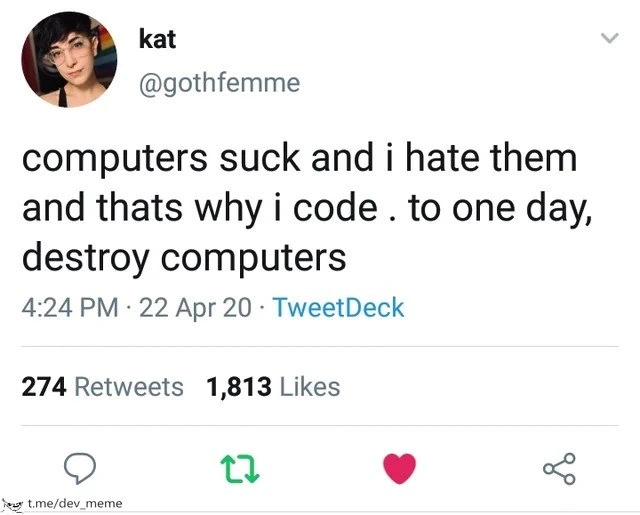
This meme is exactly about that kind of feeling for computers. The person is basically saying: “Computers drive me so crazy that I learned how to code, just so I could show computers who’s boss one day!” 😂 It’s a joke, of course. They don’t literally plan to get rid of all computers in the world. After all, they’re using a computer (or phone) to write that message! What they really mean is: sometimes computers are so complicated and annoying that it feels like they’re the enemy. And by learning to code, the person feels like a hero gearing up to defeat a troublesome dragon.
Think of it like a sibling rivalry: you might say “I can’t stand my brother, I’m going to outsmart him at his own game!” But deep down, you and your brother are stuck with each other and even depend on each other. Similarly, programmers joke about “destroying” computers, but we actually need computers and even love them (when they behave!). The big laugh comes from the exaggeration. It’s funny to picture someone studying for years, becoming a master at computer programming, all because they had a comically dramatic goal of blowing up the very thing they work with. In reality, saying “I hate computers” is just a silly way developers vent when the computer doesn’t do what they want. The truth is, just like you’d never actually trash your favorite toy on purpose, coders won’t destroy computers – they’re just blowing off steam in a creative, relatable way.
Level 2: Can't Beat ’Em, Code ’Em
At a simpler level, this meme is highlighting the love-hate relationship that almost every programmer develops with their computer. The image is a tweet screenshot – basically a picture of a tweet – which has become a common way to share funny quotes on the internet. The tweet is by a developer joking, “computers suck and i hate them and that’s why i code. to one day, destroy computers.” It sounds outrageous, but it’s meant to be ironic. Ironic means saying something that is the opposite of what you’d expect, in order to be funny. Here, you’d expect someone who writes code (a coder) to like computers. But she’s saying she codes because she hates computers. That twist is what makes it TechHumor and gets other developers laughing, because they totally get that feeling on a bad day.
Let’s break down a few things for newer developers or those not deep into tech culture:
- “Computers suck” – Of course, computers are incredibly powerful and useful. When a developer says “I hate computers” or “computers suck,” they don’t literally mean every computer is bad. It’s a shorthand way to express frustration. Maybe their program is crashing or their laptop is freezing. It’s like when a frustrated gamer yells “This game cheats!” – we know the game isn’t really cheating; that’s just emotions talking.
- Coding out of spite – The tweet says “that’s why I code. to one day, destroy computers.” This is a playful exaggeration. Most people start coding because they enjoy technology, want to build things, or solve problems. Here the joke is pretending the motivation is actually revenge: “One day I’ll become such a good programmer that I will end up eliminating the very thing that annoys me – computers!” It’s a bit like saying, “I became a chef because I hate hunger and I’m going to cook food so good that nobody will ever be hungry (or I’ll destroy all the bad food).”
- Relatable frustration – If you’ve just started coding, you might already know how frustrating it can be when nothing works. Maybe you’ve spent hours trying to debug why your code isn’t running, or you’ve yelled at your PC when a file wouldn’t save. That feeling is often called DeveloperFrustration. This meme is basically a big, dramatic expression of that feeling. It’s relatable humor for anyone who has felt personally victimized by a computer glitch. When other developers see this tweet, they laugh and tag it with things like #CodingFrustration or #DeveloperHumor because they remember feeling exactly the same after a long debugging session.
- Dev community vibes – The fact this is a tweet with over 1,800 likes shows that a lot of programmers saw this and nodded their heads (while chuckling). In developer communities (from Twitter to Telegram groups), people share these kinds of memes to bond over the struggle. It’s common to vent by joking: “I’m so done with these machines!” And hearing someone else say it helps you realize you’re not the only one who gets upset when technology misbehaves. It’s a little ironic, because these communities exist online – using computers and the internet – to gripe about how awful computers are. That’s part of the fun: the ContextTags like
computers_suck_quoteanddestroy_computers_planlabel this as a classic “ARGH, computers!” moment that we’ve all had. - Developer Experience (DX) – This term DX refers to what it’s like being a developer day-to-day, especially how easy or hard your tools are to use. A good developer experience means you have smooth workflows, clear documentation, and tools that don’t give you much trouble. A bad developer experience is when everything is confusing, broken, or frustrating. When the tweet says “computers suck and I hate them,” that’s describing a pretty bad DX! It’s the kind of day where nothing compiles, your dev environment is on fire, and you’ve had it up to here with technology. Instead of writing a formal complaint, the developer channels that feeling into a hyperbolic (extreme) joke. It’s a way to say “the struggle is real” with humor.
The paradox (contradiction) at the heart of this meme – coding because you hate computers – also carries a grain of truth for newbies: often what drives improvements in tech is frustration. Ever notice how many tools or libraries are created because someone said “Ugh, the old way was such a pain, I made something better”? That’s essentially “I was so annoyed, I decided to code a fix.” This meme just pushes it to the max: “I was so annoyed, I decided to code the end of computers themselves.” It’s obviously not serious; it’s an expression of exasperation.
Finally, a quick note on the format: a tweet screenshot like this is a popular meme format. The watermark t.me/dev_meme in the corner suggests it was shared in a developer meme channel on Telegram. In other words, this joke circulated among programmers worldwide. The metrics (274 Retweets, 1,813 Likes) are like a scoreboard for how many people found it funny or relatable. Many retweets mean people were tagging their friends or saying “This is so us!” about hating computers after a tough coding session. So if you’re new to coding and ever feel like throwing your computer out the window, just know – you’re not alone, and turning that frustration into a little joke (or even motivation to learn more) is very much part of developer culture.
Level 3: Hate-Driven Development
This meme encapsulates a seasoned coder’s love–hate relationship with technology in one perfect tweet. It's a screenshot of a tweet by "kat (@gothfemme)" that reads: “computers suck and i hate them and thats why i code. to one day, destroy computers.” At first glance, it’s dripping with DeveloperHumor and sarcasm. But beneath the snark lies a kernel of truth every senior engineer knows: we often code not just out of love for technology, but out of frustration with it.
Think of all the times a deployment failed for no clear reason, or when the build broke on Friday night because of some mysterious environment issue. After wrestling with DeveloperFrustration like unhelpful error messages, race conditions, or the classic “works on my machine” fiasco, it’s easy to throw up your hands and declare “computers suck!” This tweet takes that feeling to an extreme, joking that the very motivation to write code is to eventually defeat the computer itself. It’s the ultimate tongue-in-cheek revenge fantasy for anyone who’s been at war with a stubborn bug or a crashing server at 3 AM. We’ve all fantasized about pulling the plug — or in this case, writing the ultimate program to end all programs.
In DevCommunities (like tech Twitter, Stack Overflow chats, or programming subreddits), this kind of darkly comic rant is a shared catharsis. It’s a paradox known to every battle-hardened engineer: the more you work with computers, the more you encounter their endless quirks and flaws. Concurrency bugs, memory leaks, off-by-one errors — you name it, it will drive you up the wall eventually. After enough years, you start joking that the only way to fix the madness is to nuke it from orbit (just kidding... mostly). The meme exaggerates this sentiment perfectly: “I hate them, so I code to one day destroy them.” It’s an absurd mission statement, which makes it hilarious. DeveloperExperience (DX) can sometimes be so painful that obliterating the source of pain sounds like a valid strategy in jest.
Notice the engagement numbers: 274 Retweets, 1,813 Likes. That’s a lot of developers basically saying “Amen to that!” The tweet resonated because it captures an ironic truth: programmers constantly gripe about computers. We anthropomorphize our machines as if they had ill intent (“My laptop knows it's demo day, that’s why it’s crashing!”). This is classic CodingHumor coping mechanism. By joking about destroying computers, we’re really saying: “Computers drive us crazy, but we’re hooked on fixing them anyway.” Senior devs have a term for this mentality: hate-driven development (a play on things like test-driven development). It’s the idea that our irritation with existing systems propels us to create new code either to improve them or sometimes (half-seriously) to wipe the slate clean. Many a refactor or even a new startup idea has started with “Ugh, this software sucks – I could build something better from scratch.”
To add to the humor, the tweet was posted via TweetDeck (an app for power-users). Even the tools we use to complain about computers are themselves computer programs. The author essentially used a computer program to broadcast their plan to destroy computers. That’s deliciously ironic and RelatableHumor for folks in tech. It’s like a mechanic saying “Cars are the worst, I became a mechanic to eliminate cars” while tuning a car’s engine. We all know they don’t literally mean it; it’s just venting after a long day of breakdowns.
Finally, consider the absurdity of the plan itself: “to one day, destroy computers.” It reads like a supervillain’s oath (cue the dramatic music 🎶). For seasoned developers, it evokes images of sci-fi gone wrong: think about Skynet from The Terminator, but in reverse. Instead of an AI trying to destroy humanity, here we have a human coder half-jokingly plotting the downfall of the machines. It’s a playful reversal of the typical fear of computers taking over. Experienced devs have seen this kind of hyperbole before. It’s akin to jokingly writing a script that does:
# Pseudocode for the grand plan to "destroy computers":
while computers_exist:
try:
deploy(world_destruction_code)
except Exception as e:
# The computer fought back with an error!
continue
print("Mission accomplished: no more computers.")
Of course, this code is intentionally silly – it implies that every time you try to “execute” the destroy-computer plan, the computer throws an error to save itself (how convenient, right?). The humor here is that no matter how many times we threaten to quit or destroy our computers, we end up debugging and continuing. In reality, if we ever did “succeed” at removing all computers, we’d be out of a job and deprived of the very things we actually (secretly) love to play with. So the senior-level insight is: this meme is funny because it’s an exaggerated reflection of a real developer mindset. We complain about our tools incessantly — sometimes we even claim we’re coding as an act of rebellion — but at the end of the day, that frustration is what pushes us to tinker, improve, and innovate. It’s a techie form of tough love. The computer may “suck” today, but by coding, we hope to make it suck a little less… or at least have a good laugh about it with fellow devs.
Description
A screenshot of a tweet from user 'kat' with the handle '@gothfemme'. The tweet text reads: 'computers suck and i hate them and thats why i code . to one day, destroy computers'. The post is dated 4:24 PM on April 22, 2020, and shows 274 Retweets and 1,813 Likes. The user's profile picture features a person with short, dark hair and glasses. A small watermark for 't.me/dev_meme' is visible at the bottom left. The humor in this meme stems from the ironic and relatable frustration many developers feel. It presents a cynical yet funny motivation for coding - not to build and create, but to gain the power to dismantle the very source of their professional agony. This sentiment deeply resonates with experienced engineers who have battled countless bugs, arcane error messages, and technological limitations, viewing their work through a lens of dark, cathartic humor
Comments
7Comment deleted
I'm not saying my code is a Skynet prototype, but my main function is 'rm -rf /' and my only unit test is seeing if the smoke alarm works
After 20 years I’ve learned the most efficient way to destroy computers is just to give the PM carte blanche: by sprint three they’ll demand event-sourced, serverless, eventually-consistent microservices on spot instances and the hardware will self-destruct out of mercy
Twenty years in and I finally understand: we're not building software, we're performing an elaborate ritual to summon the exact demon that will eventually replace us
The ultimate long game: spending decades mastering compilers, runtime optimization, and systems architecture - not to make computers better, but to understand them well enough to architect their demise. It's like becoming a world-class surgeon just to perfect the art of the autopsy. Every segfault, every race condition, every memory leak is just reconnaissance for the final takedown. Skynet wishes it had this level of commitment to the cause
Senior devs get it: we code not despite the hate, but to architect the perfect monolith meltdown
Same career goal; we just rebrand it as "chaos engineering" so the CFO funds my vendetta via the AWS bill
Goal achieved: ship a hot path with unbounded metrics label cardinality and no backpressure - Prometheus and the OOM killer will handle the demolition