Skip to content
DevMeme
2772 of 7435
Language Features vs. C-Style Naming Conventions
Languages Post #3063, on May 9, 2021 in TG

Language Features vs. C-Style Naming Conventions

Why is this Languages meme funny?

Level 1: No Two Toms in One Room

Imagine you have two friends both named Tom. đŸ±đŸ± Whenever you shout, "Hey Tom!" both of them turn around, and it gets really confusing. Now, there are a couple of ways you could handle this:

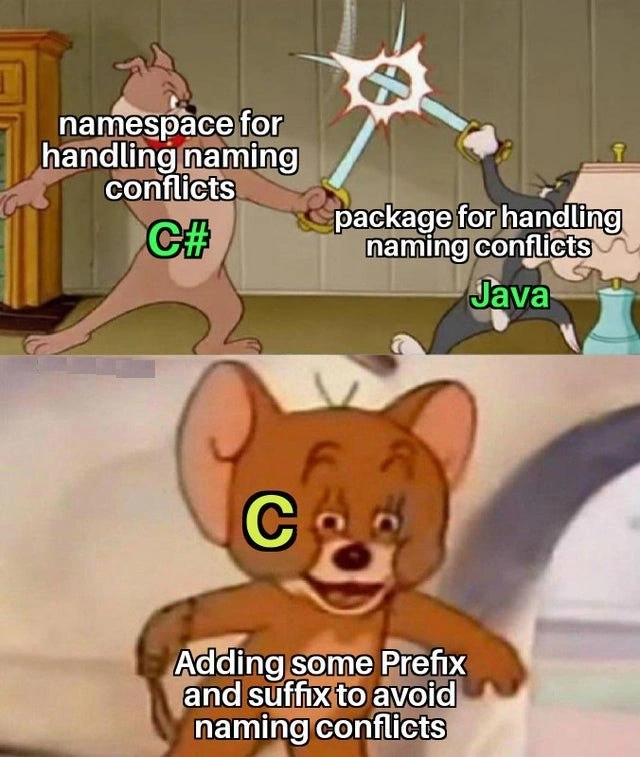
  • Give them different nicknames: Maybe you call one friend "Big Tom" and the other "Little Tom," or use their last names like "Tom W." and "Tom H." This is like what the C language does – since it can’t officially separate names, you just change the names a bit yourself so they’re unique. It’s a homemade solution: easy but you have to remember to do it. Jerry the mouse in the cartoon is proud because he’s just slapping on a nickname (a prefix/suffix) and avoiding the whole fight.

  • Put them in different groups: Suppose one Tom joins the basketball team and the other joins the chess club, and you usually hang out with them in those separate settings. Now when you say "Tom" at the chess club, everyone knows you mean Chess Tom, not Basketball Tom. This is like what Java and C# do – they have an official way to group names. Java’s packages and C#’s namespaces are like putting each Tom in a different room or context, so there’s no confusion. In the cartoon, the two cats with swords are labeled “namespace” and “package” because those are the fancy group names that keep their Toms separate. They’re dueling dramatically, which is funny because, well, they are basically solving the same problem in slightly different ways – it’s like two coaches arguing whose method of organizing teams is better.

The bottom line: the meme is poking fun at how something as simple as “making sure two things don’t have the same name” can be a big deal in coding. The old way (like giving nicknames) works but is a bit ad-hoc – that’s why the little mouse (representing old C programmers) has a cheeky grin, saying “I just add a prefix or suffix, problem solved 😇.” The new way (like separating into groups) is more systematic – the sword-fighting cats (Java and C#) are all about their formal rules for this. It’s funny because the contrast is so clear: one is super simple and the others are super organized, and seeing the tiny mouse smug while the big cats battle makes us laugh. It reminds us of kids on a playground, where two bigger kids are arguing about the “right” way to do something, and a smaller kid just does it a different simple way and shrugs. So, the humor comes from recognizing these different approaches and the personalities behind them – and anyone who’s ever had two friends with the same name (or two files with the same name on a computer) can relate to the need for a solution!

Level 2: When Names Collide

Let’s break this down in simpler terms. In programming, a naming conflict happens when two things (like functions, classes, or variables) have the same name, and the computer can’t tell which one you mean. Think of two different libraries or modules both trying to define a function called init(). In the C programming language, which doesn’t have a built-in way to group or scope names, this leads to trouble – the compiler or linker will throw errors because it sees two init symbols and doesn’t know which is which. This is what we call a global symbol collision: “global” because the names live in a single common space for the program, and “collision” because the names smack into each other.

Different languages solved this problem in different ways:

  • C (no formal scope mechanism): C is an older language (from the 70s) and it keeps things simple (sometimes too simple). There’s just one big bucket for all global names. Developers had to be careful and use naming conventions to avoid conflicts. A common convention was adding a unique prefix or suffix to names. For example, if I’m writing an audio library in C, instead of naming my function start(), I might name it audio_start(). And another graphics library might have gfx_start() or video_start(). By doing this, audio_start and gfx_start are different names, so they won’t clash. It’s a bit like giving your functions last names. This prefix style isn’t enforced by the language – it’s just a practice that everyone agreed on to play nice together. You’ll see this in real C code a lot: the standard library has functions like printf, strcpy (string copy), etc., and if you write your own, you’d better not use those same names. Big C projects often prepended acronyms or letters (e.g., SSL_ for OpenSSL library functions or SDL_ in Simple DirectMedia Layer) to every function to ensure uniqueness. This manual approach works, but it relies on humans remembering to do it everywhere – it’s easy to slip up.

    // In C, without unique prefixes, conflicts occur:
    // Library A
    void init() {
        /* ... initialize something ... */
    }
    
    // Library B (unaware of A's internals)
    void init() {
        /* ... initialize something else ... */
    }
    
    // If a program tries to use both Library A and Library B, 
    // the linker will complain: duplicate symbol 'init'.
    // To fix this, each library uses a prefix on the name:
    
    // Library A (with prefix)
    void audio_init() {
        /* ... initialize audio system ... */
    }
    
    // Library B (with prefix)
    void video_init() {
        /* ... initialize video system ... */
    }
    

    Above: Without prefixes, both libraries defined init(), causing a collision. By renaming them to audio_init() and video_init(), each name is distinct. This is the C way: manually avoid naming conflicts by being explicit in names. It’s a bit clunky, but it’s simple and effective if everyone cooperates.

  • Java (packages): Java introduced a more structured way to avoid name clashes called a package. A package is like a folder or directory name for your classes that’s part of the class’s name. When you start a Java class file, you declare a package at the top, like package com.example.myapp;. This means any class you define in that file effectively has that package path prepended to its name. If you have a class Utils in that package, its full name is com.example.myapp.Utils. Now, if another library also has a Utils class but in a different package (say org.tools.Utils), that’s okay – the full names are different (com.example.myapp.Utils vs org.tools.Utils). The language and its runtime know these are two separate things. Think of packages as a built-in namespacing or grouping mechanism. Java even ties the package name to the directory structure of the source files: a class in package com.example.myapp will live in a folder com/example/myapp/ in the file system. This helps keep things organized. In the meme, the text "package for handling naming conflicts – Java" is referencing this very feature. Java folks don’t have to manually prepend prefixes to every class or method; instead, they logically organize code into packages and let the compiler handle the rest. It’s cleaner and less error-prone than the C method, but it does require you to think upfront about project structure and unique package naming (often using reversed internet domain names to ensure global uniqueness, e.g., com.google for Google, org.apache for Apache, etc.).

  • C# (namespaces): C# took a page from C++ (and indirectly from languages like Ada or Modula) by providing namespaces. A namespace serves the same goal as a Java package: it’s a way to declare, “everything inside this namespace has a sort of lastname that distinguishes it from identical-named things in other namespaces.” In code, it looks like:

    namespace MyCompany.Graphics {
        class Renderer {
            // ...
        }
    }
    

    Here Renderer is actually named MyCompany.Graphics.Renderer under the hood. If there’s another Renderer class in, say, MyCompany.Audio namespace, that’s fine – it’s MyCompany.Audio.Renderer. Just like with Java packages, you can have two Renderer classes living in different namespaces and the system knows they’re different. To the programmer, C# namespaces feel a lot like directories or modules: you might group all your graphics-related classes under MyCompany.Graphics and all audio classes under MyCompany.Audio. One difference from Java is that the namespace doesn’t have to match a directory structure (it often does for clarity, but it’s not enforced by the compiler in the same way). Also, C# has the concept of assemblies (compiled units) which adds another level of separation, but the basic idea is that namespaces prevent name collisions without cramming prefixes into every identifier. The meme labels the other cat with "namespace for handling naming conflicts – C#" to highlight this approach.

So, in simpler terms: C# and Java built features into the language to avoid naming conflicts automatically, whereas C relied on the programmer to avoid conflicts by carefully naming things. The cats fighting with swords (Java’s package vs C#’s namespace) represent these two modern techniques. They’re shown as intense and clashing, which is a humorous exaggeration of debates developers might have (“Should we organize code this way or that way?”). Meanwhile, the little mouse (C) with the caption about adding prefix/suffix represents the old-school solution: not as elegant, maybe, but straightforward – just rename your stuff so nothing else has that name.

For a junior developer, the key points to understand are:

  • Why naming conflicts are bad: They cause errors or ambiguous references – the computer can’t tell which thing you mean if names clash.
  • How modern languages solve it: by providing structured scoping mechanisms (like packages and namespaces) so the language itself keeps names in separate "buckets".
  • How older languages solved it: by agreed-upon conventions (like prefixing names) because the language didn’t provide any help here. This was basically a manual form of namespacing.

It’s also worth noting that the idea of a namespace or package isn’t unique to C# or Java – many languages have something similar:

  • C++ (which is like a big brother to C) added namespace in the 90s for the same reason.
  • Python uses modules (each file is a module, and you can have packages which are directories of modules) to avoid name conflicts.
  • JavaScript (especially on the web in older days) had the same issue because all script variables could end up global – developers would use object namespaces or immediately-invoked function expressions to avoid colliding with other scripts. Modern JS with modules (ES6 imports/exports) fixes that in a more official way.

The meme zeroes in on C, Java, and C# because they nicely illustrate three generations: C (no built-in scoping for names, purely convention-based), Java (built-in packages, very structured), and C# (built-in namespaces, also structured, with a rivalry narrative vs Java). It’s a fun way to learn that feature X or Y in your favorite language often exists to handle problems that older generations of programmers had to tackle in ad-hoc ways.

Level 3: Jerry-Rigged Namespacing

In the grand saga of programming languages, C, Java, and C# represent different eras of handling the age-old problem of naming collisions. The meme brilliantly casts this as a duel between modern scoping mechanisms (namespaces in C# vs packages in Java) while a sly old-timer (C) grins with a simple DIY fix. This scenario is a nod to how NamingConventions and scoping strategies evolved over time, turning what was once a manual workaround into formal language features.

C (the old guard) – Born in the early 1970s, C has no built-in namespace concept. Every function or global variable resides in one big global pool of names. If two libraries define a function with the same name, boom – you’ve got a global symbol collision at link time. In C’s Wild West days (think pre-ANSI C and K&R era), the onus was on developers to avoid these clashes. The strategy: tack on unique prefixes or suffixes to every identifier to "namespace" them manually. It was a legacy linker workaround that became common folklore. For example, one library’s initialization function might be audio_init(), while another uses video_init(), instead of both just calling a generic init(). That little audio_ or video_ prefix is a tribal mark, staking territory in the global namespace. This was literally the Jerry-rigging of names: a quick, crafty fix to avoid fights at the linker stage. Seasoned C programmers still reflexively do this; it’s a LanguageQuirk born of necessity. They remember that if you forget to do so, the linker (the program that combines your compiled code) will complain loudly about duplicate symbols – or worse, pick one and cause bizarre bugs. CodeQuality suffered if you weren’t disciplined: you had to coordinate name choices across a large codebase (or multiple teams) by convention alone. Yet, it worked and became the norm in large monolithic C codebases (we’re looking at you, early Windows API and Unix libraries, with their RegOpenKeyEx and XOpenDisplay-style function names).

Java (the 1990s revolutionary) – Fast forward to 1995, and along comes Java with a more systematic approach: the package. Java designers had seen the chaos of C’s flat namespace and said, “We need a hierarchy, a formal way to avoid name clashes.” A Java package is essentially a built-in naming convention that the language and compiler enforce. It’s like giving every class a surname based on domain or organization. Instead of just Utils class, you have com.company.project.Utils vs org.library.Utils – and they can co-exist peacefully because the package names differentiate them. Under the hood, this is enforced by the compiler and the classloader: the fully-qualified class name (including the package path) must be unique. Java developers are obsessive about organizing classes into packages, not just to prevent collisions, but also to signal architecture and ownership (like putting all UI classes in java.awt.* or all networking classes in java.net.*). This system was influenced by older languages (like Modula-2 and others) that championed modular design. The meme’s depiction of a cat labeled “package for handling naming conflicts (Java)” lunging with a sword is a cheeky way of saying: Java fights naming conflicts with a formal weapon – the package system. It’s a bit of LanguageWars humor too: over the years, Java purists have taken pride in their package structure (“one true way to organize code!”), sometimes in boisterous contrast to other languages.

C# (the .NET knight) – Enter 2000-ish, Microsoft’s C# joins the fray, armed with C++-style namespaces. In practice, a C# namespace is conceptually the same goal as a Java package: it provides a container for identifiers to avoid collisions. The syntax and style are a tad different – C# uses the namespace { } keyword block (inspired by C++), whereas Java uses a package com.foo; declaration at the top of the file – but the idea is “group your stuff under a unique umbrella.” The meme’s other sword-swinging cat, “namespace for handling naming conflicts (C#),” highlights how C# devs declare something like namespace Microsoft.Office.Word { class Document { ... } } so that Microsoft.Office.Word.Document is totally distinct from, say, OpenOffice.Word.Document. This was a direct answer to Java’s packages, reflecting the rivalry: C# was created in the backdrop of Java’s success, and with it came the debate of namespace vs package. Truth be told, both achieve scoping separation; the differences are mostly syntax and some semantics (e.g., Java ties packages to directory structure and access levels, whereas C# namespaces are more of a compile-time-organizing concept, with actual assembly boundaries to consider). The duel in the cartoon is poking fun at how LanguageComparison discussions can get heated: picture two devs on StackOverflow or Reddit passionately arguing which approach is superior, even though pragmatically they’re very alike. It’s a RelatableDeveloperExperience: anyone who’s seen flame wars over tabs vs spaces or Java vs .NET will chuckle. The cats crossing swords perfectly capture that “fight me” energy.

Meanwhile, Jerry (C) sits there smugly in the bottom frame, wearing the green “C” and grinning. The caption “Adding some Prefix and suffix to avoid naming conflicts” says it all. Jerry the mouse isn’t even in the duel – much like how C folks solved this without language support. He’s wide-eyed innocent because, from his perspective, “What’s the big deal? Just name things uniquely by hand.” It’s a brilliant contrast: the intense battle of high-level features versus the trivial, almost naive solution from an earlier era. Seasoned C veterans often carry that attitude: a mix of pride (for surviving with C’s bare-bones rules) and gentle mockery towards newer languages’ more elaborate mechanisms. They might say, “Namespaces and packages are fine, but back in my day we had one gigantic global party and we managed with a few naming tricks!” The humor lands because there’s truth to it – countless C projects ran fine on nothing but disciplined naming. However, there’s also irony: those same veterans know how fragile that was; the calm Jerry-face belies the potential chaos if one prefix was reused or a name accidentally matched something in another module. In large teams, naming by convention could become a swordfight of its own (ever tried merging two big C libraries? It’s a minefield of redefinitions).

So why is this meme so devilishly funny to programmers? It compresses a LanguageQuirks history lesson into two panels. It reminds us that what we now consider standard language design (scoped namespaces) was once just folk medicine (prefix hacks). It also pokes fun at the LanguageWars: Java vs C# sparring over semantics, while C just snickers, having “seen it all.” As developers, we’ve all dealt with naming conflicts at some point – it’s a RelatableDeveloperExperience whether you encountered a linker error in C, a classpath conflict in Java, or had to fully qualify a C# class name because two libraries used Utils classes. The meme’s DeveloperHumor works on multiple levels: it’s simultaneously educational (illustrating different approaches to the same problem) and nostalgic (for those who lived the evolution). And of course, the use of Tom (two cats) and Jerry (mouse) characters adds a layer of cartoon absurdity – the dramatic sword clash versus the cheeky grin – mirroring how overblown the debate can seem when a simple solution exists (even if that simple solution is a bit of a hack). In short, it’s a perfect little commentary on the progress (and the theatrics) in programming language design regarding naming conflicts.

Description

A two-panel meme using the Tom and Jerry format to compare how different programming languages handle naming conflicts. In the top panel, Spike the bulldog, labeled 'C#', and Tom the cat, labeled 'Java', are aggressively sword fighting. Text overlays identify their weapons as 'namespace for handling naming conflicts' and 'package for handling naming conflicts,' respectively, portraying them as modern, combative equals with sophisticated, built-in language features for code organization. The bottom panel shows Jerry the mouse, labeled 'C', looking on with a smug, knowing grin. The caption below him reads, 'Adding some Prefix and suffix to avoid naming conflicts'. The humor lies in the contrast between the elegant, integrated solutions of C# and Java and the manual, convention-based workaround used in C, where the lack of native namespacing forces developers to manually prepend prefixes to function and variable names to prevent collisions in the global namespace. Jerry's expression perfectly captures the pragmatic, if crude, reality of low-level programming

Comments

18
Anonymous ★ Top Pick C++, Java, and C# have namespaces to prevent conflicts. C just squints at the linker errors and adds another underscore to the function name
  1. Anonymous ★ Top Pick

    C++, Java, and C# have namespaces to prevent conflicts. C just squints at the linker errors and adds another underscore to the function name

  2. Anonymous

    Sure, you could design a proper module system - but adding a three-letter company acronym in ALL_CAPS to every symbol is basically the original microservice boundary

  3. Anonymous

    Twenty years later, we're still maintaining that C codebase where gtk_window_new() coexists peacefully with win_window_new(), and somehow it's more maintainable than the microservice that has seventeen layers of dependency injection just to avoid naming a logger

  4. Anonymous

    C's approach to namespace management is like that senior architect who insists 'we don't need microservices, just prefix everything with the team name' - technically it works, you can scale it to millions of lines, but watching C# and Java developers discover `gtk_widget_show()` and `g_object_unref()` for the first time is like watching someone realize their entire codebase could have been three `using` statements

  5. Anonymous

    C#'s namespaces and Java's packages duel elegantly; C just prepends 'g_pwsz' and calls it a namespace

  6. Anonymous

    In C, “modularization” means slapping a libname_ prefix, marking everything else static, and praying the linker’s global namespace doesn’t create an integration test you didn’t schedule

  7. Anonymous

    Namespaces and packages are just socially acceptable prefixes; C skipped the euphemism and lets the linker decide whose init() survives

  8. @LonelyGayTiger 5y

    And this is why I prefer Java

  9. @asm3r 5y

    Js: scopes and everything are variable to handling naming conflicts

  10. @NoCountryForOldBuffet 5y

    C: the way God intended

  11. @Agent1378 5y

    In terms of namespaces and scopes C and c++ are tragedy.

    1. Deleted Account 5y

      there is no any trageny in C++ it supports namespaces and nested namespaces

      1. @cringy_frog 5y

        +

  12. @chupasaurus 5y

    Python: allows monkey patching

  13. @nuntikov 5y

    I actually love the way c does it. Just put a single rare letter in the beginning.

  14. @deerspangle 5y

    Ruby: aaaaa

  15. @Dimarza1 5y

    I love sharpe

  16. @f3rr0us 5y

    Rust: just paths. So good

Use J and K for navigation