Skip to content
DevMeme
2771 of 7435
A Developer's Social Media Landscape
DevCommunities Post #3062, on May 9, 2021 in TG

A Developer's Social Media Landscape

Why is this DevCommunities meme funny?

Level 1: Library vs Playground

Imagine asking your friend what they like to do after school for fun. You expect them to say something like "play soccer at the park" or "ride bikes with friends." But instead they grin and say, "I go to the library and help people solve puzzles." It’s a bit like someone choosing the library over the playground. In this situation, the developer is doing exactly that: his idea of "being social" is solving coding problems and sharing projects online, instead of using the usual social apps. It's funny because the girl asking the question didn't expect that kind of answer at all! Just like a kid who prefers reading books and doing puzzles to playing outside, this developer prefers spending time on those coding websites rather than on Facebook or Instagram. It shows that everyone has their own idea of fun and friends – and for some people, like him, the best way to socialize is by learning new things and building stuff with others.

Level 2: Where Coders Connect

Let’s break down what's actually being referenced here in simpler terms. The "social media" the developer lists are Stack Overflow and GitHub, which are both huge in the programming world:

  • Stack Overflow is a famous question-and-answer website for programmers. Imagine you're stuck on a coding problem (say an error in your Python code). You can post the question on Stack Overflow, and other developers will chime in with answers or suggestions. It's part of the broader Stack Exchange network and is like the ultimate help forum for coding. People earn points (called reputation) when their answers are upvoted because they helped someone. For many new developers, discovering Stack Overflow is a turning point – you realize almost every error message you get, someone else has already asked about it on this site! Scrolling through Stack Overflow becomes a daily habit to solve bugs and learn best practices. It's less about sharing personal updates and more about sharing knowledge, but it definitely has a community vibe. Regular users start recognizing each other by usernames and gravatar icons, and there are even inside jokes about copying code from Stack Overflow (the classic newbie move when you're desperate for a quick fix).

  • GitHub is a website for hosting code using a system called Git (which is a version control tool). If you're learning to code, you'll eventually use GitHub to save your projects online or contribute to others' projects. Think of GitHub as a mix between a code portfolio and a social network for developers. You put your code in repositories (repos) which other people can see, and they can "fork" (copy) your repo to tinker with it, or open issues to discuss problems and suggest changes. GitHub shows a contribution graph on your profile highlighting all the code changes you’ve made in a year (those little green squares that many devs get a bit proud of). You can follow other developers, star repositories you find interesting (similar to bookmarking or liking them), and even have conversations through pull request comments or project discussions. For many in the DevCommunities, having an active GitHub profile is a big deal – it's like your coding resume and a way to show you're involved in the developer world.

Now, usually when someone asks "What social media are you on?", they expect answers like Facebook, Instagram, TikTok, etc. Those are platforms for socializing in the general sense – sharing life updates, photos, chatting with friends. In contrast, Stack Overflow and GitHub are all about coding. So why did the developer respond with those? Because for developers, these places feel like social hubs. You're not posting vacation pics; you're posting code snippets or answers, but you're still interacting with people! Many programmers, especially if they're a bit introverted or just very focused on tech, don't spend as much time on traditional social media. Instead, they hang out where they can learn and connect with other programmers. That might mean helping a stranger debug a program on Stack Overflow or collaborating on an open-source app with someone on GitHub. It feels social because you're part of a big conversation in the tech world, even if it's not about everyday life.

To put it in perspective, here's a comparison between regular social media and these developer platforms:

Regular Social Media 🌐 Developer Platforms 💻
Profile pages show selfies, personal bios, and a feed of life updates. Profile pages show your code projects, a short bio, and a graph/calendar of code contributions.
Friends/Followers: you add friends or follow people to see their posts. Followers/Starring: you can follow favorite devs or "star" ⭐ interesting code repositories to keep track of cool projects.
Likes & reactions on posts, photos, or videos. Upvotes & Stars: you upvote helpful answers on Stack Overflow (boosting the answerer's reputation) and give stars to neat projects on GitHub.
Posting updates about your day, sharing selfies or memes. Posting content means asking a programming question, sharing an answer with code, or pushing a new commit to a repository.
Groups/Communities for hobbies, school, or fandoms. Communities form around programming languages/technologies (tags on Stack Overflow like [python], [javascript]) or open-source organizations on GitHub (like a group of people managing a project together).
Direct messaging to chat with friends privately. Discussions/Comments: talk through comments on a Stack Overflow question or in a GitHub issue/pull request to solve problems (more public and focused than casual private chats).

As you can see, Stack Overflow and GitHub provide many of the same kinds of interactions as typical social media, but everything is centered around programming and development rather than personal life.

For a newer developer, it might be surprising at first to think of these as "social," but think about your own early experiences: maybe the first time you asked a question on Stack Overflow and got a helpful answer from a stranger halfway around the globe. That felt pretty magical – you connected with someone purely through coding help. Or the first time someone noticed your GitHub repository and gave it a star, or opened an issue saying "Hey, I used your project and it was really useful!" – that's a warm, fuzzy moment in a coder's life. These interactions make you realize there's a whole developer community out there. So while you might not be posting selfies or liking your cousin's puppy photos, you are still participating in a social ecosystem – just one built around tech.

This meme is highlighting that contrast in a humorous way. It’s common in programming memes to joke that developers have no life outside of coding. Here, the joke is that the developer’s idea of “being social” is literally answering questions on Stack Overflow and pushing code to GitHub. For many of us starting out, spending a Friday night Googling errors and reading Stack Overflow threads, or tinkering with code on GitHub, is totally normal (and actually fun!). So when someone asks a question from the normal world (“Which social media do you use?”), the developer responds with the truth of their world — which ends up sounding funny to anyone outside tech.

In short, for a programmer, Stack Overflow and GitHub aren’t just tools; they're places to hang out with other programmers, learn new things, and even get recognized for your skills. That’s why a developer might half-jokingly list those as their “social media.” It shows how being a coder isn’t just a job or hobby – it can be a whole social life of its own.

Level 3: Open Source Social Life

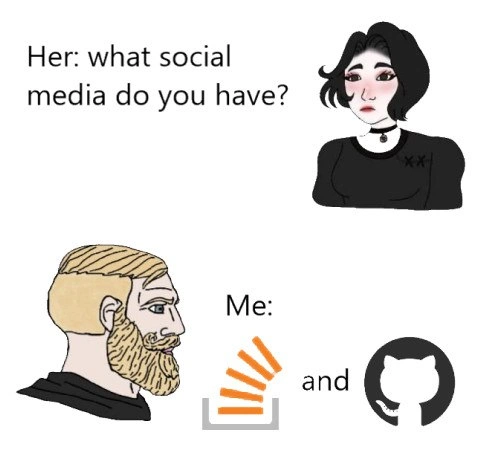
In the world of developer culture, it's completely plausible that someone's main "social networks" are Stack Overflow and GitHub. The humor here comes from how misaligned expectations are between a non-developer asking about social media versus a developer's reality. The question "What social media do you use?" usually expects answers like Facebook, Twitter, or Instagram. Instead, the developer proudly lists Stack Overflow (a Q&A forum for coding problems) and GitHub (a code repository hosting service) as if they were the usual social apps. It's a tongue-in-cheek way to say: "I'm not on regular social platforms; I hang out in developer communities instead."

For seasoned programmers, this isn't just a joke — it rings true. These platforms genuinely have social features and fulfill many social needs within a technical context:

  • Stack Overflow Reputation: On Stack Overflow, you gain reputation points by asking and answering programming questions. It's like a techie version of collecting likes or upvotes, giving a sense of peer recognition. Earning a 15k rep score can feel as rewarding as amassing followers on a mainstream network. There's even a bit of gamification with badges and achievements that keep developers engaged and coming back to help others. High reputation users become well-known in the community, similar to influencers in a niche group, and they often bond over shared challenges (like that infamous null-pointer bug that everyone trips over).
  • GitHub Profiles: On GitHub, developers "follow" each other, give ⭐ stars to interesting projects, and collaborate via pull requests. A GitHub profile can showcase your contributions and even display a graph of your coding activity (those green squares many devs obsess over filling in). In a way, that's like a social timeline of what you've been up to — only instead of vacation photos, it's commits and code reviews. Many devs take pride in their GitHub "street cred," such as maintaining popular open-source projects or having a streak of daily commits. It's analogous to an influencer flexing their follower count, but in the coder universe, we flex with well-documented dotfiles or contributions to Linux. 💻
  • Community Interaction: Both Stack Overflow and GitHub facilitate interactions with peers globally. Whether it's debating the best algorithm in a comment thread or reviewing someone’s code, these are real social exchanges — just centered on software. Longtime users might recognize each other's usernames or avatars, not unlike how you remember frequent posters in a Facebook group. Over time, you build a reputation and relationships; people appreciate the help you give, and you remember those who helped you out of a debugging jam. It's not uncommon to have a network of coding buddies you've never met in person but collaborate with daily through repositories or Q&A discussions.

From a senior perspective, this meme also hints at the introvert developer stereotype. Many programmers are known to be introverted or at least deeply engrossed in their technical world. The scenario suggests that instead of networking at parties or posting selfies, the developer invests time contributing to open source or solving strangers’ coding questions. There's a shared understanding in tech: we might not be social butterflies offline, but catch us on GitHub on a Friday night reviewing pull requests, and that's our idea of "hanging out". The joke pokes fun at ourselves for finding social fulfillment in what outsiders might see as "work." But truly, for passionate devs, collaborating on a cool open-source project or getting that green check mark for an accepted answer on Stack Overflow genuinely sparks joy.

Historically, developers have always had their own dev communities that function like social networks. Before Stack Overflow, there were forums, IRC chat rooms, and Usenet groups where programmers gathered to help each other (and swap a bit of sarcasm). Before GitHub (founded in 2008), coders shared projects on platforms like SourceForge or even via email patches. So this phenomenon isn't new — programming was a social activity in these niche circles long before mainstream social media existed. The difference now is that sites like Stack Overflow and GitHub are mainstream within the tech world and even professionally important. It's become common for developers to list their GitHub profile or Stack Overflow URL on resumes, almost as a badge of honor. Saying "I'm active on Stack Overflow" signals "I help people and know my stuff," while a rich GitHub page says "I build things and collaborate well." Those are social and technical bragging rights combined.

The meme capitalizes on all these nuances. It's funny because it’s relatable developer humor: so many coders read it and think, "Yep, that's me." We see ourselves in that moment — being asked about normal life and accidentally revealing just how deep into the tech rabbit hole we are. The underlying commentary is that for developers, the lines between work, hobby, and social life often blur. Solving a tough bug on a Q&A site or merging a pull request from a colleague across the world might very well be the highlight of our day, akin to someone else enjoying a post from a friend. It's a gentle self-own on how nerdy our social life looks from the outside, yet we're kind of proud of it.

To illustrate the developer's perspective in code, consider this playful snippet:

platforms = ["Facebook", "Twitter", "Stack Overflow", "GitHub"]
for site in platforms:
    if site in ("Stack Overflow", "GitHub"):
        print(f"Engaging on {site} ✅")  # developer's idea of 'being social'
    else:
        # skip mainstream social media sites
        continue

This pseudo-code humorously shows the developer iterating through possible platforms and only "engaging" on the tech-centric ones. In real life, that might translate to hours spent writing answers or pushing code, while the Facebook account lies dormant. The is like the little victory a coder feels when active on those sites. It’s a lighthearted way to confirm exactly what the meme depicts: given a list of sites, a coder filters out everything except the beloved Stack Overflow and GitHub.

Ultimately, at this senior level of insight, we recognize the meme is more than a one-off joke — it’s a nod to the shared reality of software engineers. It captures how our passion for coding and community often eclipses mainstream socializing. And it subtly celebrates that unique tech social life: we might be a little different, but we're having fun in our own way (with fellow geeks across the world, one commit or answer at a time).

Description

A 'Chad' Wojak meme format comparing mainstream social media with a developer's primary online platforms. In the top right, a 'Doomer Girl' character with short black hair asks, 'Her: what social media do you have?'. Below her, a classic blonde 'Chad' character looks stoically forward. His response, positioned to his right, is simply the Stack Overflow logo, the word 'and', and the GitHub logo. The meme humorously illustrates the stereotype that for many dedicated developers, their most significant online social interactions and community engagement occur on platforms related to coding and problem-solving, rather than on conventional social networks. For senior engineers, these platforms represent their professional identity, knowledge base, and collaborative space, making them the de facto 'social media' of their world
Comments

15
Anonymous ★ Top Pick My social graph isn't a web of friends, it's a dependency tree. And my most meaningful interactions are pull request comments
  1. Anonymous ★ Top Pick

    My social graph isn't a web of friends, it's a dependency tree. And my most meaningful interactions are pull request comments

  2. Anonymous

    My only “socials” are Stack Overflow and GitHub - if a conversation doesn’t end in a green checkmark or a merged PR, it’s just unversioned gossip

  3. Anonymous

    She's asking about your Instagram, but your contribution graph is your real profile pic and your Stack Overflow reputation is the only follower count that matters - though explaining why your GitHub activity shows commits at 3 AM on Valentine's Day might be harder than debugging a race condition

  4. Anonymous

    When asked about social media presence, a senior engineer's response reveals the truth: their 'followers' are GitHub stargazers, their 'likes' are Stack Overflow upvotes, and their most viral content is that one answer from 2015 that still gets accepted weekly. Their contribution graph has better engagement metrics than any Instagram feed, and their commit history tells a more authentic story than any carefully curated LinkedIn post - including those 3 AM commits that prove rubber duck debugging is a legitimate social activity

  5. Anonymous

    Social media? Stack Overflow for eventual consistency, GitHub for durable, append-only regret

  6. Anonymous

    Stack Overflow for ghosted questions, GitHub for forking exes - dev dating's merge-conflict-free

  7. Anonymous

    My only socials are Stack Overflow and GitHub - PR comments are my DMs, and the only likes I optimize for are review approvals

  8. @Nikiborg 5y

    You have forgotten an Indian YouTube

    1. @unexpiredmilk 5y

      Pooog

  9. @executor2077 5y

    LinkedIn. I love how girls are reaching out to me and I always refuse

    1. dev_meme 5y

      We had a bunch of memes about it. You wanna new wave?

  10. @yarmoliq 5y

    Social isolation media

  11. @saidov 5y

    I'm sorry, is this some kinda couple joke I'm too single to understand?

  12. @mvolfik 5y

    You know it's bad when non-programmer friends send you this

  13. @AmindaEU 5y

    and these X Giteas and Y Gitlabs and Z random forges

Use J and K for navigation