A Procedural Approach to a Social Problem
Why is this Languages meme funny?
Level 1: People Are Not Things
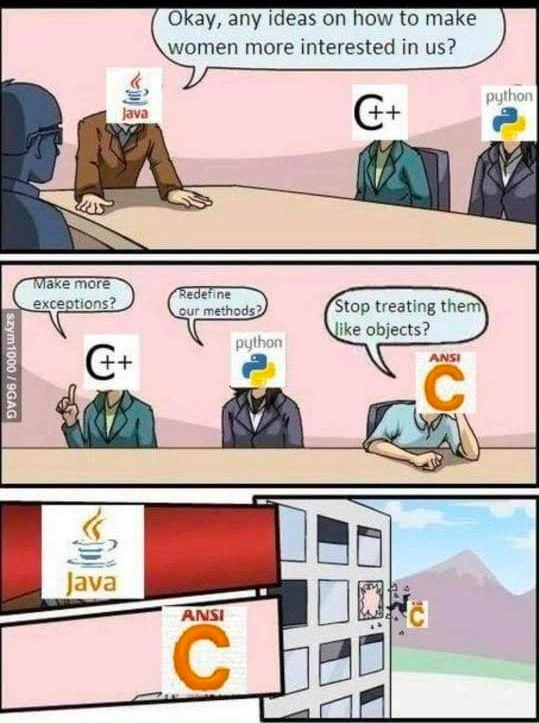
Imagine a group of four friends (who kind of act like different toys or characters) sitting at a table, trying to figure out why girls don’t want to play with them. The leader friend (let’s call him Java, who’s like a bossy big kid) asks, “How can we get girls to like us more?” The friends each give an idea:
- The first friend (C++), who loves complicated tricks, says: “What if we make special exceptions for them?” (Like, “we’ll break our usual rules just for them.”)
- The second friend (Python), who is pretty flexible and changes easily, says: “Maybe we should change our methods.” (In simple terms, “let’s change the way we do things or how we act.”)
- The third friend (C), who is older and very straightforward, says: “Maybe we should stop treating them like objects.” By this he means “stop treating girls like things instead of like people.” In other words, be respectful and don’t treat people as if they’re just toys or prizes.
Now, you’d think that last idea is clearly the right one: of course you should treat people like people! But here’s the funny (and crazy) part: the bossy friend (Java) gets mad at that suggestion. In the comic, Java actually throws the friend who said it out of the window! (Don’t worry, it’s just a goofy cartoon – it’s an exaggeration to make us laugh.) This ending is so over-the-top and silly that it makes the whole thing a joke. The humor comes from how ridiculous it is: the group was asking for a solution, someone gave a very good and obvious solution (“be nice and respect others”), and instead of saying “Good idea,” the leader literally tosses that friend right out the window. It’s a playful way to show how sometimes a group might ignore the simple, honest truth because they don’t want to change their fundamental behavior.
So, in super simple terms: this meme is funny because it’s like watching a little story where someone says “Hey, maybe just be nice and don’t treat people like objects,” and the boss figure says “No way!” and boots them out. It reminds us that treating people well is the obvious answer to getting them to like you – and it makes fun of anyone who would reject that idea. It’s using characters named after programming languages just to add a nerdy flavor, but even without knowing about coding, you can giggle at the fact that the most truthful advice literally goes flying out the window. The message at the core is clear enough for anyone: people aren’t things, and if someone suggests you should respect others, tossing that idea (or that person) out is a pretty silly (and laughable) reaction.
Level 2: Exceptions & Methods & Objects, Oh My!
Let’s break down the meme in more straightforward terms. We have a classic cartoon boardroom meeting scene with four characters, except each character’s face is the logo or name of a programming language. The languages Java, C++ (“C plus plus”), Python, and ANSI C (the standard C language) are depicted as people in suits around a conference table. This setup is a popular meme format where a boss asks a question and employees give answers – the twist being the last answer is so unacceptable to the boss that the boss literally throws that person out of a window. Here, Java (with the steaming coffee cup logo) is in the boss’s seat leading the meeting. The question on the table: “Okay, any ideas on how to make women more interested in us?” In other words, how can we attract more women to our programming languages or perhaps to the programmer community represented by us? The scene is playing on the stereotype that programming, especially languages like Java, C++, etc., have historically struggled to draw in women, and now these language mascots are brainstorming solutions like a corporate team would brainstorm a marketing or culture change.
Each language character suggests a solution, and each suggestion is a play on words mixing normal English with programming jargon (specific terms from coding, particularly from Object-Oriented Programming):
C++: “Make more exceptions?” – In everyday speech “making an exception” means giving special consideration or bending rules for someone. In programming, however, exceptions are a feature used for error handling. C++ was one of the early languages to support exceptions; you can
throwan exception to indicate something went wrong and thencatchit elsewhere to handle the error. By suggesting “make more exceptions,” the C++ character is cheekily referencing its own technical feature (exceptions in code) as if that’s a solution. It’s as if C++ is saying, “maybe we should throw around more exceptions – that’ll do the trick!” For a newcomer, just note: an exception in code is not like an exceptional person; it’s an error object used to interrupt normal flow when something unexpected happens. So C++’s idea sounds silly: it’s proposing a technical fix (“more error objects?”) to what is essentially a social question.Python: “Redefine our methods?” – The phrase “change/redefine our methods” in plain English means “change how we do things”. In programming, a method is just a function that belongs to a class/object (for example, if you have an object
dog, it might have a methodbark()that you call asdog.bark()). To redefine a method could mean to override it with a new definition. Python, as a language, is known for letting you easily define and even modify methods. In fact, Python is so flexible that you can dynamically change how an object’s method works at runtime (something we call “monkey patching”). So when the Python character says this, it’s part earnest suggestion (“maybe we should change our approach”) and part programming pun, since Python deals with methods as part of its object-oriented design. It fits Python’s persona: adaptable and open to change. But again, as a solution to “attract women,” it’s humorously vague—what methods are we redefining, exactly? It’s basically a buzzwordy answer that sidesteps the real issue, which is exactly what makes it funny when we realize the next answer hits the nail on the head.ANSI C: “Stop treating them like objects?” – Here’s the zinger. In normal language, “treating someone like an object” means you’re treating a person as a thing or an item, not respecting their feelings or agency – essentially objectifying them. It’s a phrase often used when talking about respecting women (or anyone): don’t treat people like objects. In programming terms, an object is a core concept of OOP – it’s like a little container that holds data and functions together, representing something (like a
Carobject, aUserobject, etc.). Languages like Java, C++, and Python all heavily use objects: for example, in Java when you create a string or any user-defined entity, under the hood it’s an object; in Python even a simple integer behaves like an object with methods. C, however, doesn’t use objects at all. ANSI C is a procedural language, meaning it deals in plain data (like integers, floats, structs) and functions. There’s no built-in concept of an “object” with methods in C – that came with C++ and other OOP languages. So C’s suggestion is brilliantly double-meaning: “Perhaps women would be more interested in us if we (the programming world) stop treating them like objects.” One meaning: stop objectifying women (a social commentary – i.e., respect women as people). The other meaning: maybe we should literally not treat everything as an object in our code paradigm – a sly nod to the fact that C’s peers are obsessed with OOP. It’s basically C advocating for dropping the object-oriented approach (which is ironically exactly what C as a language does, since it doesn’t have objects).
After these suggestions, the meme shows the typical final punch: Java’s avatar physically throws ANSI C’s avatar out of the skyscraper window. In the image, you see the Java logo character with an angry expression (implicitly) and the C logo figure flying out through broken glass. This is comedic exaggeration to depict that Java absolutely rejects C’s idea. Why such an extreme reaction? In the context of the meme format, it’s just how the joke works – the boss character can’t handle the truthful or out-of-the-box suggestion, so out the window the suggester goes. But thinking in terms of the characters: Java is heavily invested in OOP and perhaps in maintaining the status quo (“we’re doing nothing wrong with our objects!”). C’s idea, while sensible, implies criticism of the fundamental way Java and others operate. It’s both a blow to their ego (“are you saying we’ve been sexist or doing something wrong?”) and to their programming paradigm (“are you telling us to abandon objects – the core of our design?”). The swift boot-out is a cartoony way to show that the group (led by Java) would rather eliminate the dissenter than face that uncomfortable suggestion.
The whole scene resonates as tech humor because it personifies programming languages and uses our insider knowledge: we know “objects,” “methods,” “exceptions” in code, and we also recognize the issue of women’s interest in tech. It’s making fun of how tech folks sometimes come up with convoluted, technical answers to what are essentially human problems. Each language character’s response is stereotypical: C++ offers a complex technical mechanism (exceptions!), Python suggests a clever tweak (new methods!), and old C cuts straight to the heart of the matter with a blunt truth (respect people!). We also see a bit of “office meeting” satire – the dynamic of a boss and employees where the honest employee gets punished is a familiar trope. This helps newcomers recognize the scenario: it’s basically like an office joke comic, except with programming language mascots.
To clarify some terms that appear here:
- Object-Oriented Programming (OOP): A programming model where software is organized around objects rather than just functions and logic. Objects are instances of classes; a class defines a type (like a blueprint), and each object has attributes (data/properties) and methods (functions/behaviors). Java, C++, and Python all support OOP. In these languages, you might define a class
Carwith properties like color and methods like drive(), and then createCarobjects. OOP is great for modeling complex systems, but it also changed how programmers think about code – sometimes everything gets turned into an object model, even things that might not need it. - Procedural Programming: This is the older paradigm that ANSI C uses. Code is organized into procedures or functions, and data is kept separate. You don’t bundle data with methods; instead, you pass data into functions. For example, in C you might have a
struct Car(just holds data about the car) and separate functions likedrive(car). It’s a simpler model in many ways, but less fancy in terms of built-in structure. - Exceptions: These are special objects or signals used for error handling in many languages (including C++, Java, Python). Instead of returning an error code or message when something goes wrong, a function can throw an exception, which means it aborts normal execution and jumps to the nearest error handler. This is like if something goes wrong, you throw up a flare (the exception) and some higher-level part of the program catches it and deals with it. C did not originally have exceptions; errors in C are typically handled by return values (like a function returns
-1or NULL to indicate error and you have to check for it) or by setting a global error flag. C++ added exceptions to make error handling more structured. In everyday language, to “make exceptions” can mean to do something out of the ordinary for someone’s sake (“We usually don’t allow food in the library, but we’ll make an exception for your birthday cake”). The meme plays with this double meaning. - Methods: In OOP, functions that belong to a class are called methods. They’re the “actions” an object can perform or have performed on it. For example, if you have a
Stringobject in Java, it has methods like.length()to get its length, or.toUpperCase()to get an uppercase version. Saying “redefine our methods” in a programming sense could refer to overriding methods (like in a subclass providing a new implementation for a method inherited from a parent class) or dynamically changing function definitions (which Python can allow). In plain speech, it just means change how we do things. The meme relies on us recognizing both meanings. - Objects (in coding): Instances of classes that contain data and methods. In Java and Python, even things like a list, a string, or a number might be an object behind the scenes with associated functionality. When a programmer says “treat something like an object,” they mean model it as a class in an OOP system. In C++ and Java, for instance, you might create an object
Woman user = new Woman();if you were absurdly modeling a person in code. In C, there are no objects: you’d just have a data structure or separate variables. So C literally cannot “treat things like objects” because that concept doesn’t exist in its world – which is why that language making the quip is so fitting.
Lastly, it’s worth noting the meme format: this “boardroom meeting” comic is a well-known template. Typically, the third panel (the window tossing) is the big joke moment. Here it’s used to amplify the punchline: the suggestion “stop treating them like objects” is both the smartest and the most unwelcome idea. Java tossing C out the window is an absurd visual gag symbolizing rejection. Developers familiar with memes expected something like this the moment they saw the setup, but the specific twist here (involving programming concepts and a social message) makes it unique and memorable. By personifying languages and making them enact a little office drama, the meme manages to poke fun at both programming and real-life tech culture in a way that’s easy to get once you know the lingo.
Level 3: Right Out the Window
For seasoned developers, this meme elicits a knowing grin because it lampoons both tech culture and programming jargon in one fell swoop. The setup is the classic boardroom suggestion meme: the boss (here personified by the Java logo in a suit) asks for ideas, a couple of underlings offer sycophantic or on-brand suggestions, and then one brave soul says the obvious but uncomfortable truth – only to be promptly ejected (literally thrown out of a high-rise window) by the boss. It’s a staple format in meme lore, often used to mock corporate dysfunction or groupthink. In this incarnation, the programming languages themselves are the meeting attendees, each with their logo plastered on a suited figure. This immediately tells any developer: “we’re treating languages as people with opinions” – a common trope in developer humor. We often jokingly attribute personalities to languages: e.g., Java is the strict manager type, enterprise-y and conservative; C++ is the complex veteran always talking about performance and advanced features; Python is the friendly adaptable one suggesting high-level solutions; and C is the crotchety old-timer, minimalist and blunt. Seeing these four in a meeting about “attracting women” already sets up a tongue-in-cheek scenario of language rivalry meets tech industry self-reflection.
The humor here works on multiple levels of insider knowledge. First, there’s the pun overload with OOP terminology: “exceptions”, “methods”, and “objects”. Each suggestion sounds like business jargon, but to a programmer they’re unmistakably referencing programming concepts:
- C++: “Make more exceptions?” – In plain terms, this could mean “maybe allow more special allowances or special cases for women”. But to a developer, it’s a wink at C++’s error-handling via exceptions (and perhaps a jab at C++’s tendency to complicate things). C++ is a language where you literally
throwandcatchexceptions as part of flow control. An experienced dev might chuckle thinking, “Ah, of course C++’s idea of outreach is to throw exceptions—typical!” It’s a goofy notion that you could attract people by increasing your exception count as if women would flock to a language that “makes exceptions” for them. - Python: “Redefine our methods?” – On the surface, “redefining our methods” sounds like “change our ways/behaviors”, a corporate-friendly suggestion. But it’s also a direct reference to methods in object-oriented lingo (the functions attached to objects). Seasoned Pythonistas know that Python is very flexible about methods – you can even monkey-patch (replace or redefine) methods of classes at runtime. Python’s suggestion plays on its reputation for being agile and high-level: if something isn’t working, just override the method with a new implementation (or adopt a new approach, as the double meaning implies). It’s humorously on brand for Python to suggest an elegant refactor of behavior to solve a problem.
- ANSI C: “Stop treating them like objects?” – This is the mic-drop line, both in the meme’s story and for those of us in on the joke. To a developer, it screams clever double entendre: In OOP, everything is treated as an object by design; but in real life, “treating women like objects” is a phrase calling out objectification – viewing people as things rather than humans. The C language doesn’t even have an
objecttype or classes – it predates OOP and thus literally never treats data as first-class objects. So C’s suggestion is simultaneously a sly dig at the OOP obsession of the others (“maybe your whole object-centric approach is the problem?”) and a straightforward moral stance (“maybe show women basic respect”). It’s funny because it’s both a tech critique and a social critique packed into one sentence – the kind of quip a jaded senior developer might drop in a meeting full of buzzwords.
Now, why does Java hurl C out of the window for this? Here’s where the cultural satire kicks in. In many tech circles (and certainly in plenty of companies), when someone points out an uncomfortable truth – especially one implying that the fundamental approach or culture is wrong – that person often faces backlash. Java, as the “boss”, represents the status quo. Java is an OO purist in this context, a language that famously imposes an object-oriented structure on everything (you can’t even write a simple “Hello World” without wrapping it in a class). From Java’s perspective, C’s idea isn’t just unconventional – it’s an affront to Java’s entire worldview and authority. It’s as if C suggested to an OOP company, “maybe the problem is our object-oriented mindset itself.” That hits a nerve! The immediate comical overreaction – tossing C out – mirrors what many veteran developers have seen in real life: propose a solution that challenges entrenched practices or power structures (especially one implying those in charge have been “treating people like objects”), and you might as well pack your things. The meme exaggerates it to literal defenestration for comedic effect, but any senior dev has tales of good ideas shot down harshly because they required fundamental change.
There’s also a layer of language rivalry and legacy here. ANSI C is the oldest language in that room by a mile – it’s the ancestor of both C++ and indirectly of Java (Java’s syntax was heavily influenced by C/C++). In the tech world, C is respected for its efficiency and simplicity, but it’s also seen as old-fashioned, lacking modern “object-oriented” conveniences. So when C speaks up with a wise, perhaps too honest suggestion, the newer OOP languages literally throw the old guy out. This mirrors a common industry pattern: organizations often discard legacy systems or ideas wholesale when they adopt a new paradigm (sometimes throwing the baby out with the bathwater). Seasoned devs see C’s expulsion as a nod to how procedural solutions or advice are frequently dismissed in today’s OO-dominated landscape – even when they might have merit. It’s ironic: the veteran language offers what is arguably the most sensible non-technical solution (respect and inclusivity), but the hotshot OOP crowd can’t handle it. The dark humor isn’t lost on us – we’ve watched perfectly good straightforward fixes get rejected because they don’t align with the current “methodology” or office politics.
Finally, the meme speaks to the broader tech culture attempt to address gender diversity. The question Java asks – “how to make women more interested in us?” – echoes countless real-world discussions in tech about how to attract more women to coding, open source, or specific programming communities. The joke is that the first responses from C++ and Python stay within their tiny technical bubble (“maybe more exceptions? new methods?”), which satirizes how tech folks sometimes propose technical or superficial solutions to social problems. It takes the non-OOP guy (C) to blurt out the obvious human solution: “maybe stop being objectifying jerks.” And even then, that truth is unwelcome. That punchline lands with devs because it’s a bit of self-deprecating truth about our industry – we nerds can be so fixated on our objects and methods that we overlook basic human respect and change. The fact that Java yeets C for saying it is the final wink: it implies “yeah, that’s what tends to happen when someone points out sexism or toxic culture in a boardroom – they get ignored or excluded.” It’s biting humor, but delivered in the comfy wrapper of programming language personification and OOP puns. In short, for an experienced developer, this meme is funny because it dramatises a collective facepalm moment – where the simplest, most ethical solution is right there on the table, and the powers that be quite literally throw it out the window.
Level 4: Paradigms Collide
At the deepest level, this meme riffs on the philosophical clash between procedural and object-oriented programming paradigms. The boardroom is more than a joke setup – it’s a metaphorical battleground of coding ideologies. ANSI C, a procedural language from the early 1970s, represents the old guard where code is organized into functions operating on data, not bundling data and behavior into objects. In contrast, Java, C++, and Python are rooted in Object-Oriented Programming (OOP), where the guiding principle is often “everything is an object.” This paradigm shift to OOP (pioneered by languages like Simula and Smalltalk in the ’60s and ’70s) was a revolutionary idea: model programs as collections of interacting objects (instances of classes) that encapsulate state and behavior. By the 1990s, OOP had become the dominant orthodoxy – embodied zealously by languages like Java, which treats the world as a hierarchy of objects.
In an OOP-centric mindset, suggesting we “stop treating them like objects” is practically heretical. It’s as if our procedural friend C is proposing to abandon the core abstraction OOP languages live by. Academically, an object in OOP isn’t a mere thing; it’s a structured entity combining data (attributes) and code (methods) to model real-world concepts. Languages such as Java and Python encourage developers to conceptualize problems in terms of classes and objects – for example, modeling a person as an object with properties (name, age) and methods (speak(), work()), literally objectifying real-world entities in code. C, however, comes from a tradition with no built-in notion of classes or objects – just structures and functions. In C, a “person” might be a struct with data fields and separate functions that take a pointer to that struct. There’s no implicit object metaphor built into the language. So when ANSI C quips “Stop treating them like objects”, it’s playfully echoing its own procedural philosophy: handle data directly, don’t wrap everything in objects. It’s a paradigm collision – C’s procedural realism versus OOP’s object abstraction.
This collision is layered with tech history. C++ (born in the 1980s) was literally nicknamed “C with Classes” – it took the minimalist C and bolted on classes, inheritance, and yes, exceptions. C++ introduced features like try/catch blocks to throw and handle exceptions (errors as first-class objects) instead of C’s style of error codes and manual checks. Meanwhile, Java (mid-1990s) went all-in on OOP: it enforced that code lives inside classes, uses exceptions ubiquitously for error handling, and originally pitched “Write Once, Run Anywhere” for enterprise efficiency. Python (early 1990s) is more multi-paradigm but is fundamentally object-oriented under the hood – everything from integers to functions is an object (you can do 5 .__add__(3) because even numbers have methods!). Python’s philosophy, influenced by ABC and education-focused design, emphasizes readable syntax but still embraces OOP when convenient (you define classes, instantiate objects, etc.). By having these language logos at the table, the meme sets up a clash of eras: procedural vs. OO. The ANSI C character is essentially a time-traveler in a meeting of OO descendants, offering advice that cuts against decades of object-oriented dogma.
There’s also a clever play on exception handling semantics. In programming, to throw an exception means to signal an error or unusual condition by literally “throwing” an object (often of type Exception) that can be caught by an error handler. Notice how Java (the boss in the meme) responds to C’s suggestion by throwing C out the window. This visual gag doubles as a coding pun: Java essentially “throws” the one who voiced an exceptional idea. The term exception itself is double-edged here. C++’s suggestion “Make more exceptions?” on the surface sounds like “maybe we should create special-case rules for women” – but to a programmer it’s a nod to C++’s love of try { ... } catch blocks and making exception objects for error conditions. The word “exception” in OOP is all about handling errors by throwing objects, whereas C (pre-OOP) handles errors with return codes and without any object thrown around. So when Java physically yeets ANSI C out the window, it’s symbolically akin to calling C’s idea an error and launching an exception event – literal exception handling, boardroom edition. An experienced developer might chuckle at this meta-joke: Java is handling C like an unwanted exception in its system, ejecting it violently instead of dealing with the uncomfortable truth it voiced.
Beyond the technicalities, the meme hints at a paradigm lock-in. Object-oriented design has been so dominant that even solving a human problem (“how to attract more women”) is being approached with OOP buzzwords by Java, C++, and Python. Each OO language character proposes a solution within the comfort zone of its own features – more exceptions (C++), redefining methods (Python). These are essentially code metaphors: “maybe we handle this like an error case” or “maybe we tweak our approach with a new method override.” Then comes ANSI C, the outlier, effectively saying “maybe the solution isn’t in our code constructs at all.” It’s a subtle academic joke about abstraction blindness: if all you have are objects, everything looks like a class hierarchy problem. C’s suggestion is a fundamentally different perspective – one might say an almost meta solution: change the way you treat people (something that no library or language feature can force – it’s about culture, not code). In the realm of computer science theory, this is like injecting an unforeseen input into a system that the system is not equipped to handle. The OOP crew’s reaction is to expel it rather than adapt. In a sense, the meme humorously illustrates how legacy wisdom (C’s straightforward approach) gets rejected by modern paradigms that would rather intensify their own complexity (more exceptions! new methods!) than question their base assumptions. The result is both absurd and telling: the object-oriented worldview literally cannot process a solution that isn’t objectifying – so it “throws it out” (pun fully intended).
Description
A three-panel comic strip in the 'Boardroom Suggestion' meme format, where the characters are personified programming languages, their faces replaced with their respective logos. In the first panel, Java, C++, and Python are at a meeting table. Java asks, 'Okay, any ideas on how to make women more interested in us?'. In the second panel, the languages offer suggestions based on their technical paradigms: C++ asks, 'Make more exceptions?', Python asks, 'Redefine our methods?'. A new character, ANSI C, offers a different take: 'Stop treating them like objects?'. The third and final panel shows the ANSI C character being thrown out of a high-rise office window by the other languages. This meme is a clever, multi-layered joke for developers. It satirizes the object-oriented programming (OOP) paradigm, where everything is treated as an 'object', by applying it to a social context. The suggestions from the OOP languages (Java, C++, Python) are technical puns. C, being a procedural language and not object-oriented, provides a solution that is both a critique of the OOP worldview and sound social advice. The punchline is the violent rejection of this simple, non-OOP solution, humorously depicting the dogmatic nature of programming language debates

Comments
8Comment deleted
The problem is that Java tried to solve the problem with a RelationshipFactorySingleton, C++ passed women by const reference but forgot to handle the dangling pointer, and C just offered a struct and a function pointer, which was honest, but not what the stakeholders wanted to hear
In an all-OOP boardroom, suggesting that not everything should be an object just triggers Java’s hidden defenestrate() method - followed immediately by an implicit System.gc()
The irony of Java throwing out C for suggesting we stop treating women like objects when Java literally won't let you pass primitives by reference because everything else has to be an object
Of course C got defenestrated - it's the only one in the room that ever handled anything by reference to reality instead of wrapping it in six layers of abstraction
The irony here is exquisite: Java throwing C out the window for suggesting not to treat women like objects, when Java's entire existence is predicated on treating *everything* as objects. Meanwhile, C++ is over there suggesting more exceptions - which is rich coming from a language where exception handling was bolted on as an afterthought and half the codebase still uses error codes. Python's 'redefine our methods' is actually the most sensible suggestion, but in typical fashion, the enterprise language with the most verbose syntax makes the executive decision. Classic case of 'do as I say, not as I instanceof.'
Java asked for ideas; C said “maybe not everything should be an object” - so Java did a throw(C). When reality won’t fit the class diagram, OOP handles it as an exception and defenestrates the pointer
Telling Java to “stop treating things like objects” is like asking a Spring shop to ditch beans - the DI graph collapses and someone gets defenestrated
C++ preaches anti-objectification, but C's structs whisper: 'PODs forever - no vtables in love.'