Skip to content
DevMeme
5852 of 7435
The moment you realize programming could have been entirely in French keywords
Languages Post #6409, on Nov 21, 2024 in TG

The moment you realize programming could have been entirely in French keywords

Why is this Languages meme funny?

Level 1: It’s All French to Me

Imagine you woke up one day and all the instructions around you – the labels on buttons, the steps in a game, the directions for your homework – were suddenly in French. You’d still recognize what you need to do from pictures or context, but the words would look foreign and confusing at first. This meme is playing with that kind of surprise in the world of coding. Coding is like giving a set of instructions to a computer. We’re used to those instructions being English words (like saying “if this happens, do that”). The joke asks: what if those coding instructions had been in French instead? The little cartoon character is smiling at first, proud that English became the language of computers, but then he realizes it didn’t have to be. In a funny twist, he pictures code full of French words – and his eyes go wide like someone saying, “I can’t read this at all!” It’s like discovering that your favorite video game’s secret cheat codes are all in another language – a bit fascinating and a bit scary. The humor comes from that sudden “oh no!” feeling: something we take for granted (computers using English words) could have been totally different. And whether you know any French or not, it’s easy to laugh at how crazy it would feel to debug a program that says “RETOURNER au lieu de RETURN” – basically, it’s joking that for an English-speaking coder, seeing code in French would make them go 😮. In simple terms: it’s funny because it shows how even the language of computers is a human choice, and changing it would make our familiar world of coding look as confusing as a foreign language class.

Level 2: When if Becomes si

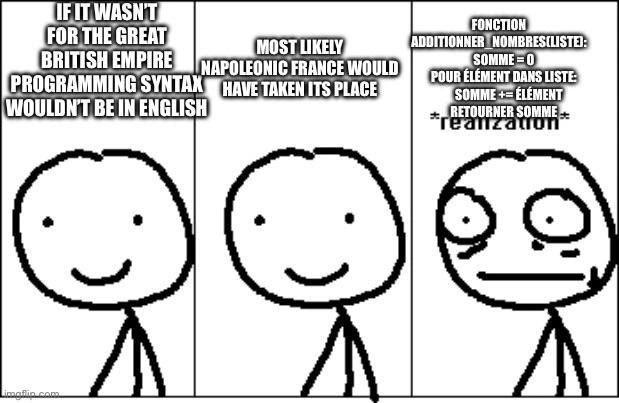
Most programming languages use English words for their basic commands, or keywords. Words like if, else, for, function, and return are so common in code that we hardly think of them as English – they’re just programming language. This meme jokes that it could have been different: if history had turned out another way, we might be writing all those commands in French instead! The first two panels set up the idea that English became the default for programming largely because the British Empire (and later the U.S.) dominated the early computing era. The third panel delivers the punchline with a shock: it shows a snippet of pseudo-code (fake code) written with French keywords, and our stick-figure protagonist’s eyes bugging out in panic at the realization. The implication is that if Napoleonic France had led the tech revolution, our code might look like this French snippet. Seasoned devs immediately imagine the headache of that alternate reality – suddenly all the tools, tutorials, and code they know (which are in English) would be in an unfamiliar tongue.

Let’s break down the French pseudo-code in the meme, because it’s a direct translation of a simple program:

FONCTION additionner_nombres(liste):  # "function add_numbers(list):"
    somme = 0                        # "sum = 0"
    POUR élément DANS liste:         # "for element in list:"
        somme += élément             # "sum += element"
    RETOURNER somme                  # "return sum"

This example defines a routine to add up numbers in a list. In an English-based language like Python or JavaScript, you’d normally see something like function addNumbers(list) { ... } or in Python def add_numbers(lst): ... return total. But here, every keyword is French:

  • FONCTION plays the role of function (or def in Python) to declare a function.
  • POUR ... DANS ... is literally “for ... in ...”, acting like a for loop that goes through each item in the list.
  • RETOURNER means “return”, to give back the result of the function.
  • Even the variable names are in French: somme means “sum” (we might use total or sum in English code), and élément means “element”.

It’s perfectly logical code – if you can read French! Computers themselves are flexible: a compiler or interpreter could be made to recognize POUR just as easily as FOR. The only reason we don’t actually do that is because of convention and historical choices. By convention, nearly all programming languages decided on English keywords early on. This was partly because the pioneers of computer science – mostly in the US and UK – wrote the first languages and documentation in English. So English became the lingua franca (ironically, that Latin phrase literally means “French language”) of programming. For example:

  • The first high-level language, FORTRAN (1950s), used English words like IF and CONTINUE.
  • COBOL (also from the 1950s) was explicitly designed to read like English sentences (e.g., ADD YEARS TO AGE GIVING TOTAL in COBOL is an English-like command). No surprise, it was created in the US and used English verbs.
  • Early operating systems and manuals were in English, so even non-English speaking programmers learned terms like “compile”, “execute”, “error” in English from the start.

The meme hints at programming_keywords_localization – the idea of translating programming languages themselves into other human languages. In practice, this is very rare. There have been a few experiments and localized languages, but none became mainstream. Why? Because it would fragment the developer community (tooling fragmentation). Imagine if Spanish-speaking coders wrote si (x < 0) entonces ... instead of if (x < 0) ..., and Russian coders used their own Cyrillic keywords, and so on. A code library written in one locale wouldn’t easily mix with another. It’d be like each country having a different version of Java or Python that wasn’t compatible with the others. Instead of one global Stack Overflow, we’d have separate forums and tools for each language – not very efficient or collaborative. This is why, even though a concept like “function” isn’t inherently an English word, we all use the same word in code. It’s a bit like how airline pilots worldwide speak English for consistency, or scientists often publish in English to reach a wider audience.

What makes this meme relatable is the culture shock it portrays. Developers from non-English countries often have to learn basic English terms because of this status quo – they memorize that “if” means “si” (Spanish “if”) or “إذا” (Arabic “if”) in their native language, just to understand code. This meme flips the perspective: it makes English-speaking devs imagine they might have had to learn French to code. The wide-eyed stick figure in the last panel represents that sudden understanding that something as logical as coding is shaped by messy world history. Colonialism_in_tech is the serious tag hiding behind the joke: centuries ago, the British and then American influence spread English around the world, and that’s why tech – from keyboards (think QWERTY) to programming syntax – defaults to English. Had the French empire or another power taken the lead, we might be using franglais_programming (French-English mix) or entirely French keywords today. It’s a humorous way to remind us that technology isn’t developed in a vacuum; human history and language have a deep impact. And for a junior developer, it’s an eye-opener: those weird English words in your code (while, for, break) aren’t magical – they’re just vocabulary. If you ever caught yourself thinking programming is like a language of its own, well, this meme says “Yes – and that language could have been French!”

Level 3: Tower of Babel Codebase

In an alternate timeline, our code editors might be parsing French keywords instead of English, and seasoned developers would be swapping war stories about the days when Napoléon’s empire shaped computing. The humor here comes from a deep historical quirk: programming syntax isn’t inherently English for any technical reason – it’s English largely because of who got to build the first computers and languages. The meme’s stick-figure realizes with horror that if British colonial influence hadn’t made English the default lingua franca of tech, we might have ended up writing code with Napoleonic France’s vocabulary. It’s a comedic what-if that hides a kernel of truth about how power and history can hard-code our tools.

Seasoned engineers immediately think of the chaos this alternate history would unleash. The panel’s pseudo-code example, with FONCTION, POUR, and RETOURNER in place of function, for, and return, is funny because it’s entirely plausible – compilers don’t care if the keyword is "if" or "si" as long as it’s consistent. But the Tower of Babel scenario would be real: imagine every country or empire shaping its own localized programming syntax. Codebases would become silos separated by language barriers – a true Babel of code. Maintaining a codebase written in French keywords might require many of us (who aren’t francophones) to keep a dictionary by our side, or worse, rewrite the code into English to collaborate. Today, a GitHub repo from India or Germany looks familiar worldwide because if (x < 0) return false; is the same in San Francisco or São Paulo. If instead one repo used French si (x < 0) retourner faux; and another used, say, Japanese keywords, global open-source collaboration could devolve into confusion.

This meme tickles the TechHistorian brain: it reminds us that developer culture and tools were forged in a particular historical context. The Great British Empire and the rise of American computing ensured that terms like “loop”, “function”, and “error” are understood globally in English. It wasn’t guaranteed to be that way – it was a historical accident of power and timing. Seasoned devs might chuckle (and shudder) recalling real localization nightmares: think about how Microsoft Excel localizes function names (English SUM() is SOMME() in French Excel). That leads to enormous headache when sharing spreadsheets across languages – a small taste of what localized programming languages could inflict on code. We avoid that mess in programming because nearly all languages decided to stick to one keyword set – usually ASCII-friendly English. Early language designers like Grace Hopper (for COBOL) or John Backus (for FORTRAN) never even considered translating keywords – they assumed English, the language of early computing research, as the default. As a result, our compilers and interpreters simply recognize English tokens by convention. If history had swung the other way, perhaps a victorious Napoléonic France would have produced a “Code Napoléon” of programming – and we’d all be writing POUR CHAQUE i DANS… instead of FOR EACH i IN….

The seasoned perspective also catches the irony of colonialism_in_tech: much like map borders or national languages were imposed by empires, the dominance of English in programming is a form of cultural lock-in. It’s not that English is a superior medium for logic – a while loop doesn’t magically work better in English than “tantque” (French for while). It’s simply that early computers were developed in English-speaking institutions, and that momentum carried forward. This has become self-reinforcing; today’s tooling, documentation, and libraries all assume English keywords, so any attempt to introduce fully localized programming languages tends to fizzle out or remain niche. Senior devs grin at this meme because it playfully exposes that our entire towering stack of software is built on what could have been a historical coin flip. The punchline – monospaced French pseudo-code causing a wide-eyed panic – exaggerates the shock a developer might feel when confronted with an alternate-universe code. It taps into a shared relief and terror: relief that we don’t have to debug code with 🇫🇷 accents aigus, and terror at the thought of needing high school French just to write a for loop. In short, the meme cleverly exploits a bit of tech-history trivia: we narrowly avoided a multilingual “babel” of programming, and the only reason is that certain nations won wars and built machines at the right time. C’est la vie… or rather, c’est la code.

Description

Black-and-white three-panel stick-figure meme. Panel 1 shows a smiling character under bold text: "IF IT WASN'T FOR THE GREAT BRITISH EMPIRE PROGRAMMING SYNTAX WOULDN'T BE IN ENGLISH". Panel 2 keeps the same smile with the caption: "MOST LIKELY NAPOLEONIC FRANCE WOULD HAVE TAKEN ITS PLACE". Panel 3 zooms to a wide-eyed, panicked face; above it, monospaced pseudo-code in French reads: "FONCTION ADDITIONNER NOMBRES(liste): SOMME = 0 POUR ÉLÉMENT DANS LISTE: SOMME += ÉLÉMENT RETOURNER SOMME" with a faint "realization" watermark. The joke riffs on how colonial power, rather than technical merit, decided that most programming keywords are English, hinting that our compilers might otherwise parse "fonction", "pour", and "retourner". Seasoned engineers will recognize the implied localisation chaos, tooling fragmentation, and historical contingency behind everyday syntax
Comments

6
Anonymous ★ Top Pick Just picture the linter yelling "accents manquants" every build and the entire i18n team finally owning the parser
  1. Anonymous ★ Top Pick

    Just picture the linter yelling "accents manquants" every build and the entire i18n team finally owning the parser

  2. Anonymous

    Imagine debugging a production issue where the stack trace reads "Erreur fatale dans FONCTION_ASYNCHRONE: Promesse rejetée à ligne soixante-dix-sept" while your French colleague insists the real problem is that you're not properly handling "l'exception non attrapée" in your "gestionnaire d'événements."

  3. Anonymous

    Imagine debugging a stack trace in French: 'ErreurDePointeurNul à ligne 42 dans FichierDeConfiguration.java' - suddenly those verbose Java exception names don't seem so bad. Though honestly, 'pour élément de liste' is arguably more readable than 'for (const element of list)' - maybe Napoleon was onto something with that explicit verbosity

  4. Anonymous

    If keywords were localized, code reviews would become philology: LGTM, but the accent in ÉLÉMENT breaks our ASCII-only linter - please fix and update the grep patterns across 200 repos

  5. Anonymous

    If keywords were locale-aware, one stray LC_ALL=fr_FR would turn every pull request into a pour request and your monorepo into a bilingual distributed system

  6. Anonymous

    Empire's legacy: 'for' saves 1 keystroke over 'pour' per loop - billions optimized since Waterloo

Use J and K for navigation