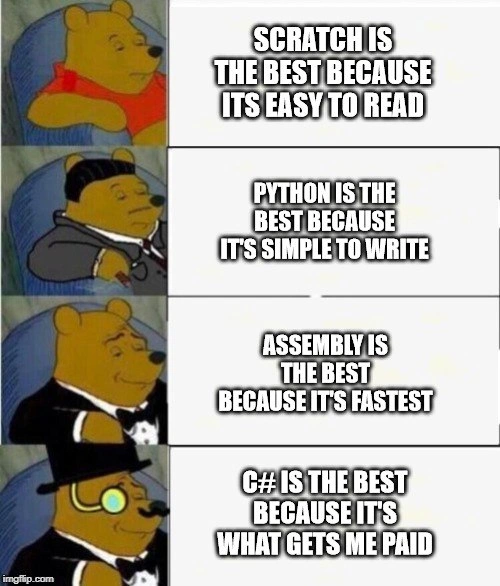
From readability to paychecks: Pooh meme ranks languages by real-world priorities
Why is this Languages meme funny?
Level 1: Pays the Bills
Imagine three kids and a teenager arguing about what the best chore is. The youngest kid says, “Cleaning my room is the best chore because it’s super easy to do.” His slightly older sibling counters, “Nah, taking out the trash is best because I finish it the fastest.” Then their teenaged brother chimes in with a smirk, “Actually, mowing the lawn is the best chore because Dad pays me $10 to do it.” The others go quiet because, well, you can’t beat getting paid! 😏 The joke here is that each person has a different idea of “best” – one likes what’s easiest, one likes what’s quickest, but the oldest cares about the reward. In the end, the chore that earns money wins out, just like how a programmer might decide the “best” programming language is the one that helps them earn their paycheck. It’s funny because it feels true: what we think is best can change when money is on the line.
Level 2: Learning vs Earning
At a simpler level, this meme is contrasting different programming languages and why someone might call each “the best.” It’s a LanguageComparison joke that gradually shifts from academic reasons to career reasons. If you’re newer to coding, let’s clarify what each panel is talking about and why it’s humorous:
Scratch: This is a beginner-friendly programming environment, often used by kids in schools. Instead of typing code, you drag and drop blocks that fit together like LEGO pieces to create programs. Scratch is extremely easy to read because each block says exactly what it does (for example, a block might say “move 10 steps” or “repeat 5 times”). There’s no complicated syntax – it’s visual and intuitive. So when someone says “Scratch is the best because it’s easy to read,” they’re valuing how understandable the code is. This is a bit funny in a professional context because Scratch isn’t used for real-world software development beyond learning. It’s like saying the best vehicle is a tricycle because it’s easy to ride – a cute claim that only makes sense if you’re very new to the whole idea of vehicles. In programming, readability is important, but calling Scratch the ultimate language is an obviously naïve (and adorable) exaggeration meant to mimic a newbie’s perspective.
Python: Python is a very popular programming language known for its simplicity and clear syntax. When people say Python code looks like “executable pseudocode,” they mean it’s close to how you might describe the steps in plain English. For example, to print a greeting you just write
print("Hello")– no extra ceremony. Many beginners learn Python as their first text-based language because you can do a lot with just a little code, and you don’t have to wrestle with complex rules. “Python is the best because it’s simple to write,” reflects that enthusiasm. It implies that because you can quickly write programs in Python (without worrying about things like manual memory management or a lot of boilerplate code), Python must be the superior language. A junior developer might feel empowered by how rapidly they can get things working in Python and might tout it as the best for that reason. The meme is gently poking fun at that mindset. Python is easy to write in relative terms, and it’s used in tons of fields (web development, data science, automation, etc.), so this panel is only a slight exaggeration. It’s basically saying, “Look, this language makes coding feel straightforward, so I love it most.” There’s truth there, but seasoned folks know “simple to write” isn’t the only factor in choosing a language.Assembly: Assembly language is quite the opposite of Scratch or Python. It’s a low-level programming language that is closely tied to a computer’s hardware. Each instruction in assembly is a very small step for the computer, like “add two numbers,” “store this value here,” or “jump to this other part of the program.” Because it’s so detailed and there’s almost no abstraction, programs written in assembly can run very fast and efficiently – the programmer has fine-grained control over what the CPU is doing. That’s why the meme’s third panel says “Assembly is the best because it’s fastest.” This refers to the fact that, in terms of execution speed, well-written assembly code can be extremely optimized. However, assembly is notoriously difficult to write and read for humans. Imagine writing a story but having to describe every letter and punctuation mark instead of just writing sentences – that’s what coding in assembly can feel like. It’s usually only used for very performance-critical sections of code, or on tiny computers (microcontrollers) where you don’t have a choice. Very few people write whole programs in assembly nowadays because it’s easy to make mistakes and takes a long time to develop. So in context, someone claiming “assembly is best because it’s fastest” comes across as a bit of an overly hardcore or impractical stance. It’s like saying a racecar is the best everyday car just because it’s the fastest on the track – true in speed terms, but not what you’d take to go grocery shopping. This panel’s joke is aimed at the kind of techie who prioritizes the computer’s efficiency over the developer’s convenience, an approach that most would find extreme except in special cases.
C#: Pronounced “C Sharp,” this is a modern, high-level programming language developed by Microsoft. It’s part of the .NET framework and is heavily used in enterprise software development – think internal business applications, large websites (using ASP.NET), desktop applications, even game development with Unity. The big deal with C# (and similar languages like Java) is that knowing it can directly land you a job, because many companies run their entire tech stack on it. When Pooh in the final panel says “C# is the best because it’s what gets me paid,” the focus isn’t on the language’s technical merits at all, but on the personal benefit to the programmer: a salary. This is a tongue-in-cheek way to say, “I’ll use whatever language my job requires, and since my job uses C#, I consider C# the best for me.” It reflects a very practical mindset. After all, even if a language is theoretically beautiful or super fast, it won’t help you if nobody’s hiring developers who use it. Many career decisions in programming involve picking up skills that are in demand. C# happened to be used in the meme, likely because the person who made it works with C# and sees it as their meal ticket. But it could have easily been Java, JavaScript, or any technology that is less “glamorous” in online debates but very relevant to employment. The humor here is in the stark honesty – it drops the pretense of “best language overall” and admits the real-world truth that different people have different “bests” depending on their livelihood. It’s a bit of a punchline because it turns the whole discussion from abstract virtues to something as straightforward as paying rent.
Now, why is the progression of Pooh Bear getting fancier outfits so fitting here? This meme format (often called the tuxedo Winnie-the-Pooh meme) is used on the internet to show an idea becoming more refined or pretentious across four panels. In the first panel, Pooh is plain, representing a simple or low-tier idea. By the last, Pooh is in a full tux with a monocle—very posh—representing the idea as the “ultimate” or most sophisticated form. Here, as the justifications for the best language change, Pooh’s attire upgrades, which visually tells us each new reason is supposedly more “elite.” The comedy comes from the fact that, typically, you’d expect increasingly technical or impressive reasons (and indeed the first three kind of follow that: easy, then simple, then fastest), but the final one flips the script. The most dressed-up Pooh ties the notion of “best” not to a technical quality at all, but to personal profit. To a newcomer, that might seem out of left field or even a bit selfish, but it highlights a slice of programmer reality: pragmatism. It’s saying, in effect, “All those lofty arguments are nice, but at the end of the day, I’ll go with what benefits me in tangible ways.” This resonates as CareerHumor because once you start working in tech, you realize that the industry’s choices of language often have less to do with theoretical perfection and more to do with practical concerns like available talent, legacy code, or company culture.
In simpler terms, the meme humorously educates us that there are many ways to judge a programming language – how easy it is for humans to understand, how easy it is to code in, how fast the computer can run it, and whether knowing it can get you a well-paying job. It marches through those points in a cheeky way. A junior developer can laugh at it once they recognize the references: the trajectory from a child’s learning tool (Scratch) to a beloved beginner language (Python) to a hardcore low-level tool (assembly) to a mainstream professional language (C#) makes a funny kind of sense. It’s like leveling up through different mindsets a programmer might have. And the final level—focusing on the paycheck—might also be a gentle caution: don’t get too caught up in arguing over which language is the prettiest or fastest in theory, because in practice the “best” language might just be the one that helps you build a career.
Level 3: Pragmatism Over Purity
This meme spotlights a classic language debate through the refined progression of Winnie-the-Pooh’s attire. Each panel escalates the justification for "X language is the best" from simplistic ideals to blunt pragmatism. It’s developer humor (DeveloperHumor) wrapping hard truths in a silly format. The first panel’s casually-dressed Pooh proclaims “Scratch is the best because it’s easy to read,” echoing the beginner’s love for readability. By the final panel, Pooh’s donning a top hat and monocle, declaring “C# is the best because it’s what gets me paid,” which hits on CareerHumor – the wry acknowledgment that real-world priorities (like a paycheck) often trump academic purity. This contrast is the joke’s punchline: after all the lofty talk about clarity, simplicity, and speed, the fanciest Pooh cares only about cold, hard cash.
Why is this funny to experienced devs? It parodies the evolution of a programmer’s mindset. Language wars are a rite of passage in tech – endless arguments on forums about Python vs Java vs C++ (or tabs vs spaces, take your pick). Early on, many of us swore by the language that felt cleanest or easiest. Later, maybe we got obsessed with performance or some technical edge. But eventually reality (and bills) set in, and we realize the “best” language is often just the one our employer uses – the essence of paycheck-driven development. The meme captures this journey in four absurd leaps: from a kid-friendly language to a scripting favorite, diving down to low-level code, and then landing on a corporate staple. Each leap brings Pooh a fancier tux, as if each reasoning is more sophisticated. Yet the irony is that the final, most “sophisticated” argument isn’t about tech at all – it’s about being pragmatic enough to choose the tool that pays the bills. This twist resonates with seasoned engineers who’ve seen idealism give way to practicality.
Let’s break down each panel’s claim in senior-engineer terms:
Scratch – “easy to read”: Scratch is a visual, block-based language aimed at beginners (often kids). You snap together colorful blocks with plain-English labels, so it’s virtually impossible to write something unreadable. It embodies code readability to the extreme – you literally see a flowchart of what happens. The meme humorously pretends someone claimed this educational toy language is “the best” simply because anyone can read it. Seasoned devs chuckle here because while readability is important, nobody ships mission-critical apps in Scratch. It’s referencing that newbie phase where “code that I can understand” feels like the ultimate goal. We’ve all met the enthusiastic beginner who thinks their first language (often something like Scratch or a super high-level scripting tool) is unbeatable due to its friendliness. This panel plays on that naive perspective.
Python – “simple to write”: Now Pooh upgrades to a modest tux, and so does the argument. Python is hugely popular and often cited as simple and intuitive to write. Syntactically, Python is concise – no need to declare types everywhere, no curly-brace chaos; it uses indentation and reads like pseudo-code. A junior coder can whip up a script quickly, and many will proudly say “Python is the best” because of how productive they feel in it. The meme captures this next-level reasoning: valuing a language for developer ease (writability) rather than just end-reader clarity. A senior developer reading this panel nods knowingly: Python’s design (PEP 8 guidelines, meaningful whitespace) indeed emphasizes readability and brevity, making it a common recommendation as a first real programming language after something like Scratch. In industry, Python powers everything from automation scripts to web backends and data science, precisely because it’s quick to write and easy to maintain. So this panel isn’t far-fetched – plenty of professionals do argue Python is “the best” for its clean, high-level syntax and how it lets you focus on logic instead of boilerplate. But it’s still a somewhat idealized stance, focusing on coder convenience, not necessarily what’s optimal for the machine or the business. The grey-tux Pooh looks a bit smug, embodying that phase when a developer has just enough experience to champion a favorite high-level language as the holy grail.
Assembly – “it’s fastest”: By the third panel, Pooh is in an even sharper tux with a bowtie, representing a serious, hardcore tech argument. Assembly language is as low-level as you can go without writing raw machine code (binary). It’s explicitly invoked here as the “fastest” for program execution. Why? Because assembly lets you control the CPU directly: you manage registers, memory addresses, and instructions with surgical precision. There’s no interpreter or heavy runtime layer – the code you write is (almost) the exact instructions the processor runs. In theory, a well-written assembly program can run blazingly fast, squeezing every bit of performance from the hardware. This argument appeals to the performance purist or the systems programmer archetype. It’s the kind of thing an old-school programmer might say after scoffing at Python’s slowness or a high-level language’s overhead. The humor here is partly in the exaggeration – very few people actually advocate writing entire applications in assembly these days, since it’s incredibly tedious and error-prone. But almost every developer has heard that one hardcore person or professor brag, “if you really need speed, nothing beats assembly.” It’s a half-truth that’s become a meme of its own. Yes, assembly is fast at runtime, but writing it is slow for humans and extremely difficult to maintain. The meme expects the reader to know this trade-off, which is why it’s funny: by the time someone is touting assembly as “the best,” they’ve gone off the deep end of practical argument and into theoretical land. It satirizes that phase when a programmer values the machine’s needs far above their own sanity or the project timeline. As a side note, modern compilers (for C/C++, Rust, etc.) are so good at optimization that they often produce assembly more efficient than what most humans would write by hand, except in very specialized situations. But the mythos of hand-crafted assembly being the fastest possible code persists in programming lore. The bow-tied Pooh represents that ultra-nerd flex: championing something extremely low-level because of a singular focus on performance.
To illustrate the gap in readability between these levels, consider a tiny task in Python versus assembly. In Python, adding numbers 1 through 10 is straightforward:
total = sum(range(1, 11)) print(total) # Outputs 55That one line
sum(range(1, 11))handles iteration and accumulation clearly and concisely. Now peek at a simplified x86-64 assembly approach to sum 1 to 10:section .text global _start _start: mov rax, 1 ; rax will hold the current number, start at 1 xor rdx, rdx ; rdx will accumulate the sum, start at 0 (xor zeroes it) mov rcx, 10 ; rcx holds the max number (10) loop_start: add rdx, rax ; sum += current number inc rax ; current number += 1 cmp rax, rcx ; compare current number to 10 jle loop_start ; if <= 10, jump back to loop_start ; At this point, rdx contains the sum (55). Normally we'd exit or print it.Even if you’re not fluent in assembly, you can sense it’s much more verbose and cryptic for doing the same thing. We manually manage registers (
rax,rdx,rcxare CPU registers), loop with jumps, and handle low-level details that Python does for us automatically. The Python code is instantly readable (“sum the range 1 to 10”), whereas the assembly shows how the CPU does each step. This stark difference underscores why the meme’s jump from Python to assembly is comedic – it’s like saying, “I’ll sacrifice all human convenience for raw speed.” Most devs shudder at the thought of writing large programs in assembly because of this complexity. So when someone in the meme confidently claims “Assembly is the best because it’s fastest,” it’s both a nod to that kernel of truth (speed) and an absurdity in practice. In other words, Pooh in a fancy tux #3 is that hyper-optimizing developer who might spend 10 hours coding in assembly to shave off 0.01 seconds of runtime. We laugh because we’ve seen folks like that – or been them – chasing performance at the expense of everything else.C# – “it’s what gets me paid”: Enter Pooh with the top hat and monocle – the most refined look for the most brutally honest statement. This is the final form: the programmer who’s done debating and has embraced pragmatism over purity. C# is a high-level, object-oriented language created by Microsoft, mainstay of the .NET ecosystem. It’s not included here because of some syntactic virtue or performance glory (though C# is quite performant for high-level apps) – it’s here as a stand-in for any technology that’s in demand in the job market. By saying “C# is best because it’s what gets me paid,” the meme cuts through all romantic notions of a “perfect language.” It’s a humorous admission that, for many of us, the “best” language is the one that our employer or clients want – the one that puts food on the table. This hits close to home for any developer who’s had to learn a less-glamorous tech stack simply because that’s what the job required. It’s a jab at paycheck-driven development: choosing your tools based on what maintains your income. In a broader sense, it mocks how language zealotry often ends once you’re faced with real-life constraints. The monocle Pooh is essentially saying, “I’ve matured (or sold out, depending on perspective). I write in whatever language the business needs, and surprise, they pay me for it. That’s my favorite.” It’s funny because it clashes with the idealistic tone of the earlier panels. After big claims about readability, simplicity, and speed making something “the best,” here comes a totally self-interested metric – money – as the ultimate decider. It’s the punch line that reveals the meme’s true message: in the real world, practicality often outranks purity. Senior devs chuckle at this because it’s both cynical and true. Many of us remember arguing passionately that some language was superior, only to end up using a completely different one at work because, well, that's what the company uses. The mention of C# (a Microsoft enterprise language) is deliberate: it evokes the image of a corporate developer in a regulated environment, perhaps less flashy than a startup coder writing Python scripts, but likely drawing a stable salary with benefits. It represents the myriad of “boring” languages (Java, C#, even COBOL in some jokes) that quietly run huge companies – and pay very real salaries.
In essence, the meme humorously ranks programming languages by shifting criteria: first human readability (Scratch), then developer ease (Python), then machine optimization (Assembly), and finally career or market value (C#). Each criterion reflects a stage or attitude in a programmer’s life. The genius of the joke is how it lampshades the pragmatism that comes with experience. Seasoned engineers have learned that no language is universally “the best” in a vacuum; the context – including personal livelihood – matters. It’s a subtle roast of youthful idealism: the more “decked-out” Pooh gets, the more he abandons idealism for real-world sensibility. By the top tier, he’s basically saying, “Call me cynical, but I’ll go with whatever language keeps my bank account happy.” And frankly, that is a sophisticated stance in its own way – one that gets a knowing laugh from anyone who has had to negotiate salaries or choose jobs based on tech stacks. The meme’s popularity stems from this shared experience: behind every carefully chosen technology in a project, there might just be an engineer thinking, “Sure, X might be cool, but does it pay?”
Description
Four stacked panels use the classic "Winnie-the-Pooh in increasingly fancy tuxedos" meme template. Panel 1 shows a casually dressed Pooh in a red shirt beside white text: "SCRATCH IS THE BEST BECAUSE ITS EASY TO READ." Panel 2 upgrades Pooh to a grey tuxedo, captioned: "PYTHON IS THE BEST BECAUSE IT'S SIMPLE TO WRITE." Panel 3 features Pooh in a darker tuxedo with a bowtie, the caption reading: "ASSEMBLY IS THE BEST BECAUSE IT'S FASTEST." Panel 4 adds a monocle and top hat to Pooh, with the bold text: "C# IS THE BEST BECAUSE IT'S WHAT GETS ME PAID." The meme humorously escalates language justifications from educational readability to pragmatic paycheck considerations, poking fun at language wars and the career-driven reality many senior engineers face

Comments
6Comment deleted
I prototype in Python, micro-optimize in assembly, but ship in C# - turns out the only latency finance cares about is the time between invoice and payment
After 20 years in this industry, I've mastered Scratch, Python, and Assembly, but my mortgage is written in C# and my kids' college fund compiles to MSIL
The real senior engineer move: spending years mastering assembly for that 2% performance gain, only to realize the market pays triple for writing CRUD apps in whatever enterprise stack has the most job postings. Turns out 'premature optimization' applies to career choices too - sometimes the fastest path to retirement isn't the fastest runtime, it's the fattest paycheck
Scratch reads easy, Python writes quick, Assembly flies fast - but C#? That's the garbage collector for your bank account
Once you’ve optimized readability, writability, and throughput, you realize the real hot path is payroll latency - C# isn’t the fastest, it just integrates best with Procurement
After 20 years, I’ve learned the fastest language is the one that compiles to invoices - usually whatever the enterprise already has licenses for