The Grand Hierarchy of Programming Language Syntax
Why is this Languages meme funny?
Level 1: Wizards and Monsters
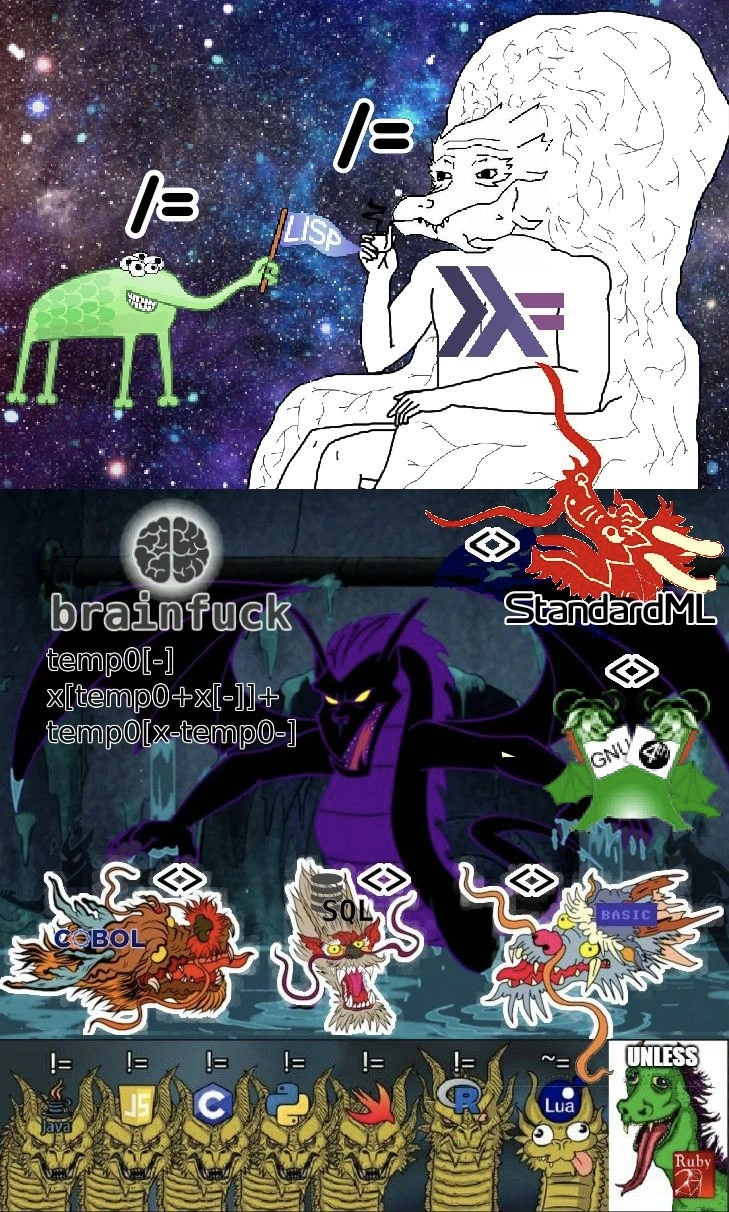
Imagine the world of programming languages as a big fantasy story! At the very top of this world, up in the stars, there are a couple of wise wizards who know very special magic. These wizards represent fancy programming languages that only the really experienced or academic folks use. One wizard is holding a little flag that says “LISP” and another huge-brained wizard wears a symbol (λ, the Greek lambda) for Haskell. Think of Lisp and Haskell as two grandmaster wizards who do things very differently from most people – their magic (coding style) is exotic and admired for its cleverness. They proudly say “we are not equal to the others,” meaning they see themselves as unique. This is like two teachers at a magic school who teach ancient, powerful spells that most normal students find hard to understand. They’re friendly with each other (both are into that functional magic), and they look down (from space!) at the rest of the world of coding with a bit of pride.
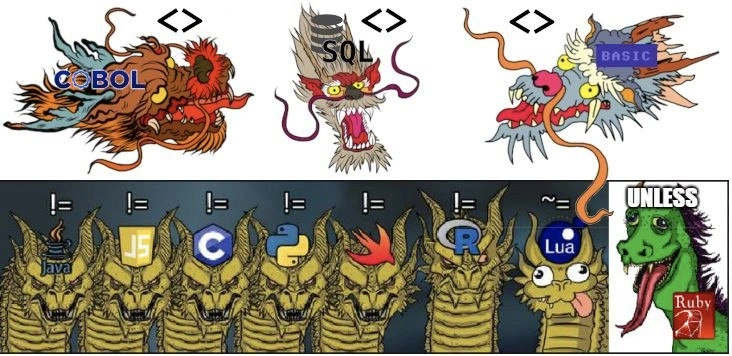
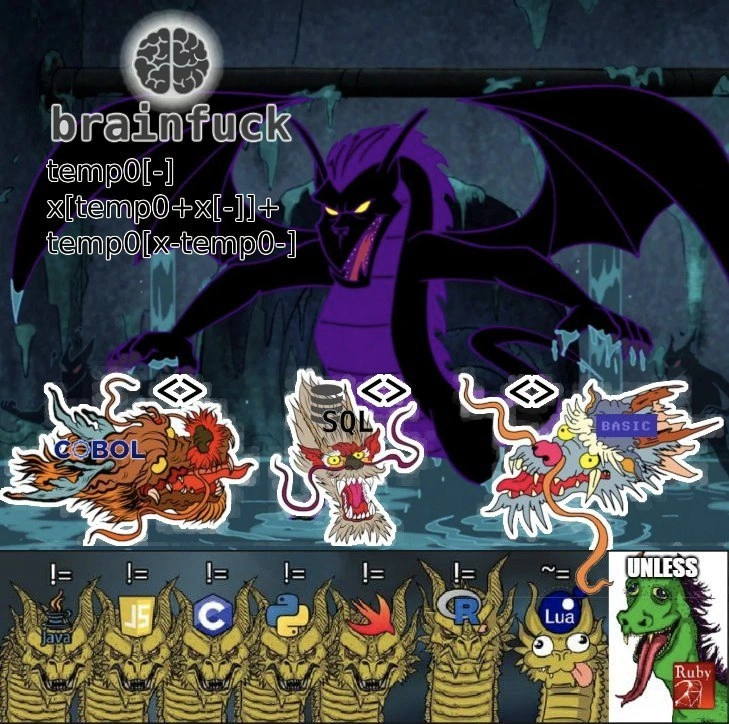
Now, go down a level into a dark, damp cave – the kind you’d find in a fairy tale – and you’ll find it filled with dragons! 🐉 Each dragon has a name: COBOL, BASIC, SQL, and one even with the weird name “brainfuck” (let’s call that one Brainf* for politeness). These dragons stand for old or odd languages – the kind of programming that feels like ancient spells or secret codes.
For example, the COBOL dragon is like a very old dragon that’s been sleeping on a pile of gold in some castle basement for decades. A lot of treasure (important old software) is tied to COBOL. Many banks and governments wrote their big systems in COBOL long ago. So this dragon is old but very important – if you disturb it, the kingdom’s economy might shake! People are nervous around it because it speaks in an old language style that few young programmers fully know now.
The BASIC dragon is also old, but more of a goofy, friendlier dragon. BASIC was the simple magic many elder wizards started with when they were young apprentices. It’s like the dragon that taught kids how to do small spells. Some say dealing too much with this dragon makes it hard to learn structured magic later (there’s an old joke about that). In the meme, this dragon has a silly face, implying BASIC is kind of a clumsy creature in the eyes of modern wizards.
The SQL dragon isn’t as scary-looking, but it’s peculiar. It’s like a dragon that only talks about treasure and counting coins (since SQL’s job is to fetch and organize data from databases). Almost every programmer at some point must talk to the SQL dragon because almost every application has data to manage. It’s not a fiery dragon, but more of a stern, specialized one. You have to speak its language exactly right (“SELECT * FROM table...”) to get what you want, or it just sits there guarding the data.
The Brainf dragon (the big purple one) is the strangest of them all. It’s huge and terrifying, not because it will burn you to a crisp (nobody actually uses it to attack), but because understanding it is a nightmare! Brainf* is a programming language made just to be insanely hard to read – like a puzzle or a prank. It’s as if a dragon spoke in complete gibberish that even other dragons can’t understand easily. Fighting this dragon is purely optional (and masochistic, as in only a thrill-seeker would do it for sport). It’s like the ultimate challenge in the cave: “If you can tame this beast, you earn bragging rights.” In the real world, programmers sometimes play with Brainf* for fun, not for real work.
There’s also a funky two-headed green dragon with GNU shields. Think of this as a dragon representing the old guards of open-source tools (GNU is an organization known for making a lot of foundational software for computers). Two-headed might mean this dragon has multiple personalities or two important aspects (like two big languages or tools from that world). It’s a bit of an inside joke: GNU’s mascot is a wildebeest (gnu), but here it’s a dragon – so it’s like a wildebeest that turned into a dragon with two heads, which is as whimsical as it sounds! Essentially, it signals “some old tech stuff from the open-source world that’s powerful but kind of monstrous in complexity.”
All these dragons in the cave form the middle tier of the hierarchy – they are either very old languages that time forgot (but are still lurking around, running critical things), or very weird languages that normal programmers rarely see (unless they go looking for odd challenges). They’re drawn as dragons to show that, to most programmers, dealing with these is like a mythical battle – daunting and not part of everyday life.
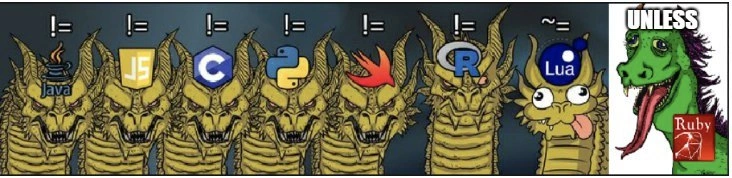
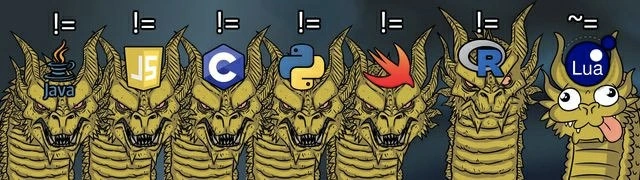
Finally, at the bottom, we’re out of the cave and back into the daylight of the everyday world, where we encounter a giant Hydra. A Hydra is a monster with many heads on one body. This Hydra’s heads each have a label: Java, JavaScript, C, C++, Lua, R (and imagine others like Python could be there too). These are the popular programming languages most people use to actually build software today – the ones you hear about in job postings or coding tutorials. The Hydra in the meme is kind of goofy-looking: each head has a derpy expression. Above them is a big == sign, which means “equals.” The joke here is that, from the perspective of those lofty wizards or even compared to crazy dragons, all these mainstream languages are basically the same breed. They might look different (different names and some different features), but they’re treated as one big family of ordinary monsters.
Think of it like a bunch of different breeds of dogs: a bulldog, a poodle, a German shepherd – very different in appearance and temperament, but ultimately all dogs. In the meme, Java, C, Python, JavaScript, etc., are like that – distinct heads, but all part of the same creature (the Hydra represents “general-purpose, imperative languages” in geeky terms – languages you’d use to build apps, which all have variables, loops, etc.). Seasoned programmers often note that once you learn one or two of these mainstream languages, the next one is easier because many concepts repeat. That’s what “==” (equal) is hinting: these languages share a lot.
Each Hydra head has a little fun in it:
- Java (with a coffee mug) – solid, workhorse language (coffee because Java). Many enterprise applications run on Java.
- JavaScript – the king of web front-end, known to every web developer.
- C – the classic language to write fast programs and operating systems.
- C++ – the more complex cousin of C (with “++” implying an increment or improvement over C).
- Lua – a lightweight scripting language often used in games (maybe the least known head for newcomers, but it’s there showing even niche-but-popular-in-area languages are part of the mix).
- R – a specialized language for stats and data science (showing even a maths/stats language is part of the Hydra’s many uses).
They all have silly faces – this implies that compared to the grand seriousness of our top-tier wizards or the ominous nature of dragons, these mainstream languages are a bit everyday and wacky. Every developer has stories of weird bugs or quirks in these languages that made them facepalm. It humanizes them: they’re powerful, but each can be a doofus sometimes, just like how a Hydra might be fierce but also clumsy with so many heads (in some myth or fantasy cartoons, a Hydra’s heads argue with each other or act goofy).
Now, one special detail: in the corner, we have a little philosopher dinosaur (Philosoraptor) peeking in, saying "UNLESS" next to a Ruby gem. This is a small joke about the Ruby language. Ruby is another popular language (especially known for web development via Ruby on Rails). Ruby’s gimmick in this meme is the word unless. Ruby has an unless keyword which works like a backwards “if”. It’s like saying “do X unless Y is true” (which is the same as “if Y is false, do X”). Most languages don’t have that; they’d make you write the negation explicitly. Ruby adding unless is one of those little touches that Ruby fans enjoy (it makes code read closer to English). The Philosoraptor meme character is often used to propose a sly thought, so here it’s as if he’s saying: “All these languages are the same... unless we include Ruby, which does something a bit different!” It’s a playful way to not leave out Ruby and to hint that Ruby folks see their language as having a bit of extra philosophy or elegance (hence a thinking raptor).
In simple terms, the entire meme is a big joke about how programmers rank programming languages like a fantasy food chain:
- Lisp and Haskell are the wise, enlightened ones at the top (the guru languages).
- COBOL, BASIC, brainfuck, etc. are the ancient or strange monsters in the middle (the ones people either fear working with or encounter rarely).
- Java, C, JavaScript, etc. are the common creatures that do most of the day-to-day work (the familiar monsters that we handle regularly).
It’s funny because it’s like seeing our technology world through a Dungeons & Dragons or sci-fi lens. We usually don’t think of code this way, but the meme dramatizes it:
- It pokes fun at “language wars” – the habit of developers to argue over which language is superior – by literally giving each language a heroic or villainous role.
- It highlights language quirks and legacy: like the fact that yes, our banking system might be effectively guarded by a COBOL dragon 🐲, or that Haskell programmers sometimes act like they’re on a higher intellectual plane (galaxy brain 🧠 in space).
If you’re not a programmer, think of it like this: imagine all the different tools or instruments people use portrayed as characters. Say, a violin and a grand piano shown as angelic beings (because classical maestros revere them), old instruments like a harpsichord or lute as dragons in a cave (old and niche), and everyday instruments like guitars, drums, keyboards as a multi-headed hydra (different looks, but all music makers). And maybe a harmonica pokes in saying “unless” because it has a funny unique note. That’s the kind of humor here – personification and hierarchies based on culture and difficulty, not actual “good vs bad.”
In the end, this meme is making programmers laugh at themselves. It’s saying: we treat some languages like gods, some like necessary evils, and others like plain tools – and here’s a crazy picture to visualize that. Even if you don’t know the languages, you can relate to the idea of people in any field having their favorites, the old stuff they begrudgingly maintain, and the common tools they use daily. By casting those into a cosmic epic with wizards, dragons, and a hydra, the meme creates a funny tech folklore vibe. The emotional core is: pride, fear, and everyday tediousness – pride in the fancy languages, fear of the legacy ones, and a bit of eye-rolling at how all the daily ones are similar. It’s humorous because it’s an exaggeration that contains a grain of truth about how developers see their world.
Level 2: The Language Zoo
This meme imagines the world of programming languages as a kind of fantastical hierarchy, and it’s loaded with references that become clearer once you know a bit about each language. Let’s break down the “cast” of this collage and why they’re portrayed this way, in simpler terms:
Top Tier – The Enlightened (Functional Programming pioneers):
At the very top, set against a starry cosmos, we have two characters representing programming languages that are often considered highly sophisticated or academic: Lisp and Haskell. These are both closely associated with functional programming – a style of coding where you mostly use functions (like in math) and avoid changing variables or state. In the image, Haskell is depicted as a giant wise being (the “big brain” character), and Lisp is a smaller green creature waving a flag with “LISP”. They’re kind of friendly toward each other (both have a != sign near them, meaning “not equal”), suggesting they see themselves as set apart from the rest.
Lisp: Lisp is one of the oldest programming languages (from the late 1950s). It introduced a lot of key ideas in computer science, like garbage collection (automatic memory management) and treating code as data. Lisp’s syntax is unique – everything is written in parentheses, e.g.,
(add 2 3)to add numbers. It allows powerful macros which can basically generate new code on the fly. Because of these capabilities, people often say Lisp feels very abstract or advanced. Fans of Lisp sometimes joke that it’s a “higher” language that changes the way you think about coding. In the meme, the little green smiling quadruped (a cute alien-looking figure) holding the Lisp flag is cheerfully hailing Lisp’s greatness. It’s like a tiny mascot for the language’s enthusiasts. Despite being small next to Haskell’s big brain, Lisp has a proud, legendary status (after all, it’s been around for decades influencing many other languages).Haskell: Haskell is a purely functional language (first appeared around 1990). Purely functional means functions in Haskell don’t have side effects – they don’t alter variables or do things like I/O directly. This makes programs easier to reason about mathematically. Haskell uses a strong static type system (you define types for things and it checks at compile time) and even advanced concepts like monads (which help handle things like input/output or state in a pure functional way). Haskell’s logo is a Greek lambda
λ, reflecting its foundation in lambda calculus (a mathematical formalism for computation). In the meme, Haskell is the big-brain Wojak wearing a toga – basically portraying Haskell as a super-intelligent philosopher or sage. That image comes from a popular meme format where a character with a huge pulsating brain represents someone on a “higher mental plane.” So Haskell is shown as this enlightened guru of programming.
The != (not equal) sign displayed by both Lisp and Haskell signifies that these two languages consider themselves “not equal” to the others — in other words, unique. It’s a playful way of saying Lisp and Haskell are in a class of their own. In programming, != is an operator used to compare things and means “not equal.” So visually, it’s marking them as distinct. (On the bottom panel we’ll see a == meaning “equal,” which contrasts with this.)
Middle Tier – The Dragons (Legacy and Unusual Languages):
The middle image looks like a dungeon or cave with stalactites, and it’s populated by dragons each labeled with a programming language. These represent languages that are either very old (we call them legacy languages when they’re old but still in use) or very esoteric (unusual, used mostly for specific purposes or even jokes). Each dragon is a different color and label:
brainfuck (purple dragon): Don’t be shocked by the name – Brainfuck is indeed the actual name of a programming language. 😅 It’s an esoteric language created in 1993 as a kind of joke/challenge. Brainfuck has an extremely minimal design: it only has 8 commands (such as
>to move a pointer,+to increment a value,[to loop, etc.). Writing code in Brainfuck is notoriously difficult because you’re essentially manipulating memory at a very low level with almost no readable syntax. The snippet shown on the dragon (temp0[-] x[temp0+x[-]]+ temp0[x-temp0-]) is a representation of what Brainfuck code might look like – confusing, right? Real Brainfuck code would just be symbols like+++[->++<](for example), which is even harder to read. The meme makes Brainfuck a giant dragon probably because it’s known as a “monster” to work with. It’s rarely used for real projects (mostly it’s a puzzle for programmers to test their skills or patience), but it’s kind of infamous. By labeling the biggest dragon “brainfuck,” the meme jokingly crowns it as a sort of ultimate boss in the dungeon of programming languages due to its extreme complexity for humans. It’s like saying, “Only a true hero would dare fight this beast,” since only a very determined (or crazy 😜) coder would write a program in Brainfuck for fun.Standard ML (red dragon): Standard ML (often abbreviated SML) is a language that came out of academia (late 1970s/early 80s). The “ML” stands for MetaLanguage. It’s a functional language with a strong type system and is known for introducing type inference (where the compiler deduces types for you). While important in the history of programming languages, SML isn’t commonly used in day-to-day programming jobs. It’s more something you’d encounter in a computer science course or certain specialized areas like theorem provers. In the meme, Standard ML is a dragon – that indicates it’s considered “arcane” or part of the old guard. Many developers might not recognize it unless they’ve studied CS formally. So it’s placed in the dungeon among the other less mainstream beasts.
GNU (two-headed green dragon): The green dragon has two heads, each carrying a shield with GNU on it. GNU is not a programming language but the name of a famous project in the free/open-source software world. GNU (a recursive acronym for “GNU’s Not Unix”) was started in the 1980s to create a free Unix-like operating system. It produced a lot of tools that programmers use (like the GCC compiler, libraries, Emacs editor, etc.). Why a two-headed dragon for GNU? It’s a bit interpretative, but it could mean a couple of things. Possibly, it’s referencing two GNU-related languages/tools that are kind of “connected at the body.” For instance, the GNU project supports Emacs Lisp (the scripting language for the Emacs editor) and Guile (a Scheme, which is a dialect of Lisp used as an extension language). Both are “GNU” Lisp dialects, so you might think of them as two heads on the same GNU beast. Another interpretation: GNU software can be powerful but also complicated or “monstrous” at times (think of the complexity of something like Emacs or the GCC compiler internals). The two heads might signify the dual nature of GNU’s legacy – one head for its technical contributions, one for its ideological side (GNU was tied to the Free Software Foundation and a philosophy about free software). In any case, putting GNU in the dragon lineup suggests it’s part of the old legacy host – important in history, maybe a bit fearsome or unwieldy now, and not exactly mainstream cool.
COBOL (orange dragon): COBOL is a very old programming language (from 1959!). The name stands for "Common Business-Oriented Language". It was designed for business data processing and has an English-like syntax (e.g.,
ADD YEARS TO AGE GIVING NEW-AGE– it looks verbose). For decades, COBOL ran on big mainframe computers in banks, insurance companies, and governments. Shockingly, even today a huge amount of critical software (like bank transaction systems, some government systems) still run on COBOL code written many, many years ago – this is why we call it legacy code. Few new developers actively choose COBOL today, but those old systems have to be maintained (you might be surprised: during the 2020 COVID pandemic, some states were desperately looking for COBOL programmers to update unemployment systems!). As a dragon, COBOL signifies something ancient, powerful, and a bit intimidating. It’s the kind of technology that’s hoarded treasure (important data and functionality) over ages, and people are afraid to touch it because it’s old and quirky, but also they can’t slay it because it’s mission-critical. If you’re a new developer, you likely won’t encounter COBOL unless you work in a field with very old systems, but every experienced dev is aware of its almost mythic status in legacy computing.SQL (white dragon): SQL stands for Structured Query Language. It’s actually extremely common in software development, but it’s quite different from typical programming languages. SQL is used to manage and query relational databases (think of tables of data). If you’ve ever used something like MySQL, PostgreSQL, or Microsoft SQL Server, you write SQL commands to retrieve or modify data (e.g.,
SELECT * FROM Users WHERE age > 30;). SQL is declarative – you describe what result you want, and the database engine figures out how to get it. It’s been around since the 1970s and is standardized, but each database has slight variations. In the meme, SQL is a dragon, possibly because, while it’s common, it’s from the old guard of technology (it’s not a new shiny language; it’s a workhorse that’s been around a long time). Also, for many developers, database work is a whole different realm – interacting with SQL can feel like dealing with a different beast compared to writing application code in C# or Java. So SQL is depicted as one of the monsters in the cave – something powerful and sometimes challenging that every developer eventually confronts when dealing with data storage.BASIC (blue dragon): BASIC is an acronym for Beginner’s All-purpose Symbolic Instruction Code. As the name implies, it was designed to be easy to learn. In the 1970s and 1980s, BASIC was the language on many personal computers (old PCs often booted into a BASIC environment, and many people of that era had their first taste of programming with BASIC). It has a simple, English-like syntax (though early BASICs required line numbers and had a lot of GOTOs for control flow, which nowadays we consider poor practice). Many modern developers see BASIC as outdated. Visual Basic was a later version used for Windows application development and macros (some businesses still have VB code running). BASIC is the meme’s blue dragon, meaning it’s another “old beast.” The expression on the BASIC dragon is a bit derpy (silly-looking), which is a playful dig at the language’s simplicity and perhaps the way it’s looked down upon by serious programmers. In truth, BASIC was hugely influential and got a whole generation into coding, but among pros it has a reputation for encouraging bad habits (there’s a famous joke: “Real Programmers don’t use BASIC”). So here BASIC is one more monster in the legacy dungeon, perhaps considered lesser (goofy-looking) compared to the fiercer ones like COBOL or brainfuck, but still part of that ancient menagerie.
In summary for the middle panel: These dragons represent older languages or niche languages that stand outside the modern programming mainstream. For a new developer, some of these names might not even come up unless you dive into history or specific sectors. But they’re important in the story of programming. The meme groups them as dungeon creatures to emphasize they’re like old monsters from past eras or alternate realms of programming. It’s humorous because developers often jokingly refer to battling with legacy code or deciphering an esoteric language as slaying a dragon – it can be daunting and require special knowledge or bravery.
Bottom Tier – The Multi-Headed Hydra (Modern mainstream languages):
Finally, at the bottom, the meme shows a Hydra – a mythical creature with many heads – to represent the popular programming languages that are widely used today. Each head of the Hydra has a logo or icon for a different language, and the faces are goofy, implying maybe they’re a bit foolish or at least not as awe-inspiring as the dragons or cosmic beings above. Importantly, above the Hydra’s heads is a == symbol, which in programming means “equal to.” The idea here is that, from a certain viewpoint, all these mainstream languages are equivalent or very similar (especially when compared to the really exotic ones like Lisp/Haskell or Brainfuck). Let’s identify the heads:
Java (yellow Hydra head with a coffee mug): Java is a hugely popular language, especially for enterprise software (banks, large companies) and also Android app development. Its icon is often a coffee cup (Java is a type of coffee). It’s an object-oriented, class-based language known for its portability (the “Write once, run anywhere” tagline for the Java Virtual Machine). Java code tends to be verbose (lots of boilerplate), and Java programs are known for their stability and performance in large systems. In the meme, Java is just one of the Hydra’s heads – suggesting that as important as it is, it’s fundamentally one of many doing similar jobs.
JavaScript (yellow head with "JS"): JavaScript is the primary language for web development – it runs in all web browsers to make websites interactive. Despite the name, it’s actually not directly related to Java; it was named that way for marketing reasons. JavaScript is dynamic and was historically used just on the front-end (browser), but with Node.js it’s also used on servers now. It’s arguably one of the most widely-used languages today. On the Hydra, one head is marked "JS". JavaScript is depicted with the same goofy style as the others, meaning the meme lumps it in with the rest of mainstream languages as not particularly special (at least in the eyes of our Lisp/Haskell sages).
C (yellow head with "C"): C is a much older language (early 1970s) but still heavily used, especially for system programming (operating systems, embedded devices) and high-performance applications. It’s a low-level language relative to something like Java – you manage memory manually, and it’s very close to how the machine works. C is praised for being minimal and powerful, but it’s also known for pitfalls like pointer errors and buffer overflows (which can cause crashes or security issues). A Hydra head with "C" acknowledges C as one of the core languages everyone eventually encounters (or at least hears about) due to its influence (many languages, like C++, Java, C#, are syntactically influenced by C).
C++ (yellow head with "C++"): C++ extends C with object-oriented features and a lot of additional complexity (templates, exceptions, etc.). It’s used in performance-critical software, games, game engines, and large applications (like major Adobe apps, etc.). C++ can be notoriously complex (there’s a lot of jokes about how no one fully knows all of C++ since it’s so large). Again, as a Hydra head, it’s shown as part of the pack – it might be fiercer in reality (some might say it’s the “complicated sibling” of C), but in the meme’s terms it’s one more mainstream language head doing similar kinds of things (imperative code, managing memory or using heavy libraries).
R (yellow head with "R"): R is a language for statistical computing and data analysis. It’s widely used by statisticians and data scientists. R has tons of packages for doing things like plotting graphs or running statistical tests. It’s not a general-purpose language for writing, say, web servers or mobile apps; it’s more for data exploration and analysis, often used interactively. Including R as a Hydra head is interesting – it shows that even a domain-specific popular language gets tossed into the general “mainstream” bucket. It suggests that from the lofty view of Lisp/Haskell, even R (though it’s declarative in some ways and high-level for stats) is just another head. Possibly the meme maker included R to broaden the scope beyond just system and web languages, acknowledging data science has its own popular language, which is R (and Python, though notably Python’s not explicitly in the image – perhaps omitted or assumed). R’s goofy face indicates that, like others, it has its own oddities (R is known for some unusual syntax and gotchas, especially if you come from other languages).
Lua (yellow head with "Lua"): Lua is a lightweight scripting language, often embedded in applications (for example, many video games use Lua for their scripting, and software like Wireshark or Nginx can use Lua for extensions). It’s known for being simple, fast, and easy to embed into a host program (it’s written in C). Lua’s presence here shows the meme maker wanted to capture a wide range of commonly used languages across different realms (enterprise, web, systems, data, embedded/games). Lua might not be as famous as Python or C#, but in certain circles it’s very prevalent. As a Hydra head, Lua indicates that yes, yet another language that, at the end of the day, isn’t too conceptually far from the others (imperative, uses variables, data structures, etc.).
All these Hydra heads are under the == symbol. In code, == checks equality. The meme uses it to say “these are all equal/similar.” Essentially, it’s implying that despite the differing logos and niches (web, enterprise, stats, etc.), these mainstream languages share a lot of common ground. They generally follow the paradigm of telling the computer how to do tasks step by step (as opposed to those top-tier functional languages which focus on what to compute in a declarative way). They also tend to borrow ideas from each other. For example, JavaScript and Python adopted first-class functions (from the functional world), Java and C# took inspiration from C++ but safer, etc. A newcomer might see Java vs JavaScript vs C++ as vastly different (and they are different in practice and syntax), but an experienced programmer often notes that once you know one, learning another is easier because concepts like loops, if-statements, and even object-oriented ideas repeat across them.
Lastly, we have the Philosoraptor with "UNLESS" and a Ruby gem icon off to the side. Let’s unpack that:
- Philosoraptor is an old internet meme: an image of a Velociraptor looking contemplative, usually captioned with a deep or witty hypothetical question (like “If Cinderella’s shoe fit perfectly, why did it fall off?” — that sort of vibe, but often tech or philosophy related). It’s a symbol of playful critical thinking or posing something paradoxical.
- Ruby is another popular programming language (known for web development via the Rails framework). The icon is a red gem (since Ruby, the gem). Ruby’s philosophy is about programmer happiness and clear code. One distinctive Ruby feature is the
unlesskeyword. In Ruby, you can writeunless conditionas the inverse ofif condition. For example:
This would executeunless is_raining go_outside() endgo_outside()only ifis_rainingis false. In most other languages, you’d doif (!isRaining) { goOutside(); }or similar. Ruby let you express it in a more English way (“unless it’s raining, go outside”). It’s a small thing, but Ruby fans often enjoy these little syntactic conveniences. - In the meme, “UNLESS” with Philosoraptor likely suggests a cheeky thought: “All these languages are the same... unless... [something]”. Given the Ruby gem, that something is probably Ruby’s unique twist. It might be hinting: “unless you consider Ruby, which is mainstream but has its own flair.” Ruby’s not depicted as a head of the Hydra, so it’s like an outsider peeking in with a wisecrack. This aligns with Ruby’s self-image a bit — Ruby developers sometimes see their language as mainstream done right, with nicer syntax and a bit of a philosophy behind it, setting it slightly apart from, say, Java or C++ in style. The meme maker, by including this, adds a layer of humor: even in the supposedly uniform Hydra of popular languages, there’s someone (Ruby, via philosoraptor) trying to philosophize or claim a special case (“we’re all equal... unless...”). It’s very much an in-joke for those who know Ruby or the philosoraptor meme.
So, putting it all together in simpler terms: The meme is showing a hierarchy of programming languages as if it were a fantasy universe:
- The top level (space) is like the heavens with wise masters (Lisp, Haskell) who are revered for their smarts (functional programming mastery).
- The middle (cave) is filled with dragons, representing the old guardians and exotic creatures of the programming world: languages that are either ancient (COBOL, BASIC), specialized (SQL), or just famously weird (brainfuck, or things from the GNU world), which many developers find intimidating or archaic.
- The bottom (the Hydra) is the regular world where most coding happens today: lots of different languages, but here they’re depicted as one multi-headed beast, implying these languages are more alike than different in the grand scheme. They’re the everyday tools (Java, C, JavaScript, etc.) that developers use – sometimes we debate which is better, but the meme jokes that from a high enough view, they’re all the same kind of creature doing the same kind of work.
And then Ruby’s “unless” is a little side joke, hinting at one language’s quirky way of doing things differently (and poking at the idea that every developer thinks their favorite language is the special exception).
The humor comes from exaggeration and personification:
- Exaggeration: Treating languages almost like religions or monsters, ranked in power. No one actually believes Haskell developers sit on cosmic thrones, but it’s exaggerating how some Haskell enthusiasts do act a bit like they have secret knowledge. Similarly, COBOL isn’t literally a dragon, but ask anyone who’s had to maintain a COBOL system – it sure can feel like confronting a dragon!
- Personification: Giving each language a character (a sage, a dragon, a goofy hydra head) based on its reputation. This makes the differences very vivid and brings the “language wars” to life in a comical way.
For a junior developer or someone new to the field, this meme is a crash course in the stereotypes and history behind various programming languages:
- FunctionalProgramming languages (like Lisp, Haskell) are admired but seen as ivory-tower or mind-bending.
- LegacyCode languages (like COBOL, BASIC) are super important historically (and even currently in legacy systems) but seen as outdated or dreaded to work with.
- Mainstream languages (Java, C, JavaScript, Python, etc.) are what most of us use daily — each has its own flavor and community, but as the meme suggests, they form one big family compared to the exotic ones.
And the != vs == signs essentially label who’s considered “different/elite” vs who’s “all the same” in this humorous hierarchy. It’s a satirical take on languageWars – those debates about “which language is best” – by illustrating that from one perspective, two languages might be worlds apart, while from another, a bunch of languages are virtually indistinguishable.
Level 3: Lisp Sages & Hydra Heads
To an experienced software engineer, this meme elicits a knowing chuckle because it caricatures debates and attitudes that are all too familiar in the tech world. We’ve all seen a bit of language snobbery and paradigm wars play out. The top panel with Lisp and Haskell as cosmic beings captures the almost reverent tone some developers use for these languages. Seasoned devs have likely encountered colleagues who claim enlightenment from learning Haskell or Lisp — suddenly every other language is “inferior” or “just syntactic sugar.” There’s a long-running joke about Haskell enthusiasts treating it like the pinnacle of programming wisdom (hence the giant brain Wojak radiating wisdom with the Haskell logo). Similarly, Lisp has an almost mystical legacy in programming culture; old-school Lisp programmers speak of the “Lisp enlightenment” where you finally get macros and code-as-data. The meme identifies these two as the sages on the mountaintop. The little green creature waving a LISP flag at the big Haskell brain is a fun touch – it’s like Lisp is the wise elder race of the past, hailing Haskell which has ascended to new heights in the academic/functional pantheon. Both proudly display != (not equal) as if saying “We are not like those others.” This corresponds to a real sentiment in some circles: that functional programming (epitomized by Lisp’s homoiconic macros and Haskell’s pure functions and monads) is a fundamentally superior way to write programs than the “common” imperative or OOP style. It’s poking fun at the intellectual elitism that can occur. A senior developer will recall countless LanguageWars discussions – whether on forums, at conferences, or over coffee with coworkers – where someone asserts that using language X (often a functional or niche language) unlocked a higher understanding of coding. The meme dials that up to 11 by literally making those languages cosmic beings.
Now, what makes this especially humorous to industry veterans is the contrast with reality. The meme’s middle and bottom panels bring in the messy, unglamorous, or pragmatic side of programming that every experienced dev has had to confront. The dungeon full of dragons is so on-point it hurts. Each of those dragons represents a technology that is powerful and often unavoidable, yet somewhat begrudged or feared by developers:
COBOL (orange dragon) – Any senior dev in banking, finance, or government knows that COBOL is the ancient titan that simply won’t die. Companies poured decades into COBOL systems; come Y2K or pandemic relief systems (many U.S. state unemployment systems infamously run on COBOL even in the 2020s), suddenly there’s a scramble for COBOL programmers to tend to the beast. The meme calling COBOL a dragon is perfect: it’s old, gigantic (millions of lines running worldwide), and few new knights (programmers) want to fight it, because who wants to write code from 1960 with all-caps and rigid columns? Yet, it’s guarding enormous treasure (critical data and business logic). Seasoned devs smile because they’ve either directly dealt with a “COBOL dragon” or know someone who has – it’s a shared war story in Legacy Systems management.
BASIC (blue dragon) – Many of us wrote our first programs in some BASIC variant (whether it was QBasic, GW-BASIC, or through Visual Basic macros). There’s a nostalgia with BASIC, but also a bit of embarrassment. Edsger Dijkstra (a famed computer scientist) notoriously said, “It is practically impossible to teach good programming to students that have been exposed to BASIC: as potential programmers they are mentally mutilated beyond hope of regeneration.” That brutal quote from the 1970s reflects how purists truly despised BASIC’s unstructured approach (lots of GOTO statements, etc.). A senior developer who’s aware of this history will see the BASIC dragon’s goofy face and recall that, indeed, BASIC was often the butt of jokes. The meme capturing BASIC as a derpy dragon matches the language’s reputation as the clumsy but pervasive old beast that nonetheless introduced many to coding.
SQL (white dragon) – Here’s one that every full-stack or backend developer recognizes: SQL is ubiquitous. It’s inescapable because data is at the heart of applications. But many programmers have a love-hate relationship with it. It’s not taught as a first language; it feels more like writing sentences (“SELECT * FROM table WHERE conditions”) than writing algorithms. It’s powerful in its domain (you can query and join complex data in a few lines), but step outside that domain and it’s awkward (ever tried to write complex business logic in pure SQL? It gets convoluted fast). Seeing SQL as a dragon implies “this thing is a different creature we must sometimes confront.” Any dev who’s spent nights optimizing a gnarly SQL query or wrestling with an ORMs translation of objects to SQL will smirk at this depiction. It’s a gentle jab at the idea that while front-end devs argue React vs Angular, deep down every serious app is dealing with the SQL dragon under the hood when it hits the database.
Standard ML (red dragon) – This one is a bit niche for industry folks, but a senior dev who studied computer science formally may recall Standard ML from a “Programming Languages” course or a compiler class. It’s one of those languages you rarely see in job postings, yet it influenced a lot of modern language design (like OCaml, F#, Rust’s type system to an extent). Standard ML’s presence in the meme is a wink to the academically inclined senior devs: “Hey, remember that functional language you flirted with in college that one time?” It’s a dragon here perhaps because it’s powerful and elegant, but to use it in the real world can feel as impractical as taming a dragon — it’s just not a common tool outside specific niches. In industry, bringing in Standard ML for a project would raise eyebrows; it lives in the dungeon of theory and specialized uses.
GNU two-headed dragon (green) – Ah, this one likely put a grin on the face of any open-source elder. The GNU project (founded by Richard Stallman) is legendary: it gave us GCC, Emacs, the GPL license, and basically the userland of modern Linux systems. Depicting something as a “GNU dragon” is amusing because GNU’s mascot is literally a wildebeest (a gnu), but here it’s armored and double-headed. There’s an inside joke: GNU is recursive by nature (the acronym jokes about itself), and the culture around GNU can be a bit, shall we say, two-headed. One head: the practical tools (compilers, shells, utilities) every Unix/Linux developer uses. The other head: the ideologies and the less mainstream stuff (like the HURD kernel that never quite took over, or the preference for Lisp in Emacs, etc.). A senior dev who’s configured Emacs (in Emacs Lisp) or compiled code with GCC might get a kick imagining those as two heads of the same beast. Essentially, the GNU dragon represents the old guard of open-source tech. It’s formidable and not always user-friendly (ever try to read GNU tool documentation?), which suits the dragon persona. And of course, many GNU tools have that 1980s-1990s vibe, aligning it with the “legacy dungeon” theme.
Brainfuck (purple dragon) – This one stands out: why would an utterly impractical joke language be the largest dragon? That’s precisely the joke from a seasoned perspective: Brainfuck is a rite of passage for some geeks (“I wrote a Brainfuck interpreter!” or “I coded FizzBuzz in Brainfuck for laughs”). It’s utterly impractical for real work, but it’s like the ultimate boss of nerd cred. The dragon is huge because it’s notoriously difficult; in a humorously masochistic way, Brainfuck commands respect among programmers just for how ridiculous it is. A senior developer likely encountered Brainfuck in the context of fun – perhaps in an article about weird languages or a coding challenge. Seeing it loom over actually useful languages (like COBOL or SQL) is comedic hyperbole: it implies absurd difficulty (Brainfuck) can trump actual business value (COBOL) in this mock hierarchy. It’s a reminder of the sometimes skewed values in developer culture: we may celebrate a complex puzzle more than the boring code that quietly runs the world. That ironic contrast is funny because it’s true — developers often idolize what is intellectually challenging (Haskell, Brainfuck, etc.) while underestimating the “boring” tech that actually earns the paycheck.
Now, the bottom panel – the Hydra of mainstream code – is something every experienced dev has lived. Over years, you learn multiple programming languages, and a surprising thing happens: you start seeing that they have more in common than not. Early in a career, people might be die-hard about “I love Java and C is so low-level” or “Python is the best and JavaScript is weird”, but a graybeard engineer will kind of shrug – variables, loops, data structures, API calls… after a while, it’s variations on a theme. The meme nails this feeling by literally making Java, JavaScript, C, C++, R, Lua heads of one creature. The == is saying “these are equivalent.” It’s exaggeration, of course (these languages do have differences and excel in different domains), but it’s true that compared to the wild dragons or the cosmic FP languages, these mainstream languages form one family. They largely follow the imperative paradigm (even if some, like Java and C++, incorporate object-oriented concepts, and R and Lua are higher-level scripting, they still have mutable variables and control flow at their core).
A senior developer will particularly appreciate the Hydra metaphor because of how the industry trends work. For example, back in the early 2000s, Java was the enterprise language. Then JavaScript went from a simple web scripting tool to a behemoth running servers (Node.js) – a new head emerging. Cut one head, two more grow: consider how many JavaScript frameworks have exploded onto the scene – today’s dev has to know not just JS, but possibly TypeScript (a variant head), plus front-end frameworks (React, Angular, Vue – each like a sub-head). Or take the rise and fall of languages: one year everyone talks about Go or Rust as the next big thing (new heads) while older heads like, say, PHP or Perl shrink into obscurity. The Hydra imagery captures the ever-evolving yet fundamentally similar nature of mainstream tech. It’s both humorous and a bit cynical: you can slay one hype, but another hype will replace it, and under the hood it’s often the same old ideas recycled. A veteran dev has the scars of chasing new heads only to realize the body is the same monster.
The goofy faces on the Hydra’s heads (especially if this image is referencing the popular “derpy dragon heads” meme template) add a dose of DeveloperHumor: as professionals, we know each of those languages has its quirks that make them a bit silly at times. For instance, Java’s verbosity (hence maybe a dumb grin), JavaScript’s infamous type coercions and oddities ("5" - 3 works but "5" + 3` concatenates – huh?), C’s footguns with manual memory management, C++’s indescribable template errors, R’s sometimes wonky performance and package ecosystem, Lua’s 1-indexed arrays throwing off C-minded folks… each mainstream language can frustrate or amuse us. Treating them as goofy-headed dragons suggests that from the lofty view of a Haskell guru or a battle-hardened senior dev, these squabbling popular languages are kind of laughable – they all have their derp moments.
And then there’s Ruby’s cameo with the “UNLESS” philosoraptor. Ruby is indeed a mainstream language (it probably should be one of the Hydra heads if completeness mattered), but the meme maker gave it a special shout-out. Why? Ruby has always been a bit of a philosopher among scripting languages. Yukihiro "Matz" Matsumoto, Ruby’s creator, designed it with the principle of developer happiness and took inspiration from Perl, Smalltalk, and Lisp. Yes, Ruby borrowed ideas like closures and a flexible syntax partly from Lisp-y thinking. The unless keyword exemplifies Ruby’s philosophy: make code read as naturally as possible. A Rubyist might cheekily say, “Unless you’ve tried Ruby, you haven’t seen how elegant everyday coding can be.” So the philosoraptor with “UNLESS” could be read as: “All these languages are the same… unless… (you use Ruby?)” – implying maybe Ruby offers a slightly different, more thoughtful experience. It’s a playful, almost self-aware insertion by the meme’s author, perhaps a Ruby fan themselves throwing a bone. Senior devs who have seen the rise of Ruby on Rails (and perhaps its plateau once Node.js and others took over the hype) will catch the nod. Ruby was once the shiny new head around 2008-2012 in web development, promising to make programmers happier (with Rails’ convention-over-configuration and expressive syntax). Some adored it; others found it too magical or slow. By highlighting Ruby’s unless, the meme acknowledges one little language quirk that sets Ruby apart – something every Ruby newbie notices and every Ruby veteran uses with a smile.
All told, from a senior perspective this meme compresses decades of LanguageComparison lore and technological evolution into one image. It’s funny because it’s true: we have our language tiers in our minds. We’ve got the “Ivory Tower” languages (often idealized in conference talks and Reddit threads but rarely seen in your company’s codebase), we’ve got the “Dungeon” languages (old stuff still running critical systems or wacky languages used in coding challenges), and we have the everyday “Hydra” languages (which we spend most of our careers coding in and realizing that, honestly, moving from one to another isn’t as earth-shattering as we thought when we were juniors). The meme uses absurdity – space aliens and dragons – to highlight real contrasts: idealism vs practicality, old vs new, academic elegance vs get-it-done pragmatism. A veteran developer appreciates this multi-layer joke because they’ve lived each layer: maybe writing Scheme in school (and feeling like that Lisp sage), then fixing a broken VB script or COBOL batch job at work (facing the legacy dragon), and daily coding in Java/Python/JS (another head of the Hydra) while debating code style in pull requests, occasionally thinking “wow, in the end, it’s all 1s and 0s anyway.” It’s a comedic reflection on our industry’s culture and history — an insider joke that doubles as a quick tour of programming language lore.
Level 4: Monads and Macrocosm
At the highest tier of this meme’s universe, we see programming languages elevated to a almost philosophical status. The cosmic scene with the big-brained sage (Wojak in a toga) wearing the purple Haskell logo and the little green Lisp creature waving a “LISP” pennant is a nod to the deep, theoretical roots of these languages. Haskell and Lisp are often revered in the programming community for their connection to academic computer science. Haskell’s lambda (λ) emblem is not just a logo — it represents Alonzo Church’s lambda calculus, a formal mathematical system that underpins functional programming. In Haskell, nearly everything is expressed as a function, and it embraces pure functional programming: functions have no side effects and given the same input, always produce the same output. This purity allows Haskell to tap into formal math for correctness; for example, managing side effects via monads (an abstract concept from category theory). A monad in Haskell is a design that lets you chain computations while maintaining pure function semantics — a concept so theoretical that many jokes equate understanding monads to achieving enlightenment. It’s fitting that Wojak’s cranium is astronomically expanded! Meanwhile, Lisp (one of the oldest high-level languages, from 1958) embodies a different kind of purity: it’s homoiconic, meaning Lisp code is written in the same structure (lists within lists, called S-expressions) that the language itself can easily manipulate. This gives Lisp incredible metaprogramming power through macros — code that writes code. Lisp enthusiasts often speak of the language as if it’s alive or magic because you can extend the language itself on the fly with macros. These lofty concepts — lambda calculus, category theory, homoiconicity — are the macrocosm of programming language theory. The meme humorously casts Haskell and Lisp as cosmic sages because mastering these languages often requires grappling with abstract math and deep programming language theory. They’re literally depicted in space, implying they operate on a higher plane of thought.
Notice the white != symbols floating near Haskell and Lisp. In many programming languages != means “not equal.” This is a clever visual metaphor. In the academic or purist view, languages like Lisp and Haskell consider themselves “not equal” to the more common languages — they see themselves as fundamentally different in nature. (As a side note, Haskell’s actual not-equal operator is /=, but the meme uses the more universal C-style != for clarity.) This leads directly to the bottom of the meme where all the mainstream languages are under a big == (equality) symbol. The cosmic gurus view those as essentially the same (equal to each other), while declaring “We are not the same as them (!=).” There’s a tongue-in-cheek almost Platonian hierarchy here: Haskell and Lisp are in the realm of Forms (pure ideals), as opposed to the mundane realm of multiple equal instances below.
Dropping down to the dungeon scene (the middle panel), we step from the ivory tower of theory into the realm of esoteric and legacy beasts. Here the meme assembles a roster of dragons, each representing a programming language known either for its obscurity, age, or peculiarity. At the forefront as the largest dragon is Brainfuck – an esoteric language so minimalistic and obtuse that it’s legendary among programmers. Brainfuck operates on a theoretical Turing machine-like tape with only 8 single-character commands (> < + - . , [ ]). Writing anything in it is a mental torture test; it was intentionally designed (in 1993 by Urban Müller) to have a tiny compiler and to challenge the boundaries of programming minimalism. The code snippet displayed on the Brainfuck dragon –
temp0[-]
x[temp0+x[-]]+
temp0[x-temp0-]
– is a stylized representation of Brainfuck code. In true Brainfuck, you’d see characters like +++[>+++<-] without any descriptive names, but here they’ve annotated it with pseudo-variables (temp0, x) to hint at what’s going on. Still, it looks like gibberish because Brainfuck is essentially gibberish to human eyes – yet it’s Turing complete, meaning in theory it can compute anything any other general-purpose language can (given enough memory and time). This dragon’s prominence lampoons the idea that a language practically unusable by humans is, in the theoretical hierarchy, just as powerful as any “normal” language. It’s the ultimate Turing tar-pit creature: powerful in principle, agonizing in practice. The meme exaggerates that power by making Brainfuck a giant boss dragon. In theoretical CS, we marvel at such minimal systems because they demonstrate the essence of computation with almost nothing – but we also recognize how impractical they are.
Surrounding the Brainfuck dragon are smaller dragons representing older or academically interesting languages. Standard ML (the red dragon labeled StandardML) is a product of language research (from the 1970s/80s). It introduced the world to the Hindley-Milner type inference system – an algorithmic way for the compiler to deduce variable types without explicit annotations. That was a huge theoretical contribution to static typing in programming language design. SML (and its relatives like OCaml) influenced many modern type-safe languages. In the meme’s hierarchy, Standard ML is a dragon – formidable in an academic sense, but mostly residing in the dungeon out of mainstream sight. There’s also a two-headed green dragon sporting GNU insignia on each head. GNU refers to the GNU Project (famous for GNU/Linux, GCC, etc.), and it’s itself a recursive acronym (“GNU’s Not Unix”). Why two heads? This could be referencing dual facets of the GNU world – perhaps the two major Lisp dialects associated with GNU: for example, GNU Emacs Lisp and Scheme (GNU Guile). Emacs (the text editor) is often jokingly called a Lisp interpreter disguised as an editor, and Guile is an official GNU extension language (a Scheme). It’s an interesting detail: Lisp shows up not just at the top with the cosmic sage, but again in the dungeon in more pragmatic forms (Emacs Lisp used for configuring editors, etc.). This highlights a theoretical idea: Lisp’s code-as-data paradigm is so powerful it has persisted from the oldest systems (Emacs, started in the ’70s) to still inspire new ones — a two-headed dragon of influence. Alternatively, the two-headed GNU dragon simply stands for the many-headed nature of open-source legacy — GNU tools and languages can be complex and two-faced (for instance, GCC supports multiple languages, acting as a beast with many fronts). In any case, the presence of GNU emphasizes free software’s historical languages, which are important yet somewhat outside the slick mainstream.
Then we have dragons labeled COBOL, SQL, and BASIC. These represent legacy languages that, while not cutting-edge, hold immense weight historically (and even currently). COBOL (Common Business-Oriented Language) was created in 1959 and became the backbone of business computing (especially finance and government) for decades. It’s verbose (almost like English) and was designed so that non-programmers (managers) could read code. Theoretically, COBOL isn’t sophisticated in modern terms (it lacks things like first-class functions or dynamic memory allocation without external libraries), but it introduced the idea of a language for a specific domain (business data processing). The COBOL dragon in the meme underscores a truth: even the mightiest modern system might ultimately rely on a COBOL program still running on a mainframe — a dragon hiding in the dungeon that we can’t slay because it holds treasure (critical data). BASIC (Beginner’s All-purpose Symbolic Instruction Code), another 1960s language, aimed to simplify programming for students. From a language theory perspective, BASIC is minimal in structure (line numbered scripts, GOTO-based control flow in its early form) – something Edsger Dijkstra criticized heavily for encouraging poor structure (we’ll get to that at a lower level). SQL, designed in the 1970s based on Dr. E. F. Codd’s relational algebra, is a different beast: it’s declarative (you state what data you want, not how to get it procedurally). In formal language terms, SQL is not Turing-complete by itself (ignoring extensions), but it’s grounded in set theory and logic. The theoretical beauty of SQL is that a query optimizer (an algorithm) figures out the best way to execute your high-level query. It’s included among dragons perhaps because it doesn’t fit with the purely imperative or functional paradigms — it’s a category of its own (the dragon that doesn’t behave like the others). Each of these dragons represents a tier of computing history: COBOL and BASIC from early high-level language design (when people were figuring out how to make coding accessible and practical), SQL from the rise of relational databases (marrying math and data management), and Brainfuck/SML/GNU from academic and fringe explorations of what programming could be. The meme humorously personifies language history as a Dungeons & Dragons bestiary.
Finally, the bottom panel brings us back to Earth, where a Hydra with many goofy heads represents the mainstream programming languages. In myth, a Hydra is a monster where if you cut off one head, two grow in its place — an apt analogy for the tech industry’s tendency to replace one popular language with a couple of new ones over time. Here we see heads labeled Java, JS (JavaScript), C, C++, R, Lua, all under a giant == sign. In code, == means “equal to.” The implication is that, in contrast to the rarefied != languages from above, these everyday languages are “all equal” — essentially the same kind of thing. From a high-level theoretical perspective, that’s largely true: Java, C, C++, JavaScript, R, Lua all follow the imperative paradigm (some are also object-oriented, some are procedural or multi-paradigm, but they share the idea of telling the computer how to do tasks step by step). They run on the Von Neumann model of computation — manipulate memory, use control flow structures like loops and conditionals, etc. In theoretical CS, these languages are all Turing complete and can simulate one another; they differ mostly in syntax and built-in features, not in computational capability. A theorist might say: all of them draw from the same well of algorithmic logic (reading and writing variables, branching on conditions). So in the meme’s hierarchy, these ubiquitous workhorse languages are collapsed into one Hydra entity. The humor is that developers often fiercely debate the differences between, say, Java and C++ or Python and JavaScript, but from the lofty perch of a language guru, those differences are superficial — “a loop is a loop, whether you write it in C or JavaScript.” There’s also a hint of derision here: the Hydra’s heads have derpy, goofy expressions (taken from a popular meme format where a multi-headed dragon has some silly-looking heads). This portrays mainstream languages as uncultured or silly in comparison to the “wise” functional languages above. It’s a satire of language wars: each Hydra head (language) thinks it’s unique, but the cosmic perspective (and indeed many senior engineers) view them as similar variants of one common lineage.
One amusing inclusion is the Philosoraptor in the bottom-right corner, labeled "UNLESS" next to a Ruby gem. The Philosoraptor is an old meme image of a Velociraptor looking thoughtful, used to pose deep or paradoxical questions (often starting with “What if...?” or subtle wordplay). Ruby is being singled out here for its syntactic quirk: the unless keyword. In most C-like languages, we only have if (and we negate conditions with ! or not). Ruby, however, offers unless as a more English-like way to say “if not X, then...”. For example, in Ruby one might write unless is_logged_in redirect_to_login instead of an if with a negation. The presence of unless is a playful feature – it doesn’t extend the theoretical capability of Ruby at all (anything you do with unless could be done with a negated if), but it’s a convenience that Ruby enthusiasts enjoy for readability. By putting Philosoraptor with “UNLESS” there, the meme adds a little footnote to the Hydra: “all these mainstream languages are the same... unless... (you consider Ruby’s little eccentricities).” It’s both a pun (Philosoraptor often ponders an “unless” scenario) and a nod that Ruby, while mostly another head of the Hydra (an imperative, object-oriented language like Python or Perl), prides itself on programmer-friendly syntax and a touch of philosophy (“Optimize for programmer happiness” is a Ruby mantra). In theoretical terms, Ruby doesn’t break the mold of the Hydra (it’s still imperative, interpreted, and so on), but it’s influenced by Perl and Lisp in giving more than one way to express logic (including an unless control flow, and even postfix conditionals and more). The meme gives Ruby a cameo, perhaps because Rubyists sometimes feel a bit apart from the crowd due to these quirks, or simply because the creator wanted to include as many language nods as possible.
In summary, at this deepest level, the meme is riffing on programming language theory and philosophy. It contrasts the foundation of computer science (lambda calculus, formal semantics, type systems — embodied by Haskell/ML/Lisp) with the pragmatic computing world (COBOL/SQL/BASIC that built industries, albeit in less elegant ways, and Brainfuck as a commentary on computational minimalism) and finally with the practical languages of today (Java, C, JS, etc., which dominate real-world software development by being general-purpose and efficient, even if not theoretically exotic). The humor emerges from understanding that all these languages, for all their differences, exist in a kind of cosmic hierarchy only in our minds. Objectively, thanks to the Church–Turing thesis, we know that any Turing-complete language can simulate any other — given unlimited memory, even Brainfuck could run a web server that a Java or Python could. Yet, we subjectively rank and mythologize them: some as god-tier, some as monstrosities. The meme uses that incongruity for comedic effect, showing a cosmic hierarchy of programming languages that’s as fantastical as it is insightful.
Description
An epic, multi-layered meme illustrating a perceived hierarchy of programming languages through their 'not equal' operators, building upon previous versions. The bottom layer depicts mainstream languages with operators like '!=' (King Ghidorah for Java/JS/C++/Python), '~=' (a goofy dragon for Lua), 'unless' (a silly dragon for Ruby), and '<>' (traditional dragons for COBOL/SQL/BASIC). Above them looms a menacing dragon for the esoteric language 'Brainfuck,' representing pure, unreadable complexity. The newest top layer, set in a cosmic backdrop, introduces the final boss: a serene, god-like dragon figure with a Lambda symbol on its chest, representing Lisp and the functional programming paradigm. This figure is presented with a 'LISP' flag by a strange creature, both associated with the '/=' operator. The meme humorously captures the developer community's tendency to create complex hierarchies, from the practical and mainstream, to the terrifyingly obscure, and finally to the academically pure and 'enlightened' Lisps
Comments
7Comment deleted
C developers fight over pointers, JavaScript developers fight over frameworks, and Lisp developers are in another plane of existence, wondering if the parentheses are balanced in the cosmic source code
Our architecture in one slide: vision starts in cosmic Lisp, prototypes blessed by the Haskell priesthood, the data layer guarded by a COBOL/SQL dragon no one’s allowed to wake, and production is a six-headed hydra of Java/JS/C/C++/R/Lua that all pretend “==” means the same thing - unless, well, Ruby has opinions
The cosmic philosopher contemplating lambda calculus while your team's still debugging a race condition in production that only happens on Tuesdays when Mercury is in retrograde
This meme perfectly captures the existential hierarchy of programming languages: LISP and Haskell exist in a higher dimensional plane debating pure functional philosophy, while the rest of us mortals are down in the trenches with COBOL dragons that refuse to die, StandardML breathing type-safe fire, and brainfuck reminding us that Turing completeness doesn't require sanity. Meanwhile, Ruby's 'unless' keyword sits in the corner like that one friend who insists on doing everything backwards just to be different - technically correct, but why would you do that to yourself?
In our polyglot monorepo, grep -R '!=' missed the incident because the SQL used '<>', Haskell returned '/=', and Lua replied '~=' - turns out the real vendor lock‑in was our regex
Esolangs: where Brainfuck's 8 ops out-Turing every bloated enterprise monolith, yet no one's volunteering for prod support
Polyglot code review: spec said “x != y”; JS insisted on !==, Haskell invoked Eq and /=, SQL went <>, Lua did ~=, Lisp debated eq/eql/equal, Ruby suggested unless - turns out inequality is the only cross‑language constant