Skip to content
DevMeme
2861 of 7435
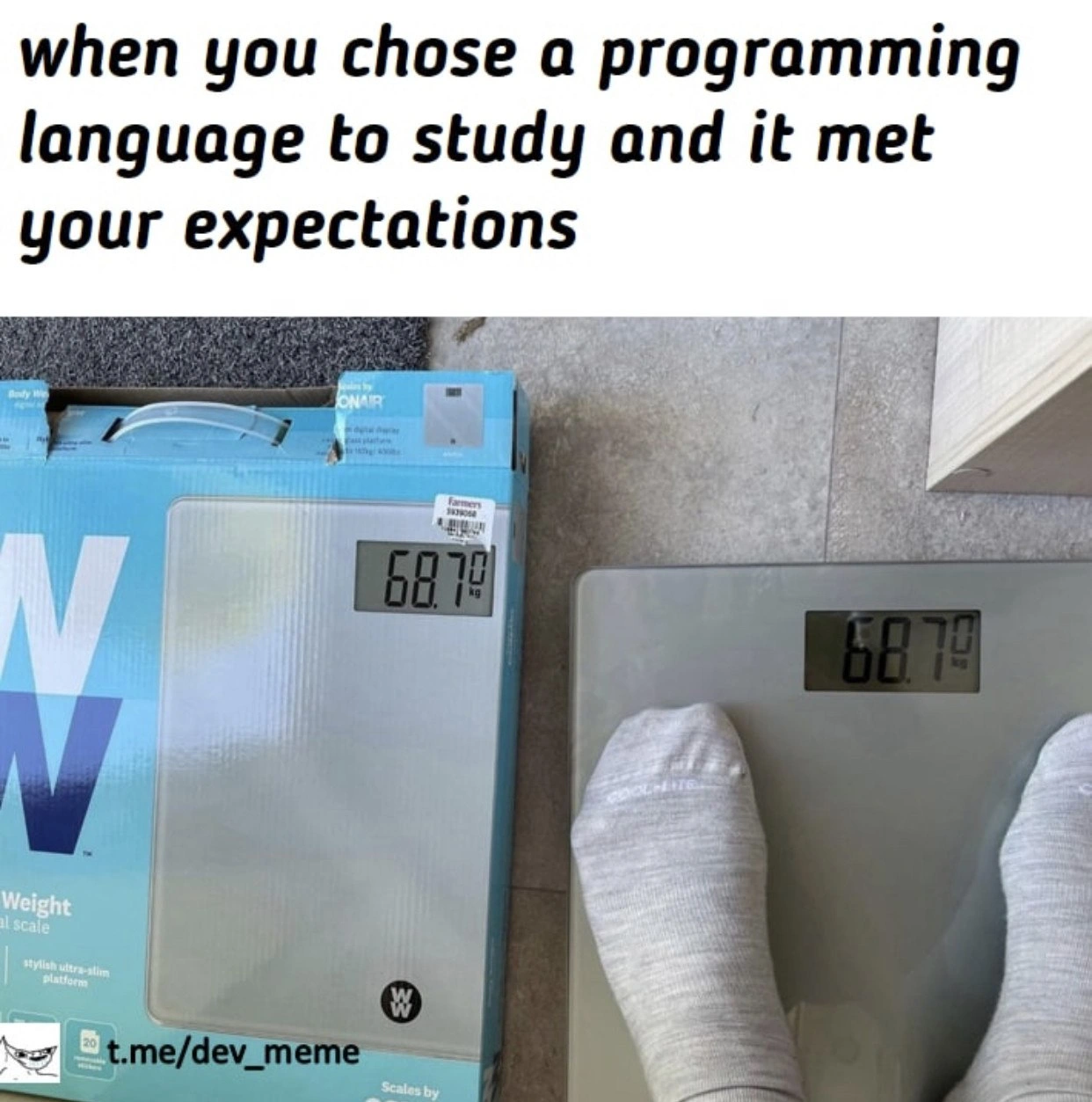
When your chosen programming language delivers exactly what you anticipated
Languages Post #3159, on May 25, 2021 in TG

When your chosen programming language delivers exactly what you anticipated

Why is this Languages meme funny?

Level 1: Just Like the Picture

Imagine you see a big, yummy cookie on a cookie box, and it looks so delicious. You beg your parent for the cookie, and when you open the box – SURPRISE! – the cookie inside looks exactly like the picture on the box and tastes just as good as you hoped. Wow! In real life, that hardly ever happens, right? Usually, things are a bit different from what the box shows. Well, this meme is saying a similar thing happened to a programmer. They started learning a new computer language (kind of like a new secret code or a new game) and it turned out to be just as great as they expected. They’re as happy and amazed as you would be getting the exact toy or treat you dreamed of. The picture with the scale shows this idea: the number on the box and the number on the real scale are the same – a perfect match! It’s a funny and happy surprise, because the person got exactly what they wanted, just like getting a toy or treat that’s exactly like the awesome picture in the ad.

Level 2: Expectations Meet Reality

At its core, this meme is playing on a classic expectations vs reality theme, but with a happy twist. The top text sets up the scenario: “when you chose a programming language to study and it met your expectations.” In other words, a developer picked a new coding language to learn, and everything they hoped it would be turned out to be true. That’s a pretty relatable developer experience – most programmers remember picking up their first language (or a trendy new one) and having certain hopes about it. Maybe you expect great performance (speed and efficiency), or you’re hoping the language will have an easy learning curve (how hard or easy it is to learn over time), or perhaps you've heard the language’s ecosystem (its libraries, tools, and community) is fantastic for what you need. In real life, those expectations often only partially come true. For example, you might dive into learning JavaScript believing it’s going to be straightforward because it’s everywhere on the web, and then you discover weird quirks (why is [] + [] in JavaScript returning an empty string?! 🤯). The expectation was one thing, the reality often another. That contrast is usually where the joke lies in “expectation vs reality” memes.

However, this particular meme flips that around. The image is a split-screen format. On the left, we see a digital bathroom scale still in its box, and through the little display window on the box you can see it showing the number 68.7 kg (probably just printed or a dummy display for the product photo). On the right, we see the actual scale on the ground with someone standing on it (we see their sock-covered feet), and the live display also reads 68.7 kg. It’s a perfect match! Visually, it’s saying: the number on the box (the advertised or expected value) is exactly the number in real life. Usually, people joke that what’s on the box is an unrealistic ideal – like how a food package shows a perfect, big burger, but the real burger you get looks smaller and messier. Here, though, expectation and outcome are identical. This would be like buying a new gadget or game after reading the box and finding it’s exactly as awesome as the box claimed. For a developer, it means the language they chose to learn is turning out exactly as good as all the tutorials and hype said it would be. No nasty surprises in syntax, no hidden performance issues, no “oh no, everything is segfaulting” moments.

Let’s break down some terms from the meme context:

  • Programming language: This is the tool or language (like Python, Java, JavaScript, Rust, etc.) that a developer decides to learn. Each has its own style and promises. For instance, Python promises readability and a vast standard library (“batteries included”), Go promises simplicity and easy concurrency, Rust promises memory safety and speed, etc. When you choose a language, you often do so because you’ve heard good things or have specific expectations (maybe “my life will be easier if I use this for my project”).
  • Met your expectations: This phrase means the experience was just what you thought it would be. In software, that could mean if you expected the code you write in that language to run fast, it did run fast. If you expected the language’s syntax to be beginner-friendly, it indeed felt simple to you. Essentially, no disappointment. Often newbies have to adjust their expectations once they actually write code – maybe they find out that making a mobile app is not as point-and-click as the advert made it seem, or that the “fast and efficient” language requires very careful coding to actually be fast. So meeting expectations is a pleasantly surprising outcome.
  • DeveloperExperience (DX): This is a term that refers to what it’s like for a programmer to use a certain technology day-to-day. Good DX means the language (and its tools) make the developer’s life easier: clear error messages, good documentation, lots of helpful libraries, an active community to help with issues, etc. When a chosen language meets expectations, it usually means it has great DX – the promise of "easy to use" or "saves you time" turned out true, so the developer is happy.
  • Learning curve: You’ll hear this a lot. A gentle learning curve means you can pick up the basics quickly and only gradually face more complexity. A steep learning curve implies you have to work really hard at the beginning because it gets complicated fast. Many programming languages advertise themselves as easy to learn, but a newcomer might still struggle with certain concepts (like pointers in C, or functional concepts in Haskell). If the language in this meme met expectations, perhaps the learning curve was exactly as expected or even easier – the person studying it didn’t suddenly hit an unexpected wall of confusion.
  • Ecosystem: This refers to all the stuff around a language – libraries (pre-written code you can use), frameworks, tools (like editors or compilers), and the community. A rich ecosystem is often part of a language’s appeal. If you learned a language expecting “there’s a library for everything I need,” and that turned out to be true, that’s expectations met! Many times, a newcomer might be promised “oh, use Language X, it has great libraries for web development” but then they find those libraries are hard to use or not well documented. In the meme scenario, everything clicked as hoped.

So why is this developer humor? Because it’s both relatable humor and aspirational. Relatable because every coder knows the feeling of “this isn't what I signed up for” when reality falls short. And aspirational because we all wish for that magical project where choosing a new tech stack goes 100% according to plan. It’s essentially celebrating a learning_to_code journey that went right. The meme’s tone is light-hearted and cheering: imagine studying a new language (which can be daunting) and then smiling because it’s just as cool and useful as you dreamed. No bitter aftertaste, no secret gotchas. The use of the scale meme format (with the product vs actual use) brilliantly captures this “no discrepancy” outcome in a single glance. And for any junior developer currently picking up a language, it’s a little beacon of hope: sometimes, expectations_match reality, and when they do, it feels awesome!

Level 3: Works as Advertised

In the world of programming, it's practically folklore that hype rarely equals reality. We've all chased the next shiny programming language promising to be fast, easy, and revolutionary, only to later discover quirks and pain points (hello, unexpected segfaults or mysterious NullPointerException!). This meme taps into that shared experience – and delivers a twist. The image shows a digital weight scale in its box reading 68.7 kg, and right next to it the same scale in use shows the exact same 68.7 kg under a pair of feet. It’s a perfect one-to-one match, visually screaming “Expectation met reality to the dot.” For seasoned developers, this scenario is both humorous and oddly satisfying. After years of enduring projects where something always goes wrong (the deployment that never only broke in production, the feature that almost met requirements), seeing a chosen technology live up to its claims feels like spotting a unicorn in the office parking lot.

The humor digs at how rare and refreshing it is when a new tool or language actually fulfills its promises. Think about all the times the marketing for a language guaranteed “simple syntax” or “unmatched performance”. More often than not, reality involves digging through Stack Overflow to handle edge cases that the tutorial blissfully ignored. Here, though, the developer's initial expectations match the outcome perfectly – a scenario so uncommon that it elicits a knowing chuckle. It's the inversion of the usual developer expectations vs reality joke: instead of a dramatic failure or mismatch, the punchline is that nothing went wrong at all. This expectations_vs_outcome meme resonates because it highlights a dream-come-true moment in a field where we're conditioned to anticipate the other shoe dropping. As experienced devs, we might joke that this is “as rare as code working on the first run without tests.” 😄 In fact, the community often jokes "it works on my machine" sarcastically – but here, it genuinely works on every machine just as the docs said, which is both funny and delightful.

From a DeveloperExperience_DX perspective, a language that “just works” and scales exactly as expected is basically the Holy Grail. It means the language design, its ergonomics (how it feels to use), and its ecosystem of tools and libraries all behaved exactly like the upfront demos and documentation claimed. No hidden runtime surprises, no “gotchas” that make you regret your choice at 2 AM. It's a bit like the product that does exactly what it says on the tin – something senior developers often wish for but rarely get. The photo of the scale drives this home with a literal example of a product matching its advertised claims to the letter. It’s a clever visual metaphor for a language’s reality matching the tutorial examples. An old joke among battle-scarred coders is that every new technology has at least one footgun (a feature so tricky it’s easy to shoot yourself in the foot). In this meme’s world, apparently the safety is on and there are no footguns in sight – the language was chosen carefully and delivers exactly the weighty benefits it promised without blowback. This consistency is so unheard-of that it becomes a geeky kind of comedy: we laugh because we’re half in disbelief and wholly relieved at the same time.

Why is this so relatable? Developers often share war stories of adopting a hyped language or framework only to hit a wall of complexity or unforeseen bugs (think of learning a “beginner-friendly” tool that still makes you cry in frustration). Here, we have the opposite: the programming_language_choice turned out to be a straightforward success. That strikes a chord because it validates the dream scenario we all secretly hope for when starting something new. It’s a nod to all those times we wished our software tools would be kinder to us. When a language’s learning curve, performance, and features truly meet our needs as expected, it feels like the universe momentarily aligned in our favor. In an industry where cynicism can run high (we’ve learned to suspect “it’ll be easy” really means “there be dragons”), this meme’s scenario is a comforting comedic release. It says: “Hey, sometimes things do go right!” and for an audience of engineers, that’s both funny and worth a celebratory high-five.

Description

The meme is split into two sections. Top text in a bold rounded font reads, “when you chose a programming language to study and it met your expectations”. Below, a photo shows a digital bathroom scale still inside its turquoise-blue retail box on the left; the box’s display window shows “68.7 kg”. To the right, the same model scale is on the floor, with a pair of sock-covered feet standing on it, and its live display also reads “68.7 kg”. The identical readings visually symbolize expectations matching reality. Technically, the joke resonates with developers who invest time learning a new language and find its real-world ergonomics, performance, or ecosystem perfectly aligned with the marketing promises, contrasting common experiences of disappointment or steep learning curves. A small “t.me/dev_meme” watermark appears in the bottom left corner of the box

Comments

10
Anonymous ★ Top Pick Picked Rust: I budgeted 120 s of compile time for 0 s of segfaults - months later, the CI stopwatch and the pager still show those exact numbers. Worth the weight
  1. Anonymous ★ Top Pick

    Picked Rust: I budgeted 120 s of compile time for 0 s of segfaults - months later, the CI stopwatch and the pager still show those exact numbers. Worth the weight

  2. Anonymous

    After 20 years in tech, finding a language that actually matches its documentation is like discovering your production metrics match your local environment - theoretically possible but practically a statistical anomaly that makes you question the simulation we're living in

  3. Anonymous

    This is the programming equivalent of when your production metrics exactly match your local benchmarks - statistically improbable, deeply satisfying, and you're not entirely sure whether to celebrate or investigate for measurement bias. Most of us know the reality: the packaged version weighs 68.7kg, but once you unbox it and step on, it's more like 'undefined', throws a NullPointerException, or returns 'NaN' because you forgot to initialize the sensor drivers

  4. Anonymous

    The rare language where boxed semantics match runtime reality - no floating-point drift or off-by-one foot placements

  5. Anonymous

    Choosing a language that “meets expectations” is like a bathroom scale matching the number on the box - both calibrated to HelloWorld(), not to prod at 3 a.m

  6. Anonymous

    Finally found a language where the hello‑world tutorial and the production SLOs return the exact same number; turns out I bought a bathroom scale with reproducible builds

  7. @AlazarGetnet 5y

    Haha well fit...

  8. @anatoli26 5y

    Rust

    1. @anatoli26 5y

      No, strike it out.. Rust exceeded the expectations multiple times 😆

  9. @nipunattri1 5y

    A programmer every customer needs, does every task as advertised

Use J and K for navigation