Skip to content
DevMeme
668 of 7435
The Transformative Power of a C++ Addiction
Languages Post #756, on Oct 28, 2019 in TG

The Transformative Power of a C++ Addiction

Why is this Languages meme funny?

Level 1: What Doesn’t Kill You

Imagine two kids: one kid eats nothing but candy every day, and another kid works hard eating their vegetables and exercising. Usually, we’d expect the kid who only eats candy to get sick or weak over time (like most bad habits make you worse), and the kid who sticks to healthy habits to grow up strong and healthy. This meme is playing with the same idea. It’s saying that coding in C++ (which is a really hard thing to do, kind of like a challenging habit) is like a “good addiction” – instead of hurting you, it ends up making you better. In the picture, when people use harmful drugs, their “after” photos look terrible (sick and tired). But for the person who “got addicted” to C++ coding, the “after” picture shows them looking happier, healthier, and more successful than before! It’s a funny opposite outcome. The reason it’s humorous is because it surprises us: we expect an addiction to be bad, but here the joke is that this one very difficult hobby actually cleaned up the person’s life (as if it “collected the garbage” from them). In simple terms, the meme is like saying, “Doing this tough thing didn’t break me, it made me stronger.” That twist – something hard making you better instead of worse – is what makes it silly and fun.

Level 2: No GC? No Problem.

Let’s break down the technical references and the joke in simpler terms. C++ is a computer programming language, and it’s known for being powerful but quite challenging. It’s commonly used in systems programming, which means building software that interacts closely with the computer’s hardware or needs to run extremely fast (for example, operating systems, game engines, or real-time systems in cars/planes). Because it’s designed for performance and flexibility, C++ gives programmers a lot of control over how the computer’s memory is used. However, with great power comes great responsibility: unlike some other languages, C++ doesn’t automatically clean up or manage memory for you.

In many modern languages (like Java, JavaScript, or Python), there’s something called a garbage collector. A garbage collector is like an automatic cleaning service for your program: when you create objects or use memory, and later you no longer need those objects, the garbage collector will later find that unused memory and free it (take out the trash) so your program doesn’t run out of memory. As a result, programmers in those languages don’t usually worry about releasing memory – it happens behind the scenes. In C++, on the other hand, the programmer is in charge of memory management. You have to manually allocate memory (for instance, using new or other methods) and then free it when you’re done (using delete or corresponding functions). If you forget to free memory that you allocated, your program will have a memory leak – the lost memory accumulates like junk you never throw away. Too many leaks can eventually cause your program to run out of memory or slow down. If you free or delete something too many times or use it after it’s freed (imagine throwing away your notes and then trying to read them again), you’ll likely crash the program or get corrupt data. C++ doesn’t stop you from making these mistakes; instead, it expects you to know what you’re doing. That’s why people say C++ has a steep learning curve.

To help manage this complexity, C++ developers use idioms like RAII, which stands for Resource Acquisition Is Initialization. Despite the fancy name, RAII is a simple but powerful idea: whenever you acquire a resource (like some memory, a file handle, or a network connection), tie that resource’s lifespan to an object. When that object goes out of scope (meaning it is destroyed automatically at the end of a function or block), it will release the resource in its destructor (a special cleanup method). In practice, this means using classes and smart pointers (std::unique_ptr, std::shared_ptr, etc.) to make sure that allocated memory or opened files get cleaned up automatically when they are no longer needed. For example, instead of doing int* arr = new int[100]; ... delete[] arr; and risking forgetting the delete, a C++ dev might use std::vector<int> arr(100); and let the vector manage that memory. When arr goes out of scope, it frees its memory by itself. RAII is like a safety net or a habit that C++ programmers develop to avoid common errors. It’s not a garbage collector per se, but it achieves a similar goal (freeing memory) in a more immediate and structured way.

Now, about undefined behavior (UB): this term means that if you do something the C++ specification doesn’t allow, the result is unpredictable. The program might compile and run, but anything could happen – it might crash right away, it might produce strange results, or it might even seem to work correctly in your test but blow up later. A classic example of UB is accessing an array out of bounds (reading or writing past the last element of an array) or using a pointer to memory that has already been freed. There is no guarantee what the program will do in those cases, because C++ doesn’t actively check and handle that error for you. In a language like Python, if you try to access a list out of bounds, it will raise an IndexError exception – a clear error. In C++, doing the same might just quietly give you whatever data was in that memory (garbage data), or cause a crash later. This means C++ programmers must learn to avoid invoking undefined behavior. They use tools (like memory sanitizers or static analyzers) and careful coding practices to catch these issues. Over time, you start almost sensing when something might lead to UB. In other words, the language trains you to be careful and think about what’s really happening under the hood.

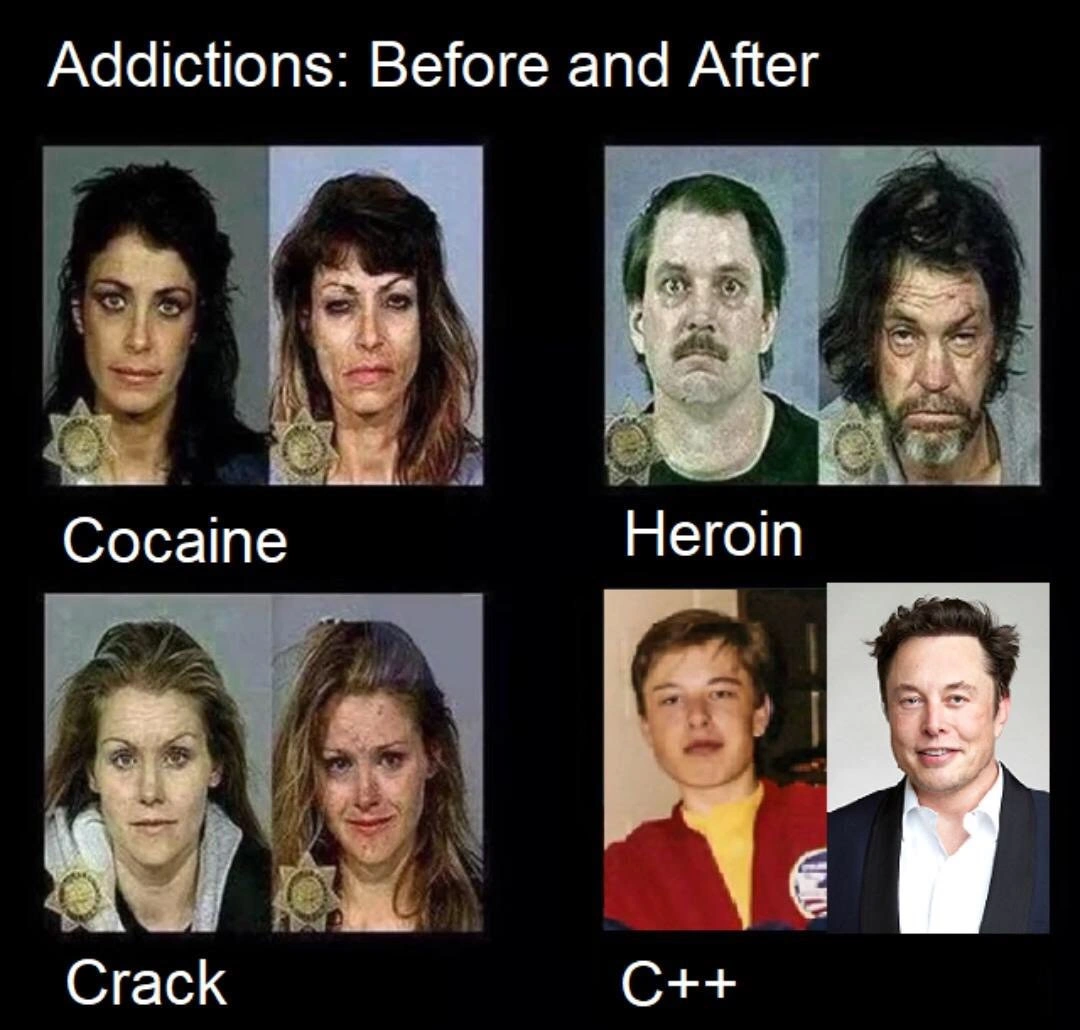
Because C++ demands this level of care, programmers who stick with it tend to become very detail-oriented and knowledgeable about how computers manage things like memory. It’s a bit like a rigorous training program. And that’s what the meme is joking about: it compares coding in C++ to having an addiction. Usually being “addicted” to something – especially drugs – is portrayed as very bad, causing you to deteriorate. But here, the joke is that being addicted to C++ (spending years and years programming in C++ obsessively) had the opposite effect: it improved the person. The meme shows a “before” picture of a young developer (perhaps looking a bit awkward or inexperienced) and an “after” picture where that same person looks older, but confident, well-dressed, and successful. In a literal sense, one might say coding in C++ aged them well — they have grey hair and a suit, instead of looking unhealthy or broken.

This is, of course, an exaggeration for humor! The meme isn’t saying you will literally become more handsome by programming in C++ 😅. It’s using an absurd contrast to highlight a sentiment: working with something as difficult as C++ can, over many years, make you a “sharper” or more advanced developer (in terms of skill). It’s a bit of an in-joke among developers. Senior C++ programmers often mentor the next generation, teaching them how to handle pointers safely, how to use patterns like RAII, and how to write efficient, bug-free code. These seniors have accumulated a lot of knowledge (sometimes through painful mistakes that they learned from). So in the meme’s imagined world, the C++ veteran isn’t burnt out — instead, he’s the wise guru in the company, maybe even a well-paid tech lead or architect, with the kind of polish that comes with confidence and experience. The “after” photo where he’s sharply dressed and looking content is a nod to that idea. It’s saying: this could be you after years of C++, as a lighthearted encouragement.

Let’s also touch on the word “addiction” here. No one is saying programming is an actual dangerous addiction – it’s a metaphor and part of the joke format. Developers sometimes humorously call themselves “addicted” to coding or to a particular technology when they spend all night solving problems or can’t step away from the computer because they’re engrossed in a project. In reality, passion or dedication would be a better word, but it’s funnier to exaggerate it as an addiction (with the meme borrowing the style of anti-drug campaigns). So when you see “C++: the only addiction with upgrade-in-place garbage collection for humans”, read it as: “C++: a habit so consuming that it actually ends up improving you, as if cleaning out your flaws.” It’s a playful twist on the usual expectation that an addiction ruins someone.

In summary, C++ is a powerful programming language that can be tough to master. Those who invest the time to learn its intricacies (manual memory management, avoiding undefined behaviors, mastering templates, etc.) often become very skilled systems programmers. The meme humorously compares that long, hard learning journey to going through an addiction – but with the punchline that, unlike drugs, this “addiction” leaves you better off. It’s funny to programmers because it mixes a serious real-world concept (drug addiction) with a nerdy subject (coding in C++), and it flips the script in a way that celebrates the hard work of C++ developers. If you’re new to programming, just know that the meme isn’t literally advising anyone to get addicted to anything – it’s using irony. The take-away is: C++ might be hard, but sticking with it can make you a really strong developer (and that’s the upgrade the meme refers to). And for those of us who have been through that grind, we can laugh at the exaggeration and maybe feel a tiny bit proud that our “habit” of writing C++ code is jokingly compared to leveling up in life.

Level 3: Undefined Behavior Bootcamp

This meme uses the classic “addictions: before and after” format – a familiar comparison humor trope often found in anti-drug PSAs. The top three rows show the stereotypical decline of drug addicts (Cocaine, Heroin, Crack) with mugshot-style photos: each person’s “after” picture looks far worse, serving as a dire warning. That’s the setup. The punchline comes in the fourth row: labeled “C++”, it shows a young, nerdy-looking developer in the “before” photo and a well-groomed, confident professional in the “after” photo. It’s a perfect subversion of expectations. Instead of a ruined mugshot, the C++ addict’s final state looks better than where they started! The meme humorously suggests that being hopelessly hooked on C++ actually made someone’s life improve. In other words, coding in C++ is the one addiction where the “side effects” include looking sharp and successful. This playful reversal taps into developer humor and decades of shared experience with this language.

Why is this especially funny (and relatable) to seasoned programmers? Because many of us joke that programming in C++ feels like an addiction or a form of masochism – it’s tough, sometimes painful, yet strangely rewarding, and once you’re deep into it, it’s hard to give up. Veteran systems engineers often speak about C++ with a mix of reverence and war-weary humor. They’ve spent years in the trenches of low-level programming: chasing down memory leaks, debugging segfaults at 3 AM, taming wild template errors, and dealing with undefined behavior that can make your program act “possessed.” This arduous journey is like an “undefined behavior bootcamp” – an unrelenting training regime that forces you to toughen up and learn fast, or you won’t survive in production. Each painful lesson (like the first time dereferencing a null pointer crashes your program, or that time a subtle race condition corrupted data) leaves a scar – but also makes you a better programmer. Over time, seasoned C++ devs accumulate a wealth of hard-earned knowledge: they know the difference between a shallow copy and a deep copy instinctively, they can spot a misuse of malloc/free or new/delete from a mile away, and they have strong opinions on const correctness, pointer arithmetic, and object lifetimes. In short, surviving C++’s trials turns you into a grizzled pro. The meme exaggerates this into visual form: the “after” C++ coder looks like a suave mentor or tech lead – perhaps even reminiscent of Bjarne Stroustrup (the creator of C++), who himself is a distinguished silver-haired gentleman after four decades of C++ evolution. The joke is that while most addictions wreck you, C++ will put some hair on your chest (and maybe gray in that hair) but leave you wiser and more refined for it. It’s a nerdy spin on “what doesn’t kill you makes you stronger.”

The phrase “upgrade-in-place garbage collection for humans” is itself a witty technical double entendre that senior devs chuckle at. It implies that as you keep using C++ (can’t quit it – you’re addicted), you undergo an in-situ improvement, kind of like a program optimizing itself while running. Normally, garbage collection is about cleaning up unused memory in a program. Here it’s metaphorical: the “garbage” (bad coding habits, ignorance, maybe youthful overconfidence) is steadily pruned away from the person, leaving a cleaner, upgraded version of you. Long-time C++ devs often joke about how the language “teaches you discipline” the hard way. Forget to free memory or close a file handle? Your program’s memory usage blows up or you hit an OS limit – you learn never to do that again. Use an uninitialized variable? Enjoy chasing an intermittent bug that only shows up under certain conditions – you quickly adopt the habit of initializing everything. Write sloppy code? The C++ compiler will punish you with either cryptic errors or worse, silently compile something that doesn’t do what you intended (undefined behavior strikes again). These experiences are the tough love that “collects the garbage” from your skill set. Seasoned devs look back on this and nod knowingly. It’s painful at the time, but it molds you into a sharper engineer. In the meme, that transformation is portrayed visually: the newbie vs. the veteran, before vs. after C++.

Let’s not forget the element of pride and gallows humor shared among C++ developers. There’s a common tongue-in-cheek boast: “I’ve been through UB hell and back, and all I got was this expensive haircut and a fancy title.” The meme’s sharply-dressed “after” figure represents that senior developer who’s seen it all – undefined behavior, race conditions, obscure compiler bugs – yet lived to tell the tale (perhaps now as an architect or a mentor to others). It resonates with those who have spent late nights wrestling with cryptic linker errors or performance issues in production. We laugh because we recognize ourselves in that journey. It’s the only field where spending 10 years on a problem might actually leave you healthier (career-wise, at least) than before. A JavaScript or Python meme might joke about rapid burnout or being overwhelmed by frameworks, but here C++ is portrayed as aging like fine wine. There’s a kernel of truth wrapped in jest: mastery of C++ can open doors to building cutting-edge systems (like game engines, high-frequency trading systems, or rocket software) – by the time you’re an expert, you might indeed be leading projects, wearing suits to meetings, and mentoring juniors about why RAII is your friend and how to avoid the pitfalls of manual memory management.

The context of language wars also adds flavor to this meme. Developers often engage in friendly (or not-so-friendly) debates over programming languages. C++ is a language that inspires both awe and frustration: it’s powerful and lightning-fast, but also notoriously complex and unforgiving. Enthusiasts of garbage-collected languages sometimes quip that C++ programmers are “addicted to suffering” or stuck in old ways. C++ veterans fire back that all that pain yields performance and deep understanding – something high-level language users may miss. This meme leans into that banter by literally framing C++ as a vice you can’t quit, but with a paradoxical payoff. It’s essentially saying, “Sure, I’m hooked on C++ and it might be rough, but look – it made me better (or at least that’s what we tell ourselves!).” The humor works because it’s self-aware: C++ devs acknowledge the absurdity of loving a language that sometimes feels like it’s trying to hurt you. By comparing it to crack or heroin and then flipping the outcome, the meme pokes fun at the code_addiction while also celebrating it. It’s the kind of joke you share with colleagues after surviving a gnarly debugging session: we’ve been through the C++ life and came out the other side stronger.

In the end, the “C++ addiction” meme is both a parody and a badge of honor. It parodies the dramatic Public Service Announcements with mugshots – here it’s a mugshot_mockup for coding – and it gives longtime C++ devs a pat on the back through humor. The before-and-after contrast (the essence of addictions_meme_format) gets turned upside-down to say, maybe this crazy thing we do isn’t so bad after all! It’s funny because it’s an overstatement with a grain of truth: C++ will put you through a bootcamp of undefined behavior, but if you endure, you just might age gracefully with C++, gaining wisdom (and perhaps a nicer wardrobe) along the way.

Hypothetical C++ veteran: “Addicted? No, I’m not addicted... I can quit anytime I want, honest. I just need to fix one more memory leak before I do.”

Level 4: Trial by Segfault

At the deepest technical level, this meme’s title is a mash-up of programming language jargon. Garbage collection (GC) is a runtime mechanism (common in languages like Java, C#, or Python) that automatically finds and frees unused memory for you. By contrast, C++ famously does not have a built-in garbage collector – it relies on manual memory management and patterns like RAII (Resource Acquisition Is Initialization) to clean up resources. The phrase “upgrade-in-place” evokes in-place algorithms (which transform data without needing extra space), and here it’s applied to humans as a joke. So “upgrade-in-place garbage collection for humans” implies that working with C++ somehow collects the garbage in the programmer’s life and upgrades them on the spot, instead of trashing them like a harmful drug would. It’s a tongue-in-cheek way to say that the hard experiences of C++ will improve you internally (in-place) rather than needing a complete overhaul of the person.

From a language design perspective, this joke hints at the stark difference between C++ and languages with automatic memory management. In a language with a GC, a developer can allocate objects freely and trust that a background process will reclaim that memory later. In systems programming (C++’s home turf), there is no such free lunch – if you call new to allocate memory, you must eventually call delete (or better, use smart pointers or stack allocation) to free it. Failing to do so causes memory leaks (unused memory piling up, akin to not taking out the trash). Other mistakes like writing past the end of an array or using a pointer after freeing it lead to undefined behavior (UB). Undefined behavior is an infamous concept in C++: it means the C++ standard provides no guarantees about what happens – the program might crash immediately, or corrupt data silently, or make demons fly out of your nose do anything at all. One common manifestation of UB is the dreaded segmentation fault (accessing memory you have no right to), which causes the OS to instantly terminate the program. Surviving enough of these crashes is a rite of passage – a trial by segfault – that forces C++ developers to learn discipline and meticulous attention to detail. It’s like a form of tough love: make an error with pointers, and the system will smack you down. Over time, this harsh feedback loop “garbage-collects” bad coding habits from the programmer’s mind. The developer is essentially acting as the garbage collector for their own code, and in doing so, upgrading their skills (in-place, without changing to a different person – or language).

Another aspect of C++ that can feel like an extreme workout is its template system. Template metaprogramming in C++ allows code to be generated or computed at compile-time using templates. It’s so powerful that it’s Turing-complete – meaning you could, in theory, compute anything in the compiler using templates (people have famously implemented compile-time Fibonacci calculators and even a Brainfuck interpreter using C++ templates!). This power comes at the cost of insanely complex error messages and steep learning curve. Tackling template metaprogramming is like a mental obstacle course: the first few times, you’re utterly confounded by pages of compiler errors, but gradually you gain the ability to bend the compiler to your will. It’s the hallucinogenic part of the C++ “addiction” – mind-bending and not for the faint of heart, yet those who endure it gain near-magical metaprogramming abilities. In the long run, features like templates and manual memory management forge a developer’s understanding of how software and hardware interact at a low level. They learn about object lifetimes, memory layouts, CPU cache effects, and even how the operating system handles virtual memory and protections (the stuff behind that segfault). Each painful bug and each hard-won insight acts like an in-place upgrade to the programmer’s brain, refining their intuition about code.

All these low-level adventures tie into the meme’s punchline. C++ is jokingly called “the only addiction with upgrade-in-place garbage collection for humans” because, unlike narcotics that deteriorate the user, C++’s difficulties continuously push developers to clean up and level up. The fundamental technical reality here is that C++ demands you manage what other languages manage for you. Over years, a C++ coder internalizes efficient habits: they think about memory and performance constantly, they write safer patterns to avoid UB (like using std::vector instead of raw arrays, or std::unique_ptr instead of raw pointers), and they fully understand what their code does under the hood. In essence, the “garbage” – memory bugs, sloppy coding practices, ignorance of the machine – gets collected from their skillset. What’s left is a sharpened, optimized programmer. The meme exaggerates this to a hilarious extreme: implying that after decades of wrestling with the C++ runtime and the C++ memory model, a programmer doesn’t end up burned out or broken – instead they’re upgraded into a high-functioning, silver-haired guru. It’s an absurd inversion of the typical addiction story, grounded in the very real low-level programming challenges that make C++ both feared and respected.

Description

This is a four-panel meme titled 'Addictions: Before and After'. The first three panels display pairs of mugshots showing the devastating physical effects of drug addiction, labeled 'Cocaine', 'Heroin', and 'Crack'. In stark contrast, the fourth panel presents a 'before' photo of a young Elon Musk and an 'after' photo of him as a successful adult, with the label 'C++'. The humor arises from the satirical equation of the notoriously complex and demanding programming language C++ with a severe, life-altering addiction. However, unlike the destructive addictions in the first three panels, the meme suggests that an 'addiction' to C++ leads to immense success, as personified by Elon Musk, a prominent figure in the tech industry. It's a dark-humor joke that resonates with developers who understand the immense effort required to master low-level languages like C++

Comments

7
Anonymous ★ Top Pick The main side effect of a C++ addiction is waking up at 3 AM screaming about memory corruption, but at least you can afford the therapy
  1. Anonymous ★ Top Pick

    The main side effect of a C++ addiction is waking up at 3 AM screaming about memory corruption, but at least you can afford the therapy

  2. Anonymous

    Only C++ could implement a life-long reference that actually increments your confidence counter while decrementing your sleep hours - call it RAII for grey hair

  3. Anonymous

    The only addiction where you start manually managing memory and end up manually managing Twitter

  4. Anonymous

    The meme perfectly captures how C++ doesn't destroy you - it just ages you 20 years while you debug template metaprogramming errors, fight the linker, and finally understand why move semantics matter. By the time you've mastered RAII, const correctness, and the rule of five, you've either founded three companies or accepted that undefined behavior is just spicy determinism. The real addiction isn't the language; it's the Stockholm syndrome of finally getting your smart pointers to compile without segfaulting

  5. Anonymous

    C++: From Titanic pretty boy to reusable rocket whisperer - undefined behavior not included

  6. Anonymous

    C++: the only addiction where mastering RAII and pointer hygiene leads to fewer core dumps and a nicer blazer

  7. Anonymous

    Only in C++ does the after photo include RAII, sanitizers, and a blazer while the linker still takes longer than standup to validate your zero-cost abstractions

Use J and K for navigation