When the Project Manager Asks for a 'Small' Change
Why is this Management PMs meme funny?
Level 1: Arguing Over Hello
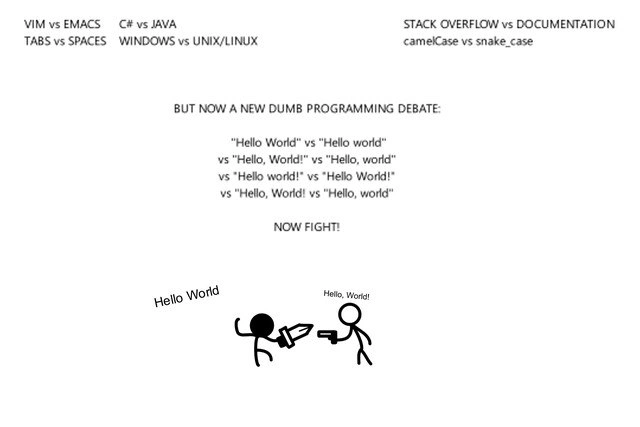
Imagine two kids on a playground who start fighting over something silly – like whether it’s better to say “Hello, world!” with a little excitement or just “Hello world” without the exclamation. One kid insists you must yell “Hello, World!” with a big flourish, and the other kid says, “No, just say hello normally!” They even argue about if you should capitalize the word World or not, even though both ways basically mean the same thing. It’s a totally silly argument, right? They’re both just saying hello! But they get all worked up and pretend it’s the most important thing ever. This meme is joking that programmers do the same thing. Developers sometimes act like those kids, having big fights over tiny details (like punctuation or capitalization in a harmless greeting). It’s funny because the stakes are so low — nothing really changes if you add a comma or an exclamation mark, but people will still choose sides and argue. The picture even shows two stick figure characters labeled with different “Hello World” versions actually battling, which is like cartoon kids dueling over who’s right about something unimportant. The humor comes from how over-the-top the fight is compared to how small the disagreement is. In simple terms: it’s making fun of us geeks for sometimes fussing over nothing, just like kids quarreling over the silliest way to say hello.
Level 2: Format Face-Off
At its core, this meme is highlighting how programmers love to argue over formatting and style issues that don’t actually affect a program’s behavior. The examples listed (VIM vs EMACS, Tabs vs Spaces, etc.) are famous flame wars — heated arguments in developer forums or teams about personal preferences or conventions:
- VIM vs EMACS: Two powerful text editors. VIM is a modal editor known for its efficiency once you learn it, and EMACS is an extensible, customizable editor known as a “do-everything” environment. Devs have long-standing loyalty to one or the other. It’s an EditorWar so classic that it’s practically a rite of passage to joke about it.
- TABS vs SPACES: Should code indentation be done with tab characters or just spaces? Using a tab (
\t) might be convenient, but different environments may display tab width differently. Using spaces (like hitting the spacebar 4 times) ensures consistent alignment everywhere. This is such a common debate that it even appeared in pop culture (it was a plot point on HBO’s Silicon Valley show!). Yet in terms of code execution, it makes no difference — it’s purely about how the code looks. - C# vs Java: Both are object-oriented languages with similar syntax and capabilities. Choosing one often comes down to the ecosystem (.NET for C# vs JVM for Java) or company preference. Still, developers from each camp often argue which language is “better,” even though they’re both capable of making robust enterprise applications.
- Windows vs Unix/Linux: This is about operating systems. Windows is popular on desktops; Linux/Unix rules the server world. Devs debate which is superior for development. Some prefer the Linux command-line and openness, others need Windows for specific tools or just familiarity. Again, it’s a matter of context and preference, but the debates can get very passionate on forums.
- Stack Overflow vs Documentation: When stuck on a coding problem, do you search on Stack Overflow (a Q&A site full of community-provided snippets and answers) or read the official documentation/manual? Some argue that relying on Stack Overflow is faster and more practical (“real-world solutions from other developers”), while others say you should RTFM (Read The Fine Manual) and understand the docs to learn properly. It’s a tongue-in-cheek comparison, since in reality most devs use both.
- camelCase vs snake_case: These are two different naming conventions for identifiers (like variable and function names). In
camelCase, you StartEachWord with a capital letter (except the first word) and omit spaces/underscores. Example:myVariableName. Insnake_case, you use all lowercase and separate words with underscores. Example:my_variable_name. Different programming languages and style guides prefer one over the other. For instance, Java and JavaScript use camelCase for variables, while Python’s style guide (PEP8) suggests snake_case. It’s purely about readability and consistency. When someone says.camelCase vs snake_caseis a debate, it means people argue which looks better or is more readable. But ultimately, either will work as long as you’re consistent — it doesn’t change what the code does.
After listing those well-known debates, the meme presents the new debate: how to properly write the output of the classic "Hello, World!" program. In programming, a “Hello World” program is traditionally the first simple program you write in a new language — it just prints or displays “Hello, World!” on the screen. It’s a tradition that dates back to the early days of programming education (the phrase appeared in an example in the 1978 C programming book by Kernighan & Ritchie). There’s no official rule on formatting it; some people include a comma and exclamation ("Hello, World!"), some just write "Hello World" plain, some might not capitalize the “world”. The meme lists every possible combination of capitalization and punctuation for this greeting:
"Hello World"– both words capitalized, no comma, no exclamation."Hello world"– only “Hello” is capitalized (as a normal sentence), no punctuation."Hello, World!"– comma after Hello, and an exclamation mark at the end."Hello, world"– comma after Hello, no exclamation, “world” in lowercase."Hello world!"– no comma, exclamation mark at end."Hello World!"– capital W and an exclamation mark."Hello, World!"(listed again, possibly just reiterating the combo with comma + exclamation + capital W)."Hello, world"(listed again, lowercase w with a comma).
Basically, the meme is showing that developers could even argue about how to punctuate "Hello World", which is a completely trivial thing. In reality, all these strings are just slightly different text outputs. It’s not a matter of correctness — “Hello, world!” and “Hello world” convey the same friendly greeting to the user. There’s no impact on the code’s performance or capabilities. The meme’s punchline “NOW FIGHT!” is prompting developers to absurdly pick a favorite style and battle it out, just like they do in those other debates. The little stick figure cartoon at the bottom embodies this: two simplistic characters labeled with different “Hello World” variants are attacking each other (one with a sword, the other with a gun). It’s a visual gag showing how programmers will suit up for battle over even the smallest disagreement. Within DeveloperCulture, these kinds of arguments are common and often joked about. They’re an inside joke: if you’ve spent time on programming forums, you’ve likely seen long threads or heated comments about whether code should use tabs or spaces, or whether to use curly brace { on a new line or the same line. Newcomers (junior devs) might be surprised how emotional people get over these tiny issues! Over time, you learn that while consistency in CodeQuality and style is important for teamwork, these specific preferences (tabs vs spaces, what punctuation to use in a hello message) are pretty arbitrary. Many teams solve them by just adopting a standard style guide or using an auto-formatter so nobody wastes time arguing. The meme is relatable because most developers have experienced these trivial dev arguments or seen a chat thread derail into a silly debate. It’s poking fun at our tendency to turn small things (like formatting a string literal output) into big discussions. For a junior developer, the takeaway is: this is a joke about how programmers sometimes argue like sports fans over things that ultimately don’t matter much for the end result. It’s part of tech humor to exaggerate these debates. So if you see older devs joking "It’s time for tabs vs spaces round 100" or "camelCase vs snake_case deathmatch", they’re acknowledging it’s a silly, never-ending fight — just like the one in this meme about the proper “Hello World” punctuation.
Level 3: War of the Words
The meme parodies the endless holy wars in programming culture by staging a fight over absolutely trivial differences. It opens with a roll call of classic dev flame-wars — VIM vs EMACS (the legendary editor war of the 80s and 90s), TABS vs SPACES (indentation style combat, even featured in sitcom jokes), C# vs JAVA (object-oriented cousins whose communities love to spar), WINDOWS vs UNIX/LINUX (the perennial OS showdown), Stack Overflow vs Documentation (quick crowd-sourced fixes vs. RTFM purism), and camelCase vs snake_case (the eternal naming convention clash). These are all well-known battles within dev communities, each side passionately convinced of its superiority despite the fact that, in practice, both options usually work. The meme then cranks the absurdity to 11: announcing a “new dumb programming debate” about the proper punctuation and capitalization of "Hello World". It lists a cascade of string literals: "Hello World" vs "Hello world" vs "Hello, World!" vs "Hello, world" vs "Hello world!" vs "Hello World!" vs "Hello, World!" vs "Hello, world". This exhaustive list covers every minor variation in casing and punctuation of the classic greeting. The humor lies in treating these variations as if they were factions in a grand war, despite having zero impact on functionality. In code, printing printf("Hello, World!"); vs printf("Hello world") doesn’t change performance, memory usage, or anything meaningful — it just outputs a slightly different string. Yet the meme commands: “NOW FIGHT!” beneath the list, as if rallying developers to take sides. This dramatization is a jab at how developers sometimes bikeshed over insignificant details. (Bikeshedding is the phenomenon where people argue endlessly about a trivial issue because it’s easy to grasp, while often ignoring harder but more important problems.) We’ve all seen huge comment threads on whether to include a comma in Hello, World, or debates over a project’s code style that burn more energy than writing the actual code. The stick figures at the bottom illustrate the absurdity: the left figure labeled "Hello World" (no comma, no exclamation, capital W) brandishes a sword, and the right figure labeled "Hello, World!" (with comma and exclamation) points a handgun. They’re literally bringing a sword-and-gun arsenal to a punctuation fight. This visual exaggeration makes senior devs smirk — it captures that familiar experience of minor issues blowing up into saga-length forum wars. In real life, no production bug was ever caused by choosing "Hello world!" over "Hello, World!", yet devs treat it like a duel for honor. Why do smart programmers care? Partly because consistency and style do matter for readability (teams might agree on CodeStyle guidelines to keep things uniform). But this meme mocks the point when that care crosses into zealotry. Experienced engineers recognize this pattern: a thread starts about a tiny stylistic choice, and dozens of programmers jump in, each championing their personal HelloWorld variant with almost religious fervor. It’s a satirical mirror of developer culture — where DevCommunities sometimes fixate on inside jokes and tiny differences (like naming conventions or tabs vs spaces) as a way to bond or assert expertise. The meme’s punchline is that we’ve run out of substantial battles, so we’re down to fighting over the punctuation in a hello-world string. It’s a gentle roast of our propensity to argue about anything, even something as innocuous as the capitalization of “World”. Seasoned devs chuckle (perhaps a bit guiltily) because they’ve witnessed or participated in these exact petty debates. We know it’s ridiculous — and that’s exactly why it’s funny. In the end, “Hello, World!” vs “Hello World” is a war where no one wins and nothing changes, perfectly capturing the spirit of pointless developer holy wars.
Description
A meme using the 'Distracted Boyfriend' format. The boyfriend is labeled 'Me, an engineer.' His girlfriend is labeled 'The perfectly good solution I just built.' The other woman who has caught his eye is labeled 'A tiny, seemingly insignificant change request.' This meme perfectly captures the feeling of dread and frustration engineers experience when a seemingly small change request from a project manager threatens to unravel a complex and carefully constructed solution. Senior engineers know from experience that 'small' changes often have cascading and unforeseen consequences
Comments
7Comment deleted
The most dangerous five words in the English language are 'Just one more small thing...'
Our sev-1 wasn’t the missing index - CI refused to deploy because someone wrote “Hello world” without the comma. Apparently the pipeline enforces punctuation more strictly than transactional integrity
We spent three sprints arguing about the Hello World format in our onboarding docs, then shipped it with a typo that nobody noticed for two years
After decades of vim vs emacs, tabs vs spaces, and camelCase vs snake_case wars, we've finally achieved peak bikeshedding: developers now argue whether 'Hello World' needs a comma, an exclamation point, or both. Next sprint's retrospective will include a 3-hour architectural decision record on punctuation standards. The real production issue? Our CI/CD pipeline has been red for a week, but at least our greeting strings are consistently inconsistent
We ditched 2PC for sagas to move faster, yet PRs still stall over the comma in "Hello, world" - apparently our strongest guarantee is bikeshed consistency
The correct greeting is whatever the formatter enforces in pre-commit; without that, your PR enters an infinite loop of nits
Microservices upgrade: 'Hello' service perpetually 502s calling the 'World' API