Skip to content
DevMeme
4397 of 7435
A Developer's Relationship with Their Code
DeveloperExperience DX Post #4815, on Aug 17, 2022 in TG

A Developer's Relationship with Their Code

Why is this DeveloperExperience DX meme funny?

Level 1: Only Using Three Tools for Everything

Imagine you have a big toolbox full of different tools — screwdrivers, hammers, saws, wrenches, drills, etc. Now someone comes along and says, “You know what? You can throw everything else away. You only need three tools to fix anything: a hammer, a screwdriver, and a wrench. You don’t need any other tool.” 🤨

If you’re not very experienced with fixing things, you might wonder if that’s true. It sounds kind of convenient, right? But if you’ve ever tried to, say, fix a computer or build a treehouse, you’ll quickly find out that just those three tools won’t solve every problem. Sure, those are important tools — a hammer is great for nails, a screwdriver tightens screws, and a wrench turns nuts and bolts. Between them, you can do a lot of basic tasks. But what if you need to cut a piece of wood in half? You can’t do that with a hammer or a screwdriver; you’d need a saw. What if you want to paint a wall? None of those three tools can do that job; you’d need a paintbrush. Or imagine trying to fix an electrical circuit with just a hammer (yikes!).

The meme is saying something similar but with programming languages instead of physical tools. It claims that out of the many programming languages in the world, you only need three: C++ (think of this like a heavy-duty hammer for building big, strong things), Python (like a handy multi-tool that’s easy to use for lots of small tasks), and JavaScript (maybe like duct tape; it’s used everywhere especially in web stuff). It’s funny because it’s such an exaggerated claim. People who write code know that while those three languages are very common and useful, you often need other “tools” for special jobs. Just like in real life, where saying “only these three tools can fix everything” would make a group of carpenters or mechanics laugh, saying “only these three languages can do everything” makes programmers laugh. They know it’s not really true — but it’s said in a way that sounds confident and simple, which is kind of ridiculous and that’s the point of the joke.

So, in simple terms: the meme is joking that you can solve any coding problem with just three programming languages, even though in reality programmers use many different languages like many different tools. It’s funny because it’s like claiming an obviously oversimplified solution to a very complex thing, and everyone in on the joke knows real life is more complicated than that.

Level 2: Three Languages, Many Domains

For those newer to the programming world, let’s break down what this meme is saying and why it’s funny (and a bit controversial). It literally claims you can do everything in programming using just three languages: C++, Python, and JavaScript. Each of these is a popular programming language, but they’re used for different purposes and have very different characteristics. The meme lists various fields (from low-level system code to web development) and assigns one of these languages to each, as if to say “see, one of these three covers each area!” Here’s what that means in simpler terms:

  • C++: This is a powerful compiled programming language often used for building software where performance is critical or where you need to operate close to the hardware. When the meme mentions “low-level programming” and “high performance code” with C++, think of things like operating systems (e.g., parts of Windows or Linux are in C/C++), game engines (Unreal Engine for many 3D games is in C++), or software like web browsers (Chrome’s core is written in C++). Low-level means you’re managing details like memory and CPU usage yourself. C++ gives you a lot of control (you can manage memory manually, interact directly with system resources, etc.), which is why it’s used in those areas. It’s also used in “game development” as listed, because games need to run as fast as possible to handle graphics and physics — C++ is fast when optimized. However, C++ is considered harder to master: you must be careful with how you allocate and free memory (mistakes can crash the program or introduce security bugs). It’s like a very fast race car: great on the track, but you better know what you’re doing when you drive it! By listing C++ for three different areas (low-level, games, high-performance), the meme is suggesting C++ is the go-to tool whenever speed or hardware control is needed. There’s truth to that, but it ignores other tools. (For example, C is another low-level language even closer to hardware, and Rust is a newer language gaining popularity in those areas for its safety features. Veterans reading the meme would instantly think “what about Rust?,” which is part of the ongoing language debates.)

  • Python: This language is basically the opposite end of the spectrum from C++ in many ways. Python is an interpreted or runtime-compiled language, meaning you typically run it via a software interpreter instead of compiling down to machine code upfront. It’s high-level, which means it handles a lot of the gritty details for you. You don’t manage memory manually; Python has a garbage collector that automatically frees up unused memory. Python’s syntax is often praised for being readable and straightforward (it looks almost like pseudocode or simple English in some cases). The meme assigns Python to “scientific programming” and “machine learning.” This matches reality: if you peek into labs, universities, or data science teams in companies, you’ll see a ton of Python code. Why? Because Python makes it quick and easy to write programs to test ideas, analyze data, or train machine learning models. There are amazing libraries (pre-written packages of code you can use) such as NumPy for numerical calculations, pandas for data manipulation, Matplotlib for plotting graphs, scikit-learn for traditional machine learning, and TensorFlow/PyTorch for deep learning. These libraries let you do complex things with a few lines of Python. But here’s the catch that the meme cheekily points out: many of those libraries are not purely Python under the hood. They are often written in faster languages like C or C++ and just provide a Python interface. For example, when you do a big matrix multiplication in NumPy, Python itself isn’t doing the heavy math — it hands it off to highly optimized C/C++ (or even Fortran from decades ago) code to crunch the numbers, then gives you back the result. This is why the meme says “Python with libraries written in C++.” It’s a wink that while Python is great for gluing things together and writing logic easily, the raw speed often still comes from C++. For a newcomer, think of it like this: Python is the easy-to-use smartphone app, but somewhere on a server there’s a powerful engine (C++ code) doing the hard work when you tap the button. Together they deliver results quickly and easily. The meme’s joke is that even when you say “Python does science/ML,” quietly C++ is in the background making it possible at scale. It’s mostly true! (A beginner might ask: why not just use C++ then for those tasks? The answer is productivity and simplicity — scientists want to focus on science, not manage memory or deal with C++ complexity. So Python lets them write simple code while C++ takes care of speed-critical parts behind the scenes.)

  • JavaScript: JavaScript is the language of the web. If you’re viewing an interactive website, chances are your browser is running JavaScript code to make that interactivity happen. The meme lists JavaScript for both “front-end web development” and “back-end web development.” Let’s clarify: front-end means the code running in a user’s browser, controlling what you see on the webpage, how buttons respond when clicked, animations, etc. Back-end means the code running on a server somewhere, handling the logic that you don’t see directly (like storing/retrieving data from a database, verifying your login, running searches, etc., then sending results to your browser). Traditionally, front-end and back-end were separate worlds: front-end was JavaScript (because browsers only ran JS), and back-end could be many languages (Java, Python, Ruby, PHP, C#, etc. running on servers). Around 2009, Node.js was introduced, which allowed JavaScript to run on the server (outside the browser) efficiently. Node.js basically took Google Chrome’s JavaScript engine (named V8) and enabled it to run as a standalone application on a server. This was a big deal because it meant you could use one language — JavaScript — for both front-end and back-end, a concept often marketed as “JavaScript everywhere!” or a unified stack. The meme is riffing on that idea, implying you don’t need any server-side language except JavaScript now. For front-end, that’s essentially true by default (though there are things like TypeScript, a language which is JavaScript plus type annotations, that many developers use — but ultimately it becomes JavaScript when running). For back-end, JavaScript (Node.js) is indeed popular, especially for real-time applications (like chat servers or collaborative tools) or as a lightweight way to create web APIs. But is it the only way? Not at all. The real world uses a variety of back-end languages: huge portions of corporate and enterprise systems are in Java or C#, a lot of startups use Python or Ruby, and newer systems might use Go or Rust. So why does the meme say JavaScript for back-end? Partly to provoke a reaction, and partly because on the internet imageboard culture, there’s a bit of a running joke about JavaScript conquering everything (and also a counter-joke about it being used for things it shouldn’t). You might even hear jokes like “Javascript is gonna replace your OS someday” said sarcastically. It stems from the fact that JavaScript showed up originally just to do small animations in web pages, and over the years it sort of ate the world: now you can make full-blown applications in it, run servers with it, even create desktop and mobile apps with frameworks that use JS. So it’s funny to think how this once humble web script language is now (in this meme’s portrayal) one of the “only three you’ll ever need.”

Now, why is this funny to developers, especially those with some experience? Because it’s over-simplified to the point of being wrong (or at least incomplete), and it does so in a very bold way. It’s like someone confidently stating a half-truth as if it’s the whole truth — it tends to make people smirk or shake their heads. The meme ignores a lot of important context:

  • There are many other programming languages out there, each with its own niche or strength. For example, Java and C# are huge in enterprise software and game development (Unity uses C#). PHP historically powers a ton of websites (Facebook started in PHP), Swift and Kotlin are used for mobile app development (iOS and Android respectively), and specialized areas have their own tools (like R for statistics, or SQL for database queries as mentioned above). Saying “you don’t need more” is an obvious exaggeration — realistically, you’d be hard-pressed to do everything with just the three languages mentioned, or at least not do everything well.
  • Each of the three languages comes with its own ecosystem and sometimes you need glue to make them work together. For instance, if your back-end is in JavaScript but you have a heavy number-crunching task, you might end up writing a C++ addon for Node.js or calling a Python script. Real systems often end up polyglot (meaning “many languages”) because different parts have different requirements. Seasoned devs know it’s good to use the right tool for the job, and sometimes that means stepping outside these big three.

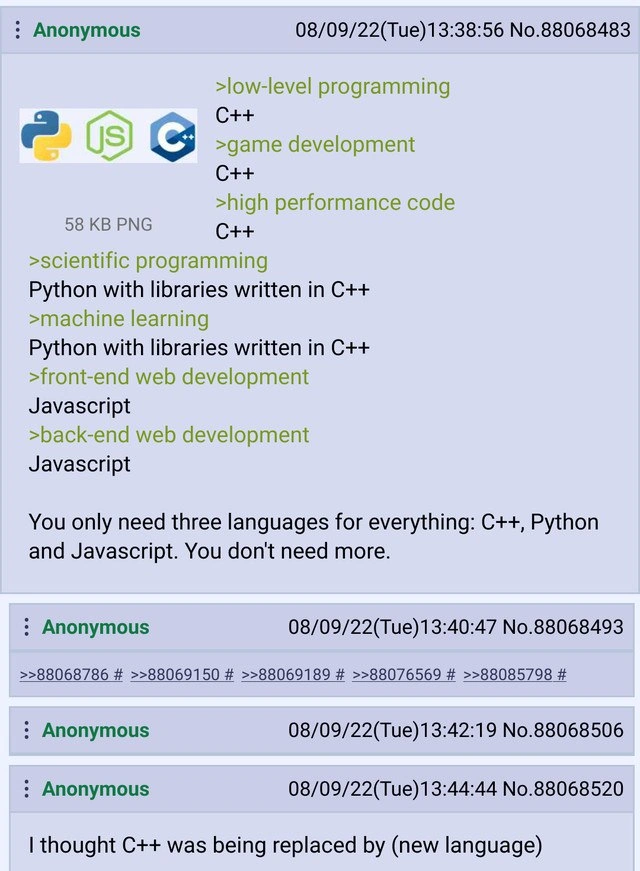
The greentext (green text with >) format in the image suggests this was posted on an imageboard (like 4chan’s tech board). That style is often used to summarize or make sarcastic points. Each > line is like a bullet point in an argument. By framing each domain as a >domain: Language pair, the poster is making it sound almost obvious or indisputable in a tongue-in-cheek way. It’s as if they’re saying: “See? Low-level? C++. Games? C++. Science? Python (but really C++). Web? JavaScript. Case closed.” The final line “You only need three languages for everything: C++, Python and JavaScript. You don’t need more.” reads as a very strong, somewhat smug conclusion. If you’re new, you might think “Oh, is that true? Do professionals actually only use these three?” Meanwhile, folks who’ve been around know that’s a setup for an argument. LanguageComparison discussions in the dev world can be as heated as sports team rivalries or what the best pizza toppings are — everyone has an opinion, and sweeping statements will definitely get responses.

Think of it this way: imagine someone saying, “In cooking, you only need salt, sugar, and flour for every recipe. You don’t need any other ingredient.” If you’re new to cooking, you might scratch your head or feel unsure. But anyone who’s cooked a variety of dishes will immediately see that as a joke or a dare for others to prove wrong (“What about pepper? What about oil or water? You can’t make an omelette with just those!”). The programming languages claim in this meme is similar — it’s deliberately reductive to get a reaction and a laugh. People will likely reply with the exact missing pieces (“What about databases? You need SQL!” or “Mobile dev? Where’s Swift/Java/Kotlin?”). In fact, in the screenshot, you can see a reply at the bottom where someone jokingly says, “I thought C++ was being replaced by (new language)” — probably hinting at a new language like Rust or Carbon. That person is basically poking the bubble, saying “hey, your list might already be outdated!” which adds to the humor and the never-ending nature of these debates.

So for a junior developer or a student, the take-away is: No, you shouldn’t literally restrict yourself to just C++, Python, and JavaScript for everything. Each is important and learning them gives you a broad foundation, but there’s a wide world of languages and tools beyond them. The meme is jokingly pretending that all that other stuff doesn’t exist or matter. The funny part is partly that there is a kernel of truth — these three languages are hugely influential and cover a lot of ground — but it’s also clearly a troll-ish stance because any one of those domains (like web back-end or scientific computing) could spark an hours-long discussion on what languages and frameworks are best. In short, the meme uses a simplistic claim to make light of the complex, sometimes silly LanguageWars that developers engage in. It’s a bit of insider humor: once you’ve seen enough of these debates, you recognize when someone is playing it for laughs. This anonymous poster basically threw a one-liner into the void, implying “fight me” to the community, and that in itself is the joke. Everyone knows it’s bait, and that’s why it’s amusing.

Level 3: Language Wars Reloaded

To a senior developer, this meme immediately reads as satire of the perennial LanguageWars in programming culture. The post confidently declares that only C++, Python, and JavaScript are needed to cover all software development needs, which is a bold (and deliberately provocative) oversimplification. Experienced devs have seen this movie before: strong opinions about a “one true language” or a minimal set of languages pop up every few months on forums and Twitter, inevitably igniting fiery debates. It’s practically an internet law in tech communities — state that “X is the only language you need” and watch the comment section explode. This meme is poking fun at that phenomenon by asserting a language_unification_argument so sweeping that it’s absurd (and thus humorous). It’s the Language Wars: Endgame edition, attempting to crown a triumvirate of winners and declare the war over. Of course, in reality, it just reloads the war with fresh ammunition.

Why these three languages? Seasoned devs will recognize that each of the chosen ones is a dominant player in its sphere of development, often for historical rather than purely technical reasons:

  • C++ for systems, games, and performance-critical software: It’s a descendant of C (the grandparent of modern languages), used since the ‘80s for operating systems, game engines, real-time systems, and anything where performance and control matter. C++ has a reputation: powerful and fast, but also notoriously complex. The meme’s author chose C++ for “low-level programming,” “game development,” and “high performance code” — domains where C++ indeed has been king (or at least the old guard) for decades. This will make experienced devs smirk because it’s true enough: many AAA games, high-frequency trading systems, or performance-sensitive libraries are written in C++ (or its precursor C). However, they also know this list omits other major players and the trade-offs involved. For example, someone in the know might say, “What about Rust or C for low-level? Or C# for games (Unity)? Or Fortran for high-performance scientific computing?” The meme doesn’t mention that, historically, Fortran was (and still is in some HPC circles) a go-to for number-crunching performance, or that Rust has emerged as a modern alternative to C++ for systems programming with memory safety. By ignoring these, the post lampoons the tendency of language fanboys to have tunnel vision. A veteran developer sees this and chuckles: here we go again, someone’s simplifying the world to their favorite tools.

  • Python for science and machine learning: The greentext notes “scientific programming – Python with libraries written in C++” and similarly for “machine learning.” This reflects a well-known reality: Python became the lingua franca of data science and ML in the 2010s, not because Python is blazingly fast (it’s not), but because it’s easy to write and comes with a wealth of libraries. Seasoned devs recall the days of MATLAB and R for scientific work, or even earlier when Fortran and C ruled numerical computing. Python’s rise was about ergonomics: scientists and researchers picked it up for quick prototyping, and an ecosystem of highly-optimized backend libraries (NumPy, pandas, SciPy, TensorFlow, PyTorch – many with C/C++ or even CUDA under the hood) did the heavy lifting. The meme humorously acknowledges that Python alone isn’t sufficient by explicitly adding “with libraries written in C++,” almost as an aside. This is basically saying: “Yeah, Python can do scientific computing… as long as it secretly hires C++ as the personal trainer for the heavy workouts.” An experienced programmer finds this funny because it’s a tongue-in-cheek admission that even one of the “necessary” languages leans on another for performance. It’s a bit like a magician showing you the trapdoor – DeveloperHumor loves this kind of reveal. Moreover, by listing Python only for those domains, the meme implicitly downplays other popular languages in back-end or general application development (like Java, C#, PHP, Ruby). A senior dev will note: Hmm, where’s Java in this grand plan? leaving them to infer that the original poster might be intentionally poking at enterprise languages by excluding them. The omission is as telling as the inclusion – it suggests a bias typical of certain online circles that consider Java “uncool” or aimed at enterprise coding, hence not part of the hacker’s holy trinity. This exclusion itself is part of the humor: it caricatures the kind of poster who proclaims “you don’t need more” while conveniently ignoring huge swaths of real-world code written in other languages.

  • JavaScript for everything web (front-end and back-end): Here the meme asserts that all web development can be done with JavaScript. Front-end web must use JavaScript (that’s essentially true historically – browsers run JS, and only recently are alternatives like WebAssembly becoming viable). Back-end web can use JavaScript (thanks to Node.js, which since the late 2000s allows JS to run server-side). The claim “JavaScript for back-end” would immediately trigger many senior developers to react with either a knowing laugh or an eyeroll. Not because JavaScript can’t run back-ends (it powers huge services like parts of Netflix, Paypal, etc.), but because the idea that you wouldn’t “need” any other back-end language is classic bait in the LanguageComparison debate. Veteran developers recall waves of hype: “Node.js will replace all other back-end platforms! JavaScript everywhere!” around 2012, or “single-language stack” startups boasting how their front and back share code. It’s true JavaScript (with Node) unlocked using one language on both client and server, solving a long-standing desire for a unified stack. But of course, what happened? We ended up with new framework wars and still plenty of other languages in play. The meme’s broad claim ignores that a huge number of back-ends are written in Java, C#, Python, Go, Ruby, PHP, you name it. A senior dev finds it funny because it’s knowingly reductionist: it’s the kind of statement that would start a thousand-comment flame war on Hacker News or dev forums. It’s bait, and the poster likely knows it. After all, saying “JavaScript is all you need on the back-end” in an imageboard is like kicking a wasp’s nest – you can expect folks to swarm in with retorts like “What about scalability and type safety? JS can’t do X as well as Y,” etc. The humor here is in the trollish simplicity of the statement pitted against the complex reality that senior engineers live every day.

In essence, the meme humorously paints a picture of a world where three languages suffice for everything, invoking the idea of a three_language_stack utopia. Senior developers recognize this as a riff on the idea of a “polyglot programmer” versus a “monoculture.” In real organizations, there’s often a tension: use the right tool (language) for each job even if it means a polyglot codebase, vs. keep the stack limited to simplify hiring, learning, and integration. Here the meme takes the monoculture argument to an extreme by implying that the right tools just happen to be C++, Python, and JS. It’s cheeky because it sweeps all the nuance under the rug. For instance, using C++ for every low-level task might be overkill or risky (sometimes plain old C or even assembly is needed for ultra-critical sections or kernel development; other times a safer language like Rust could save you from pointer bugs). Likewise, using JavaScript as the only back-end language ignores how differently Node.js behaves (single-threaded event loop) compared to something like Java or Go (multi-threaded). A grizzled engineer might chuckle remembering the time they saw someone try to write a CPU-intensive image processing server in Node.js — it probably didn’t end well, because JavaScript isn’t great at heavy parallel computation due to its design. These are the trade-offs the meme blithely ignores for the sake of a laugh.

There’s also an element of truth turned comedy that senior devs appreciate. The reason the joke lands is that, looked at superficially, these three languages do account for a huge portion of modern development:

  • Systems programming and game engines? Mostly C/C++ (with some Rust and C# creeping in).
  • Data science and ML? Python on the surface, with C/C++/CUDA underneath.
  • Web front-end? 99% JavaScript (with some TypeScript, which is basically JavaScript’s alter ego).
  • Web back-end? A significant share is JavaScript (Node) in startups and certain stacks, though far from all.

It’s almost like saying the quiet part out loud: despite the proliferation of programming languages, a few giants end up doing the lion’s share of the work in their domains. That observation resonates with experienced devs, but they also know why that is – often not because those languages are objectively the “best” in a vacuum, but due to legacy, network effects, and ecosystem. Python isn’t the fastest, but its ecosystem is unbeatable for ML because everyone contributes to those libraries and tools (momentum and community). JavaScript wasn’t the most elegant language design (even its creator Brendan Eich jokes about its rushed inception), but being the only browser language gave it an unshakeable position that later got extended to the server. C++ has its flaws (many will groan about undefined behavior or tricky syntax), but you can’t easily replace decades of optimized engines and the widespread compiler support it enjoys. In other words, each of these languages achieved a kind of critical mass in their field that reinforces their dominance. The meme cheekily presents this dominance as if it were an intentional grand plan (“You only need three languages…”), when in truth it’s more historical happenstance and inertia. That inside knowledge — understanding the historical and technical reasons why these languages rule — makes the meme all the more amusing to the veteran crowd. It’s winking at those in the know: “See how silly it is when we boil it all down? But also… look how these three really are everywhere, huh?”

One can almost imagine the sarcastic conversations this meme sparks in a team of senior engineers:

Dev A: “So I heard we’re rewriting everything in C++, Python, or JavaScript. All other languages are canceled.”
Dev B (smirking): “Great, I’ll just rewrite our PostgreSQL queries in pure JavaScript then. And our device driver in Python, that’ll go well.”
Dev C: “Don’t worry, Python will call C++ for the heavy parts!” 🤣

The greentext_style (the green >low-level programming lines) itself is a nod to how these debates often appear on forums — someone lists points in a somewhat mocking or matter-of-fact tone. The anonymity and bluntness (“You don’t need more.”) mimic the stereotypical imageboard confidence, where complex topics are reduced to one-liners and anyone disagreeing might be called out with another meme. To an experienced developer, the format signals “don’t take this at face value; it’s meant ironically.” They’ve been around long enough to smell the satire. It’s practically TechHumor 101: take a controversial stance that has a kernel of truth, state it as gospel, and watch the community ironically agree or furiously dissent — either reaction confirms the meme’s success.

Lastly, seniors might appreciate how the meme indirectly highlights the interdependence of these languages rather than their isolation. The poster gives away the joke with those qualifiers “with libraries written in C++.” It’s a sly acknowledgment: even our supposed do-it-all languages need each other. It’s reminiscent of the old saying in software, “Every large enough program ends up implementing a poor version of Lisp.” Here it’s like saying, “Every high-level language (Python, JavaScript) ends up leaning on a low-level one (C++) when things get serious.” That dynamic — high-level ease piggybacking on low-level efficiency — is very familiar to veteran developers. They’ve seen it in many forms (Java on a C++ VM, Ruby on a C interpreter, higher-level frameworks on OS kernels, etc.). So the meme also celebrates that trope in a humorous way. It’s basically the everything_in_cpp punchline: “Pfft, even when you use Python, you’re actually using C++ under the hood, so might as well admit it!” And for all the flame wars C++ vs Python folks have, in reality those two camps collaborate through these libraries. There’s some ironic camaraderie hidden in that observation, which a seasoned dev might find amusingly poetic. In the end, LanguageWars aside, software engineering often is about connecting components written in different languages and making them work together — exactly the opposite of the meme’s simplistic decree. Recognizing that irony is what makes the meme clever rather than just ignorant. It’s a wink and a nod to those who have fought in the trenches of polyglot codebases and come out the other side wary of grand proclamations like “you don’t need more.”

Level 4: Turing-Complete Trinity

In theory, any of these three languages — C++, Python, and JavaScript — is Turing-complete, meaning each can solve the same classes of computational problems given enough time and memory. This theoretical equivalence is why someone might boldly claim a few languages are enough for "everything." But Turing completeness ≠ one-size-fits-all in practice. The meme’s three_language_stack overlooks how vastly different these languages are under the hood, and why they excel in different domains. Each language embodies distinct design trade-offs rooted in computer science theory and system architecture:

  • C++ is a statically-typed, compiled language that produces optimized machine code. It gives low-level control over memory (via pointers and manual allocation) and hardware-specific capabilities (intrinsics, bit-level operations). This makes C++ ideal for high performance code and low-level programming where every CPU cycle and byte of memory counts. However, that power comes with complexity: undefined behavior, manual memory management, and the ever-looming risk of segmentation faults. C++ embraces the zero-cost abstraction principle (you don’t pay for what you don’t use), aligning with systems programming needs and the CAP theorem of language design: you can’t simultaneously maximize low-level control, high-level ease, and safety — you must choose two and sacrifice one. C++ chooses control and performance at the cost of simplicity and some safety.

  • Python, by contrast, is an interpreted (or JIT-compiled at runtime) language with dynamic typing and automatic memory management (garbage collection). It operates at a higher level of abstraction: you manipulate objects and collections without worrying about raw memory addresses. This makes Python extremely productive for developers in areas like scientific programming and machine learning, where writing and iterating on code quickly is more valuable than squeezing out maximum performance from each byte. The meme astutely notes “Python with libraries written in C++” — this hints at the classic two-language problem in computing: you use a high-level language (Python) for convenience and rapid development, but when you hit performance bottlenecks, you drop down to a lower-level, faster language (C or C++) for the heavy lifting. Numerical Python libraries like NumPy or TensorFlow exemplify this by exposing a friendly Python interface while executing blazing-fast matrix operations in optimized C/C++ (and even Fortran) behind the scenes. This architecture leverages theoretical computer science concepts like language bindings and foreign function interfaces (FFI), allowing one language to call routines written in another. The result is a hybrid model: Python provides the expressive glue, while C/C++ provides the raw compute muscle – a pragmatic workaround to the inherent trade-off between ease-of-use and performance.

  • JavaScript occupies a unique space: originally a scripting language for web browsers, it’s dynamically-typed and executed by a just-in-time (JIT) compiler inside the browser’s engine (like V8 in Chrome, written in C++). The meme slots JavaScript as the go-to for front-end web development (and even back-end web development via Node.js), essentially proposing JavaScript as the universal language of the web. Theoretically, JavaScript can do anything if you push it — even OS kernels and game engines have been written in JavaScript for experimentation — but there’s a reason browsers are sandboxed and limit direct OS access. JavaScript’s design prioritizes security (preventing code from accidentally wrecking your system) and asynchronous event-driven coding (for responsive UIs), reflecting a computer science emphasis on safety and concurrency handling in a restricted environment. It trades off low-level control (no direct pointer arithmetic in JS!) for portability and safety, as dictated by the fundamental concept of a managed runtime. That’s perfect for interactive web pages, but not for, say, writing a device driver.

The imageboard_meme glosses over these deep differences by implying these three can cleanly cover all tasks. A seasoned computer scientist will recognize this as an oversimplified view that bumps against the complexity barriers and theoretical limits of language design. There’s an implicit nod to language hierarchy and the idea of a universal language: in theory, we could pick one ultimate language and use it everywhere (the dream of “One Language to Rule Them All”). Yet Gödel, Turing, and practicality remind us that abstractions have costs. Each language in this “trinity” optimizes for certain aspects of the computability trilemma (performance, developer productivity, or safety/structure), and no single language simultaneously maximizes all. The meme’s joke lies in ignoring the rich landscape of programming language theory — from type systems (static vs dynamic typing) to runtime models (manual vs garbage-collected memory, multi-threading vs event loops) — distilling it all down to a cheeky minimal set. This Turing-complete trinity notion is fun because it’s almost true on paper and yet so far from true in the messiness of real systems. Even as these three powerhouse languages dominate their spheres, the boundaries between them are enforced by very real technical considerations like memory models, CPU architecture, and the halting-problem-like complexities of optimizing code. It’s a bit like claiming a tricycle, a sports car, and a boat are all you need for transportation: yes, they all move you around (universal in concept), but each operates in such different regimes that conflating them misses the science (and art) of why each exists.

Moreover, the interplay among C++, Python, and JavaScript in modern computing highlights a fascinating systems design principle: layers of abstraction. High-level languages often run on infrastructure built by low-level languages. For example, when you execute JavaScript in a browser, you’re invoking the V8 engine (written in C++), which in turn runs on an operating system likely partly written in C/C++. Similarly, Python’s interpreter (CPython) is implemented in C. These layers underscore a truth from computer architecture: higher-level languages depend on lower-level ones to bootstrap their execution. The meme hints at this dependency (Python with C++ libraries) but doesn’t dwell on it. A truly full-stack engineer or a language theorist would smirk here, knowing that even those “three languages for everything” sit atop a mountain of assembly, C, and machine code orchestrated by compilers, interpreters, and JITs. In other words, the “trinity” isn’t self-sufficient – it’s propped up by a lower-level monolith of code written in, ironically, C and C++ (and to some extent Java for the JVM, etc.). This cyclic dependency is a hallmark of computing progress: each generation of languages builds on the last, a concept as old as the compiler bootstrapping process.

Finally, from a language theory perspective, the meme’s stance triggers thoughts about domain-specific languages (DSLs) versus general-purpose languages. The assertion “You don’t need more” pointedly ignores the existence of specialized languages that arose exactly because using a general-purpose language was too cumbersome for certain tasks. For instance, SQL exists because querying databases is verbose and error-prone in a general-purpose language – you could do it in C++ or Python, but a dedicated declarative language is far more efficient for that domain. The meme also skips functional programming languages, system-specific scripting (shell scripts, MATLAB, R), and newer contenders like Rust (which aims to offer C++-level performance with memory safety) or Go (designed for simple concurrent back-end services). In August 2022, there was buzz about Google’s new language Carbon as a possible C++ successor — a reminder that language design is an evolving field. Each new language or DSL emerges to address a pain point or a theoretical shortcoming in existing ones (memory safety, concurrency model, developer ergonomics, etc.). By proclaiming the old triumvirate of C++/Python/JavaScript is all we need, the meme wryly ignores the innovations and research driving language evolution. It’s like a tongue-in-cheek rejection of all academic PL (Programming Languages) theory since the 1980s, distilled into a greentext shitpost. And that contrast — between deep PL theory and a blunt “just use these three, lol” — is exactly what makes experienced engineers chuckle. They recognize the grain of truth in the Turing-complete trinity and the mountain of exceptions and caveats hiding behind it.

Description

A four-panel meme depicting a rollercoaster of emotions that developers feel towards their own code. The first panel shows a developer looking at their code with pride, thinking 'This is the best code I've ever written.' The second panel shows the same developer a few hours later, looking at the same code with disgust, thinking 'This is the worst code I've ever written.' The third panel shows the developer returning to the code a week later, with a look of confusion, thinking 'I don't remember writing this code.' The final panel shows the developer looking at the code with a sense of awe and wonder, thinking 'Wow, this code is amazing! I can't believe I wrote this.' This meme perfectly captures the love-hate relationship that developers have with their own code, and the cyclical nature of self-doubt and self-confidence in the software development process

Comments

7
Anonymous ★ Top Pick My code is like a fine wine. I don't understand how it was made, but I'm told it's good
  1. Anonymous ★ Top Pick

    My code is like a fine wine. I don't understand how it was made, but I'm told it's good

  2. Anonymous

    “We only need C++, Python and JavaScript,” says the architect - six months before we’re debugging a Bash one-liner that triggers a Makefile which spawns a Rust binary to convert YAML into SQL because the Node service can’t parse its own config

  3. Anonymous

    "You only need three languages" says the developer who hasn't discovered they'll spend the next decade writing YAML configs, Dockerfiles, and Terraform scripts that somehow became Turing-complete when nobody was looking

  4. Anonymous

    The classic 'you only need three languages' take - conveniently ignoring that your C++ is really just a build system archaeology project, your Python is 80% C extensions you can't debug, and your JavaScript is actually TypeScript compiled to ES5 for IE11 support that was deprecated three years ago. But sure, three languages. Simple

  5. Anonymous

    Three languages cover everything: C++ for speed, Python to call the C++, and JavaScript to call the REST API that calls the Python that calls the C++; the actual production system is held together by Bash, SQL, and twelve thousand lines of YAML

  6. Anonymous

    C++ foots the perf bill for Python's NumPy parties; JS delivers the web's async torment. New langs? Just rebrands with fewer segfaults

  7. Anonymous

    “You only need C++, Python, and JavaScript” - accurate: C++ does the work, Python takes the victory lap via bindings, and JavaScript sells it; the hard part is getting their ABIs to speak without a quarterly incident

Use J and K for navigation