Programming Communities Guard the Door
Why is this DevCommunities meme funny?
Level 1: The Door Guard
This is like wanting to join two clubs. One club opens the door and says, "Come in, we will show you around." The other club blocks the door and says, "You should already know everything before entering." The funny part is that programming needs learners, but some programming spaces act like learners are the problem.
Level 2: Learning Without Armor
Developer communities are places where programmers ask questions, share projects, review code, debate tools, and help each other learn. They can be forums, chat servers, open-source issue trackers, classroom groups, workplace channels, or social media circles.
Gatekeeping means making people feel they do not belong unless they already meet some unofficial standard. In programming, that can look like dismissing beginner questions, mocking language choices, treating self-taught developers as inferior, or assuming someone is lazy because they do not yet know the vocabulary.
For a junior developer, the right panel feels familiar because learning to code already involves constant failure. Programs break for tiny reasons. Error messages can be confusing. Documentation assumes background knowledge. If the community response is also hostile, the learner starts fighting two problems at once: the code and the fear of looking ignorant.
The left panel represents the opposite experience: someone saying, "Come on in!" That does not mean lowering standards. It means giving people a way to improve. Good onboarding explains what went wrong, names the missing concept, and points to the next step. Bad onboarding treats not knowing as a character flaw.
Level 3: The Welcome Mat Gap
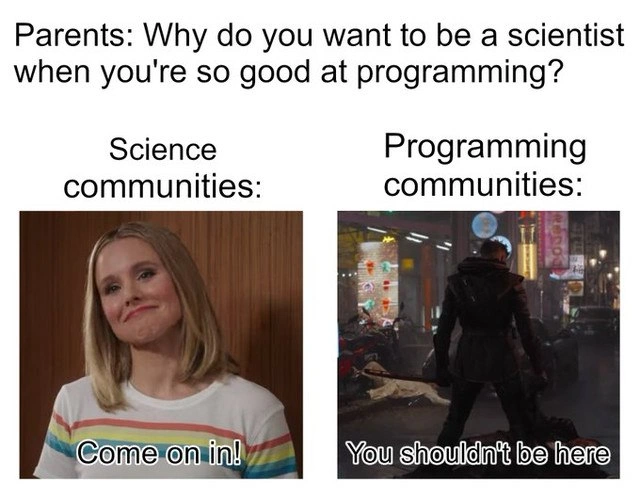
The meme begins with a parental question:
Parents: Why do you want to be a scientist when you're so good at programming?
Then it answers with social atmosphere instead of career logic. The Science communities panel shows a smiling character saying:
Come on in!
while the Programming communities panel shows a darker, more threatening scene with:
You shouldn't be here
That contrast is the whole wound. The joke is not that programming is technically harder than science, or that science communities are universally perfect. It is that many developers have experienced programming spaces where the first response to curiosity is suspicion: prove you belong, prove you already know the obvious thing, prove you searched correctly, prove your question is worthy of oxygen.
This is gatekeeping in tech compressed into two screenshots. Programming communities often present themselves as meritocratic, but the entrance exam is frequently cultural rather than technical. A newcomer may be judged on formatting, terminology, editor choice, operating system, whether they know the "right" Stack Overflow etiquette, whether their question sounds junior, or whether they accidentally triggered a holy war about tabs, semicolons, frameworks, or naming things. The compiler only needs valid syntax; the comment section apparently wants a resume, a blood oath, and prior production trauma.
Experienced developers recognize the irony because software desperately needs fresh learners. Every team complains about hiring pipelines, bus factor, documentation gaps, and maintainability, yet many public and internal communities still punish the exact vulnerability required to learn. Someone asks why their loop does not work, and instead of a path forward they get a lecture about fundamentals, a duplicate closure, or a drive-by "read the docs" with all the warmth of a failed build.
The meme also hints at a career identity problem. Parents see "good at programming" as a clean talent signal, but the person in the meme sees the social cost behind the skill. The barrier is not just algorithms or syntax; it is entering a culture where confidence is often mistaken for competence and cruelty is mislabeled as rigor. A healthier programming community still corrects mistakes, but it separates precision from humiliation. That distinction is apparently harder than centering a div, which is saying something.
Description
The meme asks, "Parents: Why do you want to be a scientist when you're so good at programming?" Below, the left panel labeled "Science communities:" shows a smiling woman with the subtitle "Come on in!" while the right panel labeled "Programming communities:" shows a dark, tense scene with the subtitle "You shouldn't be here." The technical context is not about syntax or tooling but about developer culture: programming communities are portrayed as more gatekeeping and hostile than adjacent scientific communities.
Comments
3Comment deleted
The compiler only rejects invalid syntax; the comment section rejects perfectly valid humans.
Ban whorebot, pls Comment deleted
😂😂😂 Comment deleted