The Stark Contrast in How Programmers and Biologists Discuss 'Bugs'
Why is this Bugs meme funny?
Level 1: One Word, Two Reactions
Imagine you have one group of people who find a problem and immediately start panicking and shouting, and another group of people who hear about something and remain calm and polite. That’s the joke of this meme. It’s using the word “bug” which can mean two things: a mistake in a computer or a little insect. When computer programmers find a mistake (a bug) in their work, they can get very excited, act urgently, and it might even sound like they’re arguing loudly – kind of like a bunch of kids all yelling at once because something went wrong. But when biologists (science people who study animals) talk about bugs, they mean insects like ants or ladybugs. They talk about those in a quiet, orderly way, maybe in a nice meeting room, like students in a classroom raising hands to speak.
Think of it like this: one kid’s toy breaks and all the kids start freaking out and arguing over how to fix it – that’s the top picture energy. Meanwhile, next door, a teacher is leading a gentle discussion about butterflies with a class – everyone is calm and listening, which is the bottom picture’s vibe. It’s funny because both groups use the word “bug,” but one is treating it like a big emergency (fix the broken thing now!) and the other is treating it like an interesting topic (let’s talk about this cool insect). The huge difference in how they act – crazy fight vs. calm meeting – makes us laugh. The meme is basically saying: a single word can mean such different things that it creates two completely opposite scenes. One is wild and chaotic, the other is formal and peaceful. That surprise – that the same word leads to two extremes – is why it’s so humorous, even if you don’t know much about programming or biology. You just know one side is really upset and the other side is really chill, and that contrast is silly in a great way.
Level 2: Defects vs Insects
Let’s break down the key terms and what’s actually happening in this meme. The humor revolves around the word “bug” having two meanings:
In programming, a bug is a defect or error in software. It’s when a program doesn’t work as intended because of a mistake in the code. For example, if a calculator app crashes when you try to divide by zero, that crash is due to a coding bug. Every developer is familiar with the dreaded bug: it can be as small as a typo in code or as complex as a memory leak in a huge system. When programmers “discuss a bug,” they’re talking about debugging – figuring out why the code misbehaves and how to fix it. This can be stressful! If you’re new to coding (maybe just wrote your first Python script) and it isn’t working, you know the frustration of a bug. Now imagine that feeling multiplied in a team setting: multiple engineers all trying to hunt down a tricky error. Emotions can run high because there’s pressure to fix the issue quickly, especially if users or customers are affected. That’s why the meme shows “Programmers discussing bugs” as people physically fighting – it symbolizes the argumentative, high-pressure environment that debugging sessions sometimes feel like. (Don’t worry, software teams don’t actually duke it out WWE-style, but they might argue or speak over each other when rushing to solve a bug.) This is a form of relatable tech humor: developers often joke that dealing with bugs turns into chaos or that debugging is like battling a monster.
In biology, a bug usually means an insect (or related little crawling creature). Biologists, especially entomologists (scientists who study insects), discuss bugs in the literal sense: creatures like beetles, butterflies, ants, etc. So “discussing bugs” for them could mean talking about insect species, their behavior, habitat, or how to conserve them. This is typically done in a calm, academic manner – think of a science classroom or a conference room, not an emergency firefight. Biologists might have meetings or conferences where everyone is dressed nicely, presenting their research findings on say, population dynamics of ladybugs or the genetics of butterflies. The bottom panel image – a huge round conference table with dozens of people in suits – suggests a very formal discussion, maybe even an international symposium or a committee meeting. In other words, it’s orderly. People take turns speaking, and there’s likely a moderator. When biologists debate bugs, it might be “Does this specimen belong to species A or species B?” or “How do these insects impact the ecosystem?” They use calm, technical language and follow rules of polite discussion. No one is leaping across the table to tackle someone over a disagreement about a beetle’s Latin name!
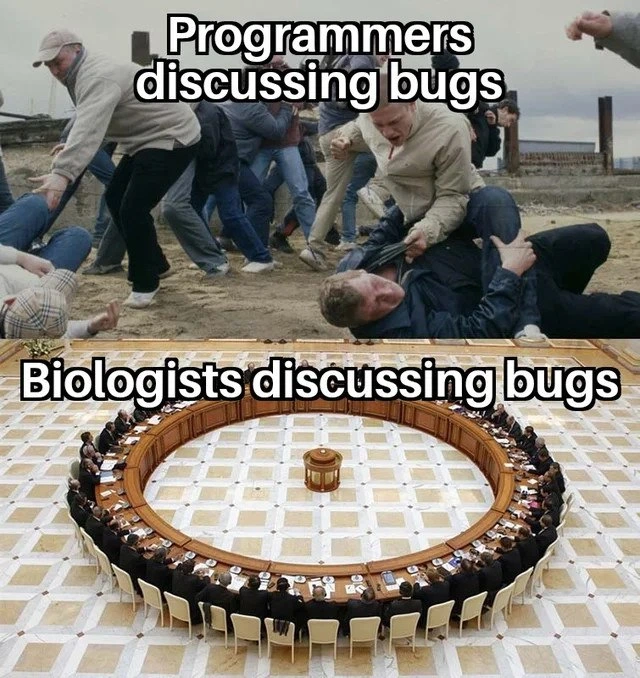
Now, why is it funny to compare these side by side? It’s all about the contrast. The top picture shows chaos – fists in the air, folks on the ground, sand flying – labeled "Programmers discussing bugs." It jokingly implies that when software developers talk about bugs (software problems), it’s like a bar brawl: loud and messy. The bottom picture shows an ultra-civilized meeting labeled "Biologists discussing bugs," implying that when scientists talk about bugs (insects), it’s this ultra-courteous, well-organized affair. The joke exaggerates reality to make a point. In reality, not every programmer argument is a fistfight (most are just spirited discussions on Slack or in a meeting room, possibly with some heated words). And not every biologist meeting is this lavish or formal – they don’t all sit in marble halls on thrones discussing ants! But the exaggeration makes the point clear: programmers and biologists mean completely different things by “bugs,” and they talk about them in completely different ways.
This is a case of a single word causing a Miscommunication if taken out of context. If you told your family “We were discussing bugs at work and it got pretty intense,” they might respond, “Why would talking about little insects get you so upset?” Conversely, if a biologist said, “We had a big discussion about bugs today,” a programmer friend might joke, “Oh, what went wrong with your code?” The two fields have their own jargon. When programmers mention bugs, they mean code issues. When biologists mention bugs, they usually mean actual bug species (or occasionally they might mean viruses/bacteria if saying “I caught a bug,” meaning an illness – but that’s yet another context!). This meme falls in a popular format of programmer_vs_biologist or generally “X vs Y” comparisons, pointing out how the same word or concept can mean very different things to different people. It’s highlighting an ambiguous term in a humorous way.
For someone early in their tech career (or just learning coding), it’s useful to know how deep the bug-fixing culture runs in programming. Teams often have things like bug trackers (software like JIRA or GitHub issues where bugs are logged and discussed), bug triage meetings (where they prioritize which bugs to fix first), or even bug bashes (events where everyone tries to find and fix lots of bugs). These can become lively, and sometimes contentious, activities. The intensity comes from people caring about their work and perhaps being under pressure. It’s not that programmers are actually aggressive people by nature; it’s that a bug in a crucial system can feel like an emergency, and in an emergency people get animated. Imagine if your app or game crashes and thousands of users are complaining – the developers responsible will be urgently communicating to fix it, voices might be tense. That’s what the meme’s top panel is poking fun at. A new developer might be surprised the first time they witness a heated debate over a seemingly minor bug. They might think, “Why is everyone so angry about this tiny error?” But often it’s because that “tiny error” might have big consequences or highlight deeper issues in the code.
On the other hand, the way biologists approach “bugs” (the insects) is usually methodical and planned. They might schedule a conference months in advance to discuss research findings. There’s an agenda: Session 1: Beetle evolutionary pathways, Session 2: Panel on butterfly migration. Attendees listen quietly, there’s Q&A, etc. It’s structured communication. Even if two scientists strongly disagree about an interpretation, they respond with something like “We respectfully disagree, and here’s our data…” No one’s flipping the table in rage because someone called their favorite beetle species “common”! To a programmer, that polite academic disagreement might seem almost overly formal. Meanwhile, to a scientist, the way developers argue about a bug might seem chaotic and lacking decorum. That’s the CommunicationGap the meme jokes about: computer geeks can appear as rowdy as a fight club when solving a technical problem, whereas scientists can seem like they’re in a calm board meeting even when discussing literally blood-sucking insects.
To illustrate the contrast clearly, here’s a light-hearted comparison of the two scenarios side by side:
| When Programmers Discuss a "Bug" | When Biologists Discuss a "Bug" |
|---|---|
| What “bug” means: A software error or glitch causing a program to malfunction. | What “bug” means: An insect or similar creepy-crawler (e.g., beetle, mantis, ladybug). |
| Typical setting: A quick, possibly impromptu meeting or a Slack chat, often during a crisis (production outage). Could even be late at night. | Typical setting: A scheduled meeting or conference, planned in advance, during regular hours (or a conference event). |
| Atmosphere: Urgent, high-stress, informal. People might interrupt each other. Tone can get loud or excited. (Imagine multiple people shouting theories at once like “Did you check the null pointer?!”) | Atmosphere: Calm, academic, formal. People speak one at a time. Tone is polite and measured. (Imagine someone saying “According to Dr. X’s study on beetle taxonomy…” in a normal voice.) |
| Visual: Developers in casual clothes (T-shirts, hoodies) huddled around computers or on a call. The meme exaggerates it to an actual fistfight outdoors to symbolize the chaos. | Visual: Researchers or officials in suits or professional attire around a conference table or podium. The meme uses an ornate round table image to emphasize the orderly discussion. |
| Emotions: Frustration, adrenaline, determination to “squash the bug” (fix the error). Maybe some finger-pointing about who introduced the bug. It can get personal (“This bug is from your code!” “No, your module caused it!”). | Emotions: Curiosity, intellectual excitement, perhaps pride in one’s findings. Possibly some polite disagreement (“We find this insect in Asia, not Africa, contrary to your report”). It’s not usually personal – they’re talking about the bugs, not blaming each other for them. |
| Goal: Find and fix the error ASAP. The end result is usually a patch or a code change. Everyone’s relieved when the bug is resolved. | Goal: Share knowledge or make a decision about insects. The end result might be a better understanding, a published paper, or an agreed plan (like a conservation strategy). No one is in a rush like it’s an emergency. |
As the table shows, a “bug discussion” in coding and a “bug discussion” in biology are almost opposites in style. The meme exaggerates both for comedic effect: the programmers literally brawling, and the biologists in an absurdly formal huge meeting (seriously, that round table looks straight out of a royal palace or something!).
For someone just getting into tech, you might also find it interesting (and amusing) that we use a lot of such terms in software development that sound like everyday words but mean something else. We talk about “bugs” (errors), “crashes” (programs suddenly terminating – not a car accident!), “threads” (parallel tasks – not actual thread), “cookies” (data stored in your browser, sadly not edible), and so on. It can definitely cause confusion when talking to people outside our field. You might tell a friend “I had to kill a process because it was hung due to a bug,” and they’ll look at you like, “Are you okay?!” This meme captures that kind of miscommunication in a very visual way. If a biologist overheard two programmers shouting “We gotta kill this bug now!” the biologist might imagine some poor insect plague, whereas the programmers mean stop the program to remove the error.
To put it simply: in software, bugs are bad – they’re mistakes we urgently want to eliminate. In biology, bugs are interesting – creatures to observe or even protect. No wonder the programmers in the meme look like they’re in a street fight (they’re “battling” a bad bug), while the biologists look like they’re at a diplomatic summit (discussing bugs that might be endangered species or such). It’s a funny reminder that context matters a lot. The next time you mention a “bug” in mixed company (say, at a party with both your programmer friends and your biologist friends present), you might want to clarify which kind of bug you mean – or else you might get some very confused looks!
Level 3: Bug Brawl vs Boardroom
At the highest level, this meme highlights a communication gap born from an ambiguous term, turning it into classic DeveloperHumor. It’s a two-panel comparison contrasting how two professions react to the word "bug." On the top, we have programmers discussing bugs, depicted as an all-out brawl in a sandy lot. This chaotic fist-fight scene perfectly captures the DebuggingFrustration and heated intensity that can occur when software engineers grapple with bugs in software (i.e., defects in code). On the bottom, we see biologists discussing bugs in a genteel, formal meeting around a huge round table – a calm, orderly conference about, presumably, actual insect bugs. The humor comes from this jarring juxtaposition: same word, totally different worlds.
Why does a simple software bug inspire what looks like a beachside wrestling match? Anyone who’s experienced a high-severity production outage or a contentious bug-fix meeting will relate. In a development team, a serious bug (like a critical error bringing down a website) can send everyone into all-hands-on-deck mode. Picture a war-room scenario: developers huddled around monitors, raised voices on a group call, fingers pointed (figuratively) in a "git blame" sense, and frantic Slack messages flying. It’s not that devs literally throw punches (we hope!), but the atmosphere can feel combative. The meme exaggerates this into a physical brawl, which is funny because it resonates with how combative debugging debates feel. There’s a shared trauma in tech teams where debugging sessions have devolved into yelling matches about root causes – one engineer insisting “It’s the database!” while another yells “No, it’s a frontend bug!” and yet another groans “I told you it’s always a DNS configuration issue!” This collective SharedPain over bug crises is fertile ground for CodingHumor. We laugh because we’ve seen how a simple glitch can turn calm colleagues into stressed-out, sleep-deprived fighters (metaphorically). The tag BugsInSoftware often implies long nights and frayed tempers, so a bug discussion among programmers is comically represented as a free-for-all brawl.
On the flip side, the bottom panel’s image of a grand roundtable meeting with suited officials evokes a very polite and methodical discussion – the sort you’d find at a scientific symposium or a government council. Here, biologists discussing bugs likely means entomologists or researchers calmly presenting papers on insect behavior or taxonomy. It’s the polar opposite vibe: structured, formal, possibly with an agenda and timed speaking slots. Why the huge difference? Because in biology, a “bug” is just an interesting subject, not an emergency. Biologists might debate classification of a beetle species or share findings about butterfly migration with measured professional courtesy. There’s passion, surely – scientists can argue too – but it’s channeled through polite discourse, data slides, and raised hands, not raised fists. The meme taps into this CommunicationGap: tech folks are notorious for heated stand-ups or impromptu shouting when systems crash, whereas academia and science circles adhere to calmer, diplomatic debate even when they disagree. Essentially, we’re looking at brawling vs. boardroom as the context_tags cleverly put it. The round table image practically screams “official conference,” complete with ornate flooring and an almost UN-security-council vibe – as if these biologists are diplomats negotiating a treaty on beetles. It’s an absurdly formal setting to juxtapose with the programmers’ sandlot smackdown.
The ambiguous term “bug” is the linchpin of the joke – a prime case of ambiguous_term_humor. In computing, a bug is an unintentional error in software that causes unexpected or incorrect results. In common parlance (and biology), a bug is an insect or creepy-crawly. So when each group “discusses bugs,” they’re literally not talking about the same thing at all. This double meaning leads to miscommunication if taken literally across fields. The meme plays on that by showing how each field’s context makes them behave. It’s implicitly imagining what it looks like if you drop in on a “bug discussion” in each domain: you’d see chaos in one, calm discussion in the other. This contrast is inherently funny because we don’t expect such a stark difference from a simple change in context. It highlights how tribal and intense the software world can be about issues, compared to the measured, perhaps even dry, approach in scientific circles. Any seasoned engineer nods knowingly here: it’s relatable humor because we’ve watched a tiny code issue escalate into what feels like a brawl in a meeting room.
There’s also an inside joke about the term “bug” itself. Fun fact: the use of "bug" to mean "software error" actually comes from a real insect. The often-cited story is that in 1947, computer pioneer Grace Hopper documented a moth that got stuck in a relay of the Harvard Mark II computer, causing a malfunction – the moth was the “first actual case of a bug being found.” They literally taped the moth in the logbook. Engineers were already using “bug” to mean glitch even before then, but this incident became legendary. It’s a beautiful irony: the programming term for a glitch originates from an actual insect, bridging the two worlds humorously. So in a way, the programmers did have an actual bug to discuss back then! Ever since, debugging (literally “removing bugs”) became the term for fixing code issues. The meme doesn’t state this outright, but knowing this tidbit adds an extra chuckle: the programmers might be figuratively fighting to remove a bug, while the biologists are nicely adding one more bug to their list of studied species.
This meme also touches on differences in communication style and workplace culture. Tech teams, especially in fast-paced environments, often communicate very directly, even abruptly, under stress. If a production server is down due to a bug, you’ll see a flurry of “What happened? Who deployed last? Find the commit that broke it!” – sometimes overlapping, heated, and chaotic. There’s even a tongue-in-cheek term “blamestorming” (a play on brainstorming) to describe team discussions that degenerate into pointing fingers about a bug. The top image of people literally wrestling is an exaggerated metaphor for those blame sessions and frantic patches. It’s RelatableHumor for developers because many have sat through a tense bug post-mortem meeting that, while civil on the surface, felt as combative as a fist-fight. Conversely, the world of biology research (or any academic field) tends to value orderly turn-taking. Imagine a scholarly debate where someone says, “I posit that this insect belongs to the genus X due to trait Y,” and their colleague responds, “Counterpoint: recent data suggests trait Y evolved convergently in genus Z,” all in measured tones. There’s disagreement, but it’s structured – more of a chess match than a boxing match. The bottom image’s impeccable round table, each person in a suit with documents, illustrates that decorum. It’s an amusing stereotype (not all programmers are scrappy brawlers; not all biologists sit in mahogany halls), but exaggeration is what makes it funny.
Finally, the meme underscores how context changes the emotional stakes. For a developer, finding a bug (especially right before a deadline or after deployment) can spike your adrenaline. It means something is broken, users might be angry, your team lead is upset, and you’re in for a long night of debugging – hence the passionate, almost desperate vibe. For a biologist, finding a “bug” might actually be a good thing (a new specimen, data for research) or at least a normal part of the job – it doesn’t typically threaten anyone’s website or wake them up at 3 AM. So their discussion lacks that life-or-death urgency; it’s intellectual, not firefighting. The meme hilariously captures this by presenting the programmers’ bug talk as outright physical conflict, and the biologists’ bug talk as a calm deliberation in a regal setting. That extreme contrast is what makes the image instantly understandable and laugh-out-loud funny to anyone straddling those worlds or aware of each. In summary, it’s poking fun at our shared pain in debugging and the sometimes absurd intensity of tech communication, by comparing it to the serene, methodical world of entomologists talking about literal beetles and butterflies. It reminds us that a single word can drag two professions into completely different realities – one into chaos, the other into conference – and that’s just inherently comedic.
Description
A two-panel meme that plays on the double meaning of the word 'bugs.' The top panel is captioned 'Programmers discussing bugs' and shows a chaotic, violent brawl with several men fighting, one pinning another to the ground. This image humorously portrays technical debates over software flaws as aggressive, blame-filled confrontations. The bottom panel, labeled 'Biologists discussing bugs,' presents a starkly different scene: a large, perfectly circular conference table in a formal hall, where dozens of people are seated in an orderly and calm fashion, engaged in a civilized discussion. The joke hinges on the pun, contrasting the high-stress, often contentious process of debugging software with the scientific, dispassionate study of actual insects. For senior developers, it's a relatable commentary on the intense arguments that can erupt during code reviews or post-mortems when a critical issue is discovered
Comments
7Comment deleted
In biology, a bug that survives is called 'fit.' In programming, a bug that survives is called 'legacy code.'
Biologists politely debate whether it’s Coleoptera or Hemiptera; our “bug taxonomy” meetings devolve into full-contact scrum over whether the null pointer lives in auth, billing, or that forgotten microservice someone forked in 2014
The real bug here is that after 20 years in the industry, we still haven't figured out whether the production incident post-mortem should be a civilized roundtable discussion or an MMA cage match - though we all know it inevitably starts as the former and devolves into the latter once someone mentions 'it worked on my machine.'
The meme perfectly captures why 'bug triage' meetings often require a Scrum Master with conflict resolution training. While biologists can calmly classify Coleoptera over tea, programmers treat every production bug like it's a personal attack on their architectural decisions from three years ago. The real difference? Biologists study bugs that have been around for millions of years; programmers create new ones every sprint and then fight about whose commit introduced the regression that broke the payment gateway at 3 AM on Black Friday
Biologists lead with Latin names; engineers lead with “steps to repro?” and conclude with a “blameless” postmortem quietly blaming the SDK - and the Friday deploy
Biologists do taxonomy; programmers do ring-topology consensus - PagerDuty elects a leader who decides if it’s a race condition or an emergent microservice feature
Entomologists classify bugs by genus; programmers by P0 fistfight severity