An SQL Query's Night Out: Looking for a Join
Why is this Databases meme funny?
Level 1: Can I Sit Here?
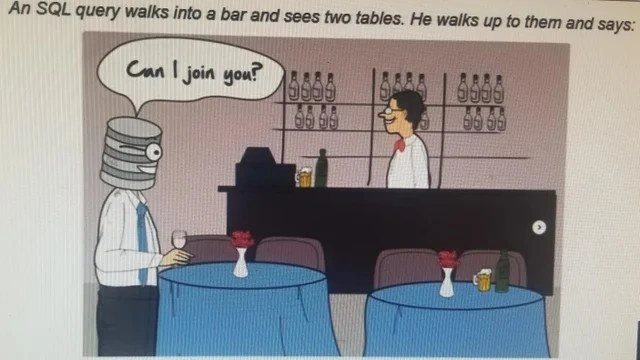
Imagine you walk into a cafeteria and see two friends sitting at a table. You ask, "Hey, can I sit with you?" That’s a normal, polite question. Now, this meme takes that idea and gives it a funny twist with computer language. In computers, a table isn’t just furniture – it’s also a bunch of information, and joining tables means putting two sets of information together. The joke shows a little database character asking two actual tables at a bar, "Can I join you?" It’s funny because he’s saying a regular thing, but it also secretly means something in computer talk. It’s like a play on words: the phrase sounds ordinary, but to computer folks it also describes an action their databases do all the time. In other words, the cartoon mixes an everyday situation with a tech idea in one simple line. Even if you don’t know SQL, you can see it’s a silly scenario – a database person wants to join two tables (literally!). And if you do know SQL, you laugh extra hard because "join" is exactly what you’d say when combining data. It’s a little nerdy joke that makes people smile by showing how one simple phrase can belong in two worlds at once.
Level 2: Joining Two Tables
Let’s break down the joke in simpler terms. In a relational database (the common kind used in many apps), information is stored in tables – kind of like spreadsheets with rows and columns. Each table holds a specific type of data. For example, you might have a Users table for user info and an Orders table for purchase info. An SQL query is just a command or question you ask the database to get information. When you need to combine information from two tables into one result, you use an SQL JOIN. The word "join" in SQL literally tells the database to connect two tables using a shared column (like an ID that appears in both).
In the cartoon, each element corresponds to something in database terms:
- The SQL query character – that person with a stack-of-disks for a head represents a query (or a database itself). Developers often depict databases as cylindrical stacks, so this figure is essentially a walking query or database guy.
- The two tables – they look like actual round bar tables with tablecloths and drinks, but they symbolize two database tables of data. (Think of one table as "Customers" and the other as "Orders" for analogy.)
- "Can I join you?" – this is a normal polite question to ask if you can sit at someone’s table. It’s also exactly how we describe combining two tables in SQL using a
JOIN. The joke is that the query is asking if it can perform a join operation on those tables, but it sounds like he’s just being social.
To a new developer or someone learning SQL, here's what a join looks like in actual code:
-- Using a JOIN to combine two tables based on a common column (e.g. user ID)
SELECT Users.name, Orders.item, Orders.price
FROM Users
JOIN Orders ON Users.id = Orders.user_id;
In this SQL statement, we’re selecting data from a Users table and an Orders table. The JOIN ... ON part tells the database to match each user with their orders using a shared key (Users.id equals Orders.user_id). The result of this query would be a new table-like set of results that merges the two tables’ information into one.
Now, why is the meme funny? Because it imagines that SQL query as a person who sees two tables and wants to JOIN them in the database sense. But spoken out loud, "can I join you?" just sounds like someone asking to sit down with two people at a bar table. It’s a perfect overlap of a tech term with a normal phrase. This kind of DatabaseHumor is very common in programming circles – a simple everyday sentence turns into a joke if you know the computer meaning behind it. The meme basically teaches what a join does (bringing tables together) in a punny way. If you’re new to SQL, remember: a JOIN is how you combine tables... and now you might also picture a friendly database query at a bar saying the same thing!
Level 3: SQL Pickup Line
In the realm of relational databases and backend development, this meme delivers a classic bit of DeveloperHumor by turning SQL syntax into a social scenario. The scene shows an anthropomorphized SQL query (the character with a cylinder-shaped database head) walking into a bar and spotting "two tables." To a database engineer, those two tables immediately bring to mind database tables of data. The query character cheekily asks, "Can I join you?" – which is both a polite social request and a spot-on reference to the SQL JOIN command. The humor here is a nerdy double entendre: in SQL, JOIN is how you combine data from multiple tables, and in everyday language "join us" means to come together at the table. This overlap is instantly recognizable to anyone who writes SQL queries regularly. It’s the kind of joke that makes a database engineer grin because it merges two contexts perfectly (pun very much intended). By literalizing the SQL action as a pickup line, the meme underscores how a simple word like "join" carries a very specific meaning in a technical context.
For seasoned developers, the phrase "an SQL query walks into a bar..." is a wink at a well-known sql_join_pun setup. It plays on the fact that we often talk about tables in databases abstractly, but here they’re also the physical tables in a bar. The cartoon bartender and setting amplify the classic “two X walk into a bar” joke format, making the punchline feel both technically clever and playfully mundane. The reason this lands so well in coding circles is because SQL JOINs are a daily occurrence in data work – combining user records with order records, or any two related sets of data. The meme basically says "writing a query to connect two datasets is as casual and common as inviting yourself to join friends at a pub table." And hey, better to JOIN the tables than to DROP them – nobody wants our SQL friend accidentally dumping data or knocking over drinks 😉. This lighthearted scenario turns an essential DatabaseQuery operation into a bar joke, celebrating the kind of pun that only makes sense if you speak the language of databases.
Description
A single-panel cartoon illustrating a classic tech pun. The setup text at the top reads, 'An SQL query walks into a bar and sees two tables. He walks up to them and says:'. The image depicts a bar scene with a bartender in the background. In the foreground, a cartoon character, dressed in a shirt and tie but with a head shaped like a stack of database disks, stands holding a drink. This character is looking towards two empty dining tables. A speech bubble from the database character asks, 'Can I join you?'. The humor is a direct pun on the SQL (Structured Query Language) command 'JOIN,' which is used to combine rows from two or more tables based on a related column between them. The cartoon visualizes this technical command in a social, real-world context, creating a simple but effective joke for anyone familiar with database operations
Comments
9Comment deleted
The two tables replied, 'Sure, but on what condition?' The query panicked, realizing he'd forgotten his ON clause and was about to create a Cartesian product
SQL query strolls into a bar, eyes two tables and murmurs, “Fancy a HASH JOIN?” - they sigh, “Update your stats first; last time you mis-estimated the cardinality and we spent happy hour spilling to tempdb.”
After 20 years in the industry, I've seen this joke more times than I've seen properly indexed foreign keys in production databases - and both still make me smile while simultaneously triggering my PTSD from that one time a junior developer wrote a cartesian join on our largest tables
This joke perfectly captures why database administrators have trust issues - the query says it wants to JOIN, but you know it's really just going to do a CROSS JOIN and create a Cartesian product of chaos. At least it asked permission first instead of just doing an INNER JOIN without consent like some rogue ORM would
Bartender: You can join if you bring an ON predicate - we banned cross joins after they turned happy hour into a full table scan
The tables replied: 'Sure, but specify the ON clause first - don't make this a Cartesian explosion.'
An SQL query walks into a bar, sees two tables: “Can I join you?” Bartender: “Inner only, on indexed keys - the last CROSS JOIN turned happy hour into a full table scan.”
┻━┻ ︵ ¯_༼ᴼل͜ᴼ༽_/¯ ︵ ┻━┻ Comment deleted
Boomer humor Comment deleted