A Programmer's Hard-to-Swallow Scroll of Truth
Why is this CodeQuality meme funny?
Level 1: Don’t Blame the Tools
Imagine you’re doing a craft or task and it doesn’t turn out well. For example, say you draw a picture and it looks messy. Now, someone gently tells you, “The drawing is messy because you rushed it, not because your pencil is bad.” That’s basically what the scroll in the meme is saying, but about computer programming. Instead of listening to that advice, the character crumples up the paper and throws it away, like a kid who doesn’t want to hear they made a mistake. It’s funny because we know the pencil didn’t cause the messy drawing – the artist did. Similarly, in programming, sometimes people blame the programming language (the tool) when the real issue is how they used it. The meme makes us laugh and nod because it’s showing a person ignoring a simple truth: if you make a mess, it’s on you, not your tools. It’s like a gamer losing a level and then blaming the controller – we all know the controller was fine, and the player just needs more practice, but it’s easier to toss aside the advice than to admit that.
Level 2: Blame the Language
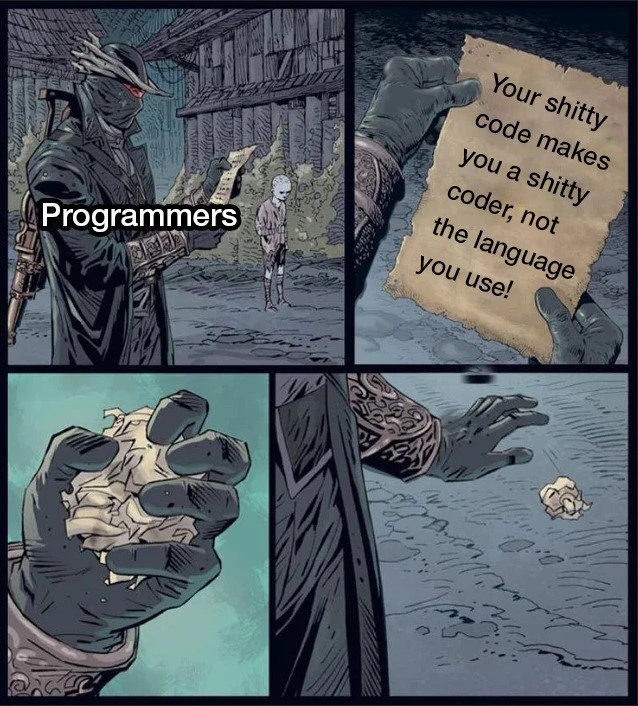
In this comic, a programmer (the person writing code) is depicted as a medieval hunter holding a scroll. The scroll’s message says essentially: “If your code is bad, it’s your fault as a coder, not the programming language’s fault.” This is highlighting a common issue in software development culture. Many developers, especially when they’re frustrated, play the blame game with their tools. They might say things like “Ugh, my program is buggy… this programming language is terrible!” or “Our project failed because Language X is just bad.” This comic calls that out by literally spelling it out on a scroll: your code is shitty (meaning low-quality or full of mistakes) because of you, not because of the language. Ouch! That’s some tough love. The Programmers character in the meme doesn’t like hearing this at all – in the next panels we see the gloved hand angrily crumpling up the parchment and tossing it away. In other words, the programmer chooses to ignore the advice completely. The humor comes from that relatable reaction: instead of taking responsibility (which we call developer_accountability), the programmer just rejects the message and will probably keep blaming the programming language for problems.
Let’s break down a few terms and elements here for a junior developer audience:
- Programming Language: This is the tool or language you use to write instructions for the computer (like Python, Java, JavaScript, C++, etc.). Each language has its own syntax (rules and style), but none of them can guarantee good or bad code by themselves. They’re just tools.
- “Shitty code”: Slang for code that is poorly written or designed. This could mean the code is buggy, hard to read, not efficient, or full of so-called code smells (common mistakes like overly complicated functions, repetition, or bad naming). When someone says code is “shitty,” they mean it has bad CodeQuality – it might work (or maybe not) but it’s not something to be proud of or easy to maintain.
- Blaming the language: Sometimes developers say the reason the code is bad is because of the programming language. For example, a person might say “This game is laggy because JavaScript is slow” or “Our system is a mess because PHP is a bad language.” They’re attributing the problems to the tool rather than how they used the tool.
- Language wars (or Language comparison debates): These are endless arguments in the programming world about which language is better. You’ll hear things like “Java vs. C#,” “Python vs. JavaScript,” “tabs vs spaces” (that one’s about formatting code, a classic DeveloperHumor topic). People get very passionate defending their favorite language and often exaggerate the flaws of the others. It’s almost like sports team rivalries, but for code. In reality, each language has strengths and weaknesses, but none will automatically make your code good if you don’t apply good practices.
- Developer accountability: This means the programmer takes responsibility for their work. In context, it means admitting “Okay, the reason this code is bad is because I wrote it too quickly or without enough planning/testing,” instead of saying “It’s all the language’s fault.” The scroll is basically telling programmers to have some accountability for code quality.
Now, why would a programmer crumple up that message? Think about how it feels to be told you did a bad job. It’s natural to get defensive. In the comic, the fantasy_hunter_meme style makes it dramatic: imagine a warrior who gets a prophecy that says “the fault is in yourself.” Not flattering! The programmer reacts by literally trashing that advice. This is a fun way to show what often happens in real life: a developer might read an article titled “Clean up your messy JavaScript code by following best practices” and instead of taking it to heart, they say “Nah, JavaScript just sucks, I’m switching to Go and everything will be perfect.” The comic exaggerates it with the physical act of crumpling a scroll, which is the scroll_crumple_template commonly used to depict someone discarding a message they don’t like.
For a junior coder, there’s a lesson here wrapped in humor. It’s telling us: good code vs bad code isn’t about the language, it’s about how you write it. For example, you could write a very clean, well-organized small program in plain C (an older language that doesn’t hold your hand much), and you could also write a horribly messy program in Python (a language known for being clean and readable). The difference will be your approach, not the language syntax. Early in our coding journey, it’s tempting to think “Maybe if I use a different language or that new framework, I won’t have these problems.” But usually, the truth is we need to improve our understanding of writing good code: things like planning our logic, breaking programs into functions, naming things clearly, testing, and so on. No language will do all of that for you. Some languages do provide more structure – for instance, Java is strict about types and structure, which can prevent certain mistakes, whereas a language like JavaScript is very flexible which can sometimes lead new coders to make a mess without realizing. But even with structure, you can still write confusing or inefficient code if you try. That’s why experienced devs chuckle at this meme: they know a skilled programmer can make something good (or bad) in any language. It’s the coder’s habits that matter most.
The visual style is also part of the joke. It’s drawn like a gloomy medieval fantasy scene. The Programmers character looks like a monster-slaying hunter, and the scroll with bold letters is like a quest item or magical message. This epic setting makes the modern advice (“your code is bad because of you”) feel like a timeless decree from the coding gods 😄. It contrasts seriousness with silliness. We usually don’t imagine programming advice delivered by a hooded knight in a village, right? By using that imagery, the meme pokes fun at how developers might dramatically reject even the most straightforward advice. Throwing the scroll to the ground in panel 4 is just like ignoring a helpful tip on a forum or shrugging off a senior colleague’s guidance. In summary, for a newer developer, the meme is saying: Don’t be that hunter. Don’t ignore the fundamental truth that improving code quality is about improving yourself, not just switching programming languages. It’s okay – we’ve all felt defensive – but the sooner you accept it, the faster you level up as a coder.
Level 3: A Poor Craftsman
In this meme, a programmer is literally handed some ancient wisdom on a parchment, and that wisdom bluntly states a harsh truth:
“Your shitty code makes you a shitty coder, not the language you use!”
Seasoned developers recognize this as the classic “poor craftsman blames his tools” scenario, wrapped in dark DeveloperHumor. The meme spotlights a common anti-pattern in software development: LanguageWars and the BlameGame. Instead of owning up to CodeQuality problems, developers often point fingers at the programming language, the framework, the editor – anything but their own practices. The fantasy hunter (labeled “Programmers”) crumpling the scroll is basically every developer who’s ever scoffed at a tough code review or ignored best practices because it’s easier to say “ugh, PHP (or Java, or JavaScript, or $LANGUAGE) is just a crappy language”. The humor cuts deep: we code-smiths sometimes act like battle-weary medieval hunters, slaying monsters (bugs) at 3 AM, yet we’ll refuse sage advice delivered right to our hands if it pokes at our ego. The scroll_crumple_template exaggerates how swiftly devs discard uncomfortable truths about developer_accountability.
From a senior engineering perspective, the meme riffs on the fact that bad code can be written in any language. All general-purpose languages are Turing complete, meaning they’re capable of implementing the same logic; the differences lie in syntax and provided abstractions, not in magical code-quality guarantees. A sloppy algorithm with lots of code smells (like giant functions, no error handling, poor naming, duplicated logic) will be sloppy in Python, Java, C++, or even in a fancy functional language. You can create an unmaintainable Big Ball of Mud in elegant Haskell or disciplined Ada if you try hard enough. Conversely, you can write clean, well-structured software in the most-maligned languages with discipline. This is why experienced devs roll their eyes when someone says “X language forces you to write messy code.” Sure, languages have features or quirks that can influence style (e.g. JavaScript’s loose typing can enable poorly structured code if you aren’t careful, C’s manual memory management can lead to nightmares if misused), but ultimately, the code quality is determined by the coder’s craftsmanship, not the tool. The meme’s scroll is basically the spirit of every senior engineer or linters’ warning, trying to break through the denial: “It’s not the language’s fault, buddy. It’s yours.” And what does the programmer do with that message? Crumple it and toss it away, just like countless devs metaphorically do in real life.
Why is this so funny and painful for industry veterans? Because we’ve all been there – either as the guilty coder or as the frustrated reviewer. The LanguageWars that rage on Reddit and HackerNews (“{insert language} is trash, that’s why your project failed”) completely miss the point that architecture, planning, and coding practices matter far more. An experienced developer has seen teams chase silver bullets: “Our product is buggy in PHP; let’s rewrite it in Node.js, that will fix everything!” Spoiler: after a year-long rewrite, they often end up with the same spaghetti in a new flavor, having burned countless hours. 🙃 We know the trade-offs: some languages give you rope to hang yourself, others handcuff you to prevent certain mistakes, but no language prevents bad logic. For example, switching from C to Java might save you from manual memory leaks, but it won’t save you from a badly designed algorithm or poor modularization. Moving from JavaScript to Python won’t automatically make your code more readable if your fundamental approach is chaotic. The meme nails this paradox by showing the dev literally throwing away a chance to reflect on their code smells and improve. There’s a shared, half-exasperated laugh in this: every senior dev has tried to tell a junior (or themselves in the mirror) some version of this scroll’s message. And often, that advice is as ignored as a crumpled quest scroll on a tavern floor because accepting it means acknowledging that the real bug is between the keyboard and chair.
On a deeper level, the humor hints at the ego and emotional side of programming. Writing code is a creative craft, and seeing it called “shitty” stings. Blaming the language is a defense mechanism. It’s like saying “It’s not that I wrote it poorly, it’s that the language made it bad!” – a comforting excuse when facing a nasty bug or a spaghetti-code fiasco. This meme resonates because it mocks that very impulse. The fantasy_hunter_meme aesthetic adds an epic flair: as if the programmer is a stubborn hero on a quest, who refuses the guidance of an ancient prophecy (the scroll) and marches on, possibly to disaster. Experienced devs chuckle because they recognize the narrative: ignoring best-practice advice is how you get haunted by legacy code monsters later. The image might as well be a metaphor for a code review comment being balled up and thrown away. We laugh, a bit darkly, because we know that scroll speaks truth – and we’ve seen exactly what happens when teams ignore it (hello 3,000-line God object classes and 2 AM production crashes). In short, the meme cleverly combines CodeQuality wisdom with the drama of a fantasy saga, and the punchline is that the “hero” programmer does the least heroic thing: walks away from responsibility.
Description
This is a four-panel comic strip meme featuring a character in dark, gothic attire, labeled 'Programmers'. In the first panel, the character reads a scroll. The second panel provides a close-up of the scroll, which reads, 'Your shitty code makes you a shitty coder, not the language you use!'. In the third and fourth panels, the programmer, in a clear rejection of this message, crumples the scroll and throws it on the ground. The meme uses the 'Scroll of Truth' format to critique the common tendency of developers to blame their tools, specifically programming languages, for their own shortcomings in producing quality code. It's a commentary on developer accountability and the refusal to accept that the root of the problem is often the individual's skill and practices, not the language's syntax or features. For senior developers, this is a familiar trope, often observed in less experienced colleagues who haven't yet learned to take full ownership of their work
Comments
10Comment deleted
Blaming the language for your bad code is the 'it's not me, it's you' of programming, except the language can't dump you for your commitment issues with writing clean code
“We rewrote the ‘bad’ JavaScript in TypeScript, then wondered why the 50-kiloline singleton still smells - turns out `: any` is just the scroll crumpled in camelCase.”
After 20 years in the industry, I've learned that blaming JavaScript for your spaghetti code is like blaming Git for your merge conflicts - technically correct, but the real problem was in the chair the whole time. The language didn't write that 500-line function with seven levels of callbacks, Karen
After 20 years in the industry, I've learned that blaming your language choice for poor code quality is like a chef blaming their knife for a burnt soufflé. Sure, some tools make certain tasks easier, but at the end of the day, a senior engineer can write maintainable, elegant code in COBOL while a junior can create an unmaintainable mess in Rust. The language is just syntax; the architecture, naming conventions, error handling, and thoughtful abstractions - that's where craftsmanship lives. This meme perfectly captures that moment when someone suggests maybe it's not JavaScript's fault your 3000-line function exists
Rewriting the monolith in Rust doesn’t fix incoherent service boundaries - CAP and cohesion don’t yield to syntax; you just get memory‑safe spaghetti
Blaming the language is adorable - GC won’t collect your design debt, the type system won’t encode your business invariants, and microservices won’t quarantine your N+1s
After 20 years across langs, I've learned: no borrow checker fixes a leaky abstraction mindset
But many shitty coders make a shitty language community, thus a shitty language ecosystem, thus... Comment deleted
it's called "positive feedback" Comment deleted
go play bloodborne Comment deleted