Nervous Master's Degree Holders After the GitHub Announcement
Why is this VersionControl meme funny?
Level 1: When Words Get Weird
Imagine you’re in class and the teacher says, “We won’t use the word captain anymore because it reminds us of something bad.” Everyone agrees to call the leader of the team “leader” instead of “captain” to be nice. Now, picture your friend who just won an award for Captain of the School Chess Club. He’s sitting there with his certificate that says “Captain”, and suddenly he hears the teacher say that using captain might be bad. He’d probably give a funny, confused look to the side, wondering, “Uh oh… is my award name bad now?”.
That’s exactly what’s happening in this meme, but with the word “master”. In the coding world, people decided to change the name of the main code branch from “master” to something else to be respectful. It’s a bit like changing “captain” to “leader” – the job is the same, just a different word. But then the meme shows a monkey puppet wearing a graduation hat – this stands for someone who has a “Master’s degree” (which is a fancy diploma). The monkey puppet looks normal at first, then suddenly sideways with big eyes, like “Wait, what about my title? I’m called a Master too!” The joke is that the poor monkey student is confused, because in his world “master” is a good word meaning he’s really good at something. He’s making a silly face as if he’s worried people might think even his Master’s degree has a bad word. Of course, nobody is actually upset about the term “Master’s degree” – it’s just a funny mix-up. The meme makes us laugh because it shows how a single word can make one person proud but make another person uncomfortable, all depending on the situation. It’s like a playful reminder that words can be tricky, and sometimes changes meant to fix one thing can sound pretty funny in another way.
Level 2: Degrees of Confusion
Let’s break down what’s happening here. Git is a popular version control system that developers use to track changes in code. In Git (and on GitHub, which is a hosting service for Git repositories), the default branch name for new projects was historically called master. A branch in Git is like a parallel line of development – think of it as different timelines for your code. The master branch was the main timeline where completed features get merged back. By 2020, the tech community started questioning some old terminology. Terms like master/slave were common in technology (for example, one database server could be the “master” that others, called “slaves,” copied data from). These terms can remind people of slavery, which is an awful part of human history, so there was a push to use more neutral words. This is part of what we call inclusive language – choosing words that don’t accidentally hurt or exclude people.
So, GitHub’s news headline – “replace 'master' with alternative term to avoid slavery references” – refers to this decision to change the default branch name to remove any slavery connotation. The new default name became main, which is pretty straightforward and just means “main line of development.” Many in the developer community (DevCommunities) were talking about this change. It was Industry Trend hype for a while: some people strongly supported it as a meaningful step, and others were skeptical or joked about it as just following a fad. If you were a junior developer at the time, you might have been learning Git using tutorials that said “push your changes to the master branch.” Suddenly, new repositories started with a branch named "main" instead. That could definitely cause a bit of confusion until you realized it’s basically the same thing under a different name.
Now, the meme adds a twist by bringing in Master’s degree holders. A Master’s degree is an academic qualification – completely unrelated to Git or version control. Here, the joke is that people who hold a Master’s degree see the word “master” being cast in a negative light (something to be replaced) and they begin to feel uneasy or awkward, as if someone might question their degree’s title too. Of course, nobody is actually suggesting renaming Master’s degrees – in academia, “master” comes from being a master of a subject, meaning an expert, and it’s a positive term. But the humor lies in the double meaning of the word master. It’s a classic case of a word meaning totally different things in different contexts.
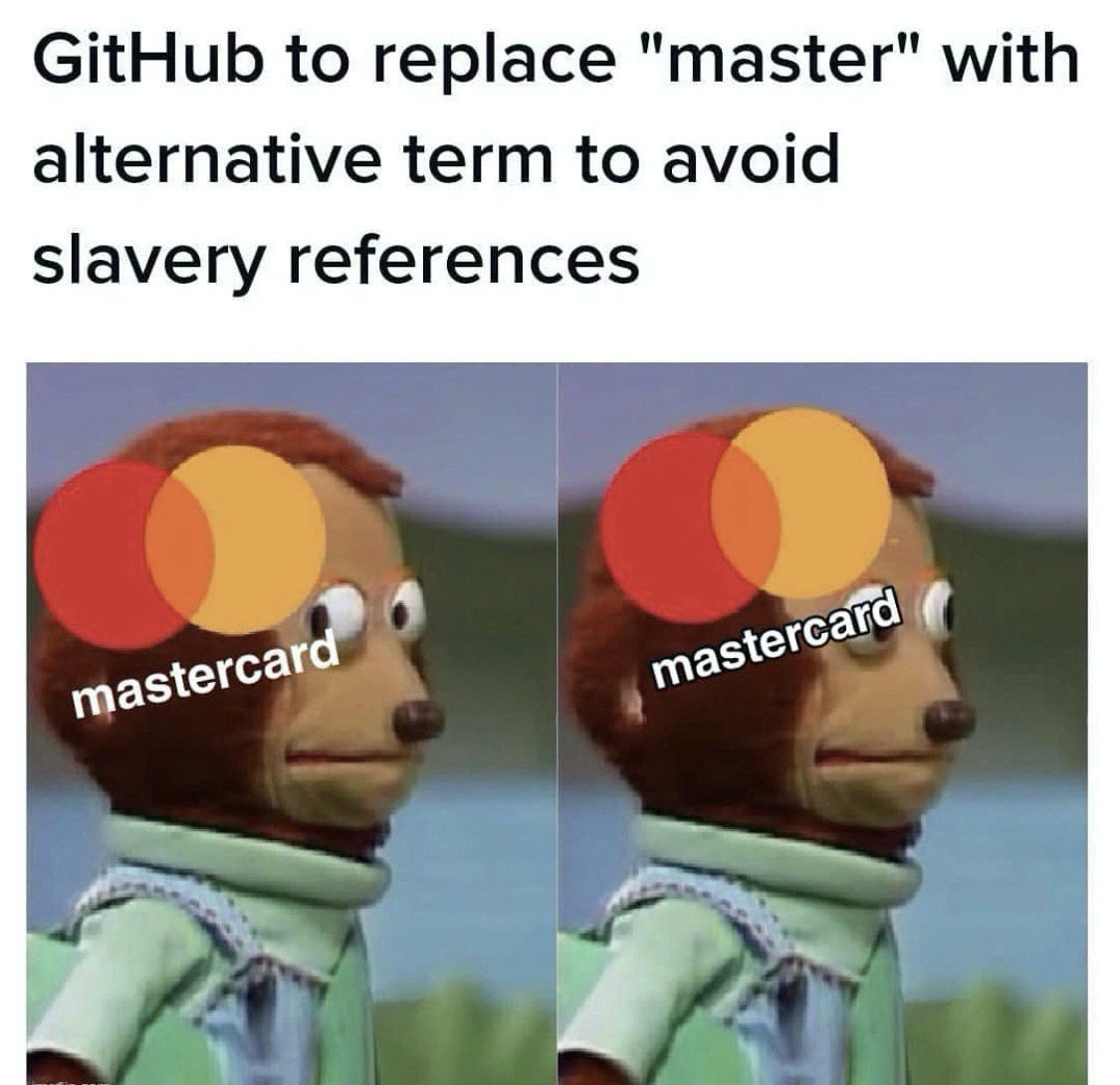
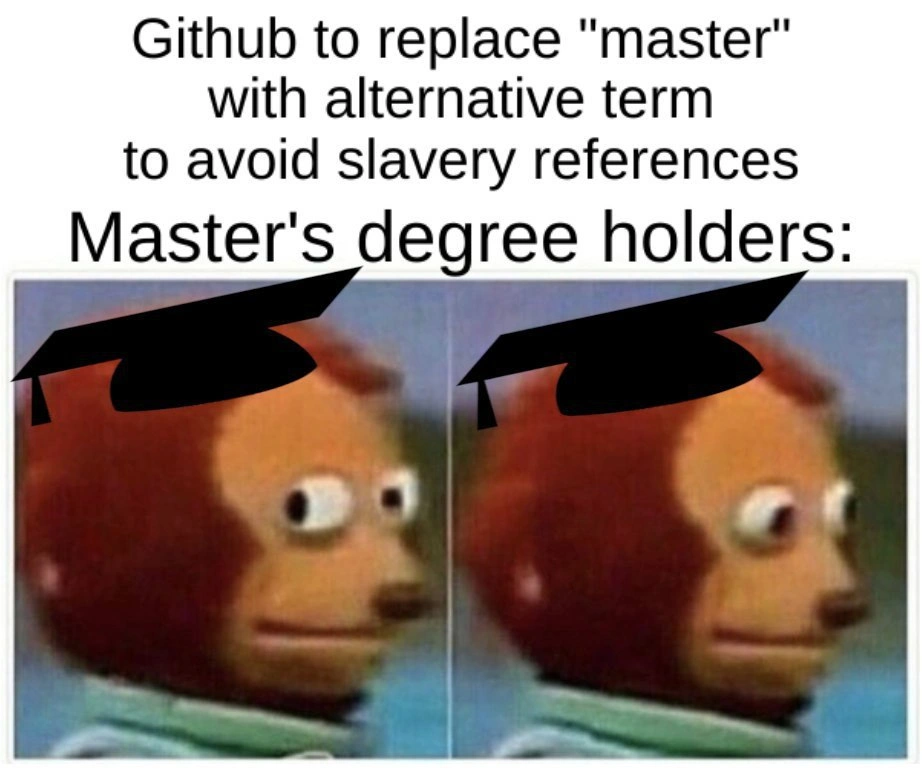
The image used is the awkward monkey side-eye meme, which is a very famous reaction image. It features a puppet (from a children’s show) that looks straight ahead and then suddenly looks to the side with wide eyes. This side-eye glance usually means “yikes… this doesn’t involve me, right?” or “I’m just going to pretend I didn’t hear that.” It’s often used when someone feels quietly concerned or caught in an awkward situation. In this meme, the puppet has a graduation cap photoshopped onto its head to clearly label it as a graduate (specifically, someone with a Master’s degree, since that’s the joke). The top text says GitHub is replacing “master” to avoid slavery references. Then just below it, it says “Master’s degree holders:” indicating that the people with that qualification are the ones represented by the monkey puppet.
In the first panel, the monkey puppet (Master’s grad) is facing forward, looking normal. In the second panel, he’s glancing sideways looking a bit alarmed or uncomfortable. This visual gag implies: Master’s graduates were just minding their own business, and now they’re glancing around like, ‘Wait, what? Do I need to worry about the word master now?’ It’s a lighthearted poke at the whole situation. The humor is very much developer humor: it assumes you know about the GitHub master-to-main change (VersionControlHumor) and also that you recognize the famous awkward monkey meme. It also touches on the classic joke that “naming things is hard” – here we are, as an industry, even debating the name of a Git branch! The tags like NamingThings and inclusive_branch_naming are directly relevant: naming stuff (like branches) is often tricky, and now we see even social considerations (inclusive language) coming into play.
So, to a junior dev or someone new to tech culture: the meme is funny because it points out a kind of silly misunderstanding. GitHub’s changing a technical term for good reasons, but that term “master” is so general that in another world (academia) it’s completely normal and even prestigious. Seeing those academic “Masters” feel momentarily threatened is absurd – obviously no one is renaming degrees – and that absurdity is what makes it a joke. It’s poking fun at how one word can live in two worlds: in one world it’s a problematic term we want to replace, and in another world it’s a mark of achievement. The side-eye monkey perfectly captures the “uh oh, am I next?” vibe in a very cartoonish, universally understandable way. This blend of software version control talk and everyday language mix-up is a great example of modern tech culture humor.
Level 3: Naming is the Hardest Problem
In mid-2020, GitHub announced it would change the name of the default branch in new repositories from master to an alternative (eventually main). This was part of a broader inclusive language initiative across tech – an effort to avoid terms that evoke master/slave imagery from historical slavery. Seasoned developers immediately recognized this as a classic case of naming things being one of the hardest problems in computer science (along with cache invalidation and off-by-one errors, as the joke goes). The meme riffs on this by highlighting an awkward ambiguity: “master” has many meanings, and context is everything. In software, master branch has long meant the primary code line – analogous to a mainline or trunk. But outside of tech, “master” often indicates a high level of expertise (Master’s degree, Master Jedi, chess grandmaster). So when GitHub moved to drop the term for sensitivity, developers chuckled that the change was technically minor yet culturally symbolic – and ripe for humor.
The awkward side-eye monkey puppet is a staple reaction meme, used here brilliantly. In the top panel, we see the news headline about replacing "master" to avoid slavery references. Below it, the caption “Master's degree holders:” sets up the punchline. The two images of the monkey puppet in a graduation cap (signifying people who hold a Master’s degree) show him first looking forward, then shifting his eyes sideways in uneasy confusion. It’s as if all the folks with advanced degrees suddenly wonder, “Uh… should we be worried about the word master in our diplomas?” The humor comes from the absurd juxtaposition – obviously a Master of Science isn’t referencing oppression at all, yet the blanket avoidance of the word “master” makes them momentarily self-conscious. This captures a real dynamic in the developer community at the time: a mix of earnest attempts to be more inclusive, and a bit of eye-rolling from those who felt it might be an over-correction or mere virtue signaling. Many senior devs had seen similar terminologies changed in other domains (databases moving from master/slave to primary/replica, Jenkins renaming master nodes to controllers, even real estate shifting from master bedroom to primary bedroom). So the meme lands as a wry observation that context matters – not every “master” is about slavery – and watching language evolve can be a bit comical and confusing.
Developers with years of experience might also recall the practical side of this change. Renaming the default branch meant updating CI pipelines, documentation, and mental habits. Some internal build scripts had "master" hard-coded, so those broke when the default became "main". Teams had to run commands like:
# Rename local 'master' branch to 'main'
git branch -m master main
git push -u origin main
git push origin --delete master # Delete old master on remote
to sync with the new naming. There was a flurry of pull requests and tweets about how to safely update branch names for existing projects. All that effort for what is, on the surface, a simple name change – something that highlights how entrenched a single word became in tooling and workflows. This lends a cynical chuckle to the veteran engineers: we can refactor an entire microservice architecture without blinking, but changing a default branch name triggers a cascade of tiny hassles (not to mention the bikeshedding over choosing the new name). Indeed, many joked that GitHub’s move “solved racism in tech, one branch name at a time” – a tongue-in-cheek way to say that while it's a positive gesture, it doesn’t fix deeper issues overnight.
To put the meme’s contrast in perspective, here’s how “master” was handled in different contexts:
| Context | Old Term | New Term (if changed) |
|---|---|---|
| Git default branch | master |
main (or user’s choice) |
| Database replication | master/slave | primary/replica, leader/follower |
| Real estate listing | master bedroom | primary bedroom |
| Academic degree | Master’s Degree | (unchanged) |
In the table above, the last line is the punchline: Master’s Degree stays the same. Master’s degree holders aren’t actually being asked to rename their hard-earned diploma to “Main’s Degree” or “Primary Degree” – that would be absurd. Yet the meme imagines those folks casting a suspicious glance, humorously personifying the overreach some feared. It’s a bit of developer humor (VersionControlHumor meets TechCulture) that underscores how tricky language and context can be. In true developer fashion, we’ve taken an industry trend (inclusive_branch_naming) and turned it into a self-referential joke about how literal our terminology can get. After all, naming things in tech is never just a trivial decision – it can literally spawn memes, debates, and the occasional side-eye from an academic primate in a cap and gown.
Description
A satirical meme that continues the commentary on GitHub's decision to replace the term 'master.' The top text announces, 'Github to replace "master" with alternative term to avoid slavery references,' followed by 'Master's degree holders:'. Below this text is the 'Awkward Look Monkey Puppet' meme, shown twice side-by-side. On each puppet's head, a black graduation cap (mortarboard) has been crudely edited on. The puppet first looks forward with a neutral expression, then darts its eyes to the side in a look of nervous concern. The meme humorously extends the logic of removing 'master' from tech jargon to academic qualifications, suggesting that people with Master's degrees should now be worried, thus satirizing the perceived 'slippery slope' of inclusive language initiatives
Comments
7Comment deleted
First they came for the master branch, and I did not speak out. Now they're coming for my Master's degree, and all I have to show for it is $100k in debt and a slightly more inclusive LinkedIn profile
Spent a week grep-ing 500k lines and every Jenkinsfile to purge “master” for “main,” then glanced at the wall and realized my Master’s diploma is now the biggest piece of legacy tech debt
Spent two years and $80k to earn a problematic title, but at least my git commits are now ethically sourced
When GitHub deprecated 'master' branches in 2020, they inadvertently created a merge conflict between version control semantics and academic credentials. Now every git push triggers an existential crisis for PhD candidates wondering if their thesis repository needs a diversity statement. The real irony? Most master's degree holders still can't resolve a three-way merge without Stack Overflow, regardless of what we call the branch
GitHub renames “master” to “main”: 5 minutes to merge the PR, 5 weeks to fix 300 Jenkinsfiles pointing at origin/master - meanwhile the Master’s grads quietly asking if their diploma needs a rebase
Renaming was one commit; unbreaking 47 CI jobs, 12 branch‑protection rules, and a vendor webhook that only listened to origin/master - that was the sprint
GitHub's master-to-main rename: the force-push that orphaned more senior dev aliases than a microservices refactor gone wrong