COVID-19.2 Release Notes: Bugs Fixed, Performance Improved
Why is this Bugs meme funny?
Level 1: Virus Updates Itself
Imagine you have a really nasty germ (virus) that makes people sick. Now pretend this germ just got a software-style update – like how a phone game gets an update to fix problems. The joke is saying: “Hey, the virus released a new version of itself! All its problems are fixed and it works even better now.” It’s funny in a cheeky way because we normally use that happy language for computer programs, not for a dangerous virus. It’s as if a villain became stronger and someone announced it like it’s great news: “Good news, the bad guy fixed his weaknesses and is even more powerful!” We laugh because it’s a silly, tongue-in-cheek way to talk about something scary, mixing our everyday tech talk with real life.
Level 2: Pandemic Patch Notes
Let’s break down the tech references. Versioning is how developers number software updates. A common scheme is semantic versioning, which uses three numbers like X.Y.Z (e.g., 2.1.5). - Major releases (X) add big features,
- Minor releases (Y) add smaller improvements,
- Patch releases (Z) fix bugs or security issues.
Here, “COVID-19.2” mimics a version number. COVID-19 is treated as the product name and “.2” suggests a minor update. (It’s like going from version 19.1 to 19.2.) In reality, viruses do mutate and change over time – almost like releasing new versions of themselves! The tweet jokes that this new mutation is a bug-fix release.
Now, in developer culture, release notes are the little descriptions of what changed in a new version. You’ve probably seen app updates on your phone that say something like “Bug fixes and performance improvements.” It’s a generic way to say “we made things better behind the scenes.” This meme copies that exact tone: “All bugs fixed. Improved performances.” It’s phrased like a bland GitHub commit message or an App Store update log. Every dev knows that line – it’s practically a running gag because it’s so non-specific!
- Bug (in software) means an error or flaw that makes a program behave in unexpected ways. (Fun fact: the term originated when engineers found a moth causing trouble in an old computer – a literal bug!)
- Performance in tech refers to how fast or efficiently something runs. Improving performance could mean an app loads quicker or uses less memory after the update.
In the meme’s context, the “bugs” are a play on words. In everyday language a bug can also mean a germ or virus that makes you sick (“catching a bug” = getting ill). So saying “All bugs fixed” implies the coronavirus worked out all its kinks. And “Improved performances” refers to the virus’s performance in the real world – according to the news, it can persist in air longer and stick around on surfaces. That’s like saying a program now runs longer on battery and is more robust under different conditions – except here it’s a virus lasting longer in the air and on objects, which is bad news for humans!
The humor lands because it’s dark humor mixing a serious situation with software engineer speak. In March 2020, people were anxious about the pandemic. Techies dealt with that stress by joking as if the virus was a software project on GitHub that just got updated. It’s a way of making the scary news feel momentarily like something from our familiar tech world. It’s labeled under PandemicHumor and DarkHumor for that reason: we’re laughing, but it’s a nervous, “this is so awful that I have to joke” kind of laugh. And only developers would describe a virus’s mutation in terms of a version control update log! By blending BugsInSoftware terminology with a real biological bug, the meme creates a nerdy inside joke: What if COVID had release notes?
Level 3: Semantic Versioning Gone Viral
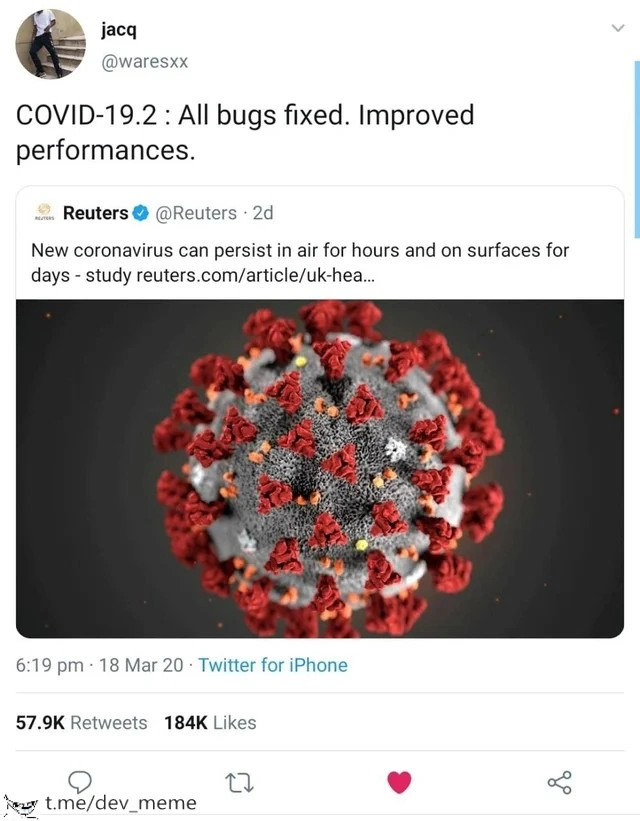
This meme mashes up software versioning culture with the grim reality of a pandemic. In the tweet, “COVID-19.2” is styled like a software version number (think semantic versioning: Major.Minor.Patch). By tagging the coronavirus with a “.2” update, it’s as if the virus just rolled out a point release. And the release notes? Pure developer lingo: “All bugs fixed. Improved performances.”
To an experienced developer, this is loaded with irony. In software, an update that fixes bugs and improves performance is normally great news. But here the “bugs” are literal – the virus itself is a “bug” (slang for a germ) that has fixed its weaknesses. The Reuters snippet underneath reports the new coronavirus can persist in air for hours and on surfaces for days. In other words, the virus just got more efficient at surviving. Describing this in upbeat patch-note language (“improved performance”) is darkly comedic. It’s a classic case of release notes irony: treating a deadly mutation like a routine software upgrade.
Seasoned devs also catch the joke that “All bugs fixed” is never really true – neither in code nor in biology. Any time we see “bug fixes and performance improvements” in an app update, we grin because we know some bugs always remain (or new ones appear). So saying a virus has all bugs fixed satirically implies it perfected itself. 😬 From a developer perspective, COVID-19.2 sounds like the virus had an active development team: squashing all its bugs (flaws) and refactoring itself to be faster and tougher. It’s a scary thought packaged as a nerdy joke.
There’s also a meta pun for the battle-scarred coders: the tweet about a virus went viral on Twitter (57.9K retweets!). That’s virality on two levels. Developers who remember the early 2020 chaos can relate to this dark humor. At the time, the world was discovering how resilient SARS-CoV-2 really was – and tech folks coped by joking in tech terms. This meme highlights an absurd truth: whether it’s code or a coronavirus, a “.2 release” with optimized performance is terrifying when it’s not running on a computer, but out in the world.
Description
A screenshot of a tweet from user 'jacq' (@waresxx). The tweet text reads, 'COVID-19.2 : All bugs fixed. Improved performances.' This text is a comment on an embedded Reuters tweet which has a microscopic image of the coronavirus and the headline, 'New coronavirus can persist in air for hours and on surfaces for days - study'. The meme's humor comes from applying software development versioning and release note terminology to a real-world virus. The joke treats the coronavirus as a piece of software, with 'COVID-19.2' being the next version. The phrase 'All bugs fixed. Improved performances' is ironic, as the 'improved performance' described by Reuters (persisting longer) is a negative trait from a human perspective. This is a classic example of gallows humor from the tech community during the early, uncertain days of the COVID-19 pandemic in March 2020

Comments
7Comment deleted
Treating a virus like a software release is peak developer humor. The next patch, COVID-19.3, will probably deprecate the human host API without any prior notice in the changelog
COVID-19.2 release notes: migrated from monolithic sneeze bursts to event-driven microdroplets - now horizontally scalable across open-plan offices
When the virus's product manager finally convinced leadership that "persistence layer optimization" was a critical feature for Q1 2020
Treating a pandemic like a semantic versioning release is peak developer brain - though I'm pretty sure this violates every principle of backward compatibility, and the rollback strategy is... questionable. At least they didn't push to production on a Friday
Virus changelog classic: 'improved performance' = now HA across air/surface clusters, zero TTL
COVID-19.2: classic “bug fixes and performance improvements” - they bumped R0 throughput, added sticky sessions on surfaces, and shipped a breaking change to the handshake protocol
Minor version bump that secretly turned ephemeral state into durable storage by increasing TTL - classic “performance improvements” slipped past the change advisory board