Skip to content
DevMeme
1966 of 7435
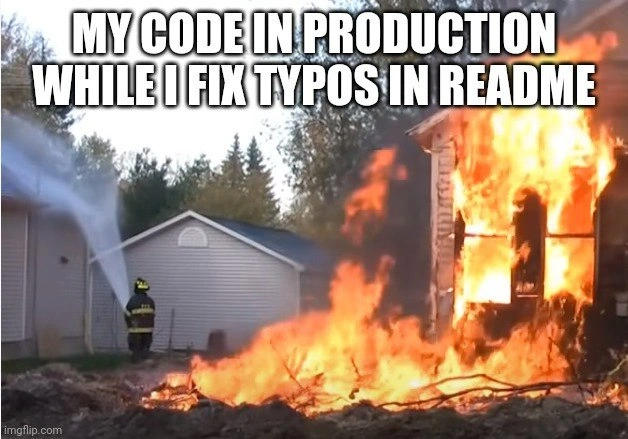
Fixing README typos during a production fire
OnCall ProductionIssues Post #2187, on Oct 22, 2020 in TG

Fixing README typos during a production fire

Why is this OnCall ProductionIssues meme funny?

Level 1: Cleaning During a Fire

Imagine your house is on fire – big bright flames everywhere, smoke filling the rooms. It’s an emergency! Now, picture that instead of grabbing a fire extinguisher or calling 911, you decide this would be a good time to fix a tiny spelling mistake on the welcome mat or maybe dust a shelf. Sounds silly, right? You’re ignoring the huge, urgent problem (the house fire) and doing something minor that isn’t important at that moment (tidying up a small detail). Obviously, fixing a little typo or cleaning a bit won’t put out a fire.

That’s exactly why this picture is funny. The burning house stands for a big crisis with the software (something is very wrong with a program that people are using, and it needs immediate attention, just like a fire). The person fixing “typos in the README” is like someone fussing over a small detail in documentation (basically a how-to guide or instruction manual for the software) while the actual software is crashing and burning. It’s a joke about doing the wrong thing at the wrong time. Everyone who sees the picture knows that the person should be focusing on the fire, so it looks ridiculous that they’re worried about a tiny mistake in text instead.

In simple terms: it’s funny because the person’s priorities are completely upside-down. Important thing on fire? Ignored. Unimportant tiny mistake? Getting all the attention. We laugh at the absurd mismatch. Even if you’re not a programmer, you know that when there’s a big problem, you should fix that first before bothering with the little stuff. This meme takes that common sense idea and flips it in a ridiculous way, which makes it instantly clear and comical. It’s like a cartoon showing someone sipping tea calmly in a burning room – you want to yell, “Hey, forget the tea, put out the fire!” But since it’s just a joke (and thankfully not real life), you can enjoy the silliness of the situation.

Level 2: Docs vs Disaster

Let’s break down the joke in simpler terms. Production is what we call the environment where the real application runs for users (the live website or service, for example). When code is in production, it’s out in the wild, serving actual customers. A failure or bug in production is a big deal – imagine the checkout system of an online store crashing on Black Friday. Developers often describe these urgent, critical problems as “production fires” because everyone has to drop everything and fight the fire to get things running again. Teams even have an on-call rotation, where one engineer is like a firefighter ready to respond if something breaks at 2 AM. This is where the term firefighting mode comes from: it means you’re in emergency fix-it-now mode, trying to extinguish the blaze of bugs or outages.

Now, on the other side of this meme, we have a README file. Almost every software project has a file named README.md (or just README) at the root of its repository. It usually contains documentation – instructions on how to set up the project, usage examples, maybe a project description. A typo in the README is just a small spelling or grammar mistake in that documentation. Fixing a typo in documentation is about as low-stakes and non-urgent as it gets; it doesn’t change how the code runs at all. It’s purely a cosmetic cleanup, often labeled as a trivial task. In fact, new developers or contributors often start by fixing typos or tiny docs issues just to make their first contribution.

So why is it funny that someone is fixing README typos while “my code in production” is on fire? It’s all about the contrast between critical failures and trivial tasks. A production outage (the house on fire in the image) is about the most urgent problem you can have in a software team – it’s like the kitchen stove bursting into flames. In that moment, everyone’s priority should be to put that fire out: find the bug, roll back the bad deploy, restart the server, etc. But in the meme, the developer is ignoring the blaze and focusing on a completely unrelated, minor thing: correcting documentation. That’s like noticing a typo in the fire evacuation manual while the building is actively burning around you. Sure, correcting the manual might help next time, but it does nothing to solve the immediate crisis! 🏚️🔥

This humorous scenario plays on a feeling many junior devs and even experienced ones can relate to: being overwhelmed by a problem and retreating to something comfortable. When you’re new or facing your first big ProductionIssue, you might not even know where to begin fixing it. The logs are spewing errors you don’t understand, senior engineers are scrambling, and you feel out of your depth. In those moments, working on a small, familiar task (like editing text or refactoring a tiny piece of code) can weirdly feel soothing. It’s a way to feel productive without engaging the scary problem head-on. This meme cranks that tendency up to 11 for comic effect. No one would literally prioritize documentation typos during an outage, but it captures that deer-in-headlights impulse: “I don’t know how to fix the fire, so I’ll tidy something I do know.”

The image of the burning house is a perfect metaphor used in DeveloperHumor circles. We often say “the build is on fire” or “the server is on fire” when systems are catastrophically failing. Here it’s visual: the entire house is engulfed in flames, representing the code/application in a state of total failure. The firefighter in the picture is tiny and ineffective – a nod to how our efforts feel when a massive bug is raging out of control. And what’s the developer doing? In the text, they claim to be fixing documentation. It’s intentionally absurd. It’s as if your car’s engine is overheating and instead of turning off the engine or calling a mechanic, you decide to adjust the seat cushions because they weren’t aligned. Clearly the critical issue (the fire, the broken engine) needs attention first.

This joke is very relatable in tech culture because prioritization is a constant challenge. There’s even an old saying about fiddling while Rome burns (doing something insignificant during a crisis) and a tech-specific phrase about yak shaving – where you get caught up in a chain of trivial tasks tangentially related to your goal. Here the developer isn’t even shaving the yak; they’ve wandered off to groom an entirely different yak! The meme exaggerates it to make us laugh, but it indirectly reminds us: Don’t lose focus on the real problems. When production is on fire, nothing else matters until that fire is out. Documentation fixes, code style clean-ups, minor refactoring – those are all great housekeeping tasks for later, once the emergency is resolved. Doing them in the middle of an outage is not just unhelpful, it’s comically ridiculous.

And yes, sometimes truth is stranger than fiction – ask around and you might actually hear a war story of a panicked newbie checking in a README update during an outage because they didn’t know what else to do. We chuckle about it now, but in the moment it’s face-palm territory. This meme takes that nugget of truth and cranks the dial to absurdity: ProductionFire blazing, developer utterly oblivious, proudly announcing their documentation is now typo-free. It’s a cautionary tale wrapped in a joke, and that mix of “oh no, I feel seen” and “thank goodness that’s not me (this time)” is why people find it so funny and shareable.


Level 3: Fiddling While Prod Burns

Picture the scene: a production deployment has gone horribly wrong – the live servers are basically a four-alarm fire. Errors are flying everywhere, users are panicking, logs are blazing red with exceptions. It's the classic ProductionIncident nightmare. In dev ops lingo, we even call this "firefighting": drop everything, fix the burning issue. Yet here, the meme’s developer decides, “Now’s a good time to correct a couple typos in the README.” 🤦‍♂️ Talk about misaligned priorities! The house (production) is literally on fire, and someone’s proudly polishing the doorknobs (documentation). This stark contrast is the joke – it highlights a prioritization fail so absurd it hurts (and yes, it's painfully relatable).

In the image, a lone firefighter sprays a feeble hose stream at a raging inferno. That’s basically our on-call engineer in “firefighting mode,” except instead of grabbing a fire hose (debugger, hotfix, rollback), they're holding a tiny water pistol (a trivial doc fix). The burning_house meme template exaggerates how out-of-control the production bug is – an entire house engulfed in flames – while the dev’s response is comically ineffective. It’s like bringing a squirt gun to a data center fire.

Why is this so funny to seasoned developers? Because we’ve all seen some version of this scenario. Maybe it’s 3 AM and your code just caused a major outage, but you’re frantically cleaning up code comments or tweaking documentation as a bizarre coping mechanism. It sounds crazy, but in a crisis, doing anything that feels productive can be a psychological lifeline. Instead of staring into the abyss of a complex production bug, some devs instinctively gravitate to an easy, safe task they know they can handle – like fixing a spelling error. It’s a form of productive procrastination: “Sure, the site is down, but at least our project README looks spotless!” 😅

There’s also a slice of dark DeveloperHumor here about team dynamics. Ever worked at a place where a critical bug is wreaking havoc and some oblivious colleague is pushing a cosmetic update? The meme nails that absurdity. It’s essentially the coding equivalent of rearranging deck chairs on the Titanic or deploying on Friday fiddling while Rome burns. The caption’s all-caps text (“MY CODE IN PRODUCTION WHILE I FIX TYPOS IN README”) mimics the frantic shouting of disbelief we all feel when witnessing this. We’re laughing at the sheer ridiculousness of prioritizing a minor documentation tweak over a ProductionBug that's burning money and user trust by the minute.

A cynical veteran might quip: “Yep, that README typo fix will definitely put out the production fire… Not.” The humor lands because it’s a shared pain point – every developer, from junior to senior, recognizes that sinking feeling when something mission-critical breaks. And we also recognize the ironic temptation to hide in a comfortable, menial task when the real problem seems overwhelming. The meme exaggerates it to absurdity: instead of SSHing into servers or rolling back a bad deploy, the dev is doing the digital equivalent of marshmallow roasting in the blaze. It’s funny, it’s pathetic, and it’s oh-so-relatable.

To put it in perspective, here’s a pseudo-code summary of the situation:

def handle_production_fire():
    if production.is_burning():
        print("🔥 Everything is on fire in prod! Panic!")
        fix_readme_typos()  # do something (utterly useless) to feel in control
    else:
        print("Production is fine. Carry on with minor tasks.")

In reality, of course, no sane engineer truly believes a documentation patch will fix a live outage. The meme isn’t literal; it’s using exaggeration to poke fun at our occasional lack of focus. It’s a satirical take on those times when developers (or their managers) worry about the wrong thing at the worst possible moment. The veteran engineers among us chuckle (or cringe) because we’ve been in war rooms where someone bikeshedded on minor issues during a crisis. OnCallHumor often highlights this exact absurdity: the database is leaking data, but someone’s obsessing over code linting or a UI pixel shift. The house is burning, and they’re watering the rose bushes.

In short, the meme resonates because it captures a universal tech DeveloperPainPoint: the disconnect between what’s urgent and what’s comfortable. It’s a cheeky reminder that when production is on fire, maybe save the README proofreading for later. Fix the fire first – then you can dot your i’s and cross your t’s in the documentation. Priorities, people! 🔥🚒🧯


Description

This meme uses the 'Firefighter spraying house' template. It shows a house completely engulfed in flames, symbolizing a critical failure in the production environment. In the foreground, a firefighter is calmly spraying water on a nearby, perfectly fine shed, ignoring the inferno. The text overlay reads, 'MY CODE IN PRODUCTION WHILE I FIX TYPOS IN README'. The visual metaphor is a powerful and humorous critique of developer procrastination and misprioritization. It highlights the common behavior of focusing on trivial, low-impact tasks (like fixing typos in documentation) to avoid tackling a major, stressful crisis (a 'production fire'). For senior engineers, it's a painfully relatable commentary on bikeshedding, denial, and the sometimes absurd allocation of resources in a high-pressure situation
Comments

7
Anonymous ★ Top Pick Ah, the 'looks good on the commit history' approach to firefighting. The README will be pristine for the post-mortem
  1. Anonymous ★ Top Pick

    Ah, the 'looks good on the commit history' approach to firefighting. The README will be pristine for the post-mortem

  2. Anonymous

    The pager’s melting down with “GLOBAL P1: 500s everywhere,” and I’m in review saying, “LGTM - once we s/whilst/while in the README.”

  3. Anonymous

    After 20 years in tech, I've learned that the only thing more permanent than a TODO comment is a typo in documentation that somehow made it through three code reviews, two release cycles, and is now immortalized in the git history while the actual service is returning 500s

  4. Anonymous

    The classic senior engineer dilemma: your monitoring dashboard is painting everything red, PagerDuty is having a seizure, and the CEO is asking why the site is down - but that missing Oxford comma in the README's installation instructions has been bothering you for three sprints, and by god, you're going to fix it right now. After all, what's a complete system outage compared to the existential horror of inconsistent markdown formatting? At least when the postmortem comes, your documentation will be grammatically impeccable

  5. Anonymous

    Prod’s a five‑alarm Sev‑1 while I merge a README typo - if a docs‑only deploy isn’t safe, the real incident is our architecture

  6. Anonymous

    Prod spewing 503s and melting under load, but can't merge until that 'teh' becomes 'the' in README.md

  7. Anonymous

    SEV1 is raging, but at least my docs-only PR keeps our DORA metrics green

Use J and K for navigation