Skip to content
DevMeme
1965 of 7435
A Misguided Analogy in App Development
QA Post #2186, on Oct 22, 2020 in TG

A Misguided Analogy in App Development

Why is this QA meme funny?

Level 1: No Bunnies Required

Imagine you created a new game on your phone, and someone asked, “Did you test it on your dog to make sure it works?” You would probably laugh and say, “No way – dogs can’t play phone games! I had my friends try it out instead.” That’s the kind of silly mix-up happening here. The boss in the picture is confused and thinks the team should test a computer program the same way you might test a new medicine or shampoo (which sometimes involves trying it on animals). We all know that’s not how it works: an animal can’t use an app or tell you if a game is fun. To check if an app is good, you let people use it or run it on a computer – no bunnies or monkeys needed! It’s funny in the meme because the boss took the idea of “product testing” way too literally, and everyone realizes how absurd that is. The team has to remind him, in essence, “Our product is just software, so we only need humans and computers to test it.” The big laugh comes from seeing someone mix up something so obvious, making it a lighthearted joke about understanding what we really do when we test apps.

Level 2: Apps, Not Shampoo

In this meme, a technical team is in a meeting with their boss, talking about testing their product. However, a funny mix-up happens. The team is referring to testing in the context of software (meaning they run the app to find any problems), but the boss misunderstands and thinks of animal testing like a shampoo company might do. The dialogue goes like this: an employee says they should stop testing on animals, and the boss responds by mentioning shampoo companies. Finally, the developer clarifies that this doesn’t apply to them, essentially saying, “That’s not relevant for us because our product is an app, not a shampoo.” The phrase “apps, not shampoo” sums it up — they build software applications, not consumer goods, so of course they wouldn’t (and couldn’t) test on animals.

Let’s break down the terms and context in simple words:

  • App: Short for application, meaning a software program (like a mobile app on your phone or a game on your computer). It’s digital – just code and pixels – not something you can physically touch like a bottle of shampoo.
  • Testing (in software): When developers or QA engineers check if an app works correctly. They look for bugs (mistakes or errors in the software) by running the app, clicking buttons, entering data, and seeing if anything goes wrong. They also use automated tests (special programs that simulate users and test parts of the app automatically). This whole process is called quality assurance (QA) or the QA process. It’s done with computers and people – no animals involved at all.
  • Animal testing (in labs): A practice mainly in industries like cosmetics or medicine. For example, a shampoo company might test a new formula on a rabbit or another animal to make sure it doesn’t hurt the animal’s skin or eyes before it’s approved for humans. It’s a physical experiment: applying a substance to an animal under controlled conditions to see what happens. People often call the animals used “guinea pigs” (even if they’re actually rabbits or mice) because a guinea pig is a common test animal. This kind of testing has nothing to do with making or testing software, and it raises ethical issues, which is why you hear about “cruelty-free” products that don’t do this.
  • Boss / Stakeholder: The boss here represents a non-technical manager, someone in charge who doesn’t have a software background. A stakeholder is just anyone who has an interest in the project (it could be a manager, a client, etc.). If they aren’t familiar with tech terms, they might misunderstand things. In the meme, the boss hears “testing our product on animals” and takes it literally. He doesn’t realize the team is talking about software testing, so he brings up an example he knows (shampoo companies testing on animals), which is a totally different context.
  • QA testers: These are team members who specialize in testing the app to catch bugs. They try to use the app in all sorts of ways a normal user would (and some ways a user might not even think of) to see if it breaks or behaves weirdly. They report problems so developers can fix them. QA testers might also write automated test scripts to check the software. Think of them as professional “product checkers” for apps. And just to be clear, they are the ones using the app for tests – there are no bunnies, mice, or any real animals doing this work!

Here’s a quick comparison to highlight the difference between testing software and testing a physical product:

Testing a software app Testing a shampoo product
Done by people (QA engineers) and by computers running automated test scripts. Done on animals (like lab rabbits or mice) by lab technicians/scientists.
Purpose: to find and fix bugs in the code; ensure the app runs without errors and is user-friendly. Purpose: to check safety for humans (make sure the product doesn’t cause rashes or harm) before selling.
How: run the app on phones or computers, simulate what a user would do (click buttons, input data), see if any part glitches. How: apply the product on an animal’s skin or eyes in a lab, then observe and measure the animal’s reaction.
Result: a list of software bugs or issues for developers to fix; a better, more reliable app for users. Result: data about whether the product is safe for humans (for example, no irritation), or if it has side effects that need addressing.
Involves: software, devices, and human testers. No physical harm – at worst the app can crash, but nobody (and no animal) is hurt. Involves: lab equipment, test cages, and live animals. There’s potential harm to animals, which is why this kind of testing is controversial and regulated.

In the meme, everyone in the room works at a company that “makes apps.” That means their product is a piece of software you might download or use on a device, not something like a shampoo you put on your hair. So when they talk about “testing the product,” they mean running the app to check for technical issues or bugs. The boss’s reply about shampoo companies shows he was thinking of the wrong kind of “testing.” It’s as if he thought their software needs to be lab-tested on bunnies, which sounds pretty crazy if you picture it. (Imagine trying to get a rabbit to navigate a smartphone app – clearly impossible!) The line “...we make apps” is the team’s gentle way of saying, “Our product is software, not shampoo, so that idea doesn’t make sense.”

The heart of the joke is that the boss mixed up two completely different worlds. It’s a humorous example of how non-technical folks might misunderstand tech jargon. For a new developer or someone just learning about QA, it’s also a neat reminder: software testing is all about computers and people, whereas animal testing is something that happens in labs for physical products. The meme exaggerates the mix-up to make us laugh. Essentially, the team is telling their boss, “Don’t worry, no rabbits are needed to test our app – just some good old-fashioned code checks and maybe a few human beta users!” And if you’re just starting out in tech, you’ll quickly learn that communicating these basics is part of the job. It’s funny and a bit endearing that the boss got it so wrong, and the developers’ reaction is a mix of surprise and amusement. After all, anyone in software can assure you: no lab animals were harmed in the testing of this app!

Level 3: Bugs vs Bunnies

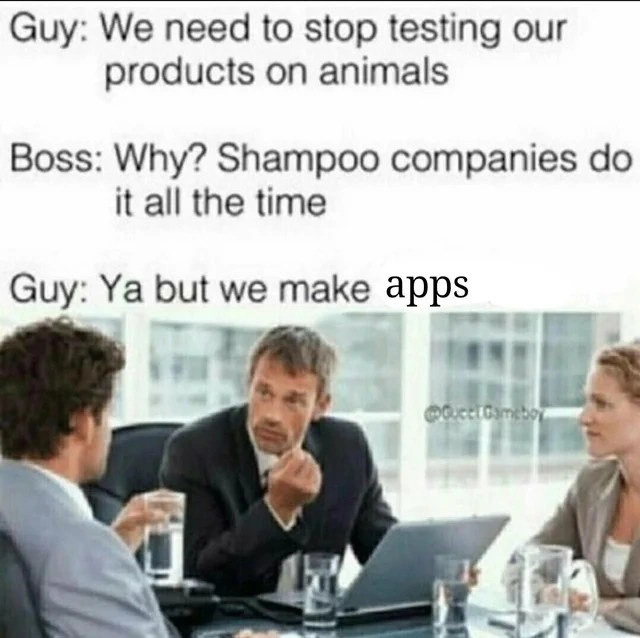
For seasoned software engineers, scenes like this evoke both laughter and a knowing sigh. The image shows a typical boardroom meeting where a major stakeholder misunderstanding unfolds. One developer deadpans, “We need to stop testing our products on animals.” The boss, completely missing the context, replies, “Why? Shampoo companies do it all the time.” Finally, the exasperated team clarifies, “...Ya, but we make apps.” The punchline “we make apps” lands with a thud of obviousness. By injecting a ridiculous mix-up into a formal work discussion, the meme turns a dry meeting scene into comedy. It’s a perfect illustration of how technical talk can derail into absurdity when interpreted through a non-technical lens. In other words, this meme is a spot-on blend of TestingHumor and MeetingHumor, poking fun at how corporate culture can collide with tech realities.

As every developer knows, testing a software product has nothing to do with lab critters. Quality Assurance (QA) for an app means using software tools and human-driven processes to check that everything works correctly. The team writes test cases, runs the app on devices or simulators, and hunts for software bugs (glitches in the code). There’s no cage of lab rats clicking on phones in the back room! The boss’s reference to “shampoo companies do it” shows he’s stuck in a physical product mindset. In industries like cosmetics or pharmaceuticals, companies historically perform animal testing – for example, applying a new shampoo to rabbits to ensure it doesn’t cause rashes before selling it to people. But that practice belongs to a completely different world. Our product is digital; you can’t smear an app on a bunny’s fur or feed a piece of software to a mouse. The developer’s polite rebuttal “we make apps” is basically saying, “hey, our work is software, not shampoo – totally different QA process!” It draws the line between software QA and lab testing, highlighting how wildly the boss missed the mark.

The absurdity shines through when you imagine it literally: a confused lab rabbit trying to navigate a mobile app’s UI, or a chimpanzee in a lab coat fumbling with the latest smartphone game. The mental image is hilariously absurd, which is why the whole room (and the meme’s audience) wants to laugh. The meme uses a real office photo with serious-looking, suit-wearing colleagues – a classic boardroom meme setup – to ground this crazy scenario in a familiar corporate scene. That contrast makes the punchline even funnier. It’s technical humor born from a huge context mismatch. Seasoned engineers feel the pain here: it’s not uncommon in corporate culture for well-meaning managers to apply the wrong analogy to a tech problem. This image just pushes it to the extreme. (It’s the kind of mix-up you’d half-expect in a Dilbert comic strip about a clueless manager.) By exaggerating the scenario, the meme gets a laugh while spotlighting a real communication gap. We’ve all been in that meeting where you have to gently explain something basic, and this meme captures that moment as classic developer humor.

Interestingly, tech jargon itself is full of metaphorical “creatures” that could mislead outsiders. We talk about software bugs, but nobody calls an exterminator – it’s just our slang for defects in code (fun fact: the term bug started when a real moth jammed an early computer in 1947, but ever since, it means an error, not an insect). There’s also “monkey testing,” a playful term implying random poking at an app like a monkey might do; rest assured, no actual monkeys are on the payroll for that – it’s humans or scripts doing unpredictable actions to see if the app breaks. Developers might say “let’s get a guinea pig for this feature” meaning an eager beta user, but that’s a willing human tester, not a literal guinea pig. We even practice rubber duck debugging – explaining our code to a toy duck to help find flaws – which shows how fond we are of quirky metaphors (at least a rubber duck can’t file bug reports!). The key is, all these are creative QA techniques that use colorful language, not real animals. The boss in the meme clearly took the idea of “testing our product” far too literally, as if the QA team runs a science lab full of bunnies. That literal interpretation is what makes the scenario so comically ridiculous to anyone who knows how QA testing actually works.

At the end of the day, software testing deals with bugs, not bunnies. No actual animals are needed — just skilled QA engineers and good testing practices. This meme hilariously drives that point home for every developer who’s had to say, “No, boss, that’s not how it works.”

Description

The meme displays a three-part text exchange over a stock image of a serious business meeting. The dialogue reads: 'Guy: We need to stop testing our products on animals', 'Boss: Why? Shampoo companies do it all the time', 'Guy: Ya but we make apps'. The image shows a man in a suit looking perplexed, perfectly capturing the moment of realization. The humor stems from the absurd application of the ethical debate around animal testing in the cosmetics industry to the world of software development, where it is nonsensical. This joke highlights the disconnect that can exist between management and technical teams, satirizing managers who apply flawed, real-world analogies to complex tech problems without understanding the context. For experienced developers, it's a relatable jab at corporate meetings where bizarre, out-of-touch suggestions are made with complete seriousness
Comments

8
Anonymous ★ Top Pick My boss once suggested we improve database performance by defragmenting the SSDs. Some analogies just don't have pointers to the right memory address
  1. Anonymous ★ Top Pick

    My boss once suggested we improve database performance by defragmenting the SSDs. Some analogies just don't have pointers to the right memory address

  2. Anonymous

    Exec: “I thought we agreed to stop all animal testing - so why are we doing a canary release?” Me: “Because ‘silently sacrifice 5 % of production traffic’ didn’t survive user acceptance testing either.”

  3. Anonymous

    After 20 years in tech, the scariest bug I've encountered isn't a race condition or memory leak - it's when leadership thinks 'dogfooding' means actual canines and starts budgeting for veterinary consultants instead of beta testers

  4. Anonymous

    The real joke is that 'testing in production' isn't just a meme - it's a deployment strategy. At least shampoo companies have the decency to use lab rats; we just ship to prod on Friday afternoon and let our users discover the edge cases. Who needs a QA environment when you have monitoring dashboards and a PagerDuty subscription?

  5. Anonymous

    Shampoo tests on rabbits for safety; we A/B test on users and blame the frontend

  6. Anonymous

    We already do animal testing - it's called dogfooding; for apps we use canary releases, not beagles

  7. Anonymous

    We don’t test on animals - we ship a canary to prod, call it observability, and let the error budget judge us

  8. @Bender666 5y

    Apps should be tested on animals. Users are like apes. Заявки должны быть протестированы на животных. Пользователи, как обезьяны.

Use J and K for navigation