Skip to content
DevMeme
5090 of 7435
The Principal Engineer's True IDE
Career HR Post #5570, on Oct 11, 2023 in TG

The Principal Engineer's True IDE

Why is this Career HR meme funny?

Level 1: Coding vs. Planning

Imagine you’re on a soccer team and the coach is in a meeting with the players. The coach asks, “What equipment do our best players use to play?” One player says, “They use fancy soccer shoes.” Another says, “They use a really good soccer ball.” But then a cheeky kid blurts out, “Our coach mostly just uses a clipboard and a whistle!” In this story, the coach’s face turns red with anger because the kid basically said the coach isn’t playing at all – he’s just planning and bossing from the sidelines. This is funny in a simple way: the coach asked about playing gear, but the joke answer was a clipboard, which is for planning, not playing. It’s like pointing out that the coach (or boss) doesn’t do the actual fun work on the field. The reason we laugh is the surprise and a bit of truth: the higher-up person (coach or principal engineer) is doing more guiding and organizing than hands-on work. The coach might not appreciate hearing that, just like the boss in the meme didn’t like the “Jira” answer. The humor comes from calling out that the “big important person” spends more time on planning tools (a whistle and plans, or Jira in the meme) than doing the actual work (playing soccer or writing code). It’s a playful way to say the boss figures are more about paperwork and planning while everyone else expected to talk about the real tools for the job.

Level 2: Issue Tracker vs Code Editor

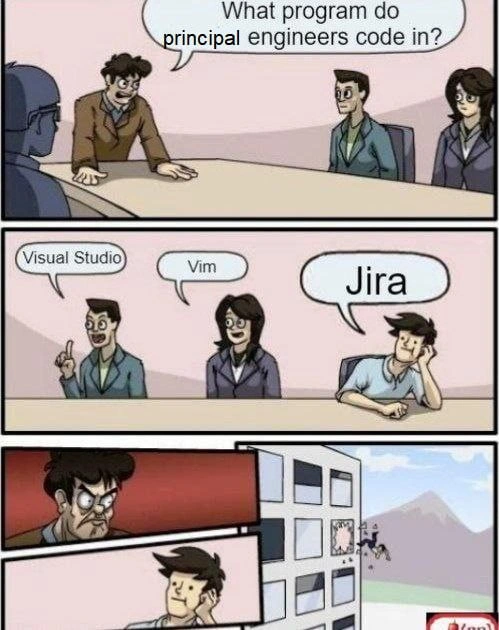
Let’s break down the joke in simpler terms. In the meme’s four-panel boardroom scene, a boss asks his team: “What program do principal engineers code in?” He’s basically asking, “Which software do our top engineers use to write code?” Two employees give reasonable answers. One says “Visual Studio”, which is a popular IDE (Integrated Development Environment) where developers write and test code (especially common for languages like C# on Windows). Another employee answers “Vim”, which is a text-based code editor that programmers use in a terminal window – it’s old-school but very powerful if you learn its keyboard commands. These two answers make sense because principal engineers, being very experienced, might indeed use advanced tools or their favorite editors to code. However, the third colleague, looking bored and unimpressed, replies with “Jira.” Now, Jira is not a coding program at all – it’s an issue tracking tool. Developers and project managers use Jira to track work items like bug reports, feature tasks, and user stories. It’s basically a big to-do list system for software teams: you create tickets (entries) for work that needs to be done, and you move those tickets through stages (like “To Do”, “In Progress”, “Done”). Jira helps coordinate who is doing what and the status of each task. So when someone says a principal engineer “codes in Jira,” they’re joking that the engineer spends all day updating tickets and meeting project goals in Jira, instead of writing actual code in an editor.

This is funny because a principal_engineer is one of the top technical roles – usually a very senior developer who has years of coding experience. You’d expect them to be working on the hardest coding problems. But in many companies, principal engineers also have a lot of management and coordination duties (even if they aren’t people managers). They review architecture, plan project timelines, mentor teams, attend strategy meetings – and yes, update Jira boards to track all that work. The meme exaggerates this reality: the colleague blurting out “Jira” suggests that principal engineers might as well be using a project management tool as their main “program,” implying they hardly code in the traditional sense. The boss’s reaction in the meme is a dramatic cartoon: in panel 3 his face turns red with anger, and in panel 4 he literally throws the “Jira” guy out of the window. This final panel is part of a known throw_out_window_gag in meme culture (derived from a classic comic strip format) used to show someone getting kicked out for a silly or unwelcome comment. The company setting and the Management_PMs vibe of the first panel set the stage – it looks like a management meeting. The first two answers (“Visual Studio” and “Vim”) are the kind of serious replies a boss might expect, naming actual coding environments. The third answer (“Jira”) is a snarky twist – basically a MeetingHumor / ManagementHumor punchline that points out a truth people often joke about. In tech CorporateCulture, it’s commonly observed that as engineers become more senior, they end up in more Meetings and spend less time coding. Jira becomes one of their primary tools for day-to-day work (tracking all those projects), whereas a junior developer might be coding in an IDE all day. The meme is using that contrast to get a laugh. The colleague who said “Jira” is essentially mocking the situation, and everyone familiar with software teams gets the reference. The humor comes from the mix-up (Jira isn’t for coding!) and the reality behind it (principal engineers dealing with Jira more than code). It’s a lighthearted way to poke fun at the SeniorEngineerStruggles of moving up the ladder – you gain responsibility, but lose keyboard time. And judging by the boss’s furious reaction, it’s the kind of joke you should probably only make in memes, not in front of your actual manager!

Level 3: Ticket-Driven Development

At the highest level, this meme skewers the reality that principal engineers often spend more time managing tasks than writing code. The manager’s question – “What program do principal engineers code in?” – sets up an expectation of some advanced IDE or editor. One eager colleague answers Visual Studio, another confidently says Vim. These are real coding tools: Visual Studio is a heavy-duty, feature-rich IDE (popular for C# or C++ on Windows), while Vim is a classic text editor revered by power-users for its keyboard-only efficiency. But then the bored colleague deadpans “Jira”, naming an issue-tracking tool as if it were a coding environment. This punchline lands like a truth bomb in enterprise engineering culture. Principal engineers, especially in big companies, are notorious for “coding” in Jira – meaning their day is filled updating tickets, triaging issues, and tweaking backlog items rather than cranking out code. It’s a sardonic take on career_progression_satire: as you climb the technical ladder, you’re rewarded with less keyboard time and more planning, meetings, and administrative overhead. The humor resonates with senior developers because it reflects a shared pain: trading the text editor for the ticket tracker. In a sense, it’s highlighting issue_tracking_over_coding as a modern affliction of senior technical roles.

From an experienced viewpoint, this joke cuts deep into CorporateCulture. Everyone laughs (perhaps a bit bitterly) because they’ve seen the principal engineer who hasn’t opened an IDE in weeks – too swamped with design docs, sprint plans, and JIRA boards. ManagementHumor and MeetingHumor abound here: the meme exaggerates how higher-ups get sucked into endless planning and status meetings. The manager’s enraged face in panel 3 and the defenestration in panel 4 (the classic throw-out-the-window gag) amplify that tension. It’s an absurd illustration of how calling out uncomfortable truths is received in a stuffy boardroom. The third colleague’s answer “Jira” is basically saying: principal engineers don’t really code, they just supervise through Jira. That’s both hilarious and uncomfortably accurate in many organizations. The boss’s over-the-top reaction – tossing the truth-teller out of a skyscraper – parodies what might happen if you voice such cynicism in real life (figuratively, one hopes!). This boardroom_meme_template has been a staple for depicting out-of-touch managers: here the manager can’t handle the brutal honesty. The meme works because it’s DeveloperHumor with a dark twist – it takes a jab at the system that turns expert coders into overworked project coordinators. Seasoned devs smirk at this because they’ve lived it: the longer your title, the more your screen fills with dashboards and ticket queues instead of code. In other words, “coding in Jira” is the veteran engineer’s lament – a wry acknowledgment that sometimes promotion means swapping your Visual Studio or Vim for Jira tickets.

Description

A three-panel comic strip meme in the 'Boardroom Suggestion' format. In the first panel, a manager at a conference table asks his team, 'What program do principal engineers code in?'. In the second panel, two employees offer standard answers: 'Visual Studio' and 'Vim'. A third, slouched and bored-looking employee chimes in with 'Jira'. The third panel shows the manager with an angry expression, followed by an external view of the office building as the third employee is thrown out of a window. The meme humorously and cynically points out a common reality in the tech industry: as software engineers advance to very senior roles like Principal Engineer, their day-to-day work often shifts from hands-on coding to architectural planning, mentorship, and project management, which means they spend a significant amount of time working in project management software like Jira rather than in a traditional code editor or IDE
Comments

15
Anonymous ★ Top Pick A principal engineer's main function is to translate business ambiguity into Jira tickets with enough technical jargon that both sides feel understood but neither is accountable for the outcome
  1. Anonymous ★ Top Pick

    A principal engineer's main function is to translate business ambiguity into Jira tickets with enough technical jargon that both sides feel understood but neither is accountable for the outcome

  2. Anonymous

    Career progression decoded: Junior picks a text editor, Senior picks a language, Principal picks which JIRA filter counts as “coding hours.”

  3. Anonymous

    The painful truth about principal engineers: they've transcended mere IDEs and text editors to achieve enlightenment through the sacred art of moving tickets across swimlanes while their muscle memory for actual coding slowly atrophies into phantom keyboard shortcuts

  4. Anonymous

    The tragic career arc of every principal engineer: You spend years mastering vim keybindings and IDE shortcuts, only to discover your primary development environment is now Jira's rich text editor, where Ctrl+C doesn't even work half the time. Your most complex 'code review' is now parsing whether 'blocked' means actually blocked or just 'I haven't started yet,' and your biggest architectural decision is choosing between 'High' and 'Highest' priority. The real kicker? You're still expected to be the technical authority, but your last meaningful commit was three sprints ago, and it was updating the README

  5. Anonymous

    Principal engineers don't code in Vim - they refactor Jira epics until the velocity chart looks optimized

  6. Anonymous

    At Principal level, your IDE is Jira, your language is JQL, and your CI/CD is a calendar invite

  7. Anonymous

    By the time you hit principal, the hot path isn’t your vimrc; it’s a JQL query - most diffs are rewritten as roadmaps and merged in steering committee

  8. @s2504s 2y

    no matter how many features you have created. the main thing is how many tickets you moved to the status completed 😔

  9. @mpolovnev 2y

    I use Slack at least twice more than IDEA at work

  10. @callofvoid0 2y

    another crypto ad ?

    1. dev_meme 2y

      Removed that spam

  11. @slavasav 2y

    This is not true at all, programmers at staff+ level don't even touch Jira with a stick

    1. @SamsonovAnton 2y

      What do they do then? Just coding? Who is responsible for tracking their tasks?

  12. @slavasav 2y

    Coding?? No, the only thing they code in is Google docs/sheets.

  13. Deleted Account 2y

    EMACS!!!!! <3

Use J and K for navigation