Skip to content
DevMeme
5089 of 7435
RAM of Ages Past: A Tribute to Deprecated Hardware
TechHistory Post #5569, on Oct 11, 2023 in TG

RAM of Ages Past: A Tribute to Deprecated Hardware

Why is this TechHistory meme funny?

Level 1: RAM in Peace

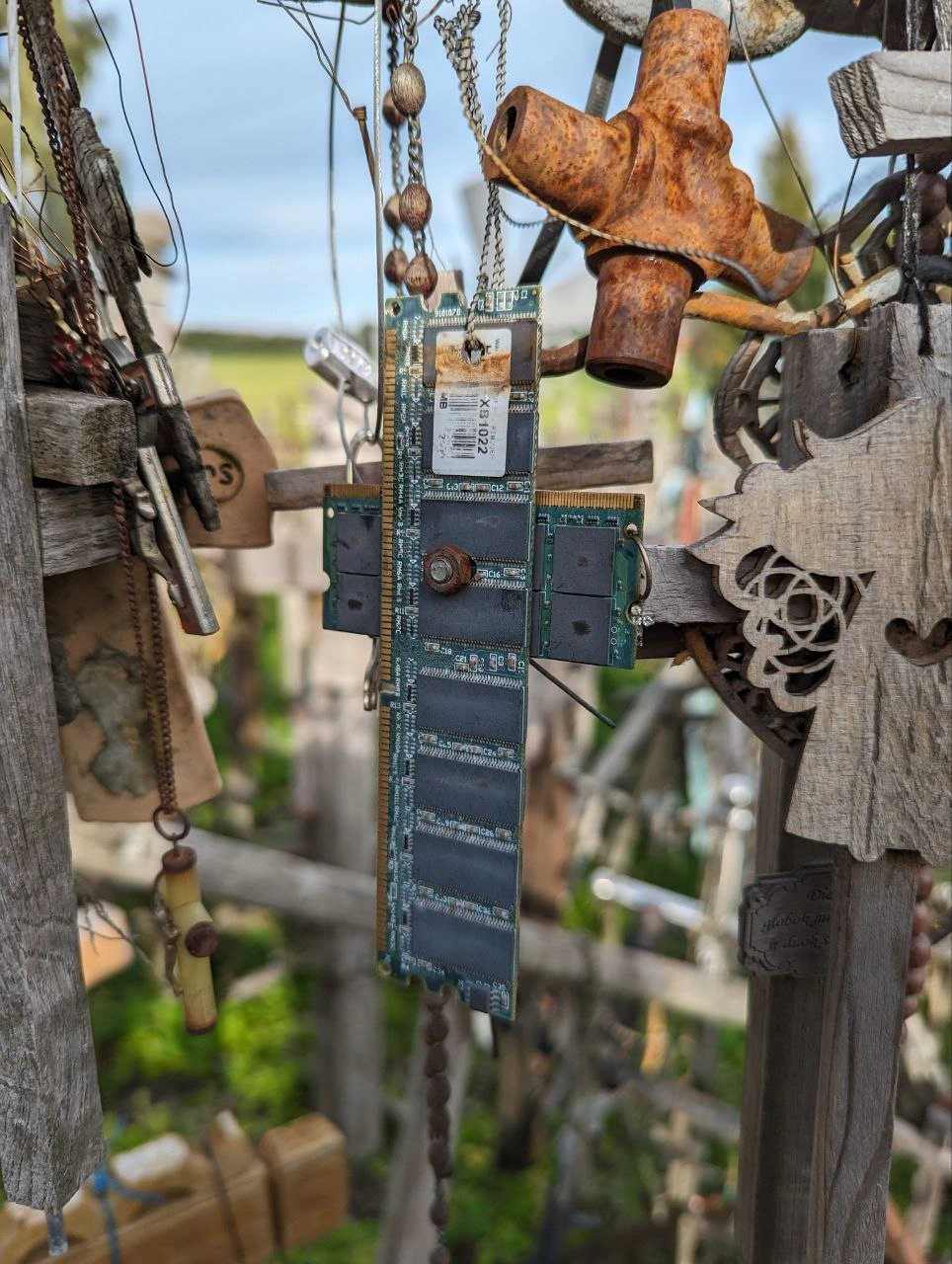
Imagine you had a favorite old toy or gadget that finally broke or became too old to use. Instead of just throwing it away, you decide to do something funny and sweet to remember it by – like putting it in a special place and treating it almost like it was a beloved friend who passed on. That’s what’s happening in this picture, but with a computer part. The green thing hanging there is a memory stick from an old computer (that’s the part that helps a computer remember things while it’s on, kind of like the computer’s brain RAM). It’s an outdated piece that people don’t use anymore, so someone took it and made a little memorial for it outdoors. They tied it up in the shape of a cross (which is often used as a grave marker or a symbol of tribute) and even gave it a sort of halo using a rusty round valve, just like you might see in images of angels or saints. Around it, there are other wooden crosses and trinkets, so it looks like a tiny graveyard or shrine.

Why is this funny or interesting? Well, we usually reserve that kind of honor for things that truly mean a lot to us – like people, pets, or very sentimental objects. Here, doing it for a computer part is both silly and heartwarming. It’s silly because, of course, a memory stick isn’t alive; giving it a “funeral” is way over-the-top. But it’s heartwarming and relatable because many of us do feel attached to our old gadgets. Think about how you might keep a toy you loved as a child, even if it’s a bit broken, just because it holds good memories. Grown-up tech geeks feel the same about the first computers or parts they worked with. This picture is basically saying “goodbye and thanks” to that old RAM stick in a humorous way. It’s like the tech person who made this is jokingly treating the part as if it went to heaven for gadgets.

So, the emotional core here is about appreciation and nostalgia. It’s funny to see a computer part on a cross, but it also shows that the person really cared about what that part represented – maybe late nights gaming or coding on a machine that used that exact stick of memory. They’re giving it a respectful send-off, almost like you’d give to a retired hero. In everyday terms, imagine your family’s old car finally stops working, and instead of scrapping it immediately, you hang the license plate in the garage like a souvenir to remember all the trips you took. That’s the vibe here: honoring the old while acknowledging it’s gone.

In one cute phrase, the meme is basically saying “Rest In Peace, dear RAM.” (Tech folks would cheekily say “RAM in Peace” as a pun.) It’s a way of showing that even our gadgets have a story and deserve a nod of respect when their time is over – all done with a big smile and a playful wink.

Level 2: Memory Module Monument

What we see here is a piece of computer memory turned into a memorial – literally! Front and center is an old RAM stick (a green computer circuit board that holds Random Access Memory) from the 1990s, and someone has made it into the shape of a small cross and hung it up like a shrine. In simpler terms, RAM is the part of a computer that stores data while the computer is running – kind of like the computer’s short-term memory or “thinking space.” This particular RAM module is a type called a 72-pin SIMM (Single Inline Memory Module), which was commonly used in PCs back in the early to mid-90s. It’s a long, thin board with black chips on it (those chips are the actual memory that stored the bits of data) and a row of gold contacts along one edge. The gold contacts are where it would plug into the computer’s motherboard to connect electrically. Back then, using gold plating on connectors helped ensure a good, non-corroded connection. So even though this memory stick has been hanging outside for a long time (you can tell everything around it is weathered and rusted), you might notice those contacts are probably still a bit shiny – gold doesn’t rust!

Now, the funny part is how this old computer part is being displayed. It’s been arranged like a cross in what looks like an outdoor collection of trinkets and crosses. Two smaller circuit board pieces have been wired through the main RAM stick to form the cross’s horizontal arms. And just above it, acting like a halo, someone hung a big rusty metal valve (the kind of valve you’d see in plumbing, now completely orange-brown with rust). The whole scene really looks like a little hardware shrine or memorial. There are wooden crosses and beads and chains around, so it might literally be a spot where people hang things in memory of something – and a tech-savvy contributor decided to commemorate a piece of old electronics. It’s like a techie’s twist on leaving a cross or a sacred object: instead of a holy figure, we have a “RAM relic.”

Let’s break down why a developer or anyone into tech would find this amusing. This RAM stick is obsolete hardware. That means it’s from an older generation of technology that’s no longer useful in modern computers – we call that LegacyHardware. Today’s computers use very different RAM modules (for example, modern RAM sticks are DDR4 or DDR5 DIMMs, which are larger, faster, and have way more pins). To give you an idea, a 72-pin SIMM like this might hold something like 8 MB (megabytes) of data. 8 MB is a tiny amount – about the size of two or three high-quality photos, or a few seconds of an MP3 song. By contrast, a typical new laptop might have 8 GB (gigabytes) of RAM, which is 1000 times more capacity. So this poor old RAM stick is really from the computing Stone Age relative to now. It can’t practically be used in any current machines; it’s a piece of RetroComputing history. That’s why seeing it turned into art is both funny and fitting. It has no modern utility except sentimental or artistic value.

For younger folks or new developers who haven’t dealt with old hardware, imagine this: it’s like finding a floppy disk or a VHS tape and turning it into a decorative coaster or wall art. It’s taking something that used to be important for daily life (or daily computing) and repurposing it as a quirky conversation piece. Here, someone literally made a monument out of a memory module. The white label on it with “X31022” suggests it was once an inventoried part (maybe from a company’s server or a lab). Now it’s been retired from duty and is on display. The whole arrangement of wood, metal, and electronics feels like a “graveyard of gadgets.” In fact, you could call it electronics as art – using discarded tech components in a creative, almost spiritual-looking display.

Let’s also clarify the imagery: In many cultures, putting up a cross by the roadside or in a yard can be a memorial sign, perhaps for someone who passed away or to mark a special site. A halo (like the rusted ring above the RAM) is usually drawn around saints or holy figures in paintings to show they’re sacred or heavenly. By giving the RAM stick a cross shape and a halo, the person who made this is jokingly treating the old memory stick like a saint or a dearly departed friend. It’s as if the RAM stick died and went to silicon heaven, and we’re marking its grave. This is definitely TechHumor: it’s humor that revolves around technology. The funny irony is that a piece of a computer – something we don’t usually think of as alive or worthy of a memorial – is being honored in this very human, spiritual way.

For a developer, there’s an extra layer of chuckling here. Many of us have a soft spot for the first computers and parts we worked with. There’s a bit of TechNostalgia – sentimental feelings about old tech – when we see something like this RAM module. Perhaps this stick (or one just like it) once lived in someone’s favorite old PC, and now seeing it hang outside like a decorative relic is both sweet and absurd. It reminds junior devs and enthusiasts that computer parts can hold emotional value. Maybe you’ve heard older programmers say, “Oh, I remember when 8 MB of RAM was a big deal!” – usually as a joke about how far things have come. This image is a perfect illustration of that journey: that once-important 8 MB module is literally hanging in a museum of lost tech.

Also, note how everything around the RAM cross is rusty or worn: the wood is gray and aged, the metal bits are oxidized, beads and chains are dangling. This tells us this isn’t a freshly made piece; it’s been out in the elements. Over time, rain and sun have aged these materials. The RAM stick likely doesn’t work at all now (if you tried to plug it in, it’d probably short out or crumble). So this is truly a memorial – it’s not coming back to active duty. It has “died” as a functional object. And that’s okay! The whole point is honoring the old component in a humorous way.

For someone new to tech, it’s also a chance to learn what a SIMM is. Before the now-common DIMMs (Dual Inline Memory Modules) used today, SIMMs were how you added memory to computers. They’re smaller and have chips on one or both sides typically. This one looks like it had chips on both sides (you can see black chips on the front; likely similar ones on the back). 72-pin refers to the number of metal connector pins; more pins can mean more data can be transferred at once. Modern memory modules have way more pins (e.g., 288 pins in DDR4 DIMMs) and thus can carry much more data faster. So this SIMM is a grandfather to the memory sticks in your current PC. Understanding that helps you see why a developer might almost respect it despite it being obsolete – it was the building block of computing decades ago.

In summary, this meme image is showing a mashup of tech and tribute. It’s as if the person is saying, “Here lies my old RAM stick – it served well, and now I commemorate it.” It’s funny because we don’t usually give funerals to electronic parts, but in the nerd world, the idea kind of resonates. After all, many of us keep old parts as mementos or put them on a shelf. This just takes it to the next level by making it a literal shrine in the wild. It teaches a bit of tech history (hey, that’s what RAM looked like in 1995!) while making us laugh at the dramatic send-off we’re giving to something as mundane as a memory module. For a junior dev or anyone new, it’s a good reminder that tech folks have a unique sense of humor and nostalgia: we sometimes treat our old gadgets like legendary artifacts – with a wink and a nudge, of course.

Level 3: Silicon Sacrament

At this level, the meme’s humor clicks with any seasoned developer or sysadmin who’s ever retired an old machine. The image takes a piece of LegacyHardware – a 1990s RAM stick – and treats it like a saintly relic on a crucifix. It’s both hilarious and oddly touching. We’re essentially seeing a hardware altar devoted to an obsolete memory module. For veteran techies, there’s a resonant subtext: we sometimes literally or figuratively worship the tech of yore. This scene nails that idea (pun intended) by literally nailing a RAM module to a cross. It’s a visual punchline for the reverence and nostalgia developers often feel toward aging hardware that once served us faithfully.

Why is this funny to an experienced dev? For one, it’s the sheer absurdity of mixing religious iconography with computer parts. We’re used to joking that some programmers treat their favorite language or their ancient mainframe like a religion – here that concept is made concrete. The SIMM is hanging like the crucified body of a tech martyr, complete with a rusty halo above it! The plumbing valve halo is a wonderfully comedic detail: a mundane, rusted pipe piece standing in for the sacred circle above a saint’s head. In this silicon sacrament, even the halo is literal rust (the oxidation process, not the programming language – although it’s ironically fitting if you think about memory safety issues that old C code on such systems had, and the modern language named Rust that aims to prevent them). The whole arrangement screams tongue-in-cheek veneration. It’s as if some grizzled sysadmin decided to give a proper send-off to the RAM stick that died in slot and caused that 3 AM outage one last time – by canonizing it in a shrine of retired parts.

There’s a layer of TechNostalgia here that any RetroComputing enthusiast will appreciate. Those of us who cut our teeth on ’90s PCs instantly recognize that green 72-pin SIMM with its black chip ICs and gold teeth. This was the type of RAM you’d find in a 486 tower or early Pentium machine. Maybe you even remember carefully inserting modules like these at a 45° angle into the motherboard socket and pushing them upright until the clips clicked – a tactile ritual of PC upgrade culture. They often came in pairs, and you’d pray you had the right type (EDO vs FPM, parity vs non-parity) or else face the dreaded POST beeping errors. Seeing one now out in the wild, weather-beaten and wired into a cross, triggers a mix of “Haha, I remember those” and “Aw, old friend, look at you now.” It’s humor with a side of heartfelt nostalgia. The TechHistory category is fully represented: that single module was once the lifeblood of a computer, storing the operating system, your DOS games, perhaps the code of a website in the early internet – and now it hangs like a retired jersey in a very bizarre hall of fame.

This meme also satirizes our tendency to sanctify legacy systems (or at least the parts from them). In many companies, a legacy system can acquire an almost mythical status. “Don’t touch that server, it’s old but critical – treat it with respect!” We joke about offering prayers to the legacy COBOL mainframe or sacrificing a 🍕 to appease the CI/CD gods – exaggerations that underscore real anxiety and reverence. Here, the old RAM is literally treated as holy. It humorously acknowledges the nightmares of legacy support: sometimes keeping ancient hardware alive feels like an act of faith. If you’ve ever been on call for a crusty old system, you get this. Picture a veteran sysadmin discovering one last spare SIMM in the storage room to resurrect a failing legacy server – they might as well have found the Holy Grail. That kind of relief can make a piece of hardware feel sacred! In fact, that inventory tag “X31022” on the module suggests it was once cataloged in some IT department’s asset list. One imagines it was decommissioned, tagged, and tossed in a junk pile – yet here it is, given new “life” as part of a memorial. We’re seeing the often unspoken sentiment: we honor the work these old components did (or at least we cope with their retirement through humor).

The combination of elements – beads, chains, wood, crosses, and this electronic part – creates a literal graveyard for obsolete electronics. There’s a shared understanding among experienced devs that behind every modern machine, there’s a trail of dead modules, fried circuits, and retired drives. Usually they end up in a cardboard box in the IT closet or recycled for scrap. But turning them into a public shrine is a whole new level of extra. It’s so over-the-top that it elicits a chuckle and maybe a knowing nod. We’ve all said our goodbyes to favorite old gadgets: the trusty Pentium desktop, the first-gen iPod, the old server that ran flawlessly for 10 years. This meme just externalizes that feeling in a cheeky, visually dramatic way.

There’s also a bit of dark humor here about tech decay. That RAM stick is literally hanging out to die, exposed to the elements. For a senior dev, it’s a reminder of how physical and brutal the passage of time is for hardware. You might joke, “Yep, that’s what happens when a server retires – we send it out to the farm to play with other old servers,” tongue-in-cheek. Seeing it actually out in a field on a cross is like the punchline to that joke. And hey, the Rust we see (on the valve) can symbolize old age in tech, but also slyly nod to how modern devs have invented a new language called Rust to avoid the memory errors of C++ that perhaps plagued those old systems. It’s almost poetic justice: the old memory module (possibly from a C/C++ era system that could leak memory) is now literally crowned with rust.

From an organizational viewpoint, the meme hints at how we memorialize retired tech. In some dev teams, it’s tradition to mount the fried PCB of a failed component on the wall as a trophy (a testament to “we slew that dragon”). I’ve seen burnt-out server power supplies turned into desk lamps or dead circuit boards framed like art. It’s a way to commemorate significant events (outages, upgrades, migrations) with a bit of humor. This outdoor shrine feels like an exaggerated extension of that tradition – the Church of Legacy Systems, where each hanging board is an offering. It humorously exaggerates the respect (or exasperation) we have for the machines that have been with us through tough deployments and late-night debugging sessions. We’re the priests keeping ancient services running, and when those finally retire, we half-jokingly canonize the hardware. “Here lies the RAM that survived Y2K and the Great Memory Leak of ’98, may it rest in peace.” The meme resonates because that attitude is real: only half in jest, we do feel a pang seeing old hardware go.

In essence, developers find this meme so relatable because it captures the dramatic devotion we have for our tools and the absurd lengths we go to honor them once they’re obsolete. It’s a send-up of LegacySystems culture and our collective tendency to both laugh at and lionize the past. We’ve all heard the phrase “one man’s trash is another man’s treasure.” In tech, one generation’s trash hardware becomes the next generation’s meme treasure. This rustic RAM-cross is exactly that – tech trash elevated to an object of ironic veneration. It’s funny, it’s nostalgic, and it’s a tiny bit heartbreaking too. A senior dev can’t help but smirk and perhaps salute: Hail the holy RAM, you served us well.

Level 4: Moore’s Law Mortuary

At the deepest level, this meme highlights the exponential obsolescence inherent in computing hardware. The central figure of the image is a 72-pin SIMM (Single Inline Memory Module) from the mid-1990s – once a cutting-edge piece of PC memory technology – now literally crucified in a makeshift shrine. Under Moore’s Law (the observation that transistor counts double roughly every 18 months), memory capacities and speeds have grown so rapidly that a module which held maybe 16 MB of RAM in 1995 became laughably insufficient just a few years later. The fundamental forces of technological progress turned yesterday’s premium hardware into today’s e-waste artifact. Here we see one of those artifacts given a ceremonious resting place. It’s a mortuary for Moore’s Law casualties, where old silicon goes when it dies – or rather, when it’s killed off by faster, larger successors.

From a hardware architecture perspective, the SIMM hanging as a cross is a time capsule of design constraints long past. A 72-pin SIMM provided a 32-bit data path; on 64-bit CPUs of the era (like early Pentiums), they actually had to be installed in matched pairs to fill the bus width. Amusingly, the cross’s horizontal bar is formed by two smaller PCB pieces – almost symbolic of how those SIMMs needed a twin to function in their original life. The black rectangles on the module are old DRAM chip packages, each containing millions of tiny capacitors storing bits of data that had to be constantly refreshed. In its prime, this module’s gold-plated edge connectors (still glinting in the photo) ensured reliable contact with the motherboard’s memory slots. Gold doesn’t corrode – so even as the surrounding steel and iron bits are reclaimed by rust, the SIMM’s gold contacts remain un tarnished, a shiny testament to both its bygone importance and the literal precious metals we used to build it. The corroded plumbing valve halo above it starkly contrasts with those untarnished contacts: a halo of oxidized iron crowning a sanctified scrap of silicon. Time and entropy spare no tech; components age and oxidize, and even gold-plated relics eventually end up weather-worn. This shrine captures that inevitability in poetic form.

The image also evokes the archaeology of technology. Just like an ancient relic in a museum, this obsolete memory module hangs as an artifact of a previous era of computing. One could imagine future historians (or aliens) stumbling upon this site and deducing a whole cult of technology from the cruciform circuits. The meme is funny, yes, but it’s also a commentary on how rapid innovation creates literal hardware graveyards. We rocket forward, leaving behind layers of discarded tech sediment – silicon circuit boards as our era’s fossils. Consider the leap in memory tech that turned this proud module into a joke:

Memory Module Era (approx) Common Capacity Bandwidth (approx)
72-pin SIMM DRAM mid-1990s 8–32 MB ~0.1 GB/s (100 MB/s)
DDR4 DIMM late-2010s 8–32 GB ~20 GB/s (20,000 MB/s)

In the mid-90s, having 32 MB of RAM was a luxury; by contrast, modern systems sport 32 GB or more – a thousand-fold increase in capacity. Bandwidth jumped by even larger factors. The old SIMM’s entire throughput is smaller than what current memory modules transfer in a single second. Those fundamental improvements follow from Moore’s Law and advances in memory design (wider buses, higher clock frequencies, improved signaling). With such staggering progress, it’s inevitable that LegacyHardware like this SIMM became useless for modern workloads. A piece of tech that once dutifully held our program data now literally hangs out to pasture because it can’t keep up with today’s needs – an ironic end that stems from the unforgiving mathematics of exponential growth.

There’s a deeper irony in how memory works versus how it endures physically. DRAM is volatile: it needs power and regular refresh cycles to retain data. The instant you powered off that old machine, every bit of code or precious data in this module evaporated. The soul of the module – the information it held – was ephemeral, gone without a trace many years ago. And yet the hardware itself, the body of the module, persists for decades as a physical object. That contrast is almost poetic: the data was transient, but the device lingers on, slowly decaying in a field. It’s a fundamental quirk of computing – information can vanish in milliseconds, but the physical medium might last generations (or at least until corrosion eats it). So here we have a relic that’s essentially a ghost: a memory with no memory left in it. The shrine-like presentation exaggerates this ghostly quality, as if we’re venerating the departed spirit of old code that once resided in these chips.

On a theoretical note, this tableau also hints at the cultural rituals around technological obsolescence. Humans have always built monuments or altars to things they valued – even when those things can no longer serve their original purpose. This electronics-as-art installation is like a tombstone for a computer component. It’s both absurd and profound that a piece of a PC’s internal memory ends up literally memorialized outdoors. The absurdity lies in treating a mass-produced circuit board as a holy relic, but the inevitability comes from the rapid iteration of tech: we have to do something with the flood of outdated parts. Why not sanctify one as a joke, especially one that might have caused blood, sweat, and tears in its day? It’s a clever, tongue-in-cheek acknowledgement of the life cycle of hardware. In academic terms, it’s illustrating how planned obsolescence and relentless innovation lead to a kind of “technological mortality,” which in turn inspires a form of geek catharsis – turning the death of hardware into dark humor. This 72-pin SIMM has joined the pantheon of retired technology, enshrined quite literally on a cross for posterity (and for laughs). In summary, the meme operates on a highly technical plane by invoking the historical context and fate of a specific computer part: it’s funny because it’s true – in the end, all hardware must rust, and here we are giving it a fittingly dramatic send-off.

Description

A close-up photograph captures a piece of obsolete computer hardware, specifically a DIMM RAM stick, repurposed into a piece of rustic, outdoor art. The green RAM module, with its black memory chips, is fastened with another small circuit board piece to form a cross shape. It hangs amidst a chaotic assembly of weathered wood, rusty metal components, and old chains, resembling a folk art wind chime. A faded white sticker on the RAM is partially visible, showing the text 'XS 1022'. The background is a soft-focus shot of a garden or yard, enhancing the sense of decay and nature reclaiming technology. This image serves as a visual metaphor for the rapid pace of technological obsolescence, where powerful components of the past become mere trinkets. For senior engineers, it's a nostalgic and slightly melancholic nod to the 'hardware graveyards' they've contributed to over their careers, representing countless past projects and retired systems

Comments

7
Anonymous ★ Top Pick This is where old RAM sticks go to die. They say on a quiet night, you can still hear the faint cries of a thousand-page swap files that never got written to disk
  1. Anonymous ★ Top Pick

    This is where old RAM sticks go to die. They say on a quiet night, you can still hear the faint cries of a thousand-page swap files that never got written to disk

  2. Anonymous

    Found the original GC root: a crucified 8 MB SIMM - proof that in the 90s we didn’t free memory, we just gave it a proper burial

  3. Anonymous

    After 20 years in tech, I finally understand why they call it 'volatile memory' - it dies for our sins every time someone deploys on Friday

  4. Anonymous

    When your memory management strategy is literally 'hang it out to dry' - a poignant reminder that today's cutting-edge 64GB DDR5 will eventually end up in someone's art installation, right next to the rusted pipe fittings of progress. At least these DIMMs finally achieved true garbage collection

  5. Anonymous

    Bless this heap: after years of “just add RAM” scaling, we built a DIMM cross so mark‑and‑sweep might finally absolve the 3 a.m. memory leaks

  6. Anonymous

    The dignified retirement DDR2 deserves after surviving Y2K, thermal throttling, and one too many off-by-one bit flips

  7. Anonymous

    A RAM crucifix - the traditional talisman of SREs on call, to ward off GC thrash, NUMA gremlins, and the Kubernetes OOM killer

Use J and K for navigation