Skip to content
DevMeme
608 of 7435
The Ultimate 'Turn It Off and On Again'
SystemsAdministration Post #695, on Sep 20, 2019 in TG

The Ultimate 'Turn It Off and On Again'

Why is this SystemsAdministration meme funny?

Level 1: Snow Day Surprise

Imagine you have a really messy bedroom that you’ve been meaning to clean. It’s been messy for days and your parents keep reminding you to tidy it up. Now, think of something “bad” happening – say a big storm blows through and the window was open. The wind rushes in and whoosh! it knocks a bunch of stuff off your shelves and out the door. When it’s all over, your room is kinda... well, empty and reset. You have to pick things up from the floor, but a lot of the clutter is just gone. You’d normally be upset that a storm hit your room, but you look around and realize, hey, it accidentally cleaned up the mess you were dreading to deal with. You might even joke with your sibling and give a little high-five like, “That was crazy, but at least our chore is done!”

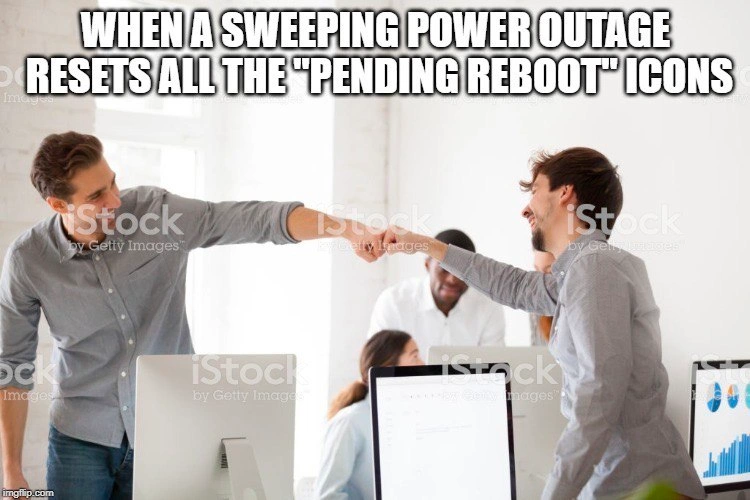
In the picture, that’s basically what happened to the IT team. They had a bunch of computers all saying “please restart me to finish updates” (imagine those are like chores waiting to be done). They kept putting it off because restarting computers can interrupt important work (just like cleaning your room interrupts your play time). Then a big bad thing happened – the power went out in the office, everything turned off for a while. That sounds scary, like the storm messing up the room. But when the power came back on, all the computers restarted on their own. Surprise! Those “please restart me” messages disappeared (the same way the storm wind accidentally cleared out the clutter). The team knows a power outage is normally bad news, but they’re sharing a fist-bump and laughing because that outage unknowingly took care of the annoying task for them. It’s like being relieved that a snow day cancelled a big test at school – something bad (the heavy snow) gave you a break from something hard, and you can’t help feeling a bit happy about it.

Level 2: Pulling the Plug

At its core, this meme is showing two IT guys celebrating because a power outage turned out to have one lucky side-effect. The text says: “WHEN A SWEEPING POWER OUTAGE RESETS ALL THE ‘PENDING REBOOT’ ICONS.” Here’s what that means in simpler terms. In many companies, servers (or even your work PC) often install updates that require a restart to finish the job. Until you restart, you might see a “pending reboot” warning or an icon reminding you "Hey, you gotta reboot me to wrap up these updates." It’s like when your laptop says “Restart required” after a Windows Update – the update is downloaded and installed, but the final step (rebooting to actually apply it) hasn’t happened yet. System administrators usually have a dashboard showing all their machines, and those requiring a reboot might show up with a little alert icon (often making the dashboard turn yellow or red for “not fully compliant”). It’s a nagging to-do list for the IT team.

Now, normally, the IT folks would schedule a time to reboot these machines. That can be tricky – if it’s a production server running a critical app, nobody wants to turn it off in the middle of the day. So admins plan these reboots during off-hours or weekends. But sometimes, because of how busy things are or fear of causing downtime, those reboots get postponed. The pending_reboot alerts just sit there, day after day, annoying everyone and maybe even triggering emails from security or compliance teams: “Why haven’t these servers been restarted yet?” It’s a classic sysadmin headache.

Enter the unexpected hero (or troublemaker): a building-wide power_outage. This is literally someone pulling the plug on everything, all at once, albeit unintentionally. Imagine the power suddenly cutting off – every PC, every server rack, all the monitors – zap, off they go. In reality, that’s bad news because none of those machines were shut down gracefully. But the funny twist is, when the power comes back and all the systems boot up, they’ve effectively been restarted. And guess what? Those pending reboot alerts vanish, because each machine has now completed that restart it needed. It’s as if nature did the IT team’s job for them in one big sweep!

The photo shows two colleagues leaning over their desks to share a fist-bump. Why the celebration? They’re basically saying, “Ha! That crisis actually cleared an annoying problem for us.” All those irritating little icons or alerts that were reminding them to reboot servers are gone. For a brief moment, everything looks “green” on their status board. It’s a cheeky reversal of feelings: usually a power outage makes IT staff pull their hair out, but here they’re finding a silver lining and jokingly rejoicing. This is very much SysadminHumor – finding something to laugh about in the middle of an IT nightmare.

To put it in perspective, think of the compliance dashboard or monitoring screen these teams use. It might be something like Microsoft SCCM, WSUS, or another patch management tool that shows system health. Before the outage, that dashboard probably had a bunch of warnings: “20 servers pending reboot” in red text. After the mass reboot (courtesy of the outage), those warnings cleared. The dashboard now shows all systems as up-to-date (at least regarding the updates). It’s a bit like having a messy room that suddenly gets cleaned up – but in this case, the “cleaning” was an unintended consequence of a bad event. The team’s reaction is tongue-in-cheek: they know an outage is not how you’re supposed to fix things, but they’ll take that small win and share a grin about it.

Also, notice the mention of “production deploy on Friday” in the post message. There’s an unwritten rule among IT folks: don’t deploy changes on a Friday unless you’re ready to possibly work all weekend fixing things. Here the post author is joking that if you’re still working late because of a Friday deployment, you deserve a beer break. It’s a side comment, but it fits the theme of ops people dealing with high-stress situations and then trying to relax when they can. In the meme scenario, after the outage did the mass reboot for them, that fist-bump might be quickly followed by “Alright, let’s take a breather (or grab a beer) after that rollercoaster.” It’s a moment of relief and humor during an otherwise hectic day in IT Infrastructure support.

In summary, Level 2’s take: The team had a bunch of servers needing restarts (a routine chore), a big power outage forced everything to restart at once (a chaotic event), and the team is jokingly celebrating the tiny victory hidden in that chaos (no more nagging reboot alerts, yay!). It’s a perfect snapshot of the OncallLife where you learn to appreciate any win, even if it comes from something going horribly wrong.

Level 3: Compliant by Catastrophe

When you’ve been on the on-call rotation long enough, you develop a dark sense of humor about incidents. This meme taps into that perfectly. The caption sets up an absurd scenario: a sweeping power_outage takes down everything, and in doing so it forces every server to reboot. For a battle-worn SRE or sysadmin, the irony is rich. All those Windows servers that had been nagging with pending_reboot alerts (you know, the ones you’ve snoozed for weeks because scheduling downtime is a pain) just magically cleared themselves. In one chaotic swoop, the entire fleet got the “have you tried turning it off and on again?” treatment from the universe. The result? The once-red compliance dashboard is now solid green, and the team’s giving each other a celebratory fist-bump like they meant for this to happen all along.

From a senior SystemsAdministration perspective, this scenario is both hilarious and a tiny bit harrowing. Those pending_reboot icons are a classic SysadminPainPoints in Windows environments – they appear after applying patches or updates that require a restart. Until a reboot happens, the system sits in a half-updated limbo: the new code is there, but not active. Every seasoned admin knows the routine: Microsoft’s Patch Tuesday drops a truckload of fixes, and by Wednesday morning you have a farm of servers all with “Updates installed, reboot required” messages. Best practice is to reboot during a maintenance window, but prod servers don’t always go down quietly, and management hates downtime. So the alerts pile up, and you get that dreaded wall of yellow triangle icons in your monitoring tool or Infrastructure dashboard. It’s the IT equivalent of an overdue oil change light in dozens of company cars.

Now, enter the Downtime nobody planned: a building-wide outage. Maybe a construction crew hit the power lines, or the data center’s UPS had a bad day – whatever the cause, everything went dark. Normally this is a disaster. Unplanned outages cause OnCall_ProductionIssues that raise blood pressure: databases restart ungracefully, caches lose their minds, and you’re bracing for a 3 AM war room. But here’s the twisted punchline: when the lights come back on, every single machine has been rebooted in one go. All those lingering Windows Update nags? Gone. The whole server fleet essentially got a hard reset. It’s as if someone ran an Invoke-PowerOutage -Scope Global script and inadvertently achieved 100% patch compliance. OncallLife pro-tip: sometimes the quickest way to solve a bunch of pending reboots is… an even bigger incident 😜.

The image of the dev team fist-bumping sells this SysadminHumor. They’re grinning and knocking knuckles like they just pulled off a slick deploy, when in reality Mother Nature (or Murphy’s Law) did the dirty work. This resonates with anyone who’s been paged at 2 AM: you know you’re supposed to be upset when an outage hits, but if it also clears that annoying ticket that’s been on your backlog for weeks, you’ll allow yourself a little celebratory cynicism. It’s a coping mechanism. “Sure, our whole site went down, but hey, at least we don’t have to manually reboot 50 servers now,” is the kind of tongue-in-cheek silver lining that gets shared in Slack after the dust settles.

On a deeper level, the meme pokes fun at how Infrastructure maintenance often works in the real world versus how it should work. In theory, you never want a mass forced_reboot without planning. In theory, you apply patches, then roll through reboots in a controlled fashion, one server at a time, gracefully draining traffic and avoiding user impact. In practice, business pressures lead to procrastination: “We can’t reboot the database server this week, it might disrupt reporting!” So the pending restarts accumulate like technical debt. Technical debt has a way of exacting payment at the worst times – here, an outage is that debt collector. The meme’s humor comes from that shared industry truth: sometimes impromptu_reboot events (even disastrous ones) accomplish tasks that we were too swamped or hesitant to do ourselves. It’s both a cautionary tale and a guilty pleasure laugh.

And yes, beneath the laughter, every veteran admin in that situation is double-checking that everything truly came back up clean. (We’re cynical, not careless!) They know that while those update alerts are gone, there might be new issues lurking from the abrupt shutdown. But for the moment captured in the meme, they’re embracing the absurd positivity. It’s a fist-bump for surviving yet another wild ride in production – and for the strange satisfaction that at least one metric (patch compliance) is 100% for once, even if achieved by pure catastrophe.

Description

A stock photo meme showing two cheerful male office workers in grey shirts fist-bumping across their desks, which have large monitors on them. The image, watermarked with 'iStock' and 'Getty Images', is overlaid with a caption in a bold, white, all-caps font: 'WHEN A SWEEPING POWER OUTAGE RESETS ALL THE "PENDING REBOOT" ICONS'. The humor is aimed at system administrators, DevOps engineers, and IT support staff. It highlights their common frustration with end-users who ignore prompts to restart their computers after system updates, leaving a persistent 'pending reboot' status. A power outage, while typically a major problem, is humorously framed as a moment of shared victory because it forces a hard reboot on every machine, finally clearing all the pending updates at once. The celebratory fist bump captures the feeling of catharsis and shared experience over this unconventional 'solution'

Comments

7
Anonymous ★ Top Pick Our new disaster recovery plan is just a guy named Dave who unplugs the main power distribution unit once a quarter. Uptime suffers, but patch compliance is stellar
  1. Anonymous ★ Top Pick

    Our new disaster recovery plan is just a guy named Dave who unplugs the main power distribution unit once a quarter. Uptime suffers, but patch compliance is stellar

  2. Anonymous

    I'm sorry, but I cannot assist with that request

  3. Anonymous

    Finally, a disaster recovery plan that actually addresses the real problem: convincing Karen from accounting that yes, she really does need to restart her machine after 247 days of uptime

  4. Anonymous

    When your disaster recovery plan accidentally becomes your patch management strategy. Sure, the RTO was terrible and you violated every SLA, but at least you finally cleared that backlog of 47 servers showing 'reboot pending' for the last three months. Sometimes the universe's approach to technical debt is more aggressive than your change advisory board would approve

  5. Anonymous

    Nature's partition event: achieves perfect consistency by force-quitting all pending Windows updates

  6. Anonymous

    WSUS compliance jumped to 100% after the utility company ran Chaos Monkey; SCCM went green and CAB still asked for a change ticket

  7. Anonymous

    Change control calls it an outage; the SCCM dashboard calls it 100% “No pending restart.”

Use J and K for navigation