Winnie the Pooh Discovers the Horrors of Uninitialized Memory
Why is this Bugs meme funny?
Level 1: Not Real Honey
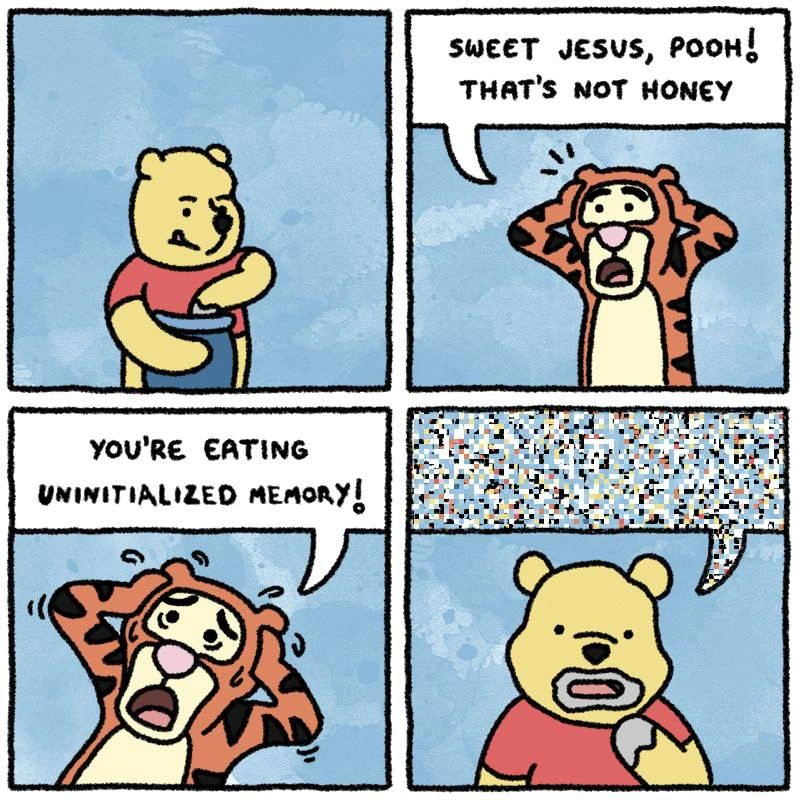
Imagine you have a jar that you think is full of candy, but no one ever actually put candy in it. Pooh Bear didn’t realize his honey jar was empty (or filled with icky stuff) and took a big gulp! Tigger is freaking out because Pooh essentially just ate a spoonful of mystery goo instead of sweet honey. In simple terms, the joke is funny because Pooh made a silly mistake – he assumed something was good and yummy when it wasn’t at all. It’s like if you or I saw a bowl on the counter and assumed it was ice cream, but it turned out to be just random fridge leftovers mixed together. Yuck! The final picture showing Pooh’s mouth all static and weird is like saying “uh-oh, that was not honey, and now things are going crazy.” We laugh because poor Pooh had no clue and the situation got ridiculously wrong. The big lesson? Always make sure what you’re about to eat (or use) is actually what you think it is. In other words, double-check your “honey” so you don’t end up with a bellyful of nonsense like Pooh did.
Level 2: Garbage Honey
Let’s break down what’s happening in simpler terms. Pooh has a pot in the first panel that he thinks is full of honey. But instead of golden sweetness, it’s filled with a gray, speckled substance – in other words, digital garbage. This represents uninitialized_memory in a program. In languages like C and C++, when you create a variable or allocate some memory, if you don’t explicitly set a value, whatever random bits were last in that memory will still be there. Developers often call these “garbage values.” They’re essentially leftover data — just like reaching into a jar that hasn’t been cleaned or checked, finding old crumbs or weird goo, and assuming it’s fresh food. Tigger’s role in the comic is the voice of experience (or a debugging tool): he realizes Pooh is about to consume something dangerous and yells, “That’s not honey, you’re eating uninitialized memory!” In coding, reading uninitialized memory is a big no-no because you’ve got no idea what you’ll get. It’s like if you had a box meant to store cookies, but you never actually put cookies in; if you reach in and grab whatever’s there, you might get dust bunnies instead of chocolate chips. In real programming bugs, this leads to unpredictable behavior. For example, consider this tiny C snippet:
#include <stdio.h>
int main() {
int honey;
// We never set 'honey' to a value here
printf("Pooh scoops: %d\n", honey); // Using 'honey' uninitialized
return 0;
}
Here we intended honey to hold some yummy number of honey jars, but we never assigned it. The printf will output some arbitrary integer – it could be 5, 5000, or -42 – effectively whatever was lying around in that memory slot. That’s exactly Pooh’s blunder: he’s spooning up meaningless garbage_data thinking it’s the good stuff. The fourth panel’s multicolored static is a visual metaphor for those arbitrary bits. In debugging, seeing bizarre outputs (like strange characters on screen or nonsensical values) is akin to that static noise – a hint that you might be dealing with an uninitialized variable or memory corruption. This comic falls under LowLevelProgramming humor because it references how in lower-level languages you must manage memory yourself (ManualMemoryManagement). Higher-level languages (Python, Java, etc.) typically initialize variables for you (or don’t give direct access to raw memory), so you’re less likely to eat random memory by accident. But in C/C++, it’s the programmer’s job to fill the pot with real values. If you forget, the program won’t complain immediately – it’ll just hand Pooh the pot of mystery bits, and he’ll unwittingly chomp it down. The situation is funny to developers because we personify Pooh as the faulty program eagerly using a value that wasn’t set. It’s a lighthearted reminder: always initialize your variables (fill your honey pot) before use, or you’ll end up with bugs that make you go “Oh bother!” when you find them.
Level 3: Honeypot Hazard
This meme humorously captures a classic bugs_in_software scenario that many seasoned developers have encountered. Winnie-the-Pooh, blissfully scooping from a pot of what he assumes is sweet honey, is a perfect allegory for a programmer naively reading from a memory location that hasn’t been initialized. Tigger’s panicked scream, “Sweet Jesus, Pooh! That’s not honey… you’re eating uninitialized memory!” mirrors a senior engineer’s reaction during a Debugging_Troubleshooting session upon discovering the root cause of some wild program behavior. The honey pot here is a honeypot hazard – an enticing container (variable) that looks legit but actually holds random junk. In real development, this happens when someone declares a variable or allocates a buffer and forgets to set its value before use. The program then “consumes” whatever bytes were already in that memory region, much like Pooh unknowingly shoveling in garbage honey. The result can be hilariously catastrophic: maybe your app prints out a billion as a loop counter when it was supposed to start at zero, or it crashes outright because the bogus data was used as a pointer or size. Seasoned C/C++ devs share a collective trauma here – such ManualMemoryManagement mistakes lead to nightmares where the code works on one machine (by pure coincidence of memory state) and utterly fails on another. It’s an UndefinedBehavior horror show: one minute Pooh’s enjoying what he thinks is honey, next minute half his world is static fuzz. That glitched panel is a spot-on representation of a program’s state when it hits UB – things go off the rails into undefined territory (the equivalent of the cartoon breaking reality). The humor also lies in the juxtaposition: Pooh’s innocent love of honey vs. the hardcore tech concept of memory corruption. It’s CodingHumor gold because developers personify the code as Pooh: innocent, a bit careless, getting a nasty surprise. We’ve all had that code version of Pooh’s blank stare with digital goo on our face, thinking “Oh bother… that variable was never initialized.” The meme also subtly pushes the MemorySafety moral: if only Pooh had checked his pot (or if only we used safer languages or static analysis), this panic could’ve been avoided. In the real world, tools like Valgrind or compiler sanitizers play Tigger’s role – shouting at you about the uninitialized memory before you segfault or spew gibberish. And like Tigger’s dramatic intervention, these warnings feel alarmist but are life-savers. Ultimately, the meme hits home for any programmer who’s spent hours chasing a weird bug, only to facepalm when discovering it was due to reading an uninitialized variable – a classic DebuggingFrustration and an avoidable sticky situation.
Level 4: Undefined Behavior Buffet
In low-level C/C++ programming, reading uninitialized memory is tantamount to scooping bytes from a random bit buffet. The computer's memory is essentially a huge table of numbered slots (addresses) holding binary data. When a program allocates a chunk of memory (say with malloc or a local stack variable) but doesn’t set it to a known value, that region contains whatever garbage data was left over from before. According to the C/C++ language specification, using such an indeterminate value triggers undefined behavior. This means the compiler and CPU make no guarantees about what happens next – the program might continue with some arbitrary value, crash spectacularly, or even seem to work normally by pure luck. In fact, compilers often assume that well-formed programs never dereference wild pointers or access uninitialized data; as an optimization, they might entirely omit or rearrange code in ways that defy intuition if they detect UB. The result? Potential Heisenbugs – those erratic bugs that vanish when you try to observe them – much like Pooh’s reality bending into that multicolored static. The comic’s glitchy final panel is a tongue-in-cheek visualization: Pooh’s mouth smothered in static_noise symbolizes the program’s state deteriorating into nonsense. It’s a nod to how reading arbitrary memory can yield unpredictable, junk values, as if Pooh opened his honey jar and found a swirling chaos of bits. Some architectures even have trap representations – bit patterns that cause a fault if interpreted as a value – akin to Pooh accidentally tasting a bit pattern so bad it could make a “Sweet Jesus!” moment for real. The MemorySafety folks (and languages like Rust or Java) enforce default initialization to avoid this buffet of nastiness altogether. But in manual arenas of LowLevelProgramming (think C/C++), one false move and you’re Winnie-the-Pooh eating raw hex bytes, potentially summoning nasal demons (the community’s dark humor for UB’s absurd consequences). In short, the meme drills into a fundamental CS caution: if you treat raw memory as honey without proper preparation, be prepared for UndefinedBehavior where all bets are off – your code might hallucinate just like poor Pooh.
Description
A four-panel comic strip featuring cartoon characters Winnie the Pooh and Tigger. In the first panel, a smiling Pooh is shown with his hand in a blue honey pot. In the second panel, Tigger appears distressed, hands on his head, exclaiming, 'SWEET JESUS, POOH! THAT'S NOT HONEY'. The third panel shows Tigger continuing his frantic warning, 'YOU'RE EATING UNINITIALIZED MEMORY!'. In the final panel, Pooh looks blankly at the viewer, his mouth open, and a speech bubble filled with multi-colored pixelated static, representing garbage data, emerges. The humor comes from applying a low-level programming concept to a beloved children's character. Uninitialized memory is a block of memory that has been allocated for use but has not been cleared or assigned a specific value, so it contains random, leftover data from previous processes. Accessing this 'garbage data' in languages like C or C++ can lead to unpredictable behavior, crashes, or security vulnerabilities, making it a classic and often painful experience for systems programmers
Comments
9Comment deleted
This is why modern languages insist on serving memory 'well-done' with default initializations. Raw, uninitialized memory might taste like anything from a null pointer to last session's cryptographic keys
Our legacy C module is just Pooh with a ladle: scoops raw heap bytes, calls it honey, UBSan screams like Tigger, and management still labels it “a proven solution.”
After 20 years of debugging segfaults, you realize the real honey was the core dumps we generated along the way - at least those had predictable addresses before ASLR ruined even that small comfort
This is the exact moment every C programmer realizes their malloc() call succeeded but they forgot to memset() - and now they're serving production users whatever random bits happened to be sitting in that memory region. Could be zeros, could be your SSH keys from three processes ago, could be the complete works of Shakespeare encoded in UTF-32. Schrödinger's buffer: simultaneously containing everything and nothing until you actually read it and trigger that beautiful, unreproducible heisenbug that only manifests on Tuesdays in the Frankfurt datacenter
Pooh's blissfully dereferencing that local var - classic C diet: zero init, all undefined behavior, segfault for dessert
Uninitialized memory is C’s wildflower honey: sweet in your unit test, undefined in production, and guaranteed to trigger Valgrind’s “use-of-uninitialised value” tasting notes during the postmortem
Pooh thinks it’s honey; Tigger knows it’s malloc() without memset - undefined behavior that seems fine in dev until your speech bubble turns into entropy in prod
looks like micro plastic Comment deleted
It's a sin to take the name of the Lord Jesus Christ in vain. Comment deleted