Skip to content
DevMeme
5637 of 7435
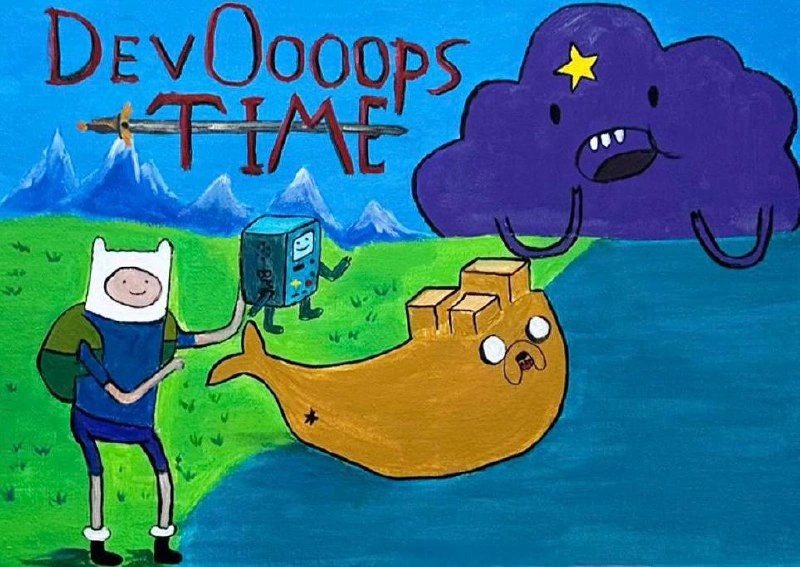
DevOoops Time: An Adventure Time Parody of Containerization and Cloud Failures
DevOps SRE Post #6184, on Aug 24, 2024 in TG

DevOoops Time: An Adventure Time Parody of Containerization and Cloud Failures

Why is this DevOps SRE meme funny?

Level 1: A Playful Oops

Imagine you and your friends are on a fun adventure trying to put on a school play. You have one friend who built a special stage that can fold up and go anywhere (that’s like the Docker whale carrying containers), and another friend who’s in charge of flipping the light switches and setting the scene automatically at the right times (that’s like the little CI/CD robot). You, the director (the developer), excitedly give the signal to start the show. At first, everything seems great – the stage is set, the lights come on – but then uh-oh! One of the big cloud props on stage starts wobbling and shouting because something went wrong with the setup. In our everyday terms, it’s like you tried to do something cool and complicated with the help of your clever tools, and suddenly an alarm goes off or a big mess starts happening. The picture makes this scary moment look like a colorful cartoon scene. The hero is smiling and optimistic, the little robot helper is friendly, the shape-shifting dog is carrying stuff, and even the upset cloud looks kind of funny. It’s showing that even when things go wrong (“oops!”), it can be seen as part of an adventure. In real life, that means when a big mistake happens at work, you gather your friends (or team), use your tools, and fix the problem together – turning a stressful incident into a team quest. So this meme is funny and heartwarming because it takes the scary idea of a big on-the-job mistake and turns it into a playful fantasy scene. Even though the cloud is yelling, everyone is in it together, just like friends who say, “Oops, let’s fix this!” when something goes wrong.

Level 2: Meet the DevOps Crew

Let’s break down the scene and the DevOps concepts it represents in simpler terms. This meme is basically a cast of DevOps tools and roles dressed up as Adventure Time characters:

  • Finn, the adventurous boy – Here, Finn stands in for a software developer or DevOps engineer. He’s the one embarking on the “adventure” of deploying code. In the meme, he’s smiling and extending a hand, showing optimism and collaboration. This is like a developer saying “Alright, let’s ship this feature!” Finn’s green backpack could even symbolize the toolkit or the knowledge he carries. In real life, that’s your know-how: scripts, playbooks, and best practices you carry into every deployment. The developer is the hero who writes the code and often also responsible for getting it running in production (especially in a DevOps culture where devs and ops work together closely).

  • BMO, the little teal console (labeled “BMO”) – In the cartoon, BMO is a cute game console robot friend. In this meme, BMO represents a CI/CD pipeline, which stands for Continuous Integration/Continuous Deployment. That’s an automated system that developers use to build, test, and deploy their code. For example, you might push your code to GitHub, and then a service like Jenkins, Travis CI, or GitHub Actions (the CI tool) automatically runs tests and, if all is good, deploys the new code to the servers. BMO shaking hands with Finn is just like a dev giving the “OK” to the CI system: “Here’s my code, please test it and put it in production.” BMO’s smiling face shows it’s happy to help – just as we imagine our automation is happily doing all the heavy lifting like running tests or deploying containers so we don’t have to do it manually. A junior developer might have seen this when merging a pull request and an automated process kicks off to deploy their changes. It feels like you have a little robot helper, which is exactly what BMO is portraying.

  • Jake as the Docker whale – Jake the dog has been turned into a Docker whale, complete with container blocks on his back. Docker is a popular technology for containerization. A container is like a lightweight mini-computer or an isolated environment that bundles an application with all its dependencies so it can run anywhere. Docker’s logo is a friendly whale carrying shipping containers, symbolizing how Docker carries your apps. In the meme, Jake (who can shape-shift in the show) symbolizes how flexible and handy containers are. He’s literally carrying the “containers” on his back (the three little rectangles). So this character is a nod to Docker and containerization – which a newer dev might know from using docker run to launch a local environment. By turning Jake into the Docker whale, the meme is saying Jake is our container friend – he’ll hold our application safely and adapt as needed. However, notice Jake’s somewhat startled face: that hints that sometimes containers (or Docker specifically) can have issues too. For instance, if a container image is misconfigured or if the host machine has a problem, all your containers (even though they package everything your app needs) can still fail. But overall, Docker in DevOps has been a game-changer: you ship these containers to the cloud, and it should run the same as on your machine. So Jake the Docker-dog is a fun way to depict that concept.

  • The Purple Cloud with a Star – This character is a parody of Lumpy Space Princess from Adventure Time, but here it represents the Cloud in a tech sense. “The cloud” usually means servers or services running on someone else’s computers (like Amazon Web Services, Microsoft Azure, Google Cloud, etc.), which you access over the internet. Instead of having your own physical server in a closet, you rent computing power from these cloud providers. They often draw a cloud symbol for it – hence a literal cloud in the meme. The yellow star on it is just like Lumpy Space Princess’s star, but we can imagine it’s also like a status light or just decoration. The cloud’s open mouth and worried expression mean something’s gone wrong in the cloud. In DevOps, if you deploy a buggy application or overwhelm your cloud server, you get errors – essentially the cloud “complains.” For a junior developer: think of when your app crashes on Heroku or AWS and you see scary error messages – that’s the cloud freaking out. The meme makes the cloud a living character who’s panicking. So the purple cloud is basically the production environment or cloud infrastructure where your app runs, and it’s drawn as having a meltdown because it didn’t like something about the new deployment. Cloud providers usually have status dashboards and alert systems; an alarmed cloud is a perfect cartoon way to show “Alert! Something is not right in production!”

  • “DEV OOOOPS TIME” text with a sword – This is a direct play on the Adventure Time title logo, but with a DevOps twist. Adventure Time’s logo has a sword through it and bright letters. Here it says “DevOoops Time.” The phrase DevOps is the practice of developers and operations working together with tools like Docker, CI/CD, and cloud to deliver software faster and more reliably. The meme inserts “OOO” into “Oops” to highlight oopsies (mistakes). This suggests that in the world of DevOps, things often don’t go perfectly – there are frequent small (or big) “oops” moments, like deploying something that breaks. The sword stabbing through “TIME” is just mimicking the show’s style, but it’s also symbolic: in an outage or emergency, it feels like time is under attack. You’ll often hear people say “Incident time” or jokingly “Adventure Time” when an on-call incident starts, meaning it’s time to jump into action. So “DevOoops Time” is a humorous way to say “It’s DevOps time — and oops, something went wrong!” It sets the expectation that this is about a DevOps adventure with some chaos involved.

In simpler terms, the whole picture is showing a DevOps team as if they’re cartoon adventurers. The developer (Finn) is setting off to deploy code, he’s got his container (Jake/Docker) and automation bot (BMO CI/CD) as buddies to help him on the journey, and the environment (Cloud) is reacting dramatically to whatever they’re doing. If you’re new to these concepts: think of it like this – you have some code (your project) you want to send out to users. DevOps is all about the process of getting that code from your laptop to a live website or service safely. Docker is a tool that packages your code so it runs the same everywhere, CI/CD is the system that actually moves that package to the servers automatically and runs tests on the way, and the Cloud is where it runs. This meme just personifies each of those parts and shows that, yes, even with all the fancy setup, deployments can be an adventure. The categories listed (like OnCall_ProductionIssues and DeploymentFailures) hint that this is about those times something breaks in production and someone has to jump in to fix it – which is exactly the vibe of the cloud yelling “Oh no!” in the picture. It’s a fun, friendly way to learn that DevOps isn’t always smooth sailing; sometimes it’s “DevOops time” and you learn from those mistakes.

Level 3: The Land of Oops

For an experienced DevOps engineer or SRE, this image is hilariously relatable. It reimagines the daily drama of DevOps as an episode of Adventure Time, cheekily titled "DevOOOOPS Time". The extra “OOO” in DevOoops screams oops! — as in “Oops, production is down!” — a feeling all too familiar when a deployment goes sideways. The scene is the Land of Oops, where our intrepid hero (the Finn-like developer in his backpack) cheerfully teams up with his trusty tools, only for the lovable cloud to start panicking. It’s a humorous take on those DevOps pain points we know and dread: imagine joyously deploying a new feature on Friday afternoon (Finn shaking hands with BMO to kick off the CI/CD pipeline), and moments later the cloud infrastructure (our purple cloud buddy with the star) starts screaming in panic because something is terribly wrong in production. Senior devs instantly recognize this scenario — the “works in staging, breaks in prod” nightmare that has ruined many a weekend. No wonder the cloud has an alarmed expression; it’s basically the face of your on-call pager blowing up. 😅

Each character is an easter egg of DevOps culture. The Docker whale reinterpreted as Jake the dog is pure genius: Docker’s logo is a whale carrying containers, and Jake is a stretchy, shape-shifting dog. Mix them, and you get a flexible, friendly container beast. In real life, Docker containers are indeed meant to be as handy and adaptable as Jake’s magical powers — package your app into a container and it can run anywhere! But any seasoned dev knows that if you stretch a container’s limits (CPU, memory, etc.) the way Jake stretches his body, things can go awry. We’ve all seen a container “grow” uncontrollably and consume all the RAM, effectively turning into a monster. Containerization solved the “it works on my machine” dilemma, but it also introduced new gotchas (like image compatibility issues or orchestration failures). So seeing Jake as a Docker whale with those container boxes on his back is both cute and a nod to the heavy lifting Docker does in our deployments.

Then there’s BMO, the sentient little console from Adventure Time, here labeled with his name and acting as the CI/CD bot – essentially Jenkins/Travis/GitHub Actions personified. To a senior dev, BMO shaking hands with the developer is symbolic of how we confidently hand off our code to automation. “CI bot, you got this, right?” 🤖✋ The optimism on Finn’s face as he makes a deal with BMO captures that hopeful moment after you merge to main and watch the pipeline green-light all the tests. In theory, CI/CD is your reliable friend that catches mistakes early and deploys smoothly. But in practice, we’ve seen CI bots cheerfully deploy code that contains a subtle misconfiguration or a bug that tests didn’t catch. It’s all friendly until BMO deploys something that causes an outage, leaving the team scrambling. The meme perfectly captures this camaraderie and potential betrayal – Finn trusts BMO, and BMO means well, but the cloud’s expression says “Something’s not right, guys!”. It’s a classic DevOps humor setup: all the right processes in place, yet chaos still erupts.

And oh, that purple cloud with a star – clearly a parody of Lumpy Space Princess (LSP) – repurposed here as the embodiment of a cloud provider (think AWS/Azure/GCP) or generally “the production environment.” In Adventure Time, LSP is melodramatic and prone to shouting, which is exactly what the cloud is doing when an incident hits. Experienced engineers know that feeling: when a cloud service starts throwing 500 errors or the CPU on your VM spikes to 100%, it’s like the sky itself is yelling at you. The star on the cloud’s forehead in the meme might even hint at a status indicator (imagine the AWS status page flashing an alert star 🚨). It’s a clever visual gag: the cloud literally has a cloud with feelings, panicking as your deployment causes trouble. Senior devs have seen production environments do weird things – containers failing to connect to databases, sudden network throttling, an incident that seemingly comes out of nowhere – and the cloud’s face is exactly how it feels at 3 AM when you’re on a Zoom call with your team, staring at graphs going red.

The “DevOOOOPS TIME” banner with a sword through “TIME” is dripping with meta-humor. In Adventure Time’s title card, the sword is just a heroic motif, but here it hints that time is literally at stake during an outage. When production is down, every second counts; you feel like you’re in a timed battle to slay a monster. The sword through the word “TIME” might also represent how deployments can cut into personal time (goodbye sleep, hello all-nighter). Seasoned folks chuckle (if a bit bitterly) at that, recalling long on-call nights when they had to become the hero with a proverbial sword, fighting off an incident dragon. The exaggerated “OOOOPS” is something any ops veteran can relate to – those moments where you deploy and immediately go “Oops… that wasn’t supposed to happen.” It’s emphasizing that DevOps is often DevOops in real life. In fact, some jokingly rebrand DevOps as “DevOops” whenever a configuration change brings production down. The meme riffs on this shared joke, giving it a colorful cartoon twist.

All these elements together lampoon the fragile alliance of Dev and Ops. We strive to automate and containerize our way to reliable deployments – and don’t get me wrong, these practices have dramatically improved how fast and safely we ship software – but any senior engineer will tell you there’s always an element of adventure (or misadventure). The meme resonates because it’s basically showing a deployment pipeline as an epic quest. Instead of swords and magic, we have Docker and CI bots. Instead of a literal monster, we have a cloud outage. Yet the dynamic is the same: things rarely go as planned, so you’d better be ready to improvise. It’s poking fun at the fact that despite all our advanced tools, a routine code push can still turn into a wild adventure in firefighting. As an experienced dev, you laugh because you’ve lived it – the joyous high-five with your CI/CD right before the system crashes and everyone yells “What time is it? On-call time!”. This meme brilliantly compresses those war stories and that camaraderie (and trauma) of on-call duty into a single, playful image. It’s cathartic humor for anyone who’s ever deployed on a Friday and instantly regretted it. DevOps humor at its finest, reminding us that even when everything goes wrong, at least we get a fun story (or a funny meme) out of it.

Level 4: Murphy's DevOps Law

At the most fundamental level, this meme highlights the inherent complexity of modern distributed systems. DevOps introduces powerful tools—containerization, cloud infrastructure, and CI/CD automation—each built on deep technical foundations that solve one problem but introduce others. The cute Docker dog (a mash-up of Jake and the Docker whale) represents containerization, which beneath the friendly façade relies on advanced OS primitives like Linux namespaces and cgroups to isolate processes. This is essentially lightweight virtualization, sharing the host kernel but sandboxing applications. It’s a brilliant paradigm enabling “it works on my machine” consistency across environments. However, as any kernel engineer knows, containers are subject to resource contention and kernel bugs. If one container misbehaves (say, a memory leak that Jake the Docker-dog can’t contain), it can still bring a whole system down. The meme’s purple cloud with a star (parodying Lumpy Space Princess from Adventure Time) symbolizes a cloud provider or cloud environment. Cloud computing itself is built on multi-tenant virtualization and distributed networking – essentially someone else’s computer spread across data centers. Under the hood, cloud services adhere to complex protocols (from consensus algorithms for data replication to hypervisor scheduling for VMs) that make on-demand scalability possible. But these layers of abstraction mean when something goes wrong, it can be deeply tangled (like an unpredictable outage in one availability zone causing cascading issues – the cloud literally freaking out).

The handshake between the Finn-like developer and BMO (the little console robot) is an allegory for CI/CD pipelines automatically moving code from commit to production. Continuous Integration and Deployment are grounded in the philosophy of accelerating feedback loops (as described in academic DevOps research like the Accelerate book’s findings on high-performing teams). The pipeline (BMO) acts as a state machine: code is built, tested, then released, ideally ensuring system state moves from “working” to “working with new features.” But from a theoretical perspective, ensuring a deployment will be problem-free is equivalent to a mini halting problem – there’s no guaranteed way to prove a new change won’t crash or stall. Even with rigorous tests, one cannot enumerate all possible states of a complex production environment (combinatorial explosion of microservice interactions, anyone?). Thus, Murphy’s Law in DevOps (“anything that can go wrong will go wrong in prod”) is practically a given by complexity theory.

In Site Reliability Engineering (SRE) terms, the meme points to why we have concepts like error budgets and chaos engineering. No system can be 100% failure-proof (the DevOops pun acknowledges that accidents are part of the process). SRE doctrine, influenced by research like Richard Cook’s "How Complex Systems Fail", recognizes that despite automation and best practices, failure is inevitable and often emergent. The sword piercing the word “TIME” in the title reminds us of the relentless dimension of time in reliability: things tend to break at the worst possible moment (a wink to Finagle’s Law). Every second of downtime during an on-call incident feels like a sword through the clock, and reducing MTTR (Mean Time To Recovery) becomes a heroic quest. We’re essentially seeing a playful representation of the Chaos that lurks behind every highly-automated system. The cloud’s alarmed face and the word “OOOOPS” echo the reality that even with cutting-edge tech, system entropy finds a way to create unexpected adventures. In summary, this meme captures a truth known to veteran engineers: integrating containers, cloud, and continuous delivery gives us incredible power, but also pushes us into a realm where the theoretical limits (from the CAP theorem trade-offs in distributed data, to non-deterministic bug behavior) make every deployment a potential “Adventure (Oops) Time.” It’s both a celebration of how far computing has come and a tongue-in-cheek nod to the inevitability of surprises in complex systems.

Description

A colorful painting that parodies the title card and art style of the animated series 'Adventure Time' to illustrate a DevOps scenario. The title text, in the show's iconic font, reads 'DEV OOOOPS TIME' with a sword piercing it. The scene depicts characters reimagined as tech concepts: Jake the Dog is a yellow whale-like creature (a reference to the Docker logo) floating in water, carrying three containers on his back. Finn the Human stands on the shore, holding BMO, a small living computer. Above, the purple, cloud-like Lumpy Space Princess looks down with a worried expression, representing 'the cloud'. The technical joke here is a clever and visually dense metaphor for a failed deployment or production incident in a modern, containerized environment. 'DevOoops' is a portmanteau of 'DevOps' and 'Oops', signifying that something has gone wrong. Jake as the Docker whale, BMO as the build agent or server, and Lumpy Space Princess as the cloud provider (like AWS or GCP) represent the core components of a CI/CD pipeline. The scene captures the chaotic, all-hands-on-deck feeling of troubleshooting a critical failure, where all parts of the system are involved and under scrutiny
Comments

8
Anonymous ★ Top Pick When the container orchestration fails, the logs are unreadable, and the cloud console is throwing 500s, it's officially 'DevOoops Time'. Your only hope is that rolling back is less of an adventure than this
  1. Anonymous ★ Top Pick

    When the container orchestration fails, the logs are unreadable, and the cloud console is throwing 500s, it's officially 'DevOoops Time'. Your only hope is that rolling back is less of an adventure than this

  2. Anonymous

    DevOoops Time: CI-BMO gives the green tick, Docker-Jake stretches into prod, and the lumpy cloud still blows up because we forgot the one thing containers can’t ship - DNS

  3. Anonymous

    Just like Finn's adventures in the Land of Ooo, every DevOps engineer's journey involves battling mysterious cloud monsters that appear at 3 AM, wielding legacy Intel hardware as their only weapon, and discovering that their trusty Docker whale companion has mysteriously died - except instead of saving princesses, we're just trying to keep the containers alive long enough for the next sprint review

  4. Anonymous

    When your Docker container goes belly-up in production at 3 AM and you're standing there with your monitoring dashboard like 'Mathematical!' - except the only math happening is calculating your MTTR while the on-call pager screams. The real adventure is explaining to stakeholders why immutable infrastructure isn't actually immortal, and that 'it works on my machine' doesn't scale to production workloads. At least the post-mortem will be algebraic

  5. Anonymous

    CI says green and Jake turns into a Docker whale hauling “stateful” boxes; the lumpy cloud then reminds you multi-AZ isn’t multi-region - welcome to DevOoops Time

  6. Anonymous

    Finn quests with BMO in hand, but no profiler stretches like Jake to catch that prod-shapeshifting memory leak

  7. Anonymous

    DevOoops Time: CI’s BMO is green, Jake’s a container with state, and the lumpy cloud learns that in “immutable infrastructure” the only immutable thing is the blame after kubectl apply to prod

  8. @mohamed_023 1y

    chroot > docker

Use J and K for navigation