Polyglot Developers Watching Language Wars
Why is this Languages meme funny?
Level 1: Different Tools
This is like people arguing whether a hammer, screwdriver, or wrench is the best tool. The funny part is that the last person is confused because they use more than one tool. Programmers do the same thing: different jobs need different languages, so acting like one language is always best is silly.
Level 2: Tools Have Jobs
Python is popular because it is readable, quick to write, and has strong libraries for automation, web development, scripting, data science, and machine learning. It is often slower than compiled languages for raw CPU-heavy work, but it is excellent when developer speed and library access matter.
C++ gives programmers more direct control over memory and performance. It is common in game engines, operating-system components, embedded systems, browsers, databases, and other places where speed and low-level control matter. That power comes with complexity: memory bugs, difficult build setups, undefined behavior, and template errors that sometimes look like a printer had a bad dream.
Java is widely used for backend systems, Android history, enterprise applications, distributed services, and large organizations that value mature tooling. The JVM, garbage collection, static typing, and huge ecosystem make it a durable choice for many teams, even if people joke about verbosity or corporate architecture.
The bottom-right text, YOU GUYS ONLY USE ONE LANGUAGE?, reframes the debate. A beginner may ask "Which language is best?" because learning one language already feels huge. Later, the question becomes "Which language is appropriate for this task?" That is the difference between collecting opinions and doing engineering.
Level 3: Constraint-Driven Taste
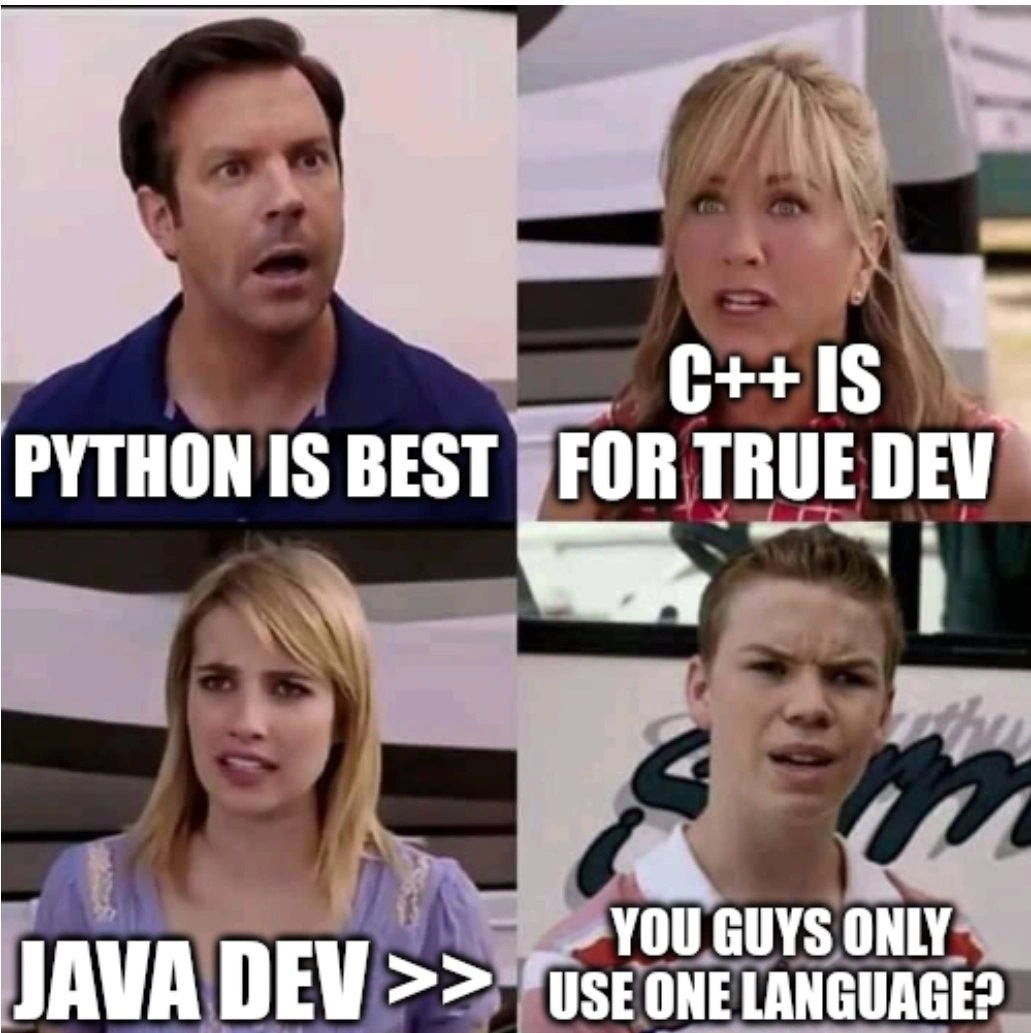
PYTHON IS BEST
C++ IS FOR TRUE DEV
JAVA DEV >>
YOU GUYS ONLY USE ONE LANGUAGE?
The meme skewers programming-language tribalism by putting three absolutist claims next to one confused practical question. The first three panels perform familiar community identities: Python as the approachable productivity champion, C++ as the badge of low-level seriousness, and Java as the enterprise workhorse with a loyal fan base. The final panel asks the thing experienced developers eventually learn to ask: why would one language be the answer to every problem?
The humor is that language debates often pretend to be about objective superiority while smuggling in identity. "Python is best" may mean "I value readability and fast iteration." "C++ is for true dev" may mean "I respect memory control, performance, and systems work." "Java dev >>" may mean "I trust mature tooling, static typing, and enormous production ecosystems." Those are not the same claim, but internet arguments flatten them into team sports because nuance gets fewer likes than a punchy slogan. A tale as old as tabs vs spaces, only with build systems.
In real engineering, language choice is rarely pure taste. It is a spreadsheet of constraints wearing a hoodie. You pick based on runtime performance, deployment target, available libraries, team experience, hiring market, observability, existing code, security posture, build times, tooling, interoperability, and how expensive it will be to maintain the thing after the person who loves the language moves teams. A backend service, a data pipeline, a game engine, an Android app, and a kernel module do not want the same trade-offs.
The fourth panel is the senior punchline because polyglot development is ordinary. A production system might use Java for a stable service, Python for data jobs and internal tooling, C++ for a performance-critical library, SQL for persistence, Bash for glue, TypeScript for the frontend, and YAML for summoning deployment regret. None of that proves one language has "won." It proves software is an ecosystem, not a single heroic compiler.
There is also a social anti-pattern being satirized: developers sometimes defend the first language that made them feel powerful. That is understandable. Tools shape how we think, and early wins become part of our professional identity. The danger starts when preference becomes doctrine. Strong engineers can explain why a language fits a context; insecure debates demand that the context fit the language.
Description
A four-panel reaction meme uses screenshots of surprised or confused characters from a comedy scene, with bold white text over each panel. The top-left panel says "PYTHON IS BEST," the top-right says "C++ IS FOR TRUE DEV," the bottom-left says "JAVA DEV >>," and the bottom-right asks, "YOU GUYS ONLY USE ONE LANGUAGE?" The visual joke contrasts single-language identity debates with the reality that experienced developers often choose languages by ecosystem, runtime constraints, team skill, and maintenance cost. It targets the familiar tribalism around Python, C++, and Java without endorsing any one language as universally superior.
Comments
20Comment deleted
The real senior answer is not a language choice; it is a spreadsheet of constraints pretending to be taste.
Why would i need more than 1 Comment deleted
At least one for database requests, one for backend, one for UI markup and possibly one for frontend. So, at least 4. Plus maybe CSS for some fancy output. Comment deleted
And PostScript for graphics and other finely formatted stuff. 🤪 Comment deleted
meme sucks Comment deleted
you don't need anything other than brainfuck Comment deleted
You don't need anything other than Binary Comment deleted
Opcodes* Comment deleted
c, c++, Makefile, bash Comment deleted
I used to be exclusively a Java dev, but after suffering through learning C++, I actually spend most of my time in Rust these days. Comment deleted
The C++ experience of going through it and thinking it’s fairly reasonable until you go over the hill and realize that oh fuck I can do nothing in this god forsaken language without cross referencing my code with the reference because there’s always some bullshit exception to a rule that will give the compiler a blank check to twist my code into a pretzel Comment deleted
C++ is an unmitigated nightmare. I don't hate the language, but I'd basically never use it by choice. Comment deleted
c++ python golang bash Comment deleted
Rust is a bit odd and awkward at times, but I find that it helps encourage me to finalize the layout of my code and project sooner. After that it's pretty straightforward. Comment deleted
well, i like rust mostly for the fact that it doesnt come with compiler gatcha mechanics tm, and when it does you have to put a big fat unsafe{} around it Comment deleted
and that because of that when youre not doing unsafe things you dont have to be on edge constantly reading back what youre typing scanning for things that might inadvertently trigger ub Comment deleted
The other bonus is the module system. I hate how C++ header files and includes work. It's awful. Comment deleted
yeap, i love the module system. tbh cpp20 modules would go a long way to fixing my gripes with headers, but pretty much the only people with full support for them rn are microsoft Comment deleted
I do wish that everything in a module didn't have to be in a single file though in Rust. Would be nice to be able to organize it a bit more. Unless there is a way and I just haven't figured it out yet. Comment deleted
honestly that doesnt bother me, since i can always just use <submodule>::*; in a mod file, and modules can have impl blocks for structs in other modules Comment deleted