The One Wish a Genie Has to Nerf: Backtracking for Life
Why is this CS Fundamentals meme funny?
Level 1: Life’s Undo Button
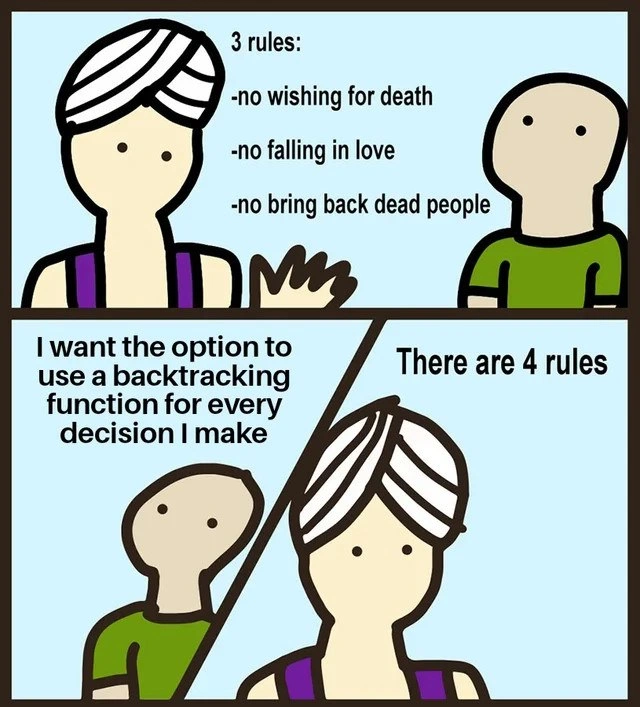
Imagine you had a magical rewind button for your life — every time you made a choice and didn’t like how it turned out, you could press rewind and try a different choice. Sounds amazing, right? In this meme, a developer actually asks a genie for exactly that power: basically an unlimited do-over for anything he does. Now, genies are super powerful in fairy tales, but even this genie immediately says, “Nope, can’t do that!” (He even jokes that he has to add a new rule just to forbid such a wish.) It’s funny because it’s a playful way of saying nobody gets endless second chances in real life. We’ve all had moments we wish we could take back or redo, so we can totally relate to the wish. But the joke is that this idea is so over-the-top that even in a magical scenario it’s off-limits. In simple terms, the meme makes us laugh and nod, because wouldn’t it be nice to have a big Undo button for life’s mistakes? Too bad even genie magic won’t grant that one!
Level 2: Life Version Control
For those newer to coding or the backstory: this meme is joking about a programmer who asks a genie for basically a life-wide undo button. Let’s break down the terms. A backtracking function in programming is a routine that helps an algorithm try out different possibilities and step back when one choice doesn’t work out. Think of it like exploring a maze: you go down one corridor, and if you hit a dead end, you backtrack – meaning you go back to the last junction and then try a different corridor. In coding, backtracking is used in algorithms to find solutions by trial-and-error systematically. For example, a program solving a Sudoku puzzle will fill in a number, and if later it finds a conflict, it will erase that number (undo that decision) and try a different number. This undo step is crucial; it’s literally the program saying, "Oops, that path didn’t pan out, let me revert and try another." So a backtracking function enables decision_tree_exploration by allowing the algorithm to rollback choices that lead to failure.
Now imagine applying this idea to real life decisions. The developer in the cartoon says, “I want the option to use a backtracking function for every decision I make.” In plain terms, they’re wishing: "I want to be able to undo any choice and try a different one, at any time." It’s like having a magic rewind button for life. Made a wrong career move? Click undo and choose a different path. Said something embarrassing? Undo and take it back. Even something trivial: ordered a dish at a restaurant and hate it? Undo and pick another meal, no one remembers the first try. Essentially, he’s asking for infinite do-overs on every decision – a limitless supply of second chances.
Why would a developer specifically ask for this? In the world of software and development, we actually have tools that feel a bit like this on a smaller scale. Version control systems (like Git) let us save snapshots of our code; if we mess up, we can revert the codebase to an earlier state. In text editors or IDEs, we have the trusty Ctrl+Z / Cmd+Z (undo) shortcut that lets us immediately fix a small mistake. Databases have transactions you can roll back if something goes wrong during a set of operations. These are all limited forms of an undo mechanism, and they’re absolute lifesavers for productivity. They give developers (especially those learning) the confidence to try things out, because mistakes aren’t permanent – at least in code. So it’s a very relatable developer experience to wish that life had a similar safety net. We joke about "life version control" where you could commit a ‘life state’, try something daring, and if it doesn’t work, just revert to the last commit as if nothing happened.
In the meme’s first panel, the genie lists his standard forbidden wishes: no killing people, no making someone fall in love, no bringing people back from the dead. These are classic rules seen in many genie stories (they’re basically there to prevent wishes that break fundamental moral or natural laws). Now the developer’s request in the second panel is portrayed as so extreme or unconventional that in the third panel the genie has to add, “There are 4 rules.” In other words, "I’m updating my list of forbidden wishes to include that crazy thing you just asked for!" The genie looks exasperated, which adds to the humor – we picture him thinking, "Of course a developer would come up with a wish so complicated I had to make a new rule." It’s funny because it merges the idea of a genie (a mythical being with its own rule set) and a programmer (who speaks in terms of functions and options). The poor genie basically got a feature request that violates his product specs!
To a junior developer or someone still learning fundamentals, there’s also a tongue-in-cheek educational angle: it name-drops backtracking, a concept you might have encountered in an algorithms class or coding interview prep, but in a totally different context (wishing with a genie). If you know what backtracking is, you immediately understand why asking for it in real life is over-the-top. If you don’t, well, now you have a fun example to remember it by! The meme is essentially saying: “Backtracking is powerful in code (you can explore many outcomes), but no, you can’t have that power for real-life decisions.” Even a genie forbids it. It underscores the idea that real life is immutable – once something’s done, it’s done, unlike a computer program that can explore alternate realities on a whim.
And let’s not forget the DeveloperProductivity angle: having an undo for everything would arguably be the greatest productivity boost (and stress reducer) ever. No more fear of deploying a bad commit or choosing the wrong library, because you could just try, and if it fails, undo! The meme whimsically captures that daydream. It’s educational and amusing rolled into one: reminding us what backtracking means in CS, and that in reality some things (like infinite undos) are just not going to happen – not even with magical help. So the next time you accidentally drop a production database table or send out a buggy release on Friday evening, you might chuckle and think, "Haha, if only I had that genie’s backtracking function right now… but alas, genie says NO."
Level 3: Edge-Case Wish
This meme brilliantly blends CS_Fundamentals with a dose of DeveloperProductivity wishful thinking. Seasoned developers will smirk at how the programmer in the comic finds an edge-case wish so extreme that it forces the genie to update his rulebook on the fly. In genie lore, there are typically three hard rules (no murder, no forcing love, no resurrection) – essentially the genie's API constraints. But leave it to a developer to discover a loophole or unanticipated requirement! By wishing for “the option to use a backtracking function for every decision,” the developer is effectively requesting a universal undo/redo for life. This is the ultimate "rollback everything" fantasy – a power to revert any action after seeing the outcome. In software terms, it’s like asking for a global git revert for reality, or an infinite "Ctrl+Z" buffer that covers your entire existence. The humor here plays on the idea that developers treat everything, even magical life decisions, as if they were software problems with an undo feature. It’s incredibly relatable developer humor: who among us hasn’t wished we could undo a production deployment gone wrong, or roll back a hasty decision in a design? We obsess over backups, version control, and fail-safes in our work. Naturally, a developer’s wildest dream is to extend that safety net to every aspect of life.
The genie’s exasperated response — “There are 4 rules.” — is the punchline that lands so well with tech folks. It’s essentially the genie saying, "Nope, not granting that one either." This moment is akin to a product manager suddenly adding a new line to the spec because a user (the dev, in this case) requested something that breaks the system. The genie_4_rules gag implies the developer found a scenario even genie magic can’t handle without an update. In software lingo, the dev’s request is a feature that introduces an impossible requirement, forcing a quick patch: Constraint 4: No wishing for a universal backtracking function!
Why is this funny to someone with experience in tech? Because it satirizes the convergence of two worlds: the magical genie trope and the pragmatic realities of computing. It’s an AlgorithmHumor meet-cute with everyday dev life. Backtracking, as a concept, is very familiar to any computer scientist — it’s how algorithms like puzzle solvers or combinatorial search handle trying alternatives. We know it’s powerful but also expensive (backtracking can chew through tons of possibilities). The developer’s wish basically asks for an always-on, cost-free backtracking superpower in reality. That triggers our knowledge that such a thing is utopian. It’s like asking a database to support infinite nested transactions with zero performance cost — sounds amazing, but totally unrealistic.
Moreover, the wish undermines the relatable developer experience of living with consequences. Part of being an engineer (and a human) is deploying changes or making choices and then firefighting or learning when things go wrong. We’ve all daydreamed about a big Undo button after a late-night server config mistake or even a personal life choice. This meme pokes fun at that temptation. The developer character doesn’t wish for money or fame; he wishes for a tool to manage outcomes (such a true developer move!). It resonates because many of us would value a cosmic safety net over a direct reward.
There’s also an implied commentary on productivity and perfectionism. A true developer at heart, the wisher basically says: “I don’t want to avoid making mistakes, I just want to be able to instantly backtrack whenever one happens.” It’s the ultimate debug mode for life. Imagine never having to worry about messing up because you can always revert to a previous state — you’d take every risk, refactor any part of your life without fear. It’s both wildly appealing and absurd. The genie’s terse upgrade to the rules acknowledges the absurdity. It’s the mythical equivalent of a code review saying, “This feature request is out of scope — it fundamentally breaks our architecture.” The laugh comes from recognizing that even in a magical scenario, a developer’s desire for an undo_every_decision feature is a step too far. It’s a cheeky acknowledgment that some things (in code and in life) just have to be final, and even genie magic won’t save you from every sticky situation. The shared grin among developers comes from thinking, "Yeah, if only life had a backtracking_function… but of course that would break everything (and where’s the fun or learning in never having consequences?)."
Level 4: Spacetime Complexity
At the deep algorithmic level, this meme touches on the limits of computation and even physics. The developer’s wish for a "backtracking function for every decision" effectively asks to explore all branches of a gigantic decision tree that is one’s life. In computer science, backtracking is a brute-force search strategy that tries a sequence of choices, and if a choice leads to a dead end, it undoes that choice and backtracks to try another path. Formally, it performs an exhaustive decision_tree_exploration by recursively exploring possible states and performing an algorithmic rollback when a partial solution fails. If we model life as a series of decisions, the number of possible timelines is combinatorially explosive – essentially factorial or worse growth, which in Big-O notation is astronomically super-polynomial. Granting a universal undo means being able to navigate this enormous state-space at will. That’s like attempting to solve an NP-hard (or probably NP-impossible!) problem in real-time; the computational complexity is through the roof. Not even a genie on infinite cloud compute could systematically traverse every alternate reality branch without hitting a cosmic stack overflow. On top of that, there are fundamental constraints: undoing decisions implies reversing time’s arrow or branching timelines freely. Even theoretical physics frowns on unrestricted timeline tampering (causality paradoxes, anyone?). No wonder the genie reacts as if this wish violates some fundamental law of the universe – it basically does! In classical genie lore, the three forbidden wishes (no killing, no forced love, no resurrection) are about not messing with fundamental forces (life, death, free will). A universal backtracking ability is in that same league, since it equates to time travel on demand. The meme humorously suggests that from the genie's perspective, a global undo is as taboo (or as computationally infeasible) as those other cosmic no-no’s. We can even think of it like an unwritten Fourth Law of Thermodynamics: no creating a perfect do-over loop. The genie’s deadpan line “There are 4 rules” acknowledges this new rule, implying "thou shall not violate spacetime consistency with unlimited undos." It’s a delightfully nerdy twist that frames an algorithmic wish as a breach of the universe’s design specifications.
def search(state):
if state.is_goal():
return True
for action in state.possible_actions():
state.apply(action) # take a step (choose an option)
if search(state): # recursively explore further
return True # found a successful outcome down this path
state.undo(action) # backtrack: undo the choice and try next
return False
# The developer basically asked the genie for a real-life equivalent of state.undo(action) at any time.
In the pseudocode above, state.undo(action) is the crux of backtracking – it cleanly rolls back a decision so the algorithm can try a different path. The joke is that the developer wants this power universally: to retroactively undo any action in life if it doesn’t lead to a desired outcome. From a theoretical standpoint, that’s like having a magical algorithm with infinite rewind capability. It ventures into realms of temporal paradox and infinite computing. The genie’s comical exhaustion (“There are 4 rules”) is essentially him saying “Even magic has its limits – you’re asking to break the system!”.
Description
A two-panel comic strip meme featuring a genie and a person making a wish. In the first panel, the genie, a character with a white turban and purple vest, lays out the standard rules: '3 rules: -no wishing for death -no falling in love -no bring back dead people'. In the second panel, the person, wearing a green shirt, makes their wish: 'I want the option to use a backtracking function for every decision I make'. The panel is split diagonally, showing the genie's immediate, deadpan response: 'There are 4 rules'. The humor lies in applying a powerful computer science algorithm, backtracking, to real life. Backtracking involves exploring decision paths and reverting to a previous state if a path leads to a dead end. For a developer, having a real-life 'undo' for every choice is the ultimate superpower, so overpowered that the genie instantly has to forbid it, making it more taboo than love or death
Comments
8Comment deleted
Real life is just a greedy algorithm running on a single thread with no state management. You make the locally optimal choice and hope for the best, because there's no call stack to unwind when you hit a null pointer exception
I asked the genie for a global Ctrl-Z; he said, “No problem - right after you design an idempotent, causally-consistent undo log for human free will.”
Finally, a way to undo accepting that "quick 30-minute refactor" that turned into a three-sprint architectural rewrite because someone mentioned the word "microservices" in a standup
Every senior architect knows the fourth unspoken rule: 'You can't backtrack from choosing microservices when your team of three is now maintaining 47 services.' Like the genie's immutable constraints, some architectural decisions create their own inescapable reality - except instead of cosmic laws, you're bound by the gravitational pull of accumulated technical debt, organizational inertia, and that one critical service nobody dares to touch because the original author left two years ago and it's written in a framework that's been deprecated since 2019
Asking for a backtracking function is basically event‑sourced life; the genie correctly flagged it as a global transaction with impossible compensating actions
Unlimited backtracking is event sourcing for reality; the genie patched the API contract to avoid an unbounded state space and causality outages
Life without backtracking: like DFS with no stack limit and infinite regret depth
ctrl+z Comment deleted