Gotta Code 'Em All: The Pokémon Go++ Language
Why is this Languages meme funny?
Level 1: Silly Name Mix-Up
Imagine you hear about something new and you totally mix it up with something else that has a similar name – that’s what’s happening here, and it’s why it’s so funny. It’s like someone said, “Hey, there’s a new Go thing coming out!” and you thought they meant Pokémon GO (the game with Pikachu) plus some cool new gadget. You’d probably picture something wild like a Poké Ball that you have to code with. That image is pretty silly, right? In reality, the person was talking about a new computer language named Go+, not anything to do with Pokémon at all. The joke is that the name “Go Plus” tricks us for a moment into mixing up a programming tool with a Pokémon toy. It’s the surprise of two very different worlds crashing together. We laugh because our brain goes, “Ha! I almost thought I’d be catching Pokémon by programming!” It’s that little moment of confusion and surprise that makes the whole idea so amusing.
Level 2: Go vs Pokémon GO
Let’s break down the two sides of this pun in simpler terms. On one side, we have Go+, a new idea in the world of programming languages. Go (often called Golang) is a popular programming language created at Google. It’s known for being simple, fast, and good at handling many tasks at once (thanks to built-in concurrency). In 2021, developers were buzzing about an experimental extension to Go called Go+ (pronounced “Go plus”). A programming language variant like Go+ means someone took Go and tried adding new features or tweaks to it – kind of like a mod or upgrade of the original language. The “plus” in the name hints that it’s Go with something extra. This naming style isn’t new in tech: for example, the language C++ got its name because in the C language, the ++ operator means “add one.” So C++ literally implies “one step above C.” Here’s a quick illustration of that operator in code:
int x = 5;
x++; // x becomes 6 (adds 1 to x)
By analogy, Go+ suggests “Go plus more.” It’s a clever name for devs, but it has an unintended twin meaning outside of coding. Enter the second side of the joke: Pokémon GO Plus. This is not a language at all, but a gaming accessory from 2016. Pokémon GO Plus is a small wearable device (shaped like a Poké Ball or map pin) that connects to your phone while you play the mobile game Pokémon GO. The device flashes and vibrates to let you know when Pokémon or game events are nearby, so you can catch Pokémon by pressing a button, without constantly looking at your screen. It’s basically a fun add-on to the hugely popular Pokémon GO game. The name “Pokémon GO Plus” means it’s an extra (“Plus”) gadget to enhance Pokémon GO.
Now you can see the overlap: Go+ (the coding language idea) and Pokémon GO Plus (the game gadget) sound almost the same when spoken. Both have the word “Go” and a “Plus.” They belong to completely different categories (one is tech software, the other is a toy for a game), but the naming similarity is striking. This meme jokes that the “new Go+ programming language” sounds like it could be a “Pokémon programming language.” It’s a classic programming_language_pun. In other words, it’s humor based on a double meaning: the phrase “Go Plus” refers to something in coding and something in gaming. This is what we call wordplay – a joke that plays with how words sound or have multiple meanings.
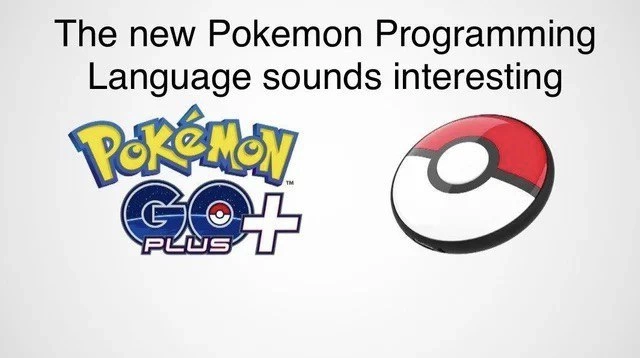
For clarity, no, there isn’t really a Pokémon-themed coding language (at least not officially!). The meme is just having fun with a naming coincidence. Such coincidences happen a lot in tech. We even have the term “naming collision” to describe when two projects or products end up with confusingly similar names. It can lead to mix-ups, but here it leads to laughs. The meme text “The new Pokémon Programming Language sounds interesting” is tongue-in-cheek. It imagines a confused scenario where someone hears about Go+ and thinks, “Huh, a Pokémon programming language? That sounds exciting (and bizarre)!” The images of the Pokémon GO Plus logo and the Poké Ball reinforce the Pokémon connection visually, making the misunderstanding very literal. It’s a nod to gaming references in developer culture – many programmers are also gamers or grew up with games like Pokémon, so they’ll instantly recognize the Poké Ball and get the joke.
To put it simply: Go+ is about writing code, and Pokémon GO Plus is about catching Pokémon. The meme mixes them up on purpose. It’s as if someone announced a new tool for programmers and a gamer misheard it as something about Pokémon. That mix-up is the whole point of the joke. Developers find this funny because it lightens the mood around new tech. Instead of seriously arguing about a new programming language (those debates can get heated in the world of Language Wars!), here they’re making a playful comparison to something goofy and familiar. In sum, this meme uses a pop culture reference (Pokémon) to make a tech joke more accessible and humorous. Anyone who knows both the Go language and Pokémon GO will chuckle at how unexpectedly those two worlds collide in one phrase. It’s a reminder that even serious tech topics can have a fun side when you look at them from a different angle.
Level 3: Gotta Name 'Em All
What happens when a programming language name collides with a Pokémon gadget? You get prime developer humor. This meme presents a fake "announcement" slide proclaiming “The new Pokémon Programming Language sounds interesting.” On the left, it flaunts the official Pokémon GO Plus logo, and on the right, a big red-and-white Poké Ball. At first glance, you might genuinely wonder: did Nintendo release a coding language for catching Pikachu? The humor kicks in once you realize it’s a wordplay mashup. It conflates the recently hyped Go+ programming language variant (pronounced “Go plus”) with Pokémon GO Plus, the wearable device for the popular mobile game. The meme format mimics a serious tech announcement, but seeing the Pokémon branding in that context is instantly absurd. It’s an inside joke poking fun at how naming in tech can unintentionally sound like pop culture references.
This joke lands so well because of a classic naming collision. In software, a naming collision is when two things end up with the same or very similar names. Here we have Go+ (a new language experiment) sharing a name pattern with Pokémon GO Plus. It’s like the worlds of coding and gaming collided in a linguistic accident. Seasoned devs are nodding knowingly because naming collisions happen a lot. We joke that “there are two hard things in Computer Science: cache invalidation and naming things.” And indeed, naming new languages is tricky – you try to pick something short and catchy, but inevitably you step on someone else’s trademark or common term. In fact, the name Go itself (for the Google-developed language) caused confusion back in the day – it’s such a generic word that the community often calls it Golang to make search results easier. There was even an older programming language named “Go!” decades before. So a new Go+ variant was basically destined to create naming_collision_humor. It’s the perfect setup for a punny meme because one mention of “Go Plus” and half the dev community immediately thinks of catching Charizard instead of writing code.
Let’s unpack the elements that make this funny for an experienced dev: First, Go+ was a buzzed-about language idea around 2021 – essentially an enhanced or modified version of Go (often touted as “Go with extras”). The “+” in the name follows a familiar pattern in tech, implying an upgrade. (Think of C vs. C++, where ++ is the increment operator in C-like languages meaning “add one.” The name C++ literally meant “C, but one better.”) Similarly, Go+ reads as “Go plus something more.” Meanwhile, outside of coding, Pokémon GO Plus was known as a gaming accessory: a little Poké Ball-shaped device that lets players catch Pokémon in the Pokémon GO mobile game without checking their phone constantly. It’s a Plus add-on for the game. Notice the parallel: in both worlds, “Plus” means an extra feature or improvement – one for a programming language, one for a game device. This convergence of naming is ripe for parody. A developer with a foot in both worlds can’t help but chuckle imagining a crossover: is Go+ how you program your Pikachu?
Dev A: “Go+, I choose you!” 💻⚡️ – jokes a programmer, invoking the classic Pokémon catchphrase as if summoning a coding language.
The meme’s punchline lives in that overlap of contexts. It’s a pop culture reference meets a tech inside-joke. Only in developer circles would you find people excitedly discussing a new language feature and others quipping about Pokémon because of a homonym. It also subtly satirizes the hype around new languages. The industry has been through many “Next Big Language” moments, often accompanied by grand announcements (and sometimes language wars over which is best). Here, instead of debating merits, devs are having a laugh: the name “Go+” unintentionally sounds like it could be a Pokémon-themed DSL (domain-specific language) for catching pocket monsters. Rather than a heated LanguageWars thread, it becomes a shared joke. It’s humor as a pressure valve – poking fun at the constant churn of “new and improved” tech. After all, we’ve seen so many “Plus” and “Pro” products that a Pokémon GO Plus programming language almost sounds plausible in jest. This meme is essentially saying: Sometimes our tech naming conventions are so wild, they might as well be designing languages for Pokémon. And for those of us who grew up on both coding and Nintendo games, that crossover is irresistibly funny.
Description
A meme that creates a programming language pun by combining the logo for the mobile game 'Pokémon Go Plus' with existing programming language names. The top text reads, 'The new Pokemon Programming Language sounds interesting'. Below, it shows the 'Pokémon GO Plus' logo next to an image of the physical Go Plus device. The joke is a visual pun that deconstructs the logo's text into 'Go' and 'Plus' (which is stylized as '++'). This creates the fictional language name 'Go++'. The humor is a play on the names of two real programming languages: Go (or Golang), developed by Google, and C++, a long-standing object-oriented language. The meme cleverly merges gaming culture with programming language humor, which would be amusing to developers familiar with both domains

Comments
7Comment deleted
Go++: All the concurrency of Go, with all the memory management headaches of C++. Your program's race conditions now have to be caught in the wild
Proposed we migrate the monolith to Go+; finance immediately budgeted for Bluetooth Pokéballs - turns out namespace collisions cost more than N+1 queries
Finally, a Go framework where catching all the exceptions is actually the point and nobody questions why you're walking around the office at 2 AM muttering about rare spawns in production
Finally, a language where 'catching exceptions' means something completely different, and garbage collection involves releasing Pidgeys back into the wild. The real question is whether Go++ will have better concurrency than the original Go, or if it'll just spawn more goroutines than there are Pokemon in the National Dex
Pokémon Go++: finally a language where the linter makes you catch() ’em all - right before your panic evolves into a legendary in prod
Pokémon GO++: Catch exceptions with a Master Ball, but segfaults always flee before you can throw
Introducing Go++: CSP with multiple inheritance, cgo by default, and an exception model literally called “catch ’em all.”