Java Developer's First Look at C#
Why is this Languages meme funny?
Level 1: Same Candy, New Wrapper
Imagine you have a favorite candy bar. One day, you try a similar candy from another brand. It comes in a different-colored wrapper and maybe it has a few extra nuts, but when you bite into it you think, "Hey, this tastes just like my favorite candy!". You realize it’s basically the same treat in a new package. That’s what this meme is saying. Java and C# are like two candies with different wrappers – to a person used to Java, C# feels almost the same, just wrapped in Microsoft’s packaging and a few extra sprinkles. The meme finds humor in this feeling of "Wait, haven’t I eaten this before?", just like when you recognize the taste of a treat even though it has a new name.
Level 2: Familiar Syntax, New Tools
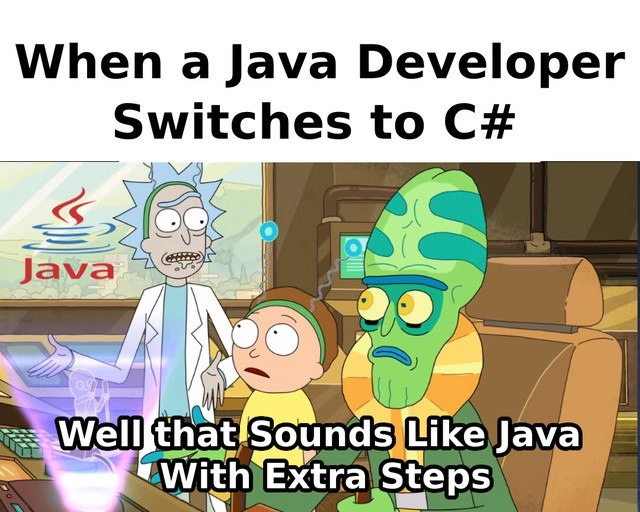
For a more junior developer or someone new to this joke, let’s break it down. Java and C# are two popular programming languages that look and feel very alike. Both are object-oriented languages – meaning you organize code into classes and objects – and both use similar syntax with curly {} braces, semicolons, and public static void main-style entry points. The meme’s top text, "When a Java Developer Switches to C#", sets up the scenario: a person who knows Java tries using C# for the first time. The bottom caption is their reaction: "Well that sounds like Java with extra steps." This is actually a reference to a Rick and Morty cartoon scene (a popular sci-fi comedy show) where a character basically says "that just sounds like X with extra steps!" to call out something as just a more complicated version of something familiar. Here, the joke is that C# feels like a slightly more complicated version of Java.
Why would a Java developer say that? Because so much of what they do in Java has a direct parallel in C#. The core concepts – variables, loops, classes, inheritance – work the same way in both languages. Even the code looks almost identical. For example, here’s a simple “Hello World” in both languages:
// Java example
public class HelloWorld {
public static void main(String[] args) {
System.out.println("Hello, world!");
}
}
// C# example
using System;
class HelloWorld {
public static void Main(string[] args) {
Console.WriteLine("Hello, world!");
}
}
As you can see, it's nearly twin code. In Java you call System.out.println, in C# you call Console.WriteLine – different name, same idea (print text to the screen). Both have a method called Main that kicks off the program. Syntactically, a Java developer reading C# code will recognize the patterns instantly: if/else statements, for-loops, try/catch exceptions, classes and interfaces – all almost copy-paste between the two, aside from minor tweaks (for instance, C# capitalizes keywords like Main and has a using System; line to import libraries, whereas Java would use an import statement). This is why the meme says "Java with extra steps": the new language isn’t new at its core, it just has some extra bits to learn.
What kind of extra bits? Mostly the ecosystem and tools. Java runs on the Java Virtual Machine (JVM), and you typically use tools like the JDK (Java Development Kit), build with Maven/Gradle, and bundle your code into a .jar (Java Archive) file. C# runs on the .NET platform (specifically the Common Language Runtime, CLR), and you often use Microsoft’s Visual Studio or VS Code, build with MSBuild or dotnet CLI, and produce an assembly like an .exe or .dll file. The languages themselves are close cousins, but the surrounding environment – the libraries, the runtime, the way you package and deploy applications – have a Microsoft flavor. For example, a Java dev might be used to finding libraries via Maven Central and adding a dependency in a pom.xml file. In C#, you’d use NuGet packages and manage them in a .csproj file or through the Visual Studio GUI. It’s a different process to achieve the same goals. Those are the "extra steps" – not necessarily bad, just additional things to learn that make C# feel like Java plus a Microsoft twist.
It helps to know this meme is tapping into developer humor about switching stacks. There’s a long-running lighthearted rivalry between Java and C# programmers (sometimes called language wars). Both communities like to tease that the other is just copying ideas. In truth, each language has influenced the other over the years. C# was created around 2000 by Microsoft (led by Anders Hejlsberg) explicitly to be analogous to Java for the new .NET Framework. In fact, early on, many features in C# 1.0 mirrored Java 1.2. Conversely, later Java versions took inspiration from C# (for instance, Java eventually added generics and lambda expressions not unlike C#’s). So when a Java dev says "C# feels like Java with extra steps", they’re joking that C# is basically Java wearing a Windows-themed costume and maybe juggling a few extra tools. The meme uses characters from Rick and Morty to amplify that feeling of comic exasperation – Morty (the kid in the image) is known for calling things out bluntly, and here he’s essentially saying, "C#? It's just Java... plus some extra stuff, right?". It’s a fun way to convey that a cross-language transition (especially between two similar languages) can be both reassuring (“hey, this isn’t so different!”) and slightly frustrating (“why do I have to learn a new way to do something I already did in Java?”).
To summarize the key terms and why they matter in this meme: Java is a programming language run on the JVM, originally by Sun (now Oracle), known for its portability and huge usage in enterprise systems. C# is a programming language on .NET/CLR, created by Microsoft, often used in Windows applications and enterprise systems as well. Both are OOP (object-oriented programming) languages, which is why their syntax and structure feel alike. The meme leverages a Rick and Morty reference – specifically the "X with extra steps" meme template – to humorously comment on cross-language transition. The bottom line for a junior dev reading this meme is: switching from Java to C# isn’t as intimidating as it sounds, because you’ll find yourself doing very familiar things, just in a slightly different way (and with Visual Studio open 😁). It’s like changing drivers in Mario Kart: new character, same race track.
Level 3: Battle of the VMs
At the highest level, this meme pokes fun at the remarkable similarity between Java and C# – two languages born from a corporate tech rivalry. Experienced developers know the backstory: Java (created by Sun Microsystems in the mid-'90s) took the software world by storm with its "write once, run anywhere" promise on the JVM (Java Virtual Machine). A few years later, Microsoft answered with C# on the .NET CLR (Common Language Runtime) – a language so closely inspired by Java that many of us jokingly called it "Java with the Microsoft flavor". The humor here is that a seasoned Java developer moving to C# might feel deja vu at every turn.
From a senior perspective, the meme hits on that "been here, done this" feeling. Both languages are object-oriented, curly-brace, garbage-collected environments. Under the hood, they share fundamental concepts: bytecode vs. Intermediate Language, JIT compilation, a large managed runtime library, and similar OOP patterns. The meme's caption "Java with extra steps" slyly exaggerates that C# took Java’s concept and added more layers (or perhaps more bureaucracy). Those "extra steps" could refer to Microsoft’s extensive tooling and frameworks. For example, a Java dev might chuckle (or groan) upon discovering that building a simple app in C# involves creating a Visual Studio Solution with a .csproj file – a bit more setup than compiling a lone .java file into a .class. It might also allude to C# having additional language features that Java lacked at first (properties with getters/setters baked in, events, LINQ for querying collections, etc.). To a Java veteran, these can feel like fancy extras on top of the same old foundation.
There’s an industry in-joke here about "language wars" too. Java and C# were long seen as rivals, each with fervent supporters. But old-timers know that the fight was often tongue-in-cheek: aside from different corporate ecosystems (Oracle vs. Microsoft), the daily coding experience is uncannily similar. This meme captures that irony. It’s like Rick (the seasoned engineer) looking at Morty (the Java dev) and saying, “C#, huh? That’s just Java... with extra steps.” The laughter (and maybe a sigh) comes from recognizing that truth: switching to C# won’t feel like a radical new adventure in programming, more like finding your old JVM tricks now wrapped in a .NET packaging. In the end, both camps borrow ideas from each other (generics, lambdas, async/await – you name it) and a senior developer can appreciate how the two languages evolved by leapfrogging features. The meme crystallizes this decades-long convergence into one punchline that senior devs find painfully accurate. After all, when you’ve spent years battling memory leaks and interface design in Java, doing it in C# can feel like looking in a funhouse mirror: same shape, just some extra distortion courtesy of Redmond.
Description
This is a two-panel meme using the 'Sounds Like Slavery With Extra Steps' format from the show Rick and Morty. The top panel has the text 'When a Java Developer Switches to C#'. The bottom panel shows a scene from the cartoon: Rick, with the Java logo floating near him, and Morty are talking to a green alien. The alien is saying, 'Well that Sounds Like Java With Extra Steps'. The meme humorously captures the sentiment of some Java developers when they first encounter C#. Due to the languages' shared history and similar C-style syntax, many core concepts appear familiar, yet C# has its own distinct features, ecosystem, and syntactic sugar (like LINQ, properties, and async/await) that can feel like additional layers on top of Java's foundation. It plays into the long-standing friendly rivalry and debate within the developer community about the merits and complexities of each language

Comments
12Comment deleted
The best part of a Java dev learning C# is their sudden appreciation for checked exceptions after their first encounter with a wild `NullReferenceException` that async/await helped hide
Made the jump from Java to C#: same NullPointerException wearing a .NET badge, JAR hell rebranded as “assembly binding redirects,” and now it’s MSBuild passive-aggressively narrating my dependency drama instead of Maven
After 20 years of arguing about checked exceptions, we finally switched to C# only to spend the next 20 years explaining why we still write 'final' in code comments out of muscle memory
Ah yes, the classic Java-to-C# migration: where you trade NullPointerExceptions for NullReferenceExceptions, discover that LINQ is just streams with better marketing, and realize that 'async/await' is what you've been manually implementing with CompletableFuture all along. The real extra step? Explaining to your team why you now need Visual Studio licenses and why 'cross-platform' suddenly means 'works great on Windows, theoretically on Linux.'
Switching from JVM to CLR feels like renaming packages to namespaces, swapping Maven for NuGet, and realizing your NPE just changed its last name to NullReferenceException - plus the generics finally survive the JIT
C# to Java vets: same JVM dance on CLR stage, but now with LINQ solos and NuGet encores
Java → C#: Spring annotations become attributes, Streams become LINQ, and NPE gets rebranded as NRE - identical outage, plus an extra meeting about why we enumerated it twice
at least C# reduces amount of getters and setters needed tho Comment deleted
When C# developer switches to Java: Well that sounds like C# 2 archaeological periods ago Comment deleted
Why would java developer switch to C# when there's kotlin? Comment deleted
+ Comment deleted
+ Comment deleted