Gotta Code 'Em All: The New Pokémon Go Plus Language
Why is this Languages meme funny?
Level 1: Mistaken Identity
Imagine you’re super into something – say you love computers – and you also know about Pokémon from games or cartoons. You hear about something called “Pokémon GO Plus”. Because it has tech-sounding words like “Go” and “Plus”, you get all excited thinking it’s a brand new computer language or gadget to program with. It’s like hearing about “Apple Pie Pro” and thinking Apple released a new high-tech device, when really it’s just a fancy pie! In this meme, the computer-loving person mixed up a Pokémon toy for a coding tool because of the name. That mix-up is the whole joke. It feels funny and a bit silly – the developer’s brain saw the word “Plus” and immediately thought of programming “++” instead of realizing it’s just an extra Pokémon thing. In simple terms: the poor developer thought he discovered a cool new coding language, but it turned out to be just a game accessory. It’s a big goofy misunderstanding, and that’s why we can’t help but smile.
Level 2: Language or Gadget?
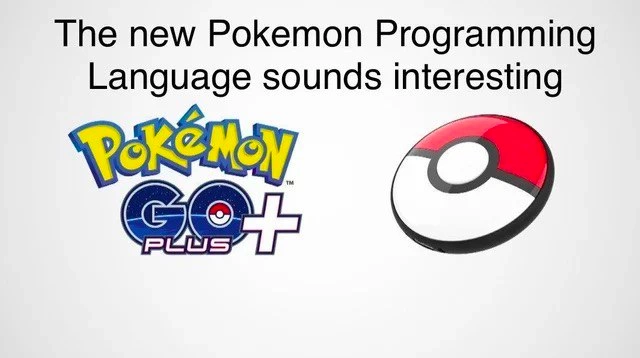
Let’s break down why this meme is funny in simpler terms. It’s all about a name mix-up between the world of programming languages and the world of Pokémon gaming. On the left of the meme image, there’s the official Pokémon GO Plus logo. Pokémon GO Plus is actually a physical device (a little Pokéball-shaped gadget) that players can use with the Pokémon GO mobile game. It flashes and vibrates when there are Pokémon or PokéStops nearby, so you can play the game without constantly looking at your phone. In other words, it’s a game accessory – definitely not a programming tool at all. On the right, there’s a big red-and-white Poké Ball icon, which is the classic symbol from Pokémon (the ball used to catch Pokémon). All of this clearly screams “Pokémon game”.
Now, here’s the twist: the text at the top says “The new Pokemon Programming Language sounds interesting”. Why would someone think a Pokémon gadget is a programming language? The joke comes from how the name “Pokémon GO Plus” sounds to a developer. In programming, there’s a language created by Google called Go (often referred to as Golang). There’s also a very famous language called C++ (pronounced “see plus plus”). That “++” part is actually taken from programming syntax – in languages like C, ++ means “add one” or increment. So C++ was named to imply it’s the next step up from the C language (a cute in-joke by its creators). Because of this, programmers often joke about any “plus” sounding like a new language version. For instance, if we saw something like “Java+” or “Python++”, we’d chuckle and think “oh, is that like a new advanced version of Java or Python?” It’s a language quirk that adding plus makes it feel like “the newer edition” of a language.
So, when a developer sees “Pokémon GO Plus”, their brain might split it into parts: “Pokémon”, “GO”, and “Plus”. “Go” by itself reminds us of the Go language, and “Plus” hints at C++ or an improved version of something. Put together, it humorously suggests “Pokemon Go++” or maybe a “Pokemon programming language with Go’s name”. Of course, there’s no actual Pokemon programming language – this is just a goofy misunderstanding! The meme is playing with the idea of naming confusion. In tech, we call this kind of mix-up a naming collision: two totally different things end up with names that look/sound similar. Here, a game device and a programming language collided in name.
Let’s clarify the terms and logos to see the difference between the tech meaning and the Pokémon meaning:
| Term/Logo | In Programming | In Pokémon/Gaming |
|---|---|---|
| Go | Go is a programming language created at Google (often called Golang). It’s used to write software, known for being simple and fast. When a developer hears “Go”, they might think of coding in Go. | “GO” in Pokémon GO is just an English word – the game wants you to go outside to catch Pokémon. It’s part of the title of a mobile game where you travel around. No coding involved! |
| Plus / ++ | “++” (plus plus) in code means “increment by one” or an improved version. For example, C++ was named to signify it’s one step beyond C. So programmers see “Plus” and might jokingly think of a new upgraded language version (like Language+ or Language++). | “Plus” in Pokémon GO Plus simply means an extra add-on. It’s not written as “++”, just a single plus sign “+” in the logo. It’s like how we say “iPhone 8 Plus” for a bigger iPhone. It indicates a bonus or enhanced product, not related to programming at all. |
| Poké Ball Icon | (Not a programming term!) It’s an image that any programmer who’s also a gamer would recognize as a Poké Ball from Pokémon. It doesn’t have a coding meaning – it’s there to make the meme obviously about Pokémon. | A Poké Ball is the iconic red-white ball used to catch Pokémon in the games and show. Seeing this image in the meme immediately tells any viewer, “hey, this is about Pokémon!” It’s a visual cue reinforcing the joke’s setting. |
In the meme, a developer sees the Pokémon GO Plus name and gets it totally wrong on purpose, for humor. The top text “The new Pokemon Programming Language sounds interesting” and the post caption “Finally a new promising language!” are written as if a developer is excitedly announcing this misunderstanding. It’s funny because it’s a techie inside joke: only someone who knows about programming languages like Go and C++ would make this kind of mistake or find it amusing. It blends a GamingReference (Pokémon GO, a hugely popular game) with a TechHumor punchline (the idea of a new programming language).
For a junior developer or someone new to coding, here’s why this resonates: in the programming world, there’s always buzz about new languages or frameworks. One week everyone’s talking about Go, next week it’s Rust or maybe a new thing called “F#” or whatever. Developers love exploring new tools – it’s almost like collecting Pokémon creatures, but instead you “collect” knowledge of languages! So the phrase “new promising language” captures that excitement. By contrast, Pokémon GO Plus is just a gadget update for a game – not actually a programming language – so it’s a humorous false alarm.
In summary, the meme takes advantage of a double meaning. “Go” and “Plus” mean something special to programmers, and they mean something totally different to gamers. The developer in the joke hears a Pokémon pun but interprets it as a coding topic. It’s the classic nerdy mix-up: our head is so full of code that even a Poké Ball makes us think of code libraries. LanguageComparison and LanguageQuirks come into play because it specifically riffs on how languages are named and versioned (Go vs Go+, C vs C++). Meanwhile, the PopCultureReference to Pokémon makes it fun and relatable, since almost everyone knows Pikachu and friends. This blending of contexts (a programming language announcement vs a game accessory) is what makes the meme witty. It’s basically saying: “Whoops, wrong context – not everything with ‘Go’ or a plus sign is a new coding language, my fellow developers!”
Level 3: Gotta Code 'Em All
At first glance, this meme mashes up programming language hype with Pokémon GO branding, creating a hilarious naming collision. The top text reads “The new Pokemon Programming Language sounds interesting” – and as seasoned devs, we immediately parse that like code. Why? Because the logo below says “Pokémon GO Plus”, and our engineer brains can’t help but see familiar patterns: Go (which we know as Google’s programming language) and Plus (which screams “++” in C-style languages). It’s as if someone announced a hybrid “Go++”, merging the names of Google’s Go with C++.
This is tickling the part of developer culture that’s obsessed with new languages. We’ve all seen the cycle: a shiny new language emerges (Rust, Kotlin, Elixir – you name it), and the tech community collectively loses it. Finally, a new promising language! – the meme’s caption nails that tongue-in-cheek excitement. The joke here is that the Pokémon GO Plus accessory (a little Bluetooth gadget for the Pokémon GO game) is mistaken for yet another programming language release. It’s poking fun at our tendency to hype up anything that sounds like it could be a new framework or language. In reality, Pokémon GO Plus has nothing to do with coding – it’s a wearable that lets gamers catch Pikachu with a click – but throw in a “Go” and a “Plus”, and developers will start imagining a language where variables are named after Charizard.
There’s also a deeper humor about naming in software. In computer science, one of the classic jokes is that “naming things” is one of the hardest problems. We reuse terms in confusing ways. Here, Go is a common word, but in our world it’s also the name of a popular language. Plus is just a word meaning “extra” in a product name, but coders see + and think of the ++ operator (which in C-derived languages means increment or “next version”). C++ famously got its name by incrementing C – literally, C++ in code would mean C = C + 1. So when we see “GO+”, our pattern-matching minds think “Go++” – perhaps an incremented form of Go, like a next-gen Go language. It’s a naming quirk being playfully exploited. The meme is essentially a PopCultureReference (Pokémon) meeting a TechHumor inside joke. It highlights how LanguageQuirks (like naming with “++” or “Go”) can cause bizarre misunderstandings across domains.
Seasoned developers also recall other times naming collisions caused confusion. For example, searching for “Go tutorial” could show the board game Go or the Golang docs. We’ve seen new language names clash with everyday words (Rust is a game and a language, Java is coffee and a language). We’re used to disambiguating with context. In this case, the context (a Pokéball icon and Pokémon logo) is blatantly non-programming, yet the meme’s humor is that a true code geek will momentarily ignore that and think, “Hmm, Pokémon GO Plus… is that like Go, but with an extension? Is it some funny new language to catch ‘em all with concurrency?” It’s absurd – imagine a programming language where you import a library of Pikachu to solve your problems! The sheer absurdity is the point.
Moreover, the meme gently ribs the “hype culture” in tech. Every few months there’s chatter about “the next big language” that will supposedly render all others obsolete. Many of us have jokingly said “Finally, a new promising language!” when we hear rumors on tech forums – half sarcastic, half curious. Here that phrase is applied to something obviously unrelated, which makes it even funnier. The developer in the joke is basically hearing what they want to hear. It’s like an over-eager Pokémon trainer seeing a rustle in the bushes and hoping it’s a legendary monster, but in reality it’s just the wind. We’ve all had those late-night delirious moments on Reddit or HackerNews where we misread a headline – “Wait, did Nintendo just make a framework? Oh… no, wrong context.” This meme captures that exact facepalm moment of realization, shared among experienced devs who’ve seen one too many “X++” names.
In short, the humor works on multiple levels for the initiated: it’s a pun on naming, a commentary on our community’s incessant craving for new tech toys, and a crossover between geeky interests (coding and Pokémon). By combining the Pokéball logo and the Pokémon GO Plus text with the language naming trope, it creates an instantly recognizable meme culture reference. We laugh because it’s so relatable – our brains are practically namespace analyzers, and sometimes that leads to monstrously funny misinterpretations. This time, the monster in the namespace was a Pikachu that our code parser tried to compile!
Description
A meme on a plain light-gray background with black text at the top that reads, 'The new Pokemon Programming Language sounds interesting'. Below the text, on the left, is the official logo for 'Pokémon GO PLUS', which features the classic yellow and blue 'Pokémon' text, with 'GO' styled inside a circle that resembles a Poké Ball, and the word 'PLUS' next to a blue plus sign. To the right of the logo is a 3D rendering of a Poké Ball, the iconic red and white sphere used for catching Pokémon. The humor comes from interpreting the product name 'Pokémon GO PLUS' as a new programming language. It leverages the fact that 'Go' is a well-known programming language developed by Google, and adding 'Plus' (or '++') is a common convention for iterating on a language, famously seen with C++. For experienced developers, this is a simple, relatable pun that plays on the constant proliferation of new languages and the naming tropes within the industry

Comments
7Comment deleted
Ah, 'Go+', the new language where you have to walk 10km just to hatch a segmentation fault
CTO just asked us to migrate to Pokémon Go +: apparently it’s like Go with generics, except you garbage-collect runaway goroutines by throwing a Pokéball at them
Finally, a language where catching exceptions is mandatory but you can only handle 6 different types at runtime before having to refactor your entire error handling strategy
When your product manager suggests adopting 'Go+' for the new microservices architecture, but you realize they've been playing Pokemon GO during sprint planning. At least the error handling would be more forgiving - just throw a Pokeball at the exception and hope for the best. Still probably more type-safe than JavaScript, though
Pokémon Programming Language? Basically Go++, where channels are Pokéballs and every goroutine you don’t catch evolves into a production leak - the compiler finally enforces “Gotta catch ’em all.”
Saw “Pokémon GO Plus” and read it as “Go++” - a language where if you don’t catch all your goroutines before main returns, they evolve into production incidents
Pokémon GO++: Where goroutines evolve into outages faster than a Magikarp into Gyarados