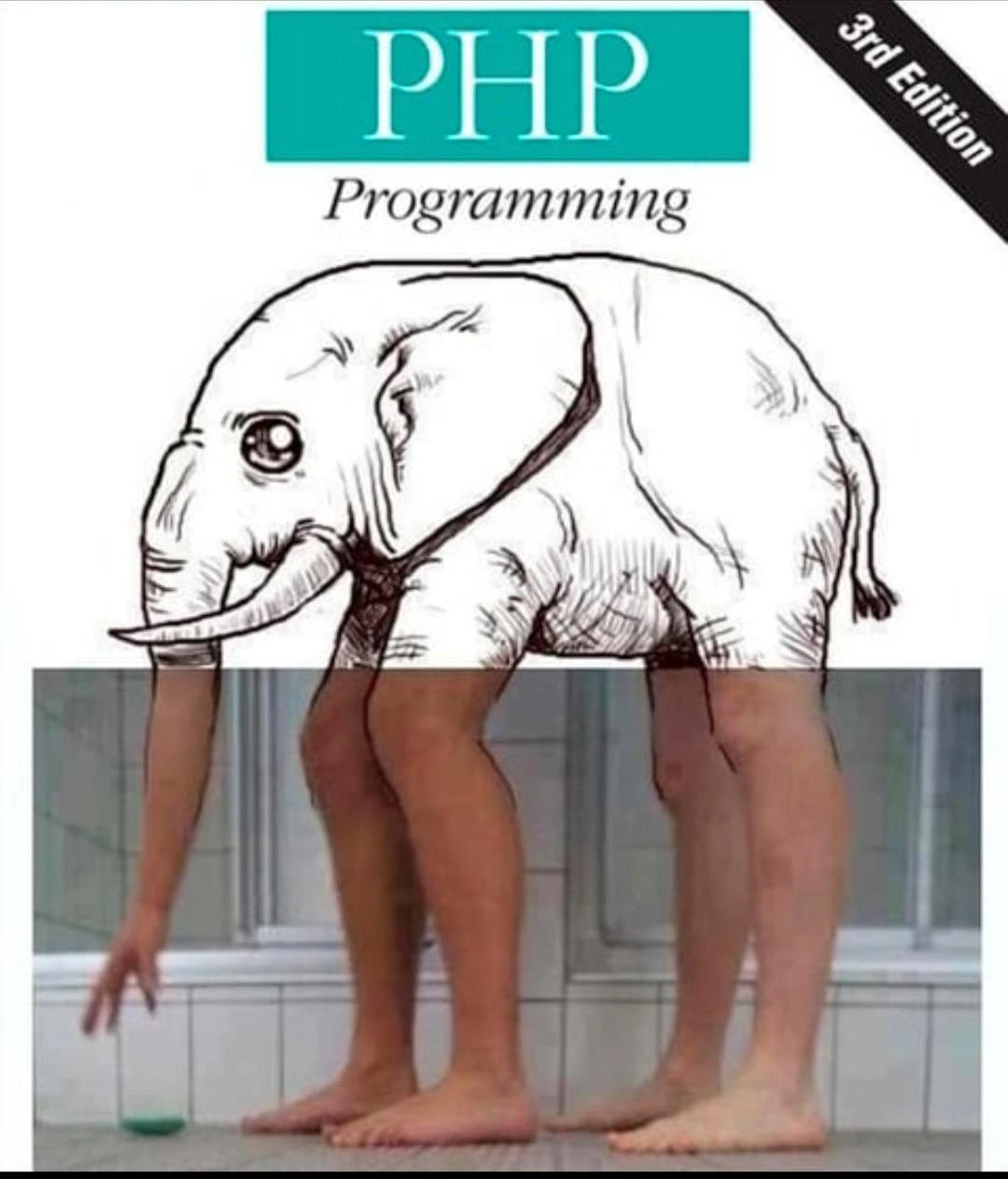
O’Reilly-style PHP book with elephant sporting human limbs mocks language quirks
Why is this Languages meme funny?
Level 1: Elephant Costume Fail
Imagine you have to make an elephant costume for a school play, but you don’t have all the right pieces. So, you take an elephant mask for the head, and then you use a human body costume for the legs. The result would look pretty silly – an elephant with people legs! Anyone can see the parts don’t quite fit together. This meme is funny for the same reason: it shows an elephant mixed with human legs to represent something that’s been hodge-podged together. The joke is saying PHP (a computer language) is built a bit like that mismatched costume. It may work well enough to use, but it sure looks goofy and inconsistent when you really look at it. Even if you don’t know programming, the picture of an elephant with the wrong legs is just plain silly – and that’s why it makes people laugh!
Level 2: Mixed-Up Mascot
Let’s break down the meme’s references and why they’re funny to developers. The picture is styled like a cover of an O’Reilly programming book. O’Reilly Media is a famous publisher in tech – their books (like “Learning Python” or “JavaScript: The Definitive Guide”) almost always have a distinctive cover featuring a single animal drawing. For example, a camel adorns the cover of the Perl book, and an elephant often represents PHP. In fact, the PHP community mascot is an elephant called the “elephpant” (a pun combining elephant with “PHP”). It’s usually a cute cartoon elephant that symbolizes PHP at conferences and on T-shirts.
In this meme cover, we do see an elephant – but something is very wrong with it! The top half is a normal outlined elephant illustration (just like a real O’Reilly cover), while the bottom half is a photo of human legs and arms posed to look like the elephant’s legs. It looks like a bizarre hybrid creature. This mash-up immediately signals that the image is a parody. It’s imitating the formal style of a book cover but subverting it with a silly, unsettling twist. The subtitle even says “Programming” and there’s a “3rd Edition” label, making it look just like a serious 3rd-edition manual. But of course, no real book would have such a ridiculous animal on its cover – that’s the joke. It’s visual satire.
Now, why choose an elephant with human limbs for PHP? This weird creature is making fun of PHP’s “patchwork” nature. PHP is a programming language used mainly in web development to build the backend of websites (things like form processing, database queries, generating HTML pages). It’s very popular – it powers huge platforms like WordPress – but it’s also infamous among developers for having many quirks and inconsistencies. PHP was not designed all at once; it started as a simple tool and lots of new features were added over the years by different people. Imagine a language that started small and then kept getting new parts bolted on: a bit of Java-like object orientation here, some borrowed syntax from C and Perl there, special-case functions for web stuff, etc. Over time, PHP became powerful, but it also ended up with a lot of odd parts that don’t match perfectly.
For example, PHP’s standard functions (the built-in tools it gives you) have inconsistent naming. One function might use snake_case_naming with underscores, while another similar function is all lowercase (nocasefunction) and another UsesCamelCase. There wasn’t one guiding style, because different functions came from different contributors at different times. This is confusing for newcomers – you have to memorize each quirk. Another example is how PHP sometimes handles data types loosely. PHP will often try to convert strings to numbers or vice versa on the fly. That can lead to weird situations, like the string "123abc" behaving like the number 123 if you use it in a math context. These are what we call language quirks – the little unpredictable things you just have to know about. Developers who have worked with PHP often collect these quirky experiences (and probably a few headaches along the way!).
So, the elephant in the image is a metaphor for PHP. An elephant with mismatched legs looks odd and thrown together, right? That’s how developers often describe PHP’s design: a bit clumsy and inconsistent, as if it were made of mismatched parts. The meme is basically saying, “PHP is like this weirdly assembled elephant – not a sleek purebred animal, but a funny mix-and-match.” This hits home for many web developers, especially those who have also used more uniformly designed languages like Python or Java. Compared to those, PHP can feel messy. Yet, PHP gets the job done – just like that awkward elephant is somehow standing and presumably walking. There’s affectionate humor in it: we poke fun at PHP’s oddities, but we acknowledge it’s still out there carrying loads (or websites) on its back.
For someone newer to programming, it helps to know there’s a long-running lighthearted rivalry between languages – often called language wars. Developers love to joke about the shortcomings of languages (especially ones they have struggled with). PHP has been the butt of jokes for years because of its hodge-podge history, while languages like JavaScript, Java, C++, and others have their own stereotypical jokes. This meme falls into that category of CodingHumor or TechSatire – using an exaggerated visual gag to poke fun at a language’s personality. Seeing the official PHP mascot – the elephpant – literally given a “half-baked” body makes anyone who’s dealt with PHP laugh and think, “Yep, that pretty much sums it up!”
Let’s also decode the “3rd Edition” label: that’s a common thing you’d see on updated programming books. It implies PHP has been around long enough to merit multiple editions of literature – indeed, PHP is on version 8.x as of 2022, and the official O’Reilly Programming PHP book has gone through several editions. By slapping “3rd Edition” on this fake cover, the meme adds a touch of realism (making it look like a real book) and maybe hints that by the 3rd edition, the language should be mature… yet the cover image suggests it’s still a bizarre creature. It’s a subtle extra irony for those who know the history: even after many versions (or “editions”), PHP hasn’t turned into a beautiful swan; it’s still a weird duckling – or rather, a weird elephant.
In summary, the meme uses the elephpant mascot in a silly mash-up to symbolize PHP’s clumsy combination of parts. It parodies the authoritative O’Reilly book style to amplify the joke: as if to say, “Here’s the honest cover for PHP – an animal that’s kind of a mess!” For a junior developer or someone new to this joke, the takeaway is: PHP is a hugely important web language, but even its own users jokingly admit it’s got an awkward, patched-together structure. This meme is a fun way the developer community nods and winks about that fact.
Level 3: Patchwork Pachyderm
This meme merges two iconic pieces of programming culture: the O’Reilly book cover style and the PHP community’s beloved elephpant mascot. O’Reilly’s programming books are famous for featuring a single animal on the cover (e.g. a camel for Perl, a snake for Python), each drawn in a consistent Victorian engraving style. Here, however, the familiar PHP elephant is grotesquely spliced with human limbs – a visual gag representing PHP’s patchwork design. Seasoned developers immediately recognize this Frankenstein-esque creature as a tongue-in-cheek metaphor for the PHP language itself.
PHP has a reputation for being a "Frankenstein" of a programming language – assembled from mismatched parts over decades. PHP started in the mid-90s as a simple set of CGI scripts (literally “Personal Home Page” tools) and evolved through ad-hoc additions rather than deliberate design. The result? A language core and standard library that can feel as jarring and cobbled-together as that elephant with human legs. Functions were added one by one by many contributors, leading to inconsistent naming schemes and parameter orders. A senior engineer will chuckle at how PHP’s standard library is a grab bag of functions like mysql_connect, mysqli_connect, and PDO::connect (all doing similar tasks in different eras), analogous to limbs from different species stitched onto one body. The meme’s uncanny elephant-humanoid hybrid perfectly captures this feeling of things that don’t quite belong together.
From a backend web development standpoint, the image is a nod to PHP’s evolution. Just as the elephpant in the picture stands on human feet, PHP stands on a foundation of uncoordinated features bolted on through versions 3, 4, 5, and beyond. For example:
Inconsistent function naming: PHP’s built-in functions have no unified naming convention. You’ll find snake_case names (
array_merge), others are lowercase without underscores (strpos), and some even use mixedCase or prefixes (mysqli_query). Each extension added its own style, revealing the language’s piecemeal growth.Odd parameter orders: The argument order in PHP functions can be confusingly inconsistent. For instance,
explode(delimiter, string)expects the delimiter first, butstrpos(string, substring)expects the string first. It feels like each function was designed by a different person (because often, they were!).Surprising type juggling: PHP will silently convert types in ways that senior devs joke about. The language tries to be helpful by auto-converting strings to numbers, booleans to strings, etc., which can lead to bizarre outcomes. For example:
<?php // PHP dynamically converts strings to numbers in arithmetic: echo "7 apples" + "2 oranges"; // Outputs: 9 // ("7 apples" becomes 7, "2 oranges" becomes 2) // Loose comparisons that catch newbies off-guard: var_dump("0" == 0); // bool(true), string "0" is treated as 0 var_dump("0" == "false"); // bool(true), "false" converts to 0 too! ?>These quirks feel as out-of-place as an elephant trying to walk on human legs. Seasoned PHP devs have learned these odd rules by heart (often the hard way), but they’re quick to joke that the language’s design is as uncanny as the creature in the meme.
The black “3rd Edition” ribbon on the image parodies how O’Reilly publishes new editions of classics like Programming PHP. A knowing reader might recall that by PHP 5 (around the third major iteration of the language), PHP tried to become more coherent – introducing a real OOP model and better practices – yet many of the old inconsistencies remained for backward compatibility. In other words, even as the language “matured” through editions, it never shed those human limbs it picked up along the way. This is the elephant in the room for PHP’s design: every improvement had to coexist with legacy baggage. The meme humorously illustrates that reality: PHP’s evolution was pragmatic but not pretty, much like a poor elephant ending up with a hodgepodge anatomy.
For veteran developers, there’s a darkly humorous undertone here. Many have war stories of wrangling legacy PHP codebases that feel like they were built by committee (or by mad scientists). The meme’s tech satire says it without words: PHP doesn’t have the sleek pedigree of some newer languages – instead, it’s the product of many quick fixes and language quirks accumulated over time. And yet, just as that odd elephant is somehow standing upright, PHP somehow powers a huge portion of the web (Facebook started in PHP, WordPress and Wikipedia still run on it). The animal might look strange, but it’s very much alive and kicking. This dual reality – ridiculous design, real-world success – is why seasoned devs smirk at the image. They recognize both the absurdity and the enduring practicality of PHP. In true O’Reilly fashion, the cover says “PHP Programming, 3rd Edition,” but the picture screams “Here be dragons (or rather, mismatched limbs)”. It’s a veteran coder’s inside joke about the chaotic evolution of a language that somehow just works, even if nobody would call it pretty.
Description
The image mimics an O’Reilly programming book cover labeled “PHP” in a teal block, with the subtitle “Programming” beneath it and a black corner ribbon reading “3rd Edition.” The familiar hand-drawn elephant mascot appears only from the torso up, while the bottom half is replaced by a photo of a person bent forward in a tiled bathroom so that their two arms and two legs line up as the elephant’s four legs. The mash-up creates an uncanny, slap-dash creature that visually represents how many developers perceive PHP’s patchwork evolution. By parodying both the O’Reilly animal series and the PHP “elephpant,” the meme humorously critiques the language’s design inconsistencies familiar to backend and web engineers
Comments
12Comment deleted
PHP: the O’Reilly animal that accepted every pull request - strict_types up top, register_globals in the knees, and it still thinks 0 == 'product-ready'
After 20 years in the industry, this is exactly how I feel maintaining that legacy PHP 5.3 app - like an elephant trying to walk on human legs through a minefield of mysql_* functions, register_globals, and magic quotes. At least the elephant remembers everything, unlike me trying to recall why we thought mixing HTML, SQL, and business logic in a single file was ever acceptable
PHP: where the elephant in the room has human legs because, much like the language itself, someone thought mixing incompatible parts without a coherent design philosophy was a perfectly reasonable architectural decision. At least the elephant is self-aware enough to know it's uncomfortable - which is more than we can say for the `array_` vs `str_` function naming conventions
PHP loose typing masterpiece: elephant head declares 'animal', runtime legs resolve to 'human'
PHP 3rd Edition: the elephant keeps walking by bolting on a new human leg for every backwards-compatibility promise - see also strpos(haystack, needle) right next to in_array(needle, haystack)
PHP in one picture: backward compatibility grafted the elephpant human legs, and the stdlib still can’t agree if the needle or haystack comes first - use === or get trampled
拍黄片 Comment deleted
please use english in this chat or add a translation Comment deleted
Bing chilling Comment deleted
uh-oh Comment deleted
This is making PHP look good Comment deleted
The least gay PHP dev be like Comment deleted