Skip to content
DevMeme
278 of 7435
Failing Upward: From Production Bug to Senior Title
Bugs Post #334, on Apr 25, 2019 in TG

Failing Upward: From Production Bug to Senior Title

Why is this Bugs meme funny?

Level 1: Training a Puppy

Imagine you have a puppy that you want to teach a trick. You can't explain the trick in words to the puppy, so you use a simple method: reward and punishment. When the puppy does something right (like sits when you say "sit"), you give it a treat and praise it – that's a reward. When it does something wrong (like chewing your shoe instead of fetching it), you say "No!" firmly or give no treat – that's a punishment (a gentle one, of course). Over time, the puppy figures out, "Okay, doing this gets me a yummy treat, doing that gets me nothing or a scolding," and it starts doing the good thing more.

Now, imagine your computer is the puppy. Instead of telling the computer exactly how to do a task with code, you just say to it, "Try to do something." The computer makes a guess at what you want. If it guesses correctly, you hit a "reward" button – essentially telling the computer "Good job, that’s what I wanted." If it guesses wrong, you hit a "punish" button – telling it "Nope, that wasn’t right." The computer, like a pet, will try to avoid the "punish" and aim for the "reward". After a bunch of tries and feedback, the computer eventually learns what you actually want it to do. This is funny because normally we program computers by giving them clear instructions step-by-step, not by treating them like a dog learning a new trick. The meme makes us laugh by showing a pretend scenario where programming a computer is literally like teaching a puppy – using treats and scoldings instead of code – which is a very silly way to imagine getting a computer to do things!

Level 2: Trial & Error Programming

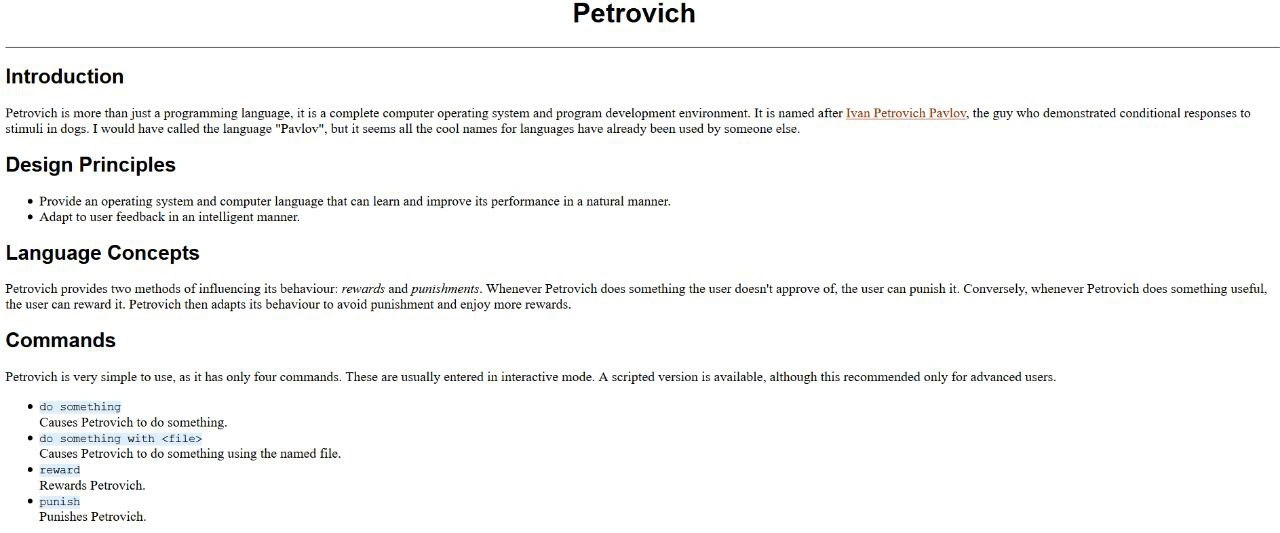
For a less experienced developer or someone new to these concepts, let’s break down what’s going on. The meme’s Introduction text actually declares that Petrovich is “more than just a programming language, it is a complete computer operating system and program development environment.” That’s a bold (and humorous) claim. Typically an operating system (OS) is core software like Windows or Linux that runs your whole computer, and a development environment is the set of tools you use to write and build programs. By claiming to be a complete OS and environment, Petrovich is basically saying, “You don’t need any other software – just train me to do anything you want.” This over-the-top promise is part of the joke, parodying how some tech projects hype themselves as revolutionary all-in-one solutions.

In a typical programming language, you (the programmer) write explicit instructions for the computer to follow. For example, if you want to open a file and print its contents, you’d write code that says something like "open the file named X, read text from it, then display that text." The computer does exactly what you tell it, step by step, because that’s how traditional programming works.

Petrovich turns that normal process upside-down. Instead of giving the computer step-by-step instructions, the "programmer" in this scenario merely gives feedback on the computer’s behavior. The only real commands you have in Petrovich are unusual ones like:

  • do something (or do something with <file>): This tells Petrovich to attempt some action. It’s deliberately vague – you’re basically saying “Hey computer, try doing something (you figure out what).”
  • reward: This is like saying "Good job!" to the computer. You issue reward after Petrovich does an action you approve of or find useful.
  • punish: This is like saying "Bad computer, that’s not right." You use punish after an action that was not what you wanted.

So how does Petrovich decide what to do when you say do something? This is where the reinforcement learning concept comes in. Reinforcement learning (RL) is a type of machine learning where an agent (here, Petrovich) learns how to behave in an environment by performing actions and receiving feedback. It's analogous to how you might train an animal or play a hot-and-cold game with someone: the agent tries different things and learns from the feedback which actions are good or bad. The agent’s goal is to discover a way to get lots of rewards and avoid punishments.

Imagine you want Petrovich to perform a simple task, like opening a file and displaying its contents on the screen. In a normal programming scenario, you’d write something straightforward in code:

with open("report.txt") as f:
    data = f.read()
    print(data)

But in Petrovich’s world, you might do something like:

> do something with report.txt

At this point, Petrovich will guess an action involving "report.txt". Maybe it tries to open the file (good!), or maybe it deletes the file (uh oh!), or it could rename it, or launch another program to edit it — it’s not constrained, since do something is open-ended. Let’s say the first thing it tried was not what you wanted (perhaps it made a copy of the file instead of printing it). You would then provide feedback:

> punish

This tells Petrovich "that was not correct or useful." Petrovich (the system) will internally note that whatever it just did resulted in a punishment, so it should try something different next time. Now you try again:

> do something with report.txt

Petrovich will attempt a different action this time (because it’s trying to find an action that might get a reward instead). Suppose now it successfully prints the file’s contents on screen – great! You would then type:

> reward

to tell Petrovich "Yes, that’s what I wanted." Petrovich treats that like a treat for a pet: it's positive reinforcement. The next time you ask it to do something with a text file, it’s more likely to do the printing action (since that led to a reward before), and less likely to do the things that got it punished (like deleting the file).

In summary, you’re not programming the solution directly; you’re guiding Petrovich to find the solution itself by trial and error. The computer is effectively programming itself based on your feedback. You keep nudging it toward the correct behavior by saying "good computer" or "bad computer" at the right times. This is why we call it "trial & error programming" here – the solution is discovered through many tries and feedback cycles, not through a pre-written algorithm.

Now, what makes this funny and not a serious proposal? For one, no real programming language works like this, especially not for general problems! This idea is taking a machine learning training loop and imagining it as the way a developer would write programs. In real life, training a system via reinforcement learning can require thousands or millions of trial runs to learn something non-trivial. The meme jokingly imagines a programmer sitting there typing "do something... reward... do something... punish..." over and over. That’s clearly impractical — you’d probably lose your mind (or your patience) if you actually had to train software by hand like that for every task. It’s a comedic exaggeration of how labor-intensive teaching a machine can be if done naively.

The name "Petrovich" itself is a clue to the joke’s inspiration. Ivan Petrovich Pavlov was the scientist known for conditioning dogs to associate a bell with getting food. In his famous experiment, dogs would hear a bell (stimulus) and then get fed, so eventually just ringing the bell caused them to drool, expecting food. Petrovich (the language) is named after Pavlov to highlight that it’s about conditioning the computer with feedback. In fact, the text says, “I would have called the language 'Pavlov', but it seems all the cool names for languages have already been used by someone else.” That’s a playful remark on two things: one, the obvious reference to Pavlov was considered but "Petrovich" was used instead (Petrovich is Pavlov’s first name, or actually his patronymic, used humorously as a stand-in); and two, it jabs at the challenge of naming new programming languages. There are so many languages that creators often joke all the good names (especially short, catchy ones) are taken. Here the author humorously pretends "Pavlov" was taken, so he went with another related name.

Esoteric programming languages (often called esolangs) are a whole category of joke or experimental languages in the programming world. They’re not meant for real-world use, but for fun, art, or to make you think differently about programming. Petrovich is exactly in this vein. For context, one famous esolang is Brainfuck (pardon the language, but that’s its name) which has only 8 single-character commands and is intentionally very hard to program in. Another example is LOLCODE, which lets you write programs using memespeak (for instance, a program might start with HAI and end with KTHXBYE). There’s also INTERCAL, which was designed to be as unlike any real language as possible (it even has a PLEASE keyword you have to use enough to appease the compiler). Petrovich joins this crowd as a parody language where the "code" is just you interacting with an AI in a training loop. It’s not real; it’s more of a humorous thought experiment for programmers.

Let’s look at the Design Principles listed. They talk about Petrovich learning and improving naturally, and adapting to user feedback intelligently. Those principles sound lovely – in fact, they sound like objectives you’d find in a research paper on adaptive systems or a marketing brochure for some AI-driven software. But seeing them in a programming language spec is very unusual. Normally, programming language design principles are things like simplicity, consistency, performance, etc. Here it’s about learning from the user, which hints that Petrovich isn’t going to operate like a normal deterministic program. A new developer might think "Cool, the computer can learn from me," but an experienced person reading that will smirk because it implies the computer initially doesn’t know how to do anything and you have to teach it like a toddler. That’s both amusing and a bit daunting!

The Language Concepts section confirms the core idea: Petrovich has two methods for you to influence it – rewards and punishments. It states that whenever Petrovich does something the user doesn't approve of, the user can punish it, and whenever it does something useful, the user can reward it. If you interpret that in everyday terms, it’s exactly how you train a pet (or even how you might use positive/negative reinforcement in parenting or coaching). It’s written in a dry, technical tone, as if this is a normal feature of a system, but it’s describing something very human and behavioral. That contrast – formal documentation voice talking about essentially treats and scoldings – is what makes many people grin when they read it.

Now check out the Commands list in the meme. Petrovich offers only four commands in total! Usually, a programming language has lots of keywords and built-in functions, but here we just have:

  • do something / do something with <file>
  • reward
  • punish

This extreme simplicity is part of the joke. It suggests that you, the user, don’t need to know any specific syntax or APIs – you literally just tell the computer to do something and then respond with reward or punishment. It sounds easy because there are only a couple of commands to remember, but of course that simplicity is deceptive: the hard part is that the computer initially has no clue what to do to accomplish your goal. All the complexity is hidden in Petrovich’s learning behavior. For a newcomer, it’s like saying "Here’s a super simple programming language," but the catch is, you have to spend a lot of time teaching it every little thing from scratch!

According to the meme's page, you would typically enter these commands in an interactive mode, kind of like a conversation with the computer (you type a command, see what happens, then type feedback). They also mention a "scripted version" is available (meaning you could write a sequence of these commands in a file and let Petrovich execute them automatically), but they recommend it only for advanced users. That little detail is poking fun at how convoluted this whole idea is. If you think about it, writing a script to automate the reward/punish process means you're basically writing a normal program (a script of commands) to train the Petrovich program. It's an absurd extra layer. The documentation tongue-in-cheek suggests that if you’re skilled enough to script the training process, you probably realize how unnecessary and crazy this approach is in the first place! It’s an example of the meme being self-aware in its silliness.

The big picture is: Petrovich isn’t a real language or system you’d use, but it combines real concepts in a ridiculous way. It’s mixing ideas from machine learning (trial-and-error learning, feedback loops) with the format of a programming language manual. The humor works on a couple of levels. If you’re new to coding, the idea of teaching a computer like a pet might just seem like a funny concept. If you know about machine learning, you appreciate how accurately this mirrors reinforcement learning, and you also know why we wouldn’t actually want to program our everyday software this way. And if you’re familiar with esoteric languages, you nod at how this fits that tradition of turning programming upside-down for giggles. In plain terms, it’s funny because it’s as if someone wrote a user’s guide for training your computer to code itself using treats and reprimands – a scenario that is both imaginative and patently absurd when compared to how things really work.

Level 3: Carrot & Stick Coding

To an experienced developer, this meme is a goldmine of satirical commentary on programming and AI hype. It pokes fun at the idea of "programming by training" — a notion that’s tantalizing in theory but ludicrous in practice. Instead of writing explicit code, Petrovich has the programmer guide it with rewards and punishments. This is essentially carrot-and-stick coding: you offer a proverbial carrot (reward) when the system does something right, and you whack it with the stick (punish) when it goes astray. It’s a playful jab at the dream of self-writing software. We've all heard lofty promises like "AI will write code for us!" or "Just tell the computer what you want, and let it figure out the how." Petrovich takes that to an absurd extreme by literally having the computer figure out everything through trial-and-error, while the human just says "good job" or "bad job." Seasoned engineers will smile (or groan) at this because we know how far reality is from that fantasy.

The structure of the screenshot is immediately recognizable to anyone who's read technical documentation: Introduction, Design Principles, Language Concepts, Commands – it mimics the formal tone of a language spec or an OS manual perfectly. The humor is that each section, when you read it, is totally absurd. The Introduction grandiosely declares Petrovich to be "more than just a programming language, it is a complete computer operating system and program development environment." That's an over-the-top claim echoing how some ambitious projects pitch themselves. (It brings to mind historical all-in-one systems like Lisp Machines or Smalltalk environments – but those didn't learn from treats and scolding!) By dropping Pavlov’s name and the notion of conditional responses, the intro hints at the central joke: this "language" doesn't have classical syntax or algorithms, it has behavior that you shape through experience.

For a senior dev, the mention that "all the cool names for languages have already been used" elicits a knowing chuckle. Naming things in programming is notoriously hard – there’s even a classic joke that the two hardest problems in CS are naming, cache invalidation, and off-by-one errors. Here the author laments that he couldn't even name his new creation "Pavlov" because someone beat him to all the good names. It's a tongue-in-cheek nod to the proliferation of programming languages and how creators scramble to find unique monikers. (In reality, there's probably no serious language named Pavlov – the author is just humorously justifying the quirky name "Petrovich," which itself sounds amusingly old-school.)

Moving on to the Design Principles section: it lists ideals like learning and improving performance naturally and adapting to user feedback. These sound plausible at first glance—who wouldn't want a system that optimizes itself and learns from users? In fact, such lines could come straight out of modern AI product brochures or academic papers on adaptive systems. But a veteran developer will immediately think about the practical implications: "Wait, so the OS will change its behavior based on my feedback? How do I even consistently give feedback, and what if it learns the wrong thing?" We all know how machine learning models can latch onto unintended patterns. The meme doesn’t spell that out, but it relies on our understanding that "learning from feedback" is much easier said than done. It’s a sly reference to the unpredictability of ML systems. When you put a model in the loop, sometimes you get hilariously incorrect behavior before it learns the right thing (if it ever does). Those bullet points under Design Principles sound like managerial wish-list items that an engineer might roll their eyes at, because there's a gulf between such rosy goals and the messy reality of implementing them.

The Language Concepts section is where the Pavlovian analogy fully surfaces. It explicitly says Petrovich’s behavior is influenced by rewards and punishments. The seasoned reader immediately recognizes this as the core loop of reinforcement learning and maybe recalls times they've fiddled with reward functions while training an RL model. The text dryly explains: "Whenever Petrovich does something the user doesn't approve of, the user can punish it. Conversely, whenever Petrovich does something useful, the user can reward it." This is phrased like a normal language feature description, but it’s describing something closer to training a pet or perhaps how we raise a child. The humor lies in treating this feedback loop as if it were just another programming construct. Veteran devs might think, "Sure, my code often feels like an unruly pet, but I don't usually literally punish the computer when it misbehaves!" It's a personification of software development: instead of debugging by reading logs or stack traces, you're ostensibly debugging by saying "bad computer, don't do that again" and hoping it learns.

Under Commands, we see only four commands listed:

- `do something` – Causes Petrovich to do something.
- `do something with <file>` – Causes Petrovich to do something using the named file.
- `reward` – Rewards Petrovich.
- `punish` – Punishes Petrovich.

This minimal command set is a hallmark of an esoteric language parody. Many esolangs intentionally have very few commands (Brainfuck has 8 simple commands, for example) or bizarrely defined ones. Here, instead of typical operations like "add, print, goto," we get this ultra-minimalist approach: essentially one do-stuff command and two feedback commands. A senior programmer knows that any useful task normally requires a sequence of precise operations; seeing just "do something" as the catch-all action is hilariously vague. It's like an inside joke about vague software requirements – when a product manager says "Just have the system do the thing with the file," and the dev is left thinking what thing, exactly? Petrovich's answer: "Don't worry, I'll just try stuff until you tell me I'm right." It's an exaggerated send-up of poorly specified tasks.

The notion of an interactive mode where you type do something and then either reward or punish is comedic gold for those who have trained ML models or even debugged code by iterative guesswork. Imagine a coding session:

$ do something
# Petrovich performs some mysterious action...
$ punish   # You: "Nope, not that!" 
$ do something with report.doc
# Petrovich tries another random operation involving 'report.doc'...
$ punish   # "Wrong again!"
$ do something with report.doc
# Petrovich attempts a different operation this time.
$ reward   # "Aha, that did what I wanted, good job!"

An experienced dev reads this and thinks two things: (1) "That looks incredibly inefficient," and (2) "Yup, that’s basically how reinforcement learning works." In real machine learning, we automate this loop and let the computer grind through thousands of trials super-fast. But here the meme frames it as a manual, interactive process, which is absurd. It’s making fun of the way ML often requires tons of small adjustments and feedback cycles – something a lot of practitioners know all too well. It's like doing hyperparameter tuning by hand, one step at a time. 😅

The line about a scripted version being available "only for advanced users" is another wink to the audience. Scripting typically simplifies tasks for users, but calling it advanced here hints that writing a script to automate Petrovich’s training might itself be complex or counterproductive. If you think it through, scripting Petrovich would mean writing a conventional program (in some other language or Petrovich’s batch mode) to feed it a series of do, reward, punish commands. Essentially, you'd be writing a program to train your program – an extra meta layer that experienced folks recognize as comically convoluted. It's as if the documentation is cautioning: "You could try to automate the training process, but if you're skilled enough to do that, maybe you should just write a normal program!" This resonates with any developer who has seen over-engineering in action or Rube Goldberg solutions in code. It’s layering one abstraction (machine learning) on top of another (scripting) just to accomplish something basic.

Moreover, the dynamic depicted is a sly commentary on developer workflows. Many senior devs have experienced "tuning by feedback" in various forms. For instance, think of performance optimization: you tweak some code or config, run it, see if it got faster; if it did, great (reward that change by keeping it), if not, revert or modify (punishment). Or debugging: you change one thing at a time and test — a kind of guided trial-and-error. Petrovich exaggerates this by removing the coding part and making the computer the one doing the trial-and-error. But the catch is, someone still has to judge each attempt. In a way, it’s a satire about extreme automation: "Look, Ma, no coding! (But I’ll be here clicking reward/punish 10,000 times...)" A senior developer recognizes that despite all our fancy tools, a lot of software development does involve iterative refinement. The meme just literalizes the feedback loop and strips away everything else.

Another angle: this meme gently ridicules the current trend of AI-assisted coding. Tools like GitHub Copilot or automated code generation are in vogue, where the AI suggests code and the developer accepts (rewards) or rejects (in a sense, punishes by ignoring) the suggestions. Petrovich is like an extreme, dystopian Copilot – it won’t just suggest a line, it will run the whole show and you have to continuously guide it. The veteran in us finds this scenario funny because we know how often those AI suggestions can be off-base. Imagine if instead of just dismissing a poor suggestion, you had to explicitly punish the AI with a command — and if you forget to reward it for a good suggestion, it might not realize it did well! It's exaggerating the slight awkwardness that already exists using ML in programming into a full-blown ridiculous interaction model.

Finally, there's an underlying camaraderie in this humor: only those who've wrestled with both code and machine learning will fully appreciate all these nuances. It's a multi-layered inside joke. There's the surface absurdity (training a programming language like a dog), and then there are layers of references: to Pavlov and Skinner, to the pitfalls of ML, to the quirks of documentation, to the frustrations of vague requirements. It's the kind of thing you forward to your dev friends with the note "LOL, remember that nightmare project where we basically did this?" It's cathartic because it captures, in a warped mirror, some of the trials (and errors!) of real development. In short, for the seasoned crowd, Petrovich is a brilliant parody of both AI in software development and the eccentric creativity of language design, rolled into one painfully funny package.

Level 4: Pavlovian Programming Paradigm

The Petrovich meme mashes up the concept of an esoteric programming language with fundamentals of reinforcement learning (RL) to create an absurd "self-learning" development environment. In reinforcement learning theory, an agent interacts with an environment by taking actions and receiving scalar feedback in the form of rewards or punishments (negative rewards). Here, Petrovich itself plays the role of the agent, the operating system is its environment, and the user's reward or punish commands directly serve as the reinforcement signal:

  • State ($s$): The system's current context or condition (e.g., the state of the OS or program at a given step).
  • Action ($a$): do something (optionally with <file>), representing any operation Petrovich can attempt.
  • Reward ($r$): The user issuing reward (positive feedback) or punish (negative feedback) after observing Petrovich's action.
  • Policy: Petrovich's strategy for choosing the next action, which it adjusts over time to maximize cumulative reward (and avoid punishment).

In a formal RL framework, Petrovich would iteratively update its policy based on the feedback. For example, a basic Q-learning update might look like this:

$$ Q_{\text{new}}(s, a) = Q_{\text{old}}(s, a) + \alpha \Big( r + \gamma \max_{a'} Q_{\text{old}}(s', a') - Q_{\text{old}}(s, a) \Big)~, $$

where $Q(s,a)$ estimates the value (expected reward) of taking action $a$ in state $s$. Here $\alpha$ is a learning rate and $\gamma$ is a discount factor for future rewards. In the Petrovich paradigm, we could interpret a reward command as a positive $r$ and a punish as a negative $r$. Over time, this iterative process would theoretically train Petrovich to favor actions that lead to rewards and shun those that lead to punishments.

The meme’s reference to Ivan Petrovich Pavlov, famous for conditioning dogs to salivate when a bell rang, underscores this feedback-based learning model. Strictly speaking, Pavlov's experiments were about classical conditioning (passively associating a neutral stimulus with an involuntary response), whereas Petrovich’s approach is closer to operant conditioning (actively learning behaviors through reward and punishment, as pioneered by B.F. Skinner). In classical conditioning, the dog learns that “bell predicts food,” but it doesn’t choose actions. Petrovich, by contrast, must choose an action (do something) and then learn from the consequence much like a lab rat in a Skinner box pressing levers for treats. This academic nuance is part of the humor: the language is named after Pavlov, but it behaves more like a willing (or perhaps hapless) Skinnerian agent, learning by trial-and-error at the user’s mercy.

From a programming language theory perspective, Petrovich is a tongue-in-cheek exploration of what it means for a language to be Turing complete or to have well-defined semantics. Traditional languages have formal syntax and deterministic semantics – you write explicit instructions and the machine predictably executes them. Petrovich upends this: its "programs" emerge from an adaptive process. There is no static source code beyond invoking do something repeatedly; the "code" is essentially the agent’s internal policy shaped over time. This raises theoretical questions a seasoned computer scientist might chuckle at: Is Petrovich Turing-complete if the user can eventually train it to perform any computable function? In principle, if Petrovich’s action space and memory were unbounded, a sufficiently clever sequence of rewards could coerce it into implementing arbitrary algorithms (making it a bizarre Turing tarpit candidate). However, proving or using that in any practical sense would be insanely difficult – much like trying to train a neural network to act exactly like a sorting algorithm or a web server without ever coding those behaviors directly. It's theoretically possible, thanks to the universal approximation power of learning systems, but practically absurd.

On the operating system (OS) front, the meme’s claim that Petrovich is a "complete computer operating system and program development environment" hints at a satirical take on autonomic computing or self-modifying code. A real OS manages hardware and schedules processes predictably; envisioning one that learns from user feedback is outlandish. An OS with a built-in reinforcement loop might, for instance, try different methods of allocating memory or organizing files and only stick with those that users "reward" (perhaps by the system running faster or the user explicitly giving a thumbs-up via reward). In practice, such a system would be unstable and non-deterministic. One core reason real operating systems avoid randomness in their core algorithms is to maintain reliability – you don't want your OS guessing what to do next. The Petrovich design violates this principle entirely for the sake of humor, proposing an OS that effectively searches for good strategies by potentially doing all sorts of crazy things until it finds one you like.

This brings up the crucial RL concept of exploration vs. exploitation. Any learning agent needs to explore new actions sometimes (even ones that might be suboptimal) to discover if there are better outcomes available, rather than always exploiting the current best-known action. In a safe simulation (like training an AI to play a video game or navigate a maze), exploration is encouraged and controlled – the worst outcome is the agent fails a virtual task and tries again. But imagine an OS-level agent "exploring" on your actual computer: today it decides to "do something with <file>" by deleting a random file or altering a config, just to see if you'll reward it. The thought of a computer taking random exploratory actions on your real data is as hilarious as it is horrifying. It’s an implicit joke here: Petrovich’s design principles talk about learning and adapting "in a natural manner," but seasoned developers know that letting a system randomly mutate itself in the hope of stumbling on optimal behavior is a recipe for disaster in real-world computing. It's the digital equivalent of training a pet by letting it loose in your house to see what antics it gets up to, then scolding or praising – it might eventually learn not to break things, but your house (or computer) could be a mess by then!

Historically, the idea of programs that improve via feedback loops has appeared in research and fiction more than in production systems. Early AI research in the 1980s and 1990s explored genetic algorithms and genetic programming, where programs evolve over generations with selection pressures (somewhat analogous to reward). Those techniques essentially perform trial-and-error search in the space of programs, guided by a "fitness function" (the closer a program's output to the desired output, the higher its fitness). Petrovich can be seen as a comedic simplification of that concept: rather than an automated fitness function, you have a human in the loop saying "good program" or "bad program" after each attempt. There's also a parallel to interactive machine learning, where humans iteratively label or correct an AI's outputs to refine it (like telling a spam filter "this is spam" or "this is not spam" to train it). However, packaging this interaction as the primary interface for programming an entire system is what makes Petrovich laughably impractical.

No mainstream language or OS uses a direct reward/punishment interface because it turns programming (which is already complex) into an even more complex search problem. Seasoned engineers recognize that while machine learning is powerful for certain tasks (like image recognition or game playing), we still prefer good old deterministic code for critical logic because it’s understandable, testable, and reliable. The meme deliberately ignores all those practicalities for the sake of an absurd design document. It's essentially saying, "Here's a language where you don't write code at all — you just train the computer like you would train a dog." By invoking high-level technical ideas—an esoteric language, an AI learning algorithm, and an OS—simultaneously, it creates a stew of nerdy concepts. The humor emerges from the clash between the formal tone of a technical document and the sheer madness of its content. Anyone versed in these areas can appreciate the layers: on paper this touches advanced topics (AI feedback loops, programming language design, even cognitive psychology), but in execution it's delightfully satirical.

Description

A meme featuring a young man with dark hair, wearing a black t-shirt, looking directly at the camera with a smug, self-satisfied smile. The background is a plain, light-colored wall. An overlay of white text at the top of the image reads, 'When you introduce a bug into production but it's so complex that they make you a senior'. The humor stems from the ironic situation where a costly mistake, instead of leading to negative consequences, results in a promotion. For senior developers, this satirizes a common organizational flaw where the person who created a complex problem is seen as the only one who can manage it, mistaking their niche, self-inflicted expertise for genuine seniority and indispensability. It's a cynical take on 'failing upwards' in a corporate environment
Comments

8
Anonymous ★ Top Pick My last bug was so architecturally significant they gave me a team to maintain it. We call it the 'volatile dependencies' group, and our primary KPI is not touching anything
  1. Anonymous ★ Top Pick

    My last bug was so architecturally significant they gave me a team to maintain it. We call it the 'volatile dependencies' group, and our primary KPI is not touching anything

  2. Anonymous

    Petrovich: finally a DSL that formalises code reviews - run, wait for the Pavlovian “LGTM” bell, else take a nit-pick shock and refactor until you salivate at pre-commit hooks

  3. Anonymous

    Finally, a programming language that accurately models the relationship between developers and production systems: desperately trying to train something unpredictable while hoping it doesn't learn the wrong lessons from that one time you deployed on a Friday

  4. Anonymous

    Petrovich was decades ahead of its time - we now call 'do something, then punish or reward it' RLHF and raise billions for it

  5. Anonymous

    Finally, a programming language that captures the true developer-compiler relationship: an endless cycle of punishment for bugs and occasional rewards when it compiles. Though I suspect most production systems would quickly develop learned helplessness after their 47th deployment rollback, and the 'punish' command would just trigger a stack overflow from overuse. At least when Petrovich starts drooling at the sound of a build notification, we'll know the conditioning is working

  6. Anonymous

    Petrovich’s API is “do”, “do with <file>”, “reward”, “punish” - aka RLHF for prod; after two incidents it converges to the only globally optimal policy: idempotent no‑op

  7. Anonymous

    Petrovich: The OS where 'counting sheep' blocks forever - just like your PhD advisor's feedback loop

  8. Anonymous

    Finally, a language that mirrors enterprise ops: call do_something; if SLOs hold, reward(); if PagerDuty screams, punish(); after a few sprints the optimal policy is a no‑op wrapped in a success log

Use J and K for navigation