When Corporate Culture Tries to Patch the Linux Kernel
Why is this OpenSource meme funny?
Level 1: Using Nice Words
Imagine a classroom where one student sometimes shouts a really bad word when he gets angry. One day, the teacher says, “Instead of using that word, let’s all use a nice word like ‘hug’ when we feel mad.” So the next time the student is super frustrated, he stands up and yells, “What the hug?!” Everyone in class starts giggling. We all know he wanted to say something much meaner, but he had to replace it with a friendly word. It sounds so silly and out-of-place that you can’t help but laugh. The kid is still just as upset as before, but now it’s like his anger is wearing a big cuddly costume. This meme is funny for the same reason: it shows a situation where a really angry, not-so-nice expression gets turned into something sweet and polite. It’s like putting a happy face sticker over an angry face – it might look nicer, but the angry feelings are still peeking through, which makes the whole thing feel ridiculous and amusing.
Level 2: No More F-Bombs
For a newer developer, this scenario might sound a bit confusing or random. Here’s what’s happening and why it’s funny:
- Linux kernel – This is the core part of the Linux operating system, kind of like the brain of the OS that controls everything on your computer. Linux is OpenSource, meaning its code is publicly available and anyone can contribute improvements or fixes. People from big companies (like Intel) and independent programmers all work together on it.
- Patch – In software, a patch is a set of changes submitted to the codebase. Think of it as a proposal: “I changed these lines of code; should we include this change?” Linux development happens through patches emailed or submitted to maintainers (the folks in charge of different parts of the code). They review patches to decide if they should be added. Patches can do all sorts of things – add features, fix bugs, clean up code comments, you name it.
- Code of Conduct – This is a document that a community (like the Linux developers) adopts to set rules for how members should behave. In 2018, Linux adopted a new code of conduct to encourage everyone to be more respectful and welcoming. Before this, the tone on the mailing lists could be very harsh. The code of conduct basically says “be respectful, no harassment, and yes, that includes not using nasty language or personal attacks.”
- F-word and F-bombs – The “F-word” refers to the curse word “f**k.” Dropping an “F-bomb” means someone used that word (because it’s like a big explosive word in a conversation). Linus Torvalds and others were famous for occasionally peppering their communications with F-bombs when they were extremely frustrated. For example, a developer might write in a message: “This code is so f***ing broken.” It’s not polite, but it conveyed how strongly they felt! Under the new rules, that kind of wording is discouraged.
- The proposed patch (joke) – The meme jokingly claims that an Intel developer had an idea: go through all the Linux code and comments and replace every instance of the F-word with the word “hug.” This is not a typical kind of patch – usually patches fix technical issues, not social ones. That’s why it’s funny. It’s imagining a very literal fix: since the maintainer guidelines now say “no profanity,” someone writes a script to scrub the profanity out of the repository itself. It’s like using a filter to make the whole project G-rated.
- What “excuse me what the hug” means – There’s a popular internet meme phrase “excuse me, what the f***?” used when something is so surprising or absurd that you do a double-take. It usually has a funny image with it. Here, the phrase has been turned into “excuse me, what the hug?” to follow the new no-swearing rule. It reads like a shocked reaction from a developer who just heard about this patch – they want to say “what the f***?!” but they’ve dutifully replaced the forbidden word with “hug.” The phrase itself sounds goofy, which is the point.
- Why it’s humorous – Replacing a harsh swear word with a gentle word like “hug” creates a huge contrast. It’s as if a very angry sentence put on a big smile. Developers know that if you’re mad enough to use an F-word in a comment, swapping in a cute word doesn’t magically make you calm or the situation less severe. It just makes the wording bizarre. For example, imagine a comment in the code was:
After the patch, it might become:// This function is so f***ing slow, it ruins performance.
Now the comment sounds kind of funny – the person was clearly upset about the slow code, but now it reads like they’re upset and giving you a hug about it. It’s a silly mismatch in tone.// This function is so hugging slow, it ruins performance. - Commit message etiquette – This refers to how you write the notes that go with your code changes (commit messages). Good etiquette means being clear, concise, and professional. Many projects (especially after adopting a code of conduct) ask developers to avoid rudeness or crude language in these messages. The meme’s scenario is basically an extreme enforcement of etiquette: imagine a rule that any rude word in your commit gets auto-replaced with a friendly word. It’s taking a serious guideline and pushing it to a comical extreme.
- In summary, the meme uses exaggeration to poke fun at the idea of “policing tone” in a huge open-source project. Linux developers are passionate, and sometimes that came out as cursing. The new culture asks them to be kinder. The joke is, instead of trusting people to behave, what if we just technically filtered out the bad words? It’s funny because real life is more complicated – you can’t truly solve a human issue (people being rude) just by editing words. But picturing it leads to comic moments like “hug-filled” error messages and comments. It’s a blend of DeveloperHumor and a touch of sarcasm about changing long-standing developer culture with simple rules.
Level 3: Code of Cuddles
For veteran Linux developers, this meme hits close to home by riffing on a dramatic culture shift in the open source world. It references the introduction of a new Code of Conduct in the Linux kernel community (circa late 2018) aimed at toning down the project’s famously brash communication style. The Linux kernel – the core of the Linux Operating System – has long been led by Linus Torvalds, who was notorious for blunt, profanity-laden critiques on the mailing list. Under pressure to improve community conduct and CodeQuality (at least in terms of respectful discourse), the project adopted a formal set of behavior rules. The meme jokes that in order to comply, an Intel developer proposed a literal code patch to replace every F-bomb in the kernel’s source with the word “hug.” It’s a tongue-in-cheek exaggeration of how corporate politeness might be imposed on a previously rough-and-tumble OpenSourceCulture.
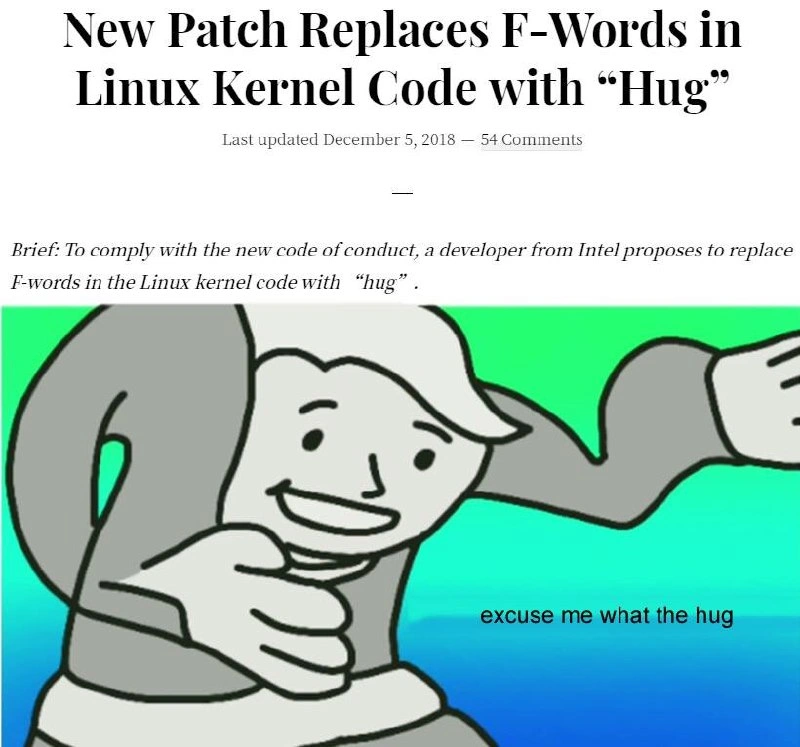
The top half of the meme mimics a tech-news headline: “New Patch Replaces F-Words in Linux Kernel Code with ‘Hug’”. It even includes a faux update timestamp (“Last updated December 5, 2018 — 54 Comments”), as if this were a hotly debated issue on an online forum. The subtext explains that to follow the new code_of_conduct, an Intel developer suggests swapping all F-words in the Linux kernel code with “hug.” This setup immediately evokes the real tension between the old-school Linux ethos and the modern push for inclusivity. Long-time kernel contributors recall that the Linux mailing lists and even some code comments could be laced with profanity – not out of hate, but as a rough sort of candor. Linus himself once infamously flipped the bird (literally, in a talk) to NVIDIA and wrote emails like “Please **stop this insane patch, it’s utter garbage,” albeit with harsher terms. Seeing a proposal to scrub such fiery language feels almost surreal.
The bottom half of the meme delivers the punchline visually. It shows a cartoon figure (resembling Fallout’s Vault Boy) with arms outstretched in a friendly embrace, set against a bright, cheerful background. Over it, the caption reads: “excuse me what the hug”. This phrase parodies the internet expression “excuse me, what the f***?”, a reaction of shock or disbelief, by applying the hypothetical patch’s logic – replacing the shocker word with “hug.” The result is absurdly wholesome. It highlights the humor: we’re effectively auto-censoring an astonished profanity into something cuddly. It’s like the kernel’s anger got a soft toy makeover.
Seasoned engineers laugh because they recognize the subtext: you can’t patch-away developer frustration that easily. The meme exaggerates a scenario where instead of addressing why developers drop F-bombs (tight deadlines, stubborn bugs, flame-war emails at 3 AM), management opts to simply sanitize the wording. It’s a comedic take on maintainer_guidelines meeting corporate HR. Imagine the Git diff of such a patch: lines of - // This is f***ing ridiculous turning into + // This is hugging ridiculous. The code’s functionality wouldn’t change a bit – only the temperament of the comments. In fact, here’s a hypothetical diff that this meme brings to mind:
--- a/kernel/panic.c
+++ b/kernel/panic.c
@@
- printk("Kernel panic – serious f*** up occurred!\n");
+ printk("Kernel panic – serious hug up occurred!\n");
Developers see the inherent comedy: “hug up” in a critical error message is hilariously out of place. By joking about a linux_kernel_patch for profanity_replacement, the meme touches on real events (the adoption of a kinder communication policy) in a ridiculous way. It satirizes the idea that one could solve a community’s interpersonal problems with a quick regex find-and-replace. At an industry level, it also pokes fun at the broader trend of tech communities cleaning up their language and behavior – the Linux project being a high-profile example where a maintainer actually stepping in to say “let’s be civil” made news. Veteran open-source folks remember how contentious that was: some hailed it as progress towards a more welcoming community, while others bemoaned it as the end of the free-speaking hacker spirit. This meme distills that debate into one brilliant, sarcastic snapshot. The phrase “excuse me what the hug” perfectly captures how jarring it felt for many: it’s essentially the community doing a double-take at the new rules, with one eyebrow raised, half-smirking. In short, Linux developers see in this joke the clash between raw honesty and enforced positivity – and they find it both painfully accurate and hugging funny.
Description
A two-part meme reacting to a real-world event in the open-source community. The top half is a screenshot of a news article headline that reads, 'New Patch Replaces F-Words in Linux Kernel Code with “Hug”'. A sub-heading indicates the article was updated on December 5, 2018, and a brief summary explains the proposal was made by an Intel developer to comply with a new code of conduct. The bottom half features the 'Excuse Me What the Fuck' meme format, using the Vault Boy character from the 'Fallout' video game series. The character, drawn in a grayscale, cartoonish style against a blue and green background, has a look of utter bewilderment and distress. The original profane caption is humorously replaced with 'excuse me what the hug', directly referencing the article's content. The meme satirizes the clash between the traditionally blunt, unfiltered culture of Linux kernel development and the more sanitized, corporate-friendly language proposed under the new code of conduct, capturing the community's incredulous reaction
Comments
8Comment deleted
The 'hug' patch was immediately rejected. Turns out, `git blame` is a lot more terrifying when it leads back to a mandatory corporate sensitivity training
git diff now shows `-f*** off +hug off`; we basically swapped spinlocks for mutexes - friendlier semantics, deadlocks unchanged
Next they'll want us to replace segfaults with "unexpected hugs" and kernel panics with "emotional moments" - can't wait to debug why my driver is giving too many hugs per second
After the patch, `git blame` on those lines reads like a self-help book - the hardware is still broken, but now it's hugged broken
Ah yes, the great kernel sanitization of 2018 - because nothing says 'professional development environment' quite like replacing decades of colorful commit messages with mandatory group hugs. I'm sure Linus was absolutely thrilled to refactor his legendary flame mails into 'constructive embrace sessions.' Next patch: replacing 'kill -9' with 'gently suggest process termination.'
Kernel devs swapping 'fuck' for 'hug': because nothing diffuses a scheduler deadlock like a group hug among threads
Linux patch replaces F-words with “hug” - cute, but keep it to comments; the last well‑meaning sed that touched symbols turned futex into hugtex and we learned kindness is not ABI‑compatible
A tree-wide sed that makes HR happy while guaranteeing 100k lines of diff churn, trashed git blame, and some future maintainer wondering why the scheduler keeps "hugging" locks