A Portrait of the Aspiring FinTwit Investor
Why is this FinTech meme funny?
Level 1: Opposite Day Investing
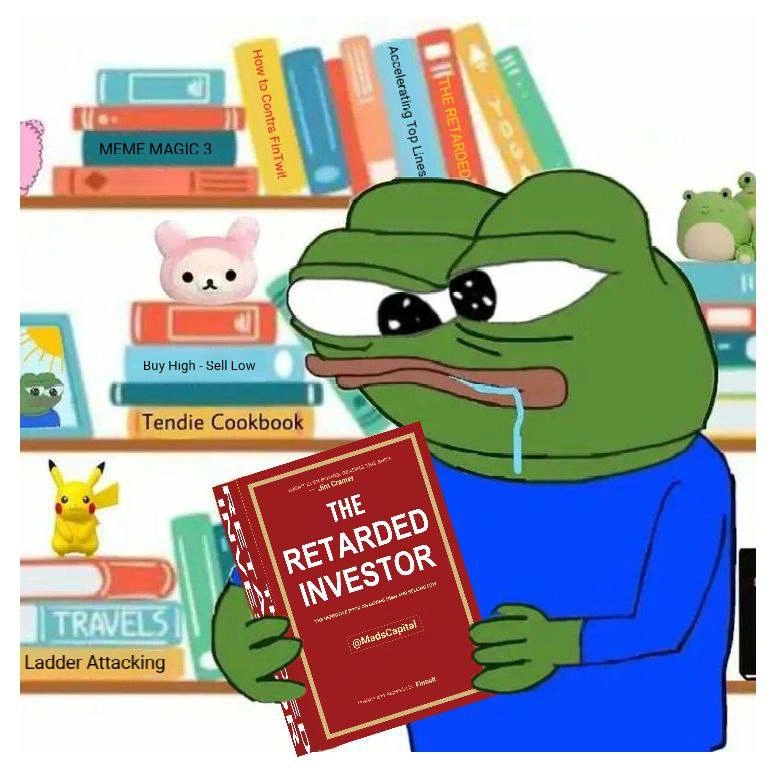
Imagine you want to learn how to do something the right way, but every lesson you get is actually teaching you the wrong way. That’s the joke here. We see a cartoon frog (Pepe) trying to learn how to make money in the stock market, but all the books he has are comically bad. One book literally tells him to buy high and sell low – which is like a book on cooking that tells you to burn all your food. 🤦♂️ Normally, if you want to make money, you should buy things when they’re cheap and sell them when they’re expensive. But this poor frog is studying the exact opposite strategy, as if it’s a great idea. It’s as silly as a kid reading a guide on “How to always lose your games” and thinking he’ll become a champion. The scene is funny because we (the viewers) immediately understand that Pepe is doing everything backwards, yet he seems totally proud and engrossed in his ridiculous books. In simple terms: the frog wants to be good at investing, but he’s learning all the wrong moves – and he doesn’t even realize it. It’s a bit like watching someone prepare for a test by memorizing all the wrong answers; you can’t help but laugh at how misguided it is.
Level 2: Meme Investor 101
Let’s break down the joke in simpler terms, especially if you’re not deeply into finance or meme culture. This image is mixing financial humor with internet meme references. We have a frog character (that’s Pepe the Frog) reading a bunch of silly-titled books about investing. The whole joke is that all the books are basically terrible advice. It’s like the opposite of what a smart investor or a student of finance would actually read. Here’s what each element means:
Pepe the Frog: Pepe is a popular cartoon frog from internet memes. Different communities use him to represent various emotions or personas. In this meme, Pepe represents a clueless person (he’s even drooling to show he’s not very sharp) who is trying to learn about investing. If you see Pepe, think “internet meme character” – he’s often used humorously or ironically.
WallStreetBets (WSB): This is an online forum (on Reddit) where a lot of everyday people talk about stocks and options. It became famous (or infamous) for its members using a ton of memes and often bragging about very risky trades. People on WSB use a lot of slang and self-deprecating humor – for example, calling themselves “apes” or even “retards” (in an attempt to be funny by being outrageous). They also refer to making money as winning “tendies.” The culture there is basically chaotic, meme-filled investing, often ignoring traditional advice. This meme’s scenario – a frog reading goofy investment books – is a direct nod to WallStreetBets culture.
“Buy High – Sell Low”: Normally, the basic rule of investing is buy low, sell high (buy something at a low price, then sell it later at a higher price to make a profit). “Buy high, sell low” flips that around. It means buying when the price is high (expensive) and selling when the price is low (cheap), which would make you lose money. No one sets out to do that, but many beginners accidentally do because they get excited and buy a stock after it has already risen a lot (so they bought high), and then they get scared and sell after it falls (so they sold low). This book spine on the shelf is basically labeling the frog’s strategy as the worst one possible. It’s joking that he’s studying how to lose money.
Tendies: “Tendies” is a fun term for money or profits, popularized by WallStreetBets. It’s short for chicken tenders. The silly backstory is like: a trader living in his mom’s basement wants to earn enough money from stocks to buy chicken tenders (a favorite comfort food). It became a meme for any gains or rewards from trading (“Gimme tendies!”). In the image, one book is titled “Tendie Cookbook.” That implies a guide on how to cook up (make) tendies (profits). Of course, it’s mocking the idea that there’s a simple recipe for quick riches. It’d be like a newbie programmer thinking there’s a magic recipe book for making a hit app without actually learning to code.
“Ladder Attacking”: This refers to something that was a hot topic in meme-stock circles. When GameStop and other “meme stocks” were swinging wildly, some forum folks claimed that the big hedge funds were using a tactic called a “short ladder attack” to force the stock price down. In simple terms, they imagined these big players were quickly buying and selling amongst themselves at slightly lower and lower prices, creating an illusion of a steady price drop – like stepping down a ladder. This isn’t a term you’d find in a real finance textbook; it was more of a conspiracy-sounding explanation on the internet. So a book called “Ladder Attacking” is a joke that Pepe is learning from the myths of meme trading forums, not from legitimate sources. In reality, if someone is losing money on a stock, it’s usually because of market forces or their own timing, not some secret ladder trick – but it’s easier for a newbie to blame a mysterious “attack” than to admit the investment was a bad idea.
“MEME MAGIC 3”: Meme magic is an ironic phrase implying that memes (funny images, jokes, viral posts) have almost magical power to affect real-world outcomes. On WallStreetBets, users sometimes half-jokingly credit “meme magic” when a stock they’ve been hyping with memes suddenly shoots up. It’s like saying “our memes made it happen!” Of course, what really happens is that a bunch of people get excited and buy, which raises the price – no actual magic, just group behavior. By titling a book “MEME MAGIC 3,” the meme creator is poking fun at this idea. It’s as if there were a whole series of textbooks on using meme power to trade stocks (there isn’t, in reality!). Pepe reading it suggests he genuinely thinks posting enough 🚀 rocket emojis and jokes on a forum will make him rich. It’s a humorous jab at the superstition-like belief in hype.
“How to Count to Infinity”: This book is a goofy, impossible concept. Infinity isn’t a number you can count to; you’d be counting forever. Including this title on the shelf exaggerates how useless and absurd the collection of books is. It tells us, “Yep, none of this makes sense.” It’s like if someone had a book “How to square a circle” on their shelf – just an impossible task posed as a guide. The presence of this book signals that Pepe’s educational materials are not just bad, they’re laughably absurd. It emphasizes the clueless vibe.
“Accelerating Top Line”: In business talk, “top line” means revenue (the total money a company brings in, before expenses – it’s literally the top line of an income statement). “Accelerating top line” means “making revenue grow faster.” This phrase is something you’d hear in corporate earnings calls or see in a business strategy book. It’s a bit of corporate jargon. Its appearance here is funny because it sounds kind of serious, but in context it’s clear Pepe doesn’t get it. It’d be like a kid throwing in a fancy phrase they heard, without understanding it. If Pepe is reading “Accelerating Top Line,” he might think he’s learning something profound, but really he might be missing the point (like focusing on revenue growth without learning about profits, costs, or actual investing techniques). Basically, it’s there to show he’s out of his depth, grabbing at any impressive-sounding concept.
“Travels”: One book is just titled “TRAVELS.” We’re not given more info, but it stands out because it’s not explicitly about finance or memes. It could be a generic travel book or maybe a subtle joke (maybe referencing “Gulliver’s Travels” as a pun for “gullible travels,” implying a journey of gullibility). In any case, seeing it among these other titles reinforces how haphazard Pepe’s bookshelf is. It’s like he grabbed random books, not even all on topic. This adds to the humor: imagine someone trying to learn a subject but half their books are irrelevant or joke books. It shows a total lack of direction in his learning.
Pepe’s Toys (Bear, Pikachu, Frog): The items on the shelf that aren’t books are toys, which really drives home the idea that Pepe approaches investing with a childlike mind. The pink bear plushie likely hints at a “bear market,” which means a period when stock prices go down a lot. Typically, a bear market is a serious thing investors worry about. Here it’s depicted as a cute pink teddy bear, as if Pepe isn’t taking even the scary parts of the market seriously (or doesn’t understand them). The Pikachu figurine is there basically as a pop culture Easter egg – Pikachu is a symbol of childhood (Pokémon!) and also a well-known meme face (the “Surprised Pikachu” meme). Its presence just amps up the silly, youthful atmosphere. And the little green frog plushie is like a mini version of Pepe or just another frog toy, reinforcing the frog theme. All these toys among finance books are visual shorthand for “this guy is literally a big child playing with serious stuff.” It’s the meme’s way of saying he’s in over his head, and he treats the stock market like a game or a playroom.
In summary, level 2 interpretation: Pepe the Frog is basically a beginner investor who has completely misunderstood how to succeed. Instead of reading real guides or learning from experts, he’s immersing himself in meme culture and bad advice. Each book title we noted is something that sounds cool or funny to outsiders but would make professionals facepalm. And all the cute, childish touches around him (toys, silly titles) show that he’s not approaching this with the seriousness or knowledge that grown-up investing requires. It’s a parody of what happens when someone jumps into a complex field (like stock trading) armed with internet hype and half-baked ideas instead of solid education. Anyone new to these terms might learn from this meme that there’s a wrong way to learn – and Pepe is doing exactly that, with a big oblivious smile on his frog face.
Level 3: WallStreetBets Curriculum
At a more practical tech-industry level, this meme riffs on the stark difference between data-driven investing and the kind of hype-driven YOLO bets celebrated on forums like WallStreetBets. For context, WallStreetBets (often abbreviated WSB) is a notorious subreddit where millions of retail traders, many of them novices, share outrageous stock tips, brag about gains, and post "loss porn" screenshots of disastrous trades – all punctuated with memes and slang. They turned investing into an extreme sport / internet meme culture, especially during events like the GameStop short squeeze of early 2021. This image parodies that culture by showing Pepe the Frog literally studying from the WSB playbook – a shelf full of humorous anti-learning books. It’s the ultimate “what not to do” syllabus for investing, presented as if it were genuine literature. Experienced developers and traders find it hilarious because we recognize each reference from real-world fiascos and misguided strategies that circulated in those communities.
Pepe the Frog himself is a familiar face in meme culture. Originally a harmless cartoon character, Pepe has been adopted by various internet subcultures (from innocent memes to controversial ones). Here, Pepe represents the clueless investor archetype. He’s slack-jawed (even drooling) to really drive home that he’s not the sharpest tool in the shed. Yet, he looks oddly content, as if proudly engrossed in his big red book of bad ideas. This visual is immediately funny to anyone who remembers waves of newbies confidently parroting WallStreetBets lingo while doing things that make seasoned investors cringe. It’s the Dunning-Kruger effect illustrated: he’s too ignorant to know that he’s ignorant, so he’s casually mastering a buy-high sell-low strategy as if it’s an achievement.
Now, the books on that shelf are basically a catalog of insider jokes from the meme stock era. Let’s decode a few of the titles and props you see:
“Buy High · Sell Low” — This is a direct spoof of the classic investing rule “Buy low, sell high.” Normally, you want to purchase a stock at a low price and later sell it at a higher price to make money. Swapping the words encapsulates the exact mistake rookies make: they chase hype (buying when the price is already high, because everyone’s talking about it) and then panic when the hype fades (selling after the price plummets). It’s a formula for losing money. The meme is poking fun at how reliably some newbies follow this backward formula. Tech folks might chuckle because it’s like a user doing the opposite of every best practice despite the well-known guidelines – a failure mode that’s both tragic and comic.
“Tendie Cookbook” — In WSB slang, “tendies” means profits or money, jokingly referring to chicken tenders as a reward. (There’s a running joke that these traders are man-children trading stocks to earn enough for their favorite snack, chicken tenders.) A “cookbook” of tendies suggests a set of recipes for making gains. Of course, treating serious investing like following recipes from a silly cookbook is absurd. This title mocks those viral one-size-fits-all profit strategies that float around online. It’s reminiscent of get-rich-quick schemes: as if making money could be as simple as following a few meme-approved steps. Developers might relate if they’ve seen “copy-paste coding cookbook” mentalities – where someone tries to cook up a complex system by blindly following snippet recipes without understanding the ingredients.
“Ladder Attacking” — This refers to the infamous “short ladder attack” theory that gained traction on forums during volatile meme stock episodes. When certain heavily shorted stocks (like GameStop) had wild price swings, some retail traders on WSB insisted that hedge funds were employing a secret tactic: coordinating among themselves to trade the stock in a way that forms a “price ladder” downward, artificially driving the price lower. Visualize prices stepping down like rungs of a ladder as they allegedly sell to each other at incrementally lower prices. In reality, while market manipulation exists, this specific idea was an over-simplified urban legend on the forum – an attempt to explain normal volatility or automated trading in a melodramatic way. Seeing a book titled “Ladder Attacking” on Pepe’s shelf is a tongue-in-cheek way of saying he’s learning from the conspiracy theories of amateur traders rather than from actual finance textbooks. It’s the equivalent of a developer reading a blog of wild unproven hacks and treating it as gospel.
“MEME MAGIC 3” — WallStreetBets and similar communities often joke about “meme magic,” the semi-serious idea that enough people posting memes and PopCultureReferences about a stock can influence its price (as if memes themselves cast a spell on the market). During the height of meme stock mania, you’d literally see forum posts thanking “Based Meme Magic” when a stock shot up, as if their collective shitposting summoned real dollars. Titling a book “Meme Magic 3” (like it’s the third volume in a series) lampoons the pseudo-mystical belief that MemeCulture can override financial fundamentals. It’s highlighting that Pepe is studying the arcane art of meme-based market manipulation, which is as ridiculous as it sounds. The humor hits home for industry folks because we did witness meme-fueled rallies (Dogecoin’s 1000% surges powered by memes of a Shiba Inu dog, for example), and while it seemed magical, there were real psycho-social reasons behind it. Still, nobody serious writes “Spellbooks” about it… except in jest, on this shelf.
“How to Count to Infinity” — This one is pure absurdist humor. Counting to infinity is impossible; infinity is not a number you can reach by counting. By including this phony book, the meme doubles down on depicting Pepe’s library as utterly useless. It’s like saying: the stuff he reads isn’t just bad advice, it’s nonsense masquerading as knowledge. There’s also a subtle nod here: in stock hype culture, people joke about stocks going “to infinity and beyond” or setting “infinite” price targets during frenzied speculation. So a book on counting to infinity mocks that unrealistic moon-shot mindset. For a learner, it’s a hint that none of these books are grounded in reality – they’re as helpful as a math book that promises to teach an impossible task.
“Accelerating Top Line” — The “top line” is business jargon for revenue (the top line of an income statement). “Accelerating top line” means growing revenue faster. It’s something you’d hear in CEO speak or see in a startup’s pitch deck. But as a book on an investing shelf, it feels out of place. This title satirizes how people enamored with IndustryTrends_Hype might latch onto flashy business terms thinking it makes them savvy. A novice investor might read generic business bestsellers or Forbes articles with buzzwords like “accelerate your top-line growth!” and believe they’ve cracked investing, while ignoring bottom-line profits or actual analysis. The meme includes it to show Pepe’s education is a mishmash of meme lore and misunderstood business buzz. To a seasoned eye, it’s like, “Oh boy, he’s reading growth hype instead of solid finance.” It’s similar to a junior dev reading glossy tech trend pieces (“10x Your Productivity with XYZ”) instead of learning fundamentals – likely to end up with misguided ideas.
“Travels” — One book simply says “TRAVELS” on the spine. This one stands out because it’s not obviously a finance or meme reference. It might be a random filler book, or perhaps an allusion to Gulliver’s Travels (with a pun on “Gullible’s Travels”). If we take the pun interpretation: gullible describes someone who easily believes anything, which fits Pepe’s character here. So maybe the frog is literally going on “gullible travels” through the market—falling for tricks and tall tales. Even if it’s not a deliberate pun, the presence of a plain “Travels” book among these goofy titles underscores the chaotic, hodge-podge nature of his bookshelf. It’s a shelf that lacks any coherent, credible theme – much like the scattershot “knowledge” one might pick up scrolling an internet forum.
Now, beyond the books, look at the plush toys and decor scattered on the shelves. This detail reinforces the meme’s point by adding a childish, clueless vibe to the scene. There’s a pink teddy bear perched near the “Buy High - Sell Low” book. In finance, a “bear” usually means a pessimistic investor or a downward market trend (a bear market is when prices broadly go down). By showing a cute teddy bear, the meme artist is playfully referencing that serious concept in a babyish way – as if our investor treats a market crash like just another toy on his shelf. Then we see Pikachu, a famous Pokémon character, which has nothing to do with finance at all. Pikachu is basically there to scream “this guy’s library is as immature as a kid’s room.” It’s also a nod to the overlap of internet cultures: the kind of person who would say “stonks to the moon” with a straight face likely enjoys a good Pikachu meme too. Finally, there’s a small frog plushie on the top shelf to the right. That’s possibly a mini-Pepe or just another frog figure, doubling down on the frog motif. The frog toy could imply that Pepe (an adult frog) is so juvenile in his approach that he owns a frog doll – or it’s just a quirky Easter egg, hard to say. The overall effect, though, is clear: this is an investing kindergarten. The presence of toys among books suggests that Pepe’s understanding of the market is literally child-like. Seasoned developers or traders can relate – we’ve all seen environments where someone approaches a complex, serious system with a child’s level of understanding, and the results are predictably chaotic. It’s funny until it’s painful.
Stepping back, the reason this meme provokes laughter (and maybe a groan) from experienced folks is because it hits close to real situations. In the recent past, we had a flood of new retail investors armed with slick trading apps (thanks to modern FinancialTechnology like Robinhood) but very little knowledge. Many of them genuinely formed their learning from social media hype, meme-filled forums, and viral videos. There were stories of newcomers ignoring classic advice like diversification or valuation. Instead, they were buying whatever stock was trending on Twitter or Reddit (buying high), then panic selling when it inevitably crashed (selling low). The meme distills that absurdity perfectly: instead of reading actual investing books or learning algorithms, Pepe assembled a shrine to meme lore and bad ideas. It’s essentially showing a mirror to the FinTech hype culture: when technology made trading easy and pop-culture made it cool, lots of people jumped in unprepared – with outcomes as disastrous as you’d expect.
To a developer or someone in tech, there’s also an implicit analogy here. It’s reminiscent of when a newbie programmer skips the official documentation and instead learns from random dubious blog posts or copy-pastes from StackOverflow without understanding. They might end up with a “library” of bad code patterns and misconceptions – the coding equivalent of Pepe’s investment meme books. So the frog’s folly can be appreciated as a broad cautionary tale in any field: If you learn from garbage sources, you’re going to get garbage results. But the meme delivers that lesson wrapped in multiple layers of internet humor and insider references, which makes it hilarious for those who get it. It’s one of those laugh-while-you-wince situations, especially for anyone who had to help clean up the mess afterwards (be it a blown-up account or a broken codebase).
And just to drive the point home in a more visual, techy way, here’s a tongue-in-cheek pseudocode representation of Pepe’s investing algorithm:
# Pseudo-code for the "Buy High, Sell Low" strategy
while market.is_open():
if stock.price_is_rising():
buy(stock) # FOMO kicks in: buy because it's going up (price is high)
if stock.price_is_falling():
sell(stock) # Panic sets in: sell because it's going down (sell low)
This little script would reliably do the worst possible thing: it buys at the top of a rally and sells at the bottom of a dip, every time. The code comments even annotate the emotional errors (FOMO and panic) behind the actions. The result of running this in real life would be financial ruin — exactly what the meme is warning, in jest.
“Be fearful when others are greedy, and greedy when others are fearful.” — Warren Buffett
Pepe obviously flips this wisdom on its head, being greedy at the top and fearful at the bottom.
Level 4: Quant vs Meme Magic
On a deep, technical level, this meme highlights the chasm between quantitative finance and internet-fueled folly. In the world of serious FinTech and AlgorithmicTrading, decisions are driven by data, math, and code. Traders employ complex models (from Monte Carlo simulations to neural networks) and adhere to theories like the Efficient Market Hypothesis (EMH), which suggests you can’t consistently beat the market with public information. They seek out a statistical edge, carefully manage risk, and often operate within milliseconds using algorithms co-located on exchange servers. By contrast, Pepe the Frog clutching “The Retarded Investor” epitomizes an anti-quant mentality – he’s embracing meme magic as if it were a trading strategy. EMH assumes investors process information rationally, yet here we have an investor whose information diet is literally nonsense. The humor runs deep: it’s the absurd inversion of rational trading principles.
Consider the book in Pepe’s hands: “The Retarded Investor.” This is a dark parody of Benjamin Graham’s classic “The Intelligent Investor.” Graham’s book (published in 1949) is foundational in value investing – it preaches careful fundamental analysis, margin of safety, and long-term strategy. Replace “Intelligent” with a slur implying extreme foolishness, and you get the tone of this meme: Pepe is devouring a guide to doing everything wrong. It’s an uncomfortable joke (the term is offensive), but in certain online trading communities like WallStreetBets, self-deprecating slurs are used to mock one’s own brazen stupidity. The contrast is stark academically: fundamental analysis (studying balance sheets, earnings, economic moats) versus anti-analysis (ignoring all that for hype). It’s like comparing a rigorous machine learning model that predicts stock prices to a monkey throwing darts at a stock list – only here the monkey is reading a manual on how to throw darts at the worst targets.
From a theoretical perspective, Pepe’s strategy can be seen as having a negative expected value. In finance terms, if $P_{\text{buy}}$ is high and $P_{\text{sell}}$ is lower, the Return on Investment (ROI) is negative:
$$
ROI = \frac{P_{\text{sell}} - P_{\text{buy}}}{P_{\text{buy}}} < 0.
$$
He’s effectively locking in losses by design. In algorithmic trading, one seeks positive alpha (excess returns above the market) by exploiting inefficiencies. Pepe instead is systematically achieving negative alpha – an "anti-alpha" if you will. It’s as if someone programmed a trading bot to intentionally lose money: buy when the price peaks, sell when it dips. This is perversely genius in a comic way: it guarantees the opposite of the usual goal. In fact, a trader following this buy-high/sell-low rule would do worse than random chance. A random trade has an expected ROI of roughly 0 (before fees) under a fair random walk market model; Pepe’s strategy ensures an expected ROI < 0, essentially a guaranteed drain of capital. It’s financial entropy: always increasing disorder in his portfolio value.
There’s also an allusion to behavioral finance and the psychology of markets. Professional quantitative analysts model how irrational herd behavior can create anomalies. The meme magnifies that irrationality. Terms like FOMO (Fear of Missing Out) describe why inexperienced investors buy high (everybody’s euphoric, so they rush in late) and panic selling explains why they sell low (fearful after a decline). This frog is basically a caricature of all those cognitive biases rolled into one drooling grin. Academically, one might cite the Greater Fool Theory: the idea of buying something overvalued, hoping to sell to an even “greater fool” at a higher price. It only works until the supply of fools runs out – and Pepe’s book collection doesn’t seem to include a chapter on what happens when the music stops. The meme’s absurd text “How to Count to Infinity” hints at the flawed belief that prices will go up forever (“stonks only go up” as the joke goes). It’s a nod to the irrational infinite growth mindset during bubbles, which every finance textbook warns against.
Interesting enough, one of the shelf titles, “Ladder Attacking,” touches on market microstructure in a twisted way. In reality, sophisticated traders (and some malicious actors) do engage in strategies affecting the order book – e.g., spoofing (placing fake orders to nudge prices) or layering orders to simulate demand or supply. There’s even historical precedent: the 2010 Flash Crash was partly blamed on an algorithm flooding the market with bogus orders. WallStreetBets users took fragments of such concepts and spun the “short ladder attack” theory: a belief that hedge funds were handshaking trades at lower and lower prices to drive a stock down. While coordinated price manipulation can happen, the simplicity of “ladder attack” as described on Reddit is not how real high-frequency trading or short-selling works. The meme ridicules this by including a book on it, implying Pepe would rather learn a probably-nonexistent cheat code to markets than the boring reality of supply and demand. It’s a cheeky nod to how complex phenomena get oversimplified into almost conspiracy-like memes for the uninitiated. An expert looks at that and chuckles: it’s as if someone’s reading a book on alchemy in an era of modern chemistry.
Ultimately, from a systems engineering standpoint, this entire scene is like a cautionary tale of “garbage in, garbage out.” Pepe’s input (his education) comes from joke books with misleading or outright harmful advice, so the output (his investing outcome) is almost guaranteed to be garbage as well. A developer in finance might think of it this way: if you train a trading algorithm on bad data or wrong assumptions, it will perform disastrously. Here we have a human “training” his brain on meme misinformation. The humor has a bite of truth: many real-world retail investors in the recent meme stock craze did exactly this – they formed strategies from Reddit hype and joke DD (“due diligence”) posts. For a seasoned developer or quant, there’s a twisted elegance in how perfectly this meme captures the inversion of sane strategy. In summary, it’s a comedic embodiment of anti-knowledge: every principle a competent investor holds dear (diversification, valuation, patience, risk management) has been thrown out the window in favor of hype, memes, and magical thinking. The result, as any algorithm or equation would predict, is pretty much destined to be a financial fiasco – which is precisely why it’s funny to those in the know.
Description
This meme features the character Pepe the Frog, looking sad and drooling, wearing a blue shirt. He is holding a large red book titled "THE RETARDED INVESTOR" with the social media handle "@MadsCapital" on the cover. The background consists of a bookshelf filled with satirical books, whose titles are visible. These include "MEME MAGIC 3", "How to Contra FinTwit", "Accelerating Top Lines", "Buy High - Sell Low", "Tendie Cookbook", and "Ladder Attacking". The shelves are also decorated with various toys, such as a pink fluffy creature, a Pikachu figurine, and a small green frog. The image humorously critiques the culture of amateur retail investors, often found on platforms like Twitter ('FinTwit') or Reddit's WallStreetBets. It satirizes the common pitfalls and herd mentality seen in these communities, where individuals often follow poor advice leading to financial losses, encapsulated by the book title 'Buy High - Sell Low'
Comments
9Comment deleted
This is the developer who writes a trading bot that perfectly executes the 'buy high, sell low' algorithm, then opens a pull request to add more logging to figure out why the portfolio is trending towards zero
Pepe’s “Buy High · Sell Low” manual is basically the playbook for every bank that forced us to re-platform to blockchain last year - burn the budget on hype, then settle the trades on the same COBOL box we were told to sunset
Just like debugging production at 3am, retail trading teaches you that the most expensive education comes from thinking you're smarter than the system - except instead of rollback scripts, you're left with loss porn screenshots and a newfound appreciation for index funds
When your portfolio's performance looks like a recursive function without a base case - infinite losses, stack overflow of regret, and the only thing that returns is your parents' disappointment. At least your code compiles; your investment strategy just throws exceptions
Buy High, Sell Low is the retail investor’s version of our last cloud migration: pay peak for managed services, unload on‑prem at the bottom, slap “Accelerating Top Lines” on the slides, then break out the Tendie Cookbook when the burn rate hits prod
Like npm installing the hyped package du jour: buy high on FOMO, sell low when the deps break your build
Our stack selection process too often mirrors this bookshelf: buy‑high at the peak of the Gartner curve, ladder‑attack the org with 48 microservices, then paper‑hand the rewrite after the first 3 a.m. incident
my prof was always telling me to fly high. After getting to know IT industry better I realized - some people are indeed high Comment deleted
yea otherwise we couldn't buy high and sell low duh Comment deleted